Maldives brings inbound tourism products and booking platforms into GST from 1 October 2026
- Jurisdiction
- Maldives
- Tax
- GST
- Change type
- Digital services
- Status
- In force
- Impact
- Action required
- Announced
- 31 August 2026
- Effective
- 1 October 2026
- Authority
- Maldives Inland Revenue Authority (MIRA)
- Systems
- Tax engine, Invoicing, E-commerce
- Verified
- Fetched from official source · high confidence
Suppliers of accommodation, meals, transport or any other tourist activity in the Maldives, and the agency and booking intermediaries selling them — specifically including online travel agents and platforms with no fixed place of business in the Maldives.
Non-resident suppliers of Maldives inbound tourism products, and booking/agency intermediaries for them, must assess GST registration obligations with MIRA (registration deadline 30 days from 31 Aug 2026 for existing suppliers) and begin charging GST on qualifying supplies from 1 October 2026.
Tax engineInvoicingE-commerce
The Eighth Amendment to the Goods and Services Tax Act (Law Number 10/2011), enacted as Law No. 10/2026, was passed by the 20th Parliament on 26 August 2026 and ratified/gazetted by the President on 31 August 2026. It extends GST to 'inbound tourism products' (accommodation, meals, transport, or any other tourist activity in the Maldives) and to agency/booking services relating to them, deeming such supplies made in the Maldives even when supplied by a person with no fixed place of business there (e.g. non-resident booking/OTA platforms). GST on these supplies (rate under s.15(b)(6)) applies from 1 October 2026. Persons already carrying on such supply must register with MIRA within 30 days of the Act's commencement (31 August 2026); no input tax may be set off against output tax for suppliers without a fixed place of business in the Maldives.
What changed in detail
The Eighth Amendment to the Goods and Services Tax Act (Law Number 10/2011) was passed at the 28th sitting of the 20th Parliament on 26 August 2026 and published in the Government Gazette on ratification by the President on 31 August 2026. Clause 31 commences the Act from that publication date.
A new section 68 definition makes an “inbound tourism product” mean accommodation, meals, transport, or any other tourist activity in the Maldives. New section 5-2(b)(3) deems such a supply — and agency or booking services pertaining to it — to be made in the Maldives where the recipient is not a registered person, regardless of where the supplier sits. New section 13(c)(8) treats supplying an inbound tourism product without a fixed place of business in the Maldives as carrying on a taxable activity.
New section 15(a)(6) captures an inbound tourism product, and agency and booking services relating to one, supplied by a person without a fixed place of business in the Maldives. New section 15(b-1) subjects those supplies to GST at the section 15(b)(6) rate from 1 October 2026.
Two consequences follow in the same Act. Section 37(f) denies any input tax set-off to a supplier of an inbound tourism product without a fixed place of business, and section 19(e) values the supply as the consideration received less the consideration payable to a registered person. Section 51(k) requires a person already carrying on a qualifying activity to apply to MIRA for registration within 30 days of commencement.
What it means
An overseas online travel agent that never touches Maldivian soil is now a Maldivian taxpayer because of what it sells, not where it is, and the registration hook fires on the first qualifying booking rather than on a turnover threshold. Section 59-1 supplies the enforcement channel: MIRA can compel resident registered persons to identify suppliers who should be registered and are not.
The two dates do not line up, and the earlier one binds: registration for existing suppliers is due 30 days from 31 August, so the window closes at the end of September, before the rate applies on 1 October.
The input-tax denial in section 37(f) is what makes the section 19(e) valuation rule matter. Deduct nothing, but value the supply net of what is paid on to a registered Maldivian supplier, and the charge lands on the intermediary’s own margin — calculable only if the booking system can separate the resort’s share from the platform’s.
Proof
Insert a subsection after Section 15(b) of the aforementioned Act as follows: 15. (b-1) Goods and services specified in subsection (a)(6) shall be subject to GST at the rate specified in subsection (b)(6), from 1 October 2026 onwards.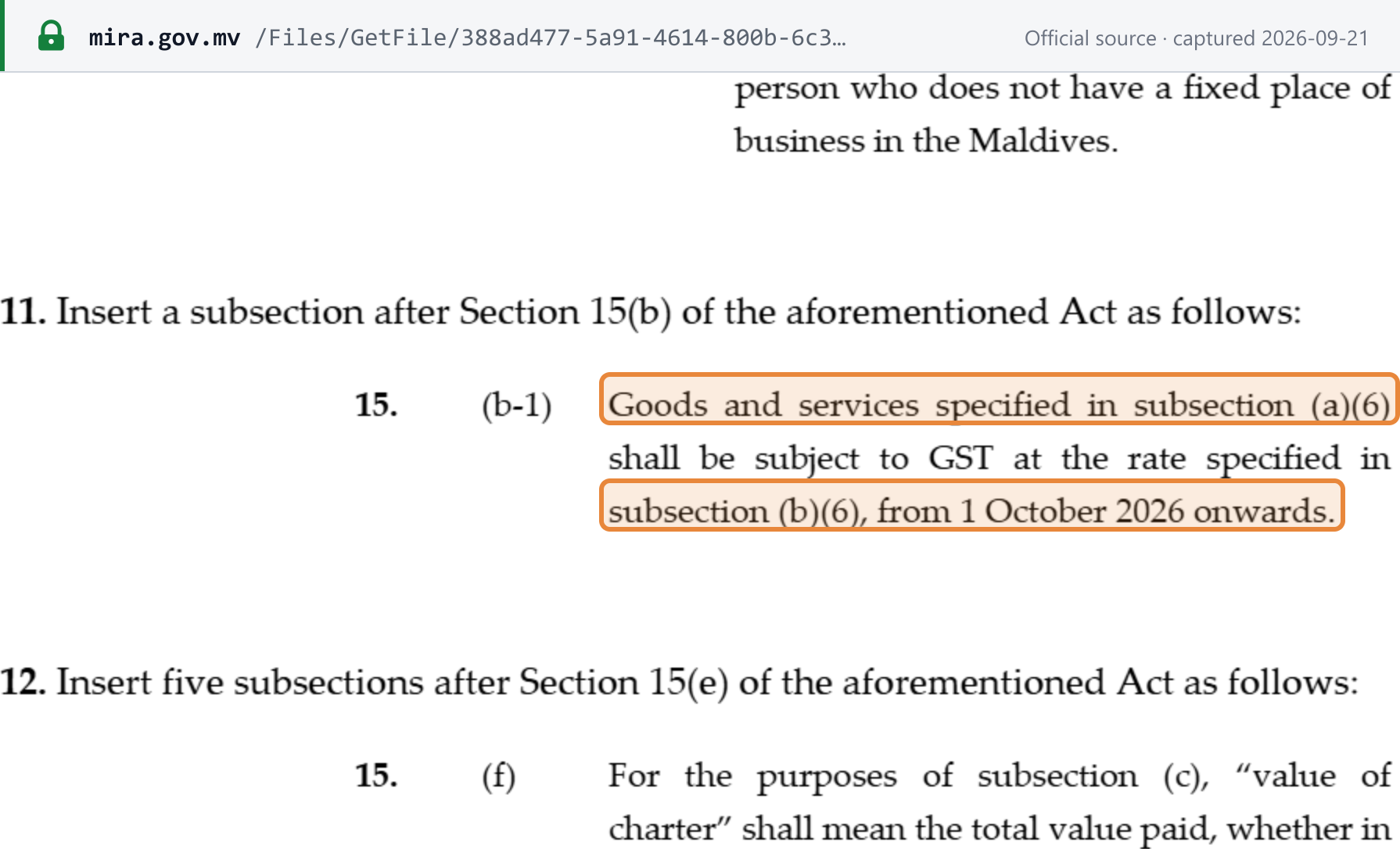 Source snapshot of the official page. Open full size ↗
Archived from the official distribution · Eighth Amendment to the Goods and Services Tax Act (Law Number 10/2011), Law No. 10/2026 — MIRA unofficial English translation, clause 11 (p.6 of 13) · www.mira.gov.mv
(b) Notwithstanding subsection (a), if the recipient of the service is not a registered person, the service shall be deemed to be supplied in the Maldives in the following circumstances: (1) the service is physically performed in the Maldives by a person who is in the Maldives at the time the service is supplied; or (2) the service relates to immovable property situated in the Maldives; or (3) the service is a supply of an inbound tourism product, or agency or booking services pertaining to the supply of an inbound tourism product.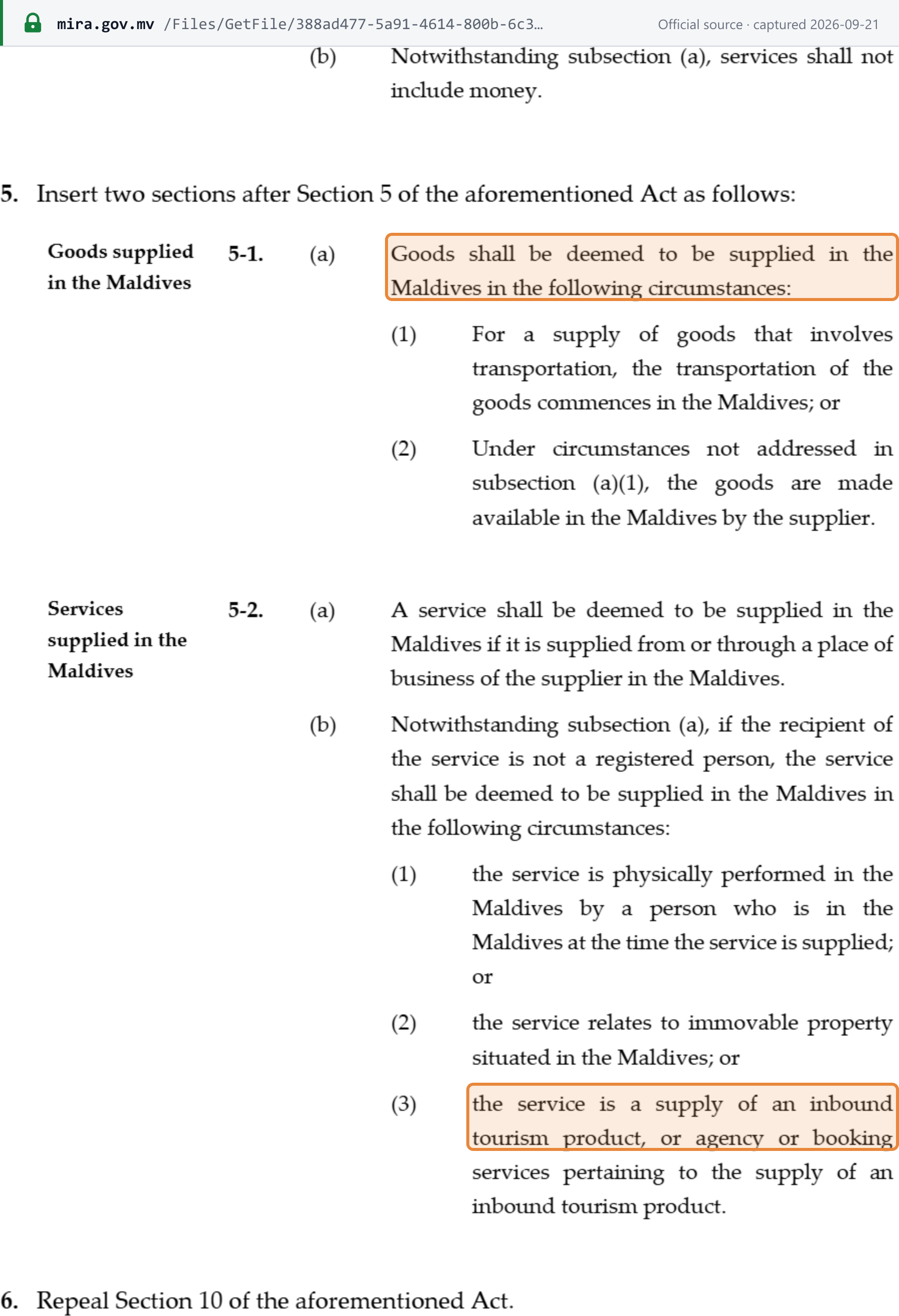 Source snapshot of the official page. Open full size ↗
Archived from the official distribution · Eighth Amendment to the Goods and Services Tax Act, Law No. 10/2026 — new GST Act s.5-2, place of supply of services (p.3 of 13) · www.mira.gov.mv