Poland: bill at first reading in the Sejm (print 3245) would push KSeF penalties to 1 January 2028 and extend the energy reverse charge to 30 June 2030
This change is proposed and is not law. The rules below describe what would change if it is adopted.
This page records one dated change. For the rules in Poland as they stand today, see the Poland guide →
- Jurisdiction
- Poland
- Tax
- VAT
- Change type
- E-invoicing
- Status
- Proposed
- Impact
- Plan ahead
- Announced
- 20 October 2026
- Effective
- 31 December 2026
- Authority
- Sejm Rzeczypospolitej Polskiej (lower house of the Polish Parliament)
- Systems
- ERP, Invoicing, Tax engine, Reporting
- Verified
- Fetched from official source · high confidence
All Polish businesses issuing invoices through KSeF, and suppliers and buyers of gas, electricity and greenhouse-gas emission allowances under the art. 145e reverse charge.
Keep KSeF penalty-readiness work on schedule until the act is signed; plan reverse-charge handling of gas, electricity and emission allowances beyond 31 December 2026.
ERPInvoicingTax engineReporting
The Polish Council of Ministers bill amending the VAT Act (Sejm print 3245, submitted to the Sejm 20 October 2026 with a request for shortened proceedings; first reading 21 October 2026) would, with effect from 31 December 2026, extend the temporary reverse-charge mechanism in art. 145e of the VAT Act from 31 December 2026 to 30 June 2030 (gas, electricity and greenhouse-gas emission allowances), and amend the 2023 KSeF Act so that the penalty provisions of art. 106ni(1)-(3) and (5)-(7) enter into force on 1 January 2028 instead of 1 January 2027 (deferral of KSeF penalties by one year).
What changed in detail
This is a bill at first-reading stage, not law. The Council of Ministers submitted a bill amending the VAT Act and the 2023 KSeF Act to the Sejm on 20 October 2026 as print 3245, with a request for shortened proceedings. Its first reading took place at the Sejm sitting on 21 October 2026.
The bill would:
- amend art. 145e(1) of the VAT Act so that the temporary reverse-charge mechanism for gas, electricity and greenhouse-gas emission allowances runs until 30 June 2030 instead of 31 December 2026; and
- amend the 2023 act that introduced KSeF so that the penalty provisions of art. 106ni(1)-(3) and (5)-(7) enter into force on 1 January 2028 instead of 1 January 2027, deferring KSeF penalties by one year.
Art. 3 of the bill provides that the act enters into force on 31 December 2026.
This is the parliamentary stage of the draft law adopted by the Council of Ministers on 20 October 2026.
What it means
The bill has to pass the Sejm and the Senate and be signed and published before 31 December 2026 to work as intended, which is why the government asked for shortened proceedings. Until that happens, the current law still starts KSeF penalties on 1 January 2027 and ends the reverse charge on 31 December 2026.
Keep KSeF penalty-readiness work on schedule, and prepare reverse-charge handling for gas, electricity and emission allowances beyond the end of 2026, so that either outcome can be handled.
Proof
3) w art. 145e w ust. 1 we wprowadzeniu do wyliczenia wyrazy „do dnia 31 grudnia 2026 r.” zastępuje się wyrazami „do dnia 30 czerwca 2030 r.”.3) in art. 145e(1), in the introduction to the list, the words "until 31 December 2026" are replaced by the words "until 30 June 2030".
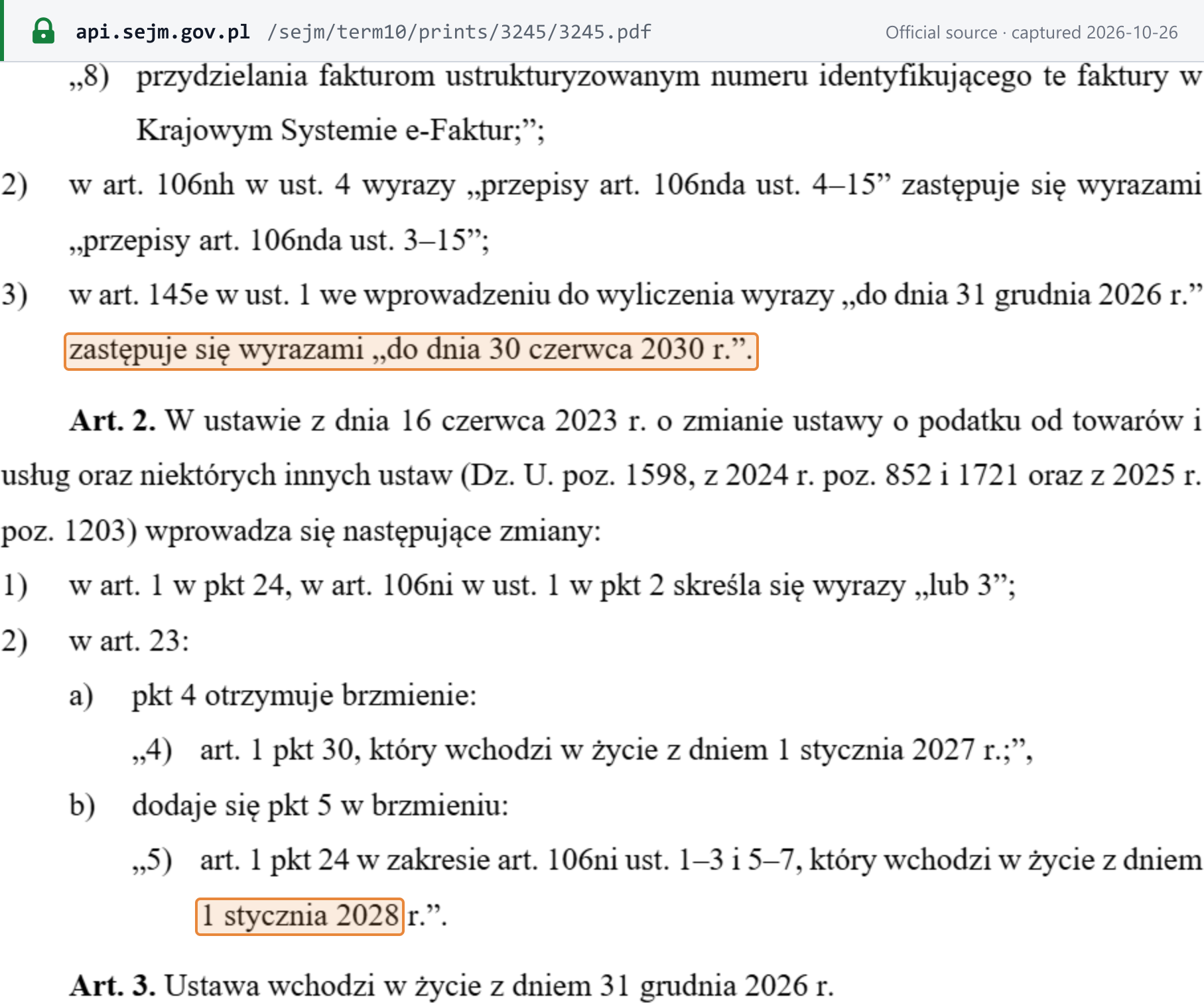 Source snapshot of the official page. Open full size ↗
„5) art. 1 pkt 24 w zakresie art. 106ni ust. 1–3 i 5–7, który wchodzi w życie z dniem 1 stycznia 2028 r.”."5) art. 1 point 24, as regards art. 106ni(1)-(3) and (5)-(7), which enters into force on 1 January 2028".
Source snapshot of the official page. Open full size ↗