Poland introduces a VAT warehouse (skład VAT) regime from 1 January 2027 (Act of 4 September 2026)
This page records one dated change. For the rules in Poland as they stand today, see the Poland guide →
- Jurisdiction
- Poland
- Tax
- VAT
- Change type
- Update
- Status
- Enacted
- Impact
- Plan ahead
- Announced
- 29 September 2026
- Effective
- 1 January 2027
- Authority
- Dziennik Ustaw Rzeczypospolitej Polskiej
- Systems
- ERP, Tax engine, Reporting
- Verified
- Fetched from official source · high confidence
Businesses holding or trading goods that could be placed in a Polish VAT warehouse; EU-based operators meeting the permit conditions.
Assess whether goods flows qualify for the VAT-warehouse procedure and prepare permit applications and weekly/monthly reporting before 1 January 2027.
ERPTax engineReporting
The Act of 4 September 2026 amending the VAT Act and the Act on rules for registration and identification of taxpayers (Dz.U. 2026 poz. 1270, published 29 September 2026) adds a new Chapter 11 to the VAT Act introducing a 'VAT warehouse' (skład VAT) regime. A VAT warehouse may be operated only under a permit issued by the head of the tax office; the operator must have its seat in the EU, be an active VAT payer for at least 12 months and meet arrears, enforcement and criminal-record conditions. The operator issues a warehouse-entry document for goods placed under the procedure and files weekly summary notifications by the 3rd day of the following week; ending the procedure triggers a tax liability payable within 5 days, with a monthly declaration by the 5th. The Act takes effect 1 January 2027, with listed provisions on 1 December 2026, 1 July 2027, 1 January 2028 and 1 July 2028.
What changed in detail
The Act of 4 September 2026 amending the VAT Act and the Act on rules for registration and identification of taxpayers (Dz.U. 2026 poz. 1270) was published on 29 September 2026. It adds a new Chapter 11 to the VAT Act introducing a ‘VAT warehouse’ (skład VAT) regime.
A VAT warehouse may be operated only under a permit issued by the head of the tax office. The operator must have its seat in the EU, be an active VAT payer for at least 12 months and meet arrears, enforcement and criminal-record conditions. The operator issues a warehouse-entry document for goods placed under the procedure and files weekly summary notifications by the 3rd day of the following week. Ending the procedure triggers a tax liability payable within 5 days, with a monthly declaration by the 5th.
The Act takes effect on 1 January 2027, with listed provisions on 1 December 2026, 1 July 2027, 1 January 2028 and 1 July 2028.
What it means
The regime is permit-only and has a 12-month active-payer entry test, so businesses wanting to operate a warehouse should check eligibility early. The staggered effective dates mean one date does not fit all provisions, so operators should check which of the 1 December 2026, 1 July 2027, 1 January 2028 and 1 July 2028 provisions concerns them.
Proof
Art. 138l. 1. Skład VAT może być prowadzony wyłącznie na podstawie zezwolenia na prowadzenie składu VAT wydanego przez naczelnika urzędu skarbowego w drodze decyzji.Art. 138l. 1. A VAT warehouse may be operated solely on the basis of a VAT warehouse permit issued by the head of the tax office by decision.
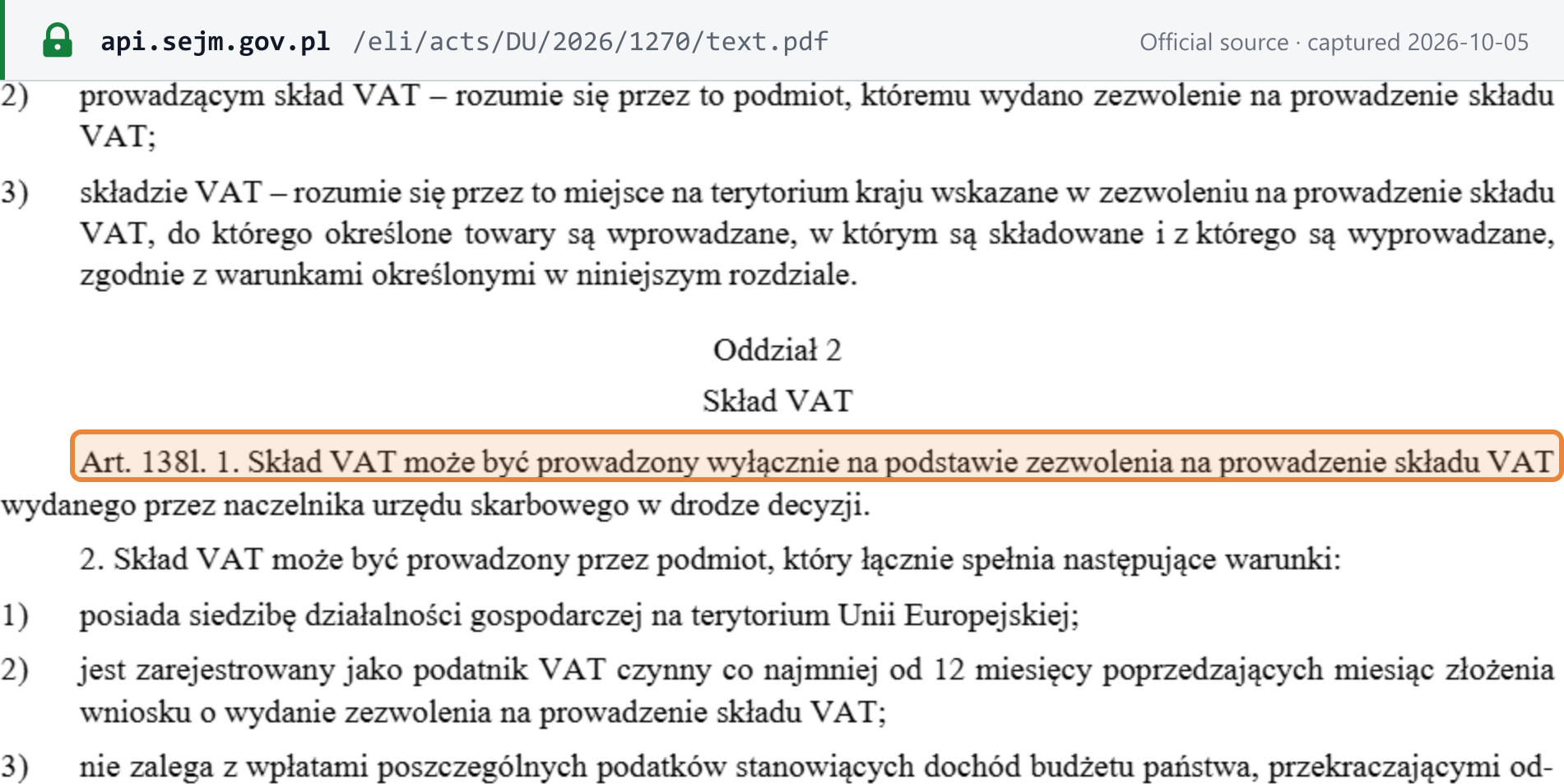 Source snapshot of the official page. Open full size ↗