California district sales tax rates change on 1 October 2026 — and LA County's tax code changes with them
This page records one dated change. For the rules in United States as they stand today, see the United States guide →
- Jurisdiction
- United States (California)
- Tax
- Sales and Use Tax
- Change type
- Rate change
- Status
- In force
- Impact
- Action required
- Effective
- 1 October 2026
- Authority
- California Department of Tax and Fee Administration (CDTFA)
- Systems
- Tax engine, POS, E-commerce, Invoicing
- Verified
- Fetched from official source · high confidence
Retailers making sales into the affected California districts, and anyone maintaining California rate tables — sellers with nexus in Los Angeles County, the City of Perris or the City of Red Bluff, plus marketplace facilitators and tax engines resolving rates by district code rather than by address. Sellers outside the named districts are unaffected: district taxes apply only within the indicated city or county limits.
Retailers selling into the affected California districts must apply the new combined rates to sales made on or after 1 October 2026. The countywide Los Angeles rate moves from 9.750% to 10.250% and its tax code changes from B47 to D29, so rate tables keyed on the old code must be remapped.
Tax enginePOSE-commerceInvoicing
California Department of Tax and Fee Administration Special Notice L-1037, dated August 2026, publishes new district sales and use tax rates effective 1 October 2026 following voter approval. The changes include the countywide County of Los Angeles rate rising from 9.750% to 10.250% (tax code B47 to D29), the City of Perris from 7.750% to 8.750%, and the City of Red Bluff from 7.500% to 8.500% (new code E05), together with consequential rates for cities within Los Angeles County. CDTFA states the rate spreadsheet became available on 1 September 2026.
What changed in detail
CDTFA Special Notice L-1037, dated August 2026, publishes voter-approved district sales and use tax changes taking effect 1 October 2026.
The headline changes:
| District | Old rate | New rate | Tax code |
|---|---|---|---|
| County of Los Angeles (countywide) | 9.750% | 10.250% | B47 → D29 |
| City of Perris | 7.750% | 8.750% | — |
| City of Red Bluff | 7.500% | 8.500% | new code E05 |
Cities within Los Angeles County move consequentially — Alhambra and Arcadia from 10.500% to 11.000%, Artesia from 10.500% to 11.250%, and so on.
CDTFA states that the downloadable rate spreadsheet became available on 1 September 2026, and that the new rates become searchable by address on 1 October 2026.
The notice itself is dated only “AUGUST 2026”. It carries no day, so this record states no announcement date.
What it means
The rate rise is the visible change. The tax code reassignment is the one that breaks things.
Los Angeles County’s countywide code moves from B47 to D29 at the same moment its rate moves. A tax engine, ERP or rate table that resolves California district tax by code — rather than by address — does not return a stale 9.750% on 1 October. It returns no match, or silently falls through to a default, because B47 no longer describes the countywide district. That failure mode is quieter and more damaging than an out-of-date percentage: an incorrect rate shows up in reconciliation, whereas a lookup miss can present as no district tax at all.
Red Bluff has the same shape in miniature, arriving with a new code E05 rather than an amended one.
The practical consequence is that this is a mapping change, not a rate change, for anyone integrating by code. Downloading the September spreadsheet and diffing the rate column is not sufficient; the code column has to be diffed too, and any hard-coded district identifiers have to be re-pointed.
Two further points worth keeping straight. First, these are district taxes layered on the statewide base — they apply only within the named city or county limits, so a seller’s exposure depends on delivery address, not on being “in California”. Second, this is unrelated to California’s separate extension of sales and use tax to digital products under SB 122, which is a base-broadening measure rather than a rate change and has its own record.
Proof
New Sales and Use Tax Rates Effective October 1, 2026 — California voters recently approved the district tax changes listed below. These rate changes only apply within the indicated city or county limits.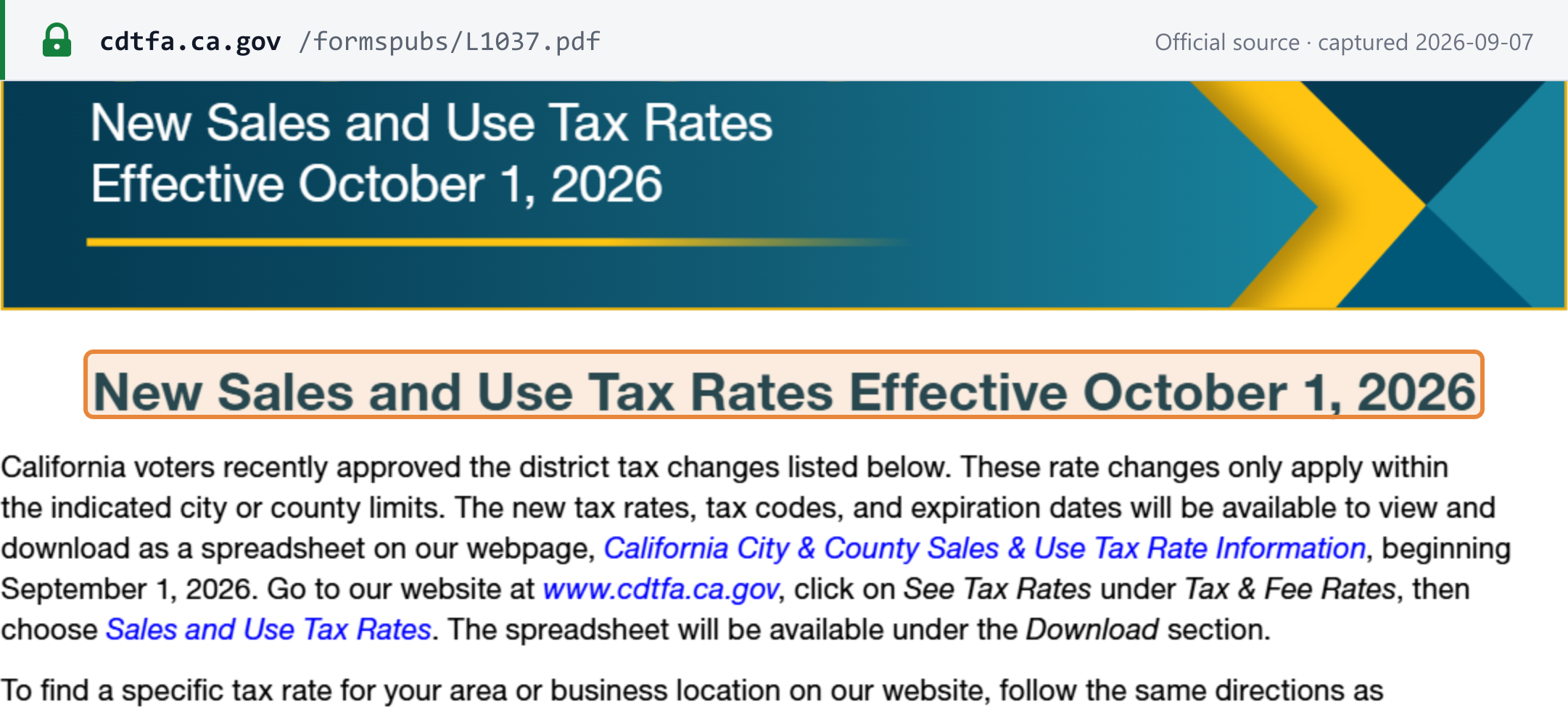 Source snapshot of the official page. Open full size ↗