Kentucky taxes data brokering services at 6% from 1 August 2026
This page records one dated change. For the rules in United States as they stand today, see the United States guide →
- Jurisdiction
- United States (Kentucky)
- Tax
- sales tax
- Change type
- Rate change
- Status
- In force
- Impact
- Action required
- Announced
- 14 April 2026
- Effective
- 1 August 2026
- Authority
- Kentucky Legislative Research Commission / Kentucky General Assembly
- Systems
- Tax engine, ERP, Invoicing
- Verified
- Fetched from official source · high confidence
Providers of data brokering services to Kentucky customers. State and local government agencies are excepted, as are supplies under pre-existing lease or rental agreements.
Businesses providing data brokering services to Kentucky customers must begin charging and remitting 6% sales tax from 1 August 2026.
Tax engineERPInvoicing
Kentucky House Bill 757 (2026 Regular Session, Acts Chapter 161) amends KRS 139.010 to define 'data brokering services' and add them as a newly taxable service subject to Kentucky's 6% sales and use tax, with an exception for state/local government agencies and for pre-existing lease or rental agreements (KRS 139.202 amendment). Signed 2 April 2026; effective 1 August 2026.
What changed in detail
The same omnibus revenue bill that simplified Kentucky’s nexus test also creates a new taxable service. House Bill 757 amends KRS 139.010 to define “data brokering services” and amends KRS 139.200 to bring them — alongside pay phone services — inside Kentucky’s sales and use tax. The rate is Kentucky’s standard 6%.
Two carve-outs travel with it. Supplies to state and local government agencies are excepted, and KRS 139.202 is amended so that pre-existing lease or rental agreements are not caught. The provision takes effect 1 August 2026.
Data brokering joins a growing list of services Kentucky has moved into the base since 2018, and it is defined in the statute rather than left to administrative interpretation — the definition sits in KRS 139.010 with the rest of the Chapter 139 vocabulary.
HB 757 became law as Acts Chapter 161 on 14 April 2026 through a veto override, not by gubernatorial signature; see the enactment-route correction →.
What it means
The taxability question here is a classification question, not a rate question. Very few businesses describe what they sell as “data brokering”, so the work is reading the KRS 139.010 definition against what your contracts actually deliver — list rental, audience segments, identity resolution, enrichment feeds and lead sales all sit near the line, and none of them carry that label on an invoice.
The pre-existing-agreement exception is the part that dates fastest. It protects contracts in place before the effective date, which means it stops protecting anything at renewal. Anyone relying on it should know exactly which agreements it covers and when each one rolls.
Proof
amend KRS 139.010 to define "data brokering services"; amend KRS 139.200 to impose sales and use taxes on pay phones and data brokering services; amend KRS 139.202 to exempt from the tax pre-existing lease or rental agreements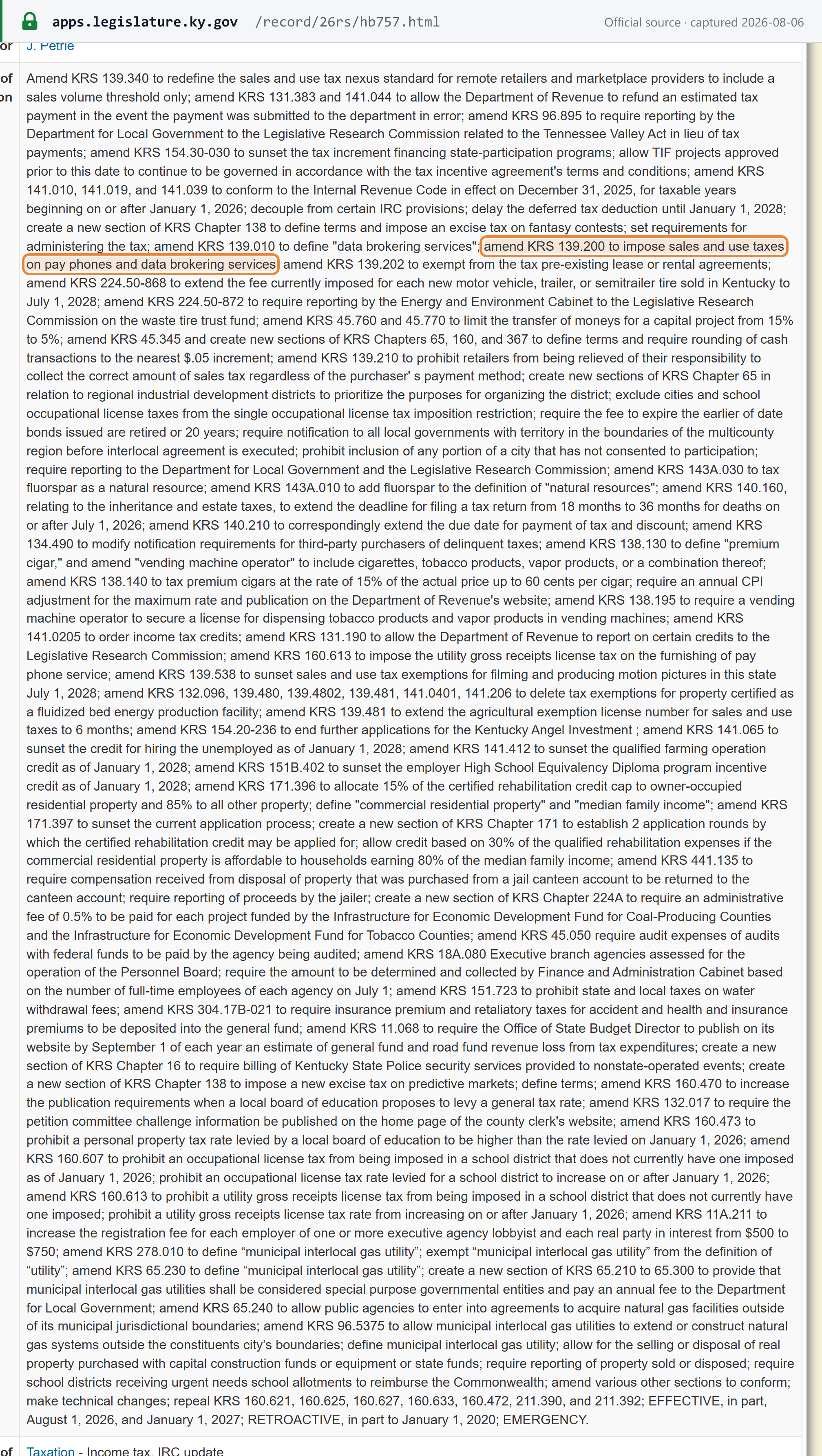 Source snapshot of the official page. Open full size ↗