Kentucky drops the 200-transaction economic nexus test from 1 August 2026
This page records one dated change. For the rules in United States as they stand today, see the United States guide →
- Jurisdiction
- United States (Kentucky)
- Tax
- sales tax
- Change type
- Threshold
- Status
- In force
- Impact
- Action required
- Announced
- 14 April 2026
- Effective
- 1 August 2026
- Authority
- Kentucky Legislative Research Commission / Kentucky General Assembly
- Systems
- Tax engine, E-commerce, Reporting
- Verified
- Fetched from official source · high confidence
Remote retailers and marketplace providers with Kentucky sales. The surviving trigger is the USD 100,000 sales-volume test in KRS 139.340; the 200-transaction alternative is removed.
Remote sellers and marketplace facilitators with Kentucky sales must reassess nexus using the USD 100,000 revenue-only threshold (no transaction-count trigger) from 1 August 2026.
Tax engineE-commerceReporting
Kentucky House Bill 757 (2026 Regular Session, Acts Chapter 161) amends KRS 139.340 to simplify the state's economic nexus standard for remote retailers and marketplace providers to a sales-volume-only threshold of USD 100,000, eliminating the prior 200-transaction alternative trigger. Signed into law 2 April 2026 (veto override 14 April 2026); effective 1 August 2026.
What changed in detail
House Bill 757 of Kentucky’s 2026 Regular Session amends KRS 139.340 so that the economic nexus standard for remote retailers and marketplace providers rests on a sales-volume threshold alone. The alternative 200-transaction trigger, which had stood since Kentucky adopted post-Wayfair nexus, is removed. The surviving test is the USD 100,000 sales threshold in KRS 139.340.
The measure takes effect 1 August 2026. HB 757 is an omnibus revenue bill whose Legislative Research Commission record notes it as “EFFECTIVE, in part, August 1, 2026, and January 1, 2027; RETROACTIVE, in part to January 1, 2020; EMERGENCY” — so the August date attaches to this provision rather than to the whole Act.
On the enactment route, note the correction recorded in issue 2026-W31: HB 757 was not signed by the Governor. It was delivered to the Governor on 2 April 2026, line-item vetoed on 13 April 2026, and the General Assembly overrode those vetoes on 14 April 2026, the same day the bill was delivered to the Secretary of State as Acts Chapter 161. See the enactment-route correction →.
What it means
This is one of the few nexus changes anywhere that reduces the registered population. Sellers of low-value, high-volume goods — digital downloads, consumables, small parts — routinely cross 200 Kentucky transactions while sitting well under USD 100,000 of Kentucky revenue, and those sellers may now fall out of Kentucky nexus entirely.
Falling out is not automatic housekeeping. Deregistration has its own procedure and its own trailing-return obligations, and a seller who stops collecting before confirming they are below the revenue test has simply created an under-collection exposure. Run the revenue-only test against the same lookback period your engine already uses, then decide; do not infer the answer from the transaction count you were previously tracking.
Proof
Amend KRS 139.340 to redefine the sales and use tax nexus standard for remote retailers and marketplace providers to include a sales volume threshold only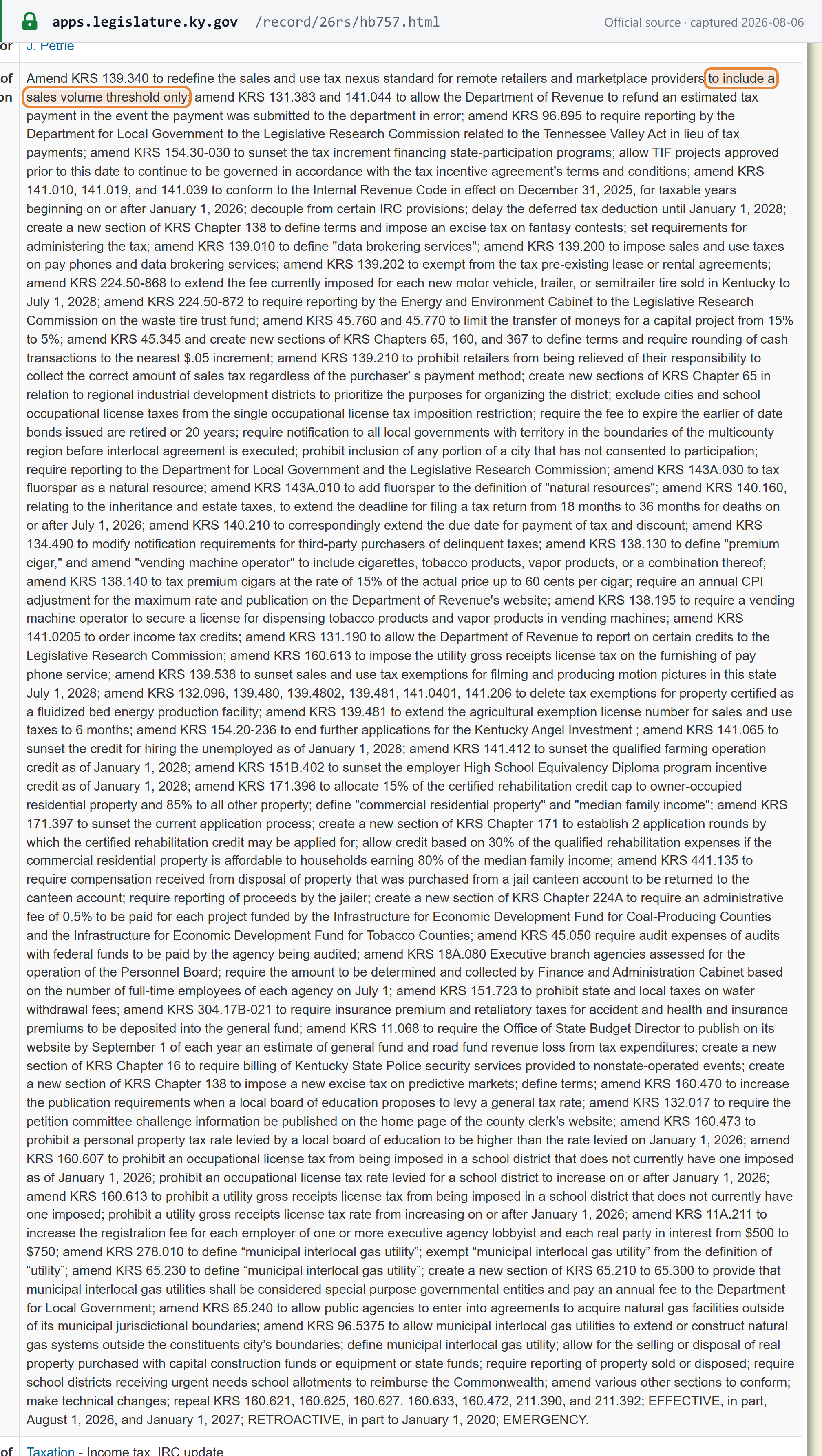 Source snapshot of the official page. Open full size ↗