
Austria compliance calendar

35 recurring Umsatzsteuer (VAT), Werbeabgabe (advertising duty), Digitalsteuer (digital services tax) and 10 more obligations — returns, payments and listings — each with its due rule and official source, plus the dates new Austria rules take effect.

Mon
Tue
Wed
Thu
Fri
Sat
Sun
31
1
2
3
4
5
6
7
8
9
10
11
Return filing Payment Report / listing Other Law change takes effect

Dates already include the weekend and public-holiday shift where Austria applies one — 26 of 35 obligations here do. The rest stand as computed, and each obligation's notes say which applies to it and why. Confirm against the linked official source before relying on a date.

Recurring obligations, with sources

Each deadline cites the official text that states it and the date we last verified it.

Umsatzsteuervoranmeldung (U30) — monthly

Umsatzsteuer (VAT) · Monthly · return filing

15th of the 2nd month after the month ends Verified 2026-09-07
Who files
Businesses whose turnover in the previous calendar year exceeded EUR 100,000, and quarterly filers who have opted up to monthly for the whole assessment period
Notes
The advance return and the payment share one date: the 15th of the second month after the period, so the June return and the June money are both due on 15 August. Miss the weekend arithmetic and you miss both. A transfer counts on the day it is credited to the tax office's account, not the day you instruct it — though a payment credited within three days of the due date carries no legal consequences, which is a tolerance and not a later deadline. Do not plan around it.
Source
UStG 1994 § 21 Abs. 1 — Voranmeldung und Vorauszahlung Rechtsinformationssystem des Bundes (RIS), Bundeskanzleramt
See the source text
“Der Unternehmer hat spätestens am 15. Tag (Fälligkeitstag) des auf einen Kalendermonat (Voranmeldungszeitraum) zweitfolgenden Kalendermonates eine Voranmeldung bei dem für die Einhebung der Umsatzsteuer zuständigen Finanzamt einzureichen, in der er die für den Voranmeldungszeitraum zu entrichtende Steuer (Vorauszahlung) oder den auf den Voranmeldungszeitraum entfallenden Überschuß unter entsprechender Anwendung des § 20 Abs. 1 und 2 und des § 16 selbst zu berechnen hat.”
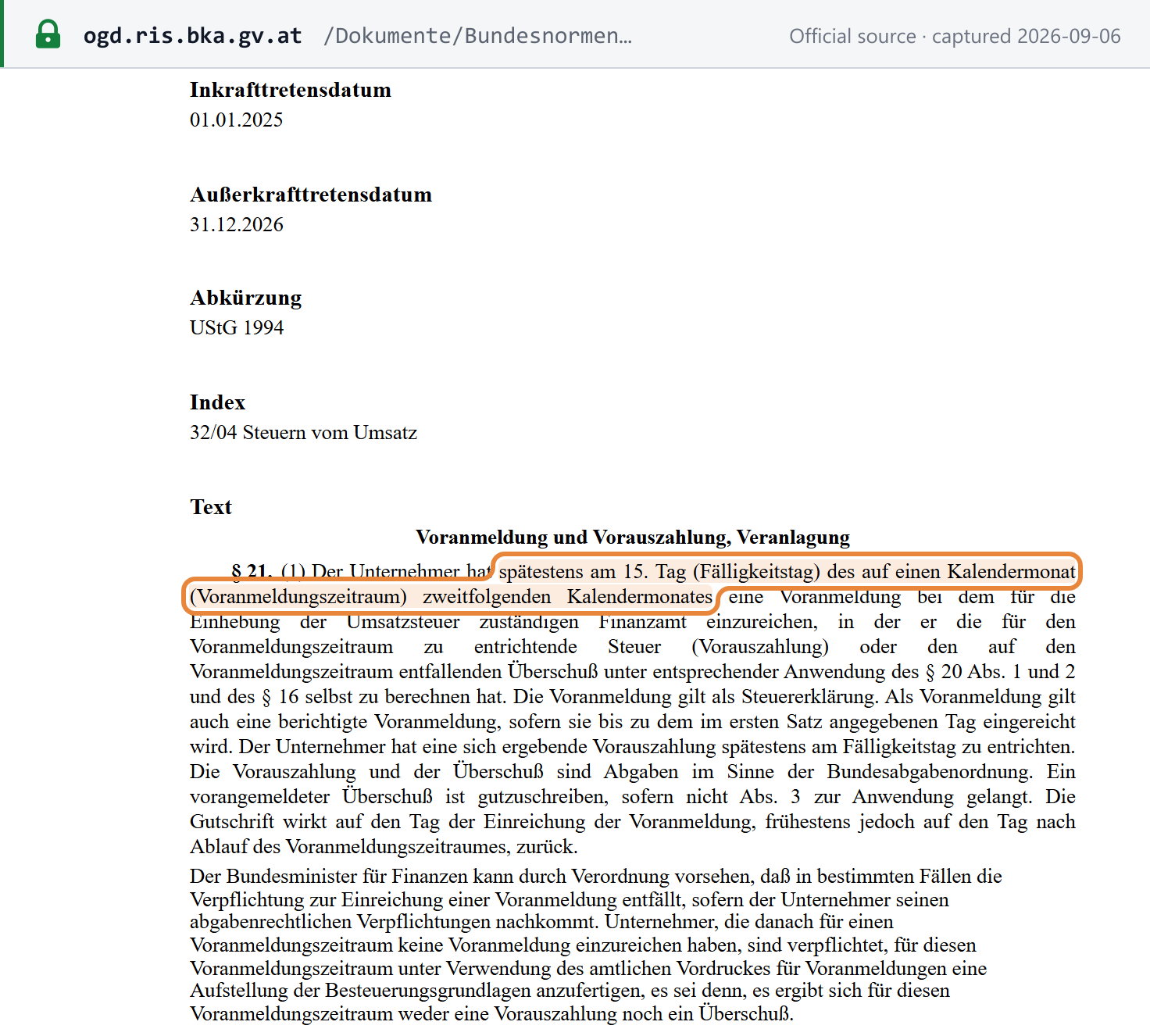
Screenshot of Rechtsinformationssystem des Bundes (RIS), Bundeskanzleramt showing the Umsatzsteuervoranmeldung (U30) — monthly deadline Open full size Captured from Rechtsinformationssystem des Bundes (RIS), Bundeskanzleramt on 2026-09-07
Umsatzsteuervoranmeldung (U30) — quarterly

Umsatzsteuer (VAT) · Quarterly · return filing

15th of the 2nd month after the quarter ends Verified 2026-09-07
Who files
Businesses whose turnover in the previous calendar year did not exceed EUR 100,000 — in practice those above EUR 55,000 and not above EUR 100,000, since below EUR 55,000 no advance return need be filed at all
Notes
Quarterly filing is the default below EUR 100,000 of prior-year turnover, giving due dates of 15 May, 15 August, 15 November and 15 February. You may choose the calendar month instead by filing a timely return for the first month of the year, and that choice binds you for the rest of it. Below EUR 55,000 of prior-year turnover you may not have to file the advance return at all — but the relief is narrower than it sounds: it goes if any advance payment is not paid in full and on time, if a period produces a refund rather than a payment, or if the tax office asks you to file anyway.
Source
UStG 1994 § 21 Abs. 2 — Kalendervierteljahr als Voranmeldungszeitraum Rechtsinformationssystem des Bundes (RIS), Bundeskanzleramt
See the source text
“Für Unternehmer, deren Umsätze nach § 1 Abs. 1 Z 1 und 2 im vorangegangenen Kalenderjahr 100 000 Euro nicht überstiegen haben, ist das Kalendervierteljahr der Voranmeldungszeitraum; der Unternehmer kann jedoch durch fristgerechte Abgabe einer Voranmeldung für den ersten Kalendermonat eines Veranlagungszeitraumes mit Wirkung für den ganzen Veranlagungszeitraum den Kalendermonat als Voranmeldungszeitraum wählen.”
Captured from Rechtsinformationssystem des Bundes (RIS), Bundeskanzleramt on 2026-09-07

Umsatzsteuererklärung (U1) — annual return, filed electronically

Umsatzsteuer (VAT) · Annually · return filing

30th June each year Verified 2026-09-07
Who files
All businesses filing the annual VAT return electronically, which the VAT Act makes the default — small businesses under the EUR 55,000 Kleinunternehmergrenze with no tax to pay are exempt from filing one at all
Notes
Electronic filing is the legal default and carries the later date: the end of June following the year. Paper filing is only open to a business for which electronic transmission is unreasonable for want of the technical means, and it is due two months earlier. If you are represented by a tax adviser you are probably not on this date at all but on the quota arrangement, which runs to the following year. A small business under EUR 55,000 with no tax to pay for the year need not file an annual return.
Source
BAO § 134 Abs. 1 — Frist für die Abgabenerklärungen Rechtsinformationssystem des Bundes (RIS), Bundeskanzleramt
See the source text
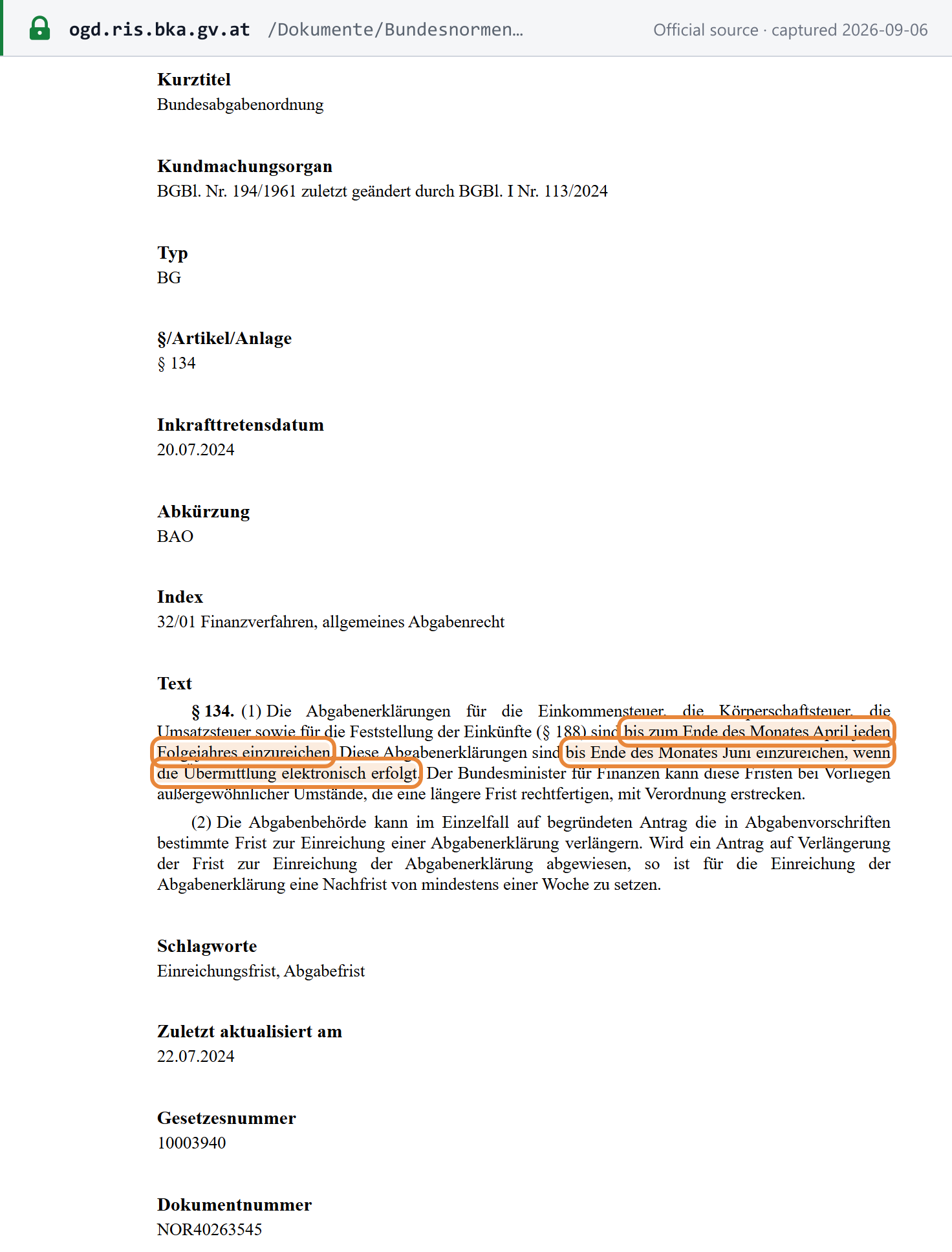
“Die Abgabenerklärungen für die Einkommensteuer, die Körperschaftsteuer, die Umsatzsteuer sowie für die Feststellung der Einkünfte (§ 188) sind bis zum Ende des Monates April jeden Folgejahres einzureichen. Diese Abgabenerklärungen sind bis Ende des Monates Juni einzureichen, wenn die Übermittlung elektronisch erfolgt. Der Bundesminister für Finanzen kann diese Fristen bei Vorliegen außergewöhnlicher Umstände, die eine längere Frist rechtfertigen, mit Verordnung erstrecken.”
Screenshot of Rechtsinformationssystem des Bundes (RIS), Bundeskanzleramt showing the Umsatzsteuererklärung (U1) — annual return, filed electronically deadline Open full size Captured from Rechtsinformationssystem des Bundes (RIS), Bundeskanzleramt on 2026-09-07
Umsatzsteuererklärung (U1) — annual return, filed on paper

Umsatzsteuer (VAT) · Annually · return filing

30th April each year Verified 2026-09-07
Who files
Businesses for which electronic transmission is unreasonable for want of the technical means — the statutory exception, not a free choice
Notes
The paper date is the end of April, two months before the electronic one. It is not an alternative you can simply prefer: the VAT Act allows the official form only where electronic transmission is unreasonable because you lack the technical means. Where the end of April falls on a weekend or a holiday the deadline moves forward, and the first of May being a public holiday means it can move by more than a day.
Source
BAO § 134 Abs. 1 — Frist für die Abgabenerklärungen Rechtsinformationssystem des Bundes (RIS), Bundeskanzleramt
See the source text
“Die Abgabenerklärungen für die Einkommensteuer, die Körperschaftsteuer, die Umsatzsteuer sowie für die Feststellung der Einkünfte (§ 188) sind bis zum Ende des Monates April jeden Folgejahres einzureichen. Diese Abgabenerklärungen sind bis Ende des Monates Juni einzureichen, wenn die Übermittlung elektronisch erfolgt. Der Bundesminister für Finanzen kann diese Fristen bei Vorliegen außergewöhnlicher Umstände, die eine längere Frist rechtfertigen, mit Verordnung erstrecken.”
Screenshot of Rechtsinformationssystem des Bundes (RIS), Bundeskanzleramt showing the Umsatzsteuererklärung (U1) — annual return, filed on paper deadline Open full size Captured from Rechtsinformationssystem des Bundes (RIS), Bundeskanzleramt on 2026-09-07
Umsatzsteuererklärung under the Quotenregelung (represented taxpayers)

Umsatzsteuer (VAT) · Annually · return filing

31st March each year, for the year before last Verified 2026-09-07
Who files
Taxpayers who have instructed a professional tax representative with a current power of attorney, or an authorised cooperative audit association, to file their returns
Notes
If a tax adviser files for you, your annual VAT return is not due in April or June at all: the quota arrangement runs to 31 March of the second year after the assessment period, so the 2025 return is due 31 March 2027. The tax office can extend that to 30 June for a whole adviser portfolio at once. Your adviser will very likely ask for your papers long before then, because their office works to interim quota targets through the intervening autumn and winter that have nothing to do with your own date.
Source
BAO § 134a — automationsunterstützte Quotenregelung Rechtsinformationssystem des Bundes (RIS), Bundeskanzleramt
See the source text
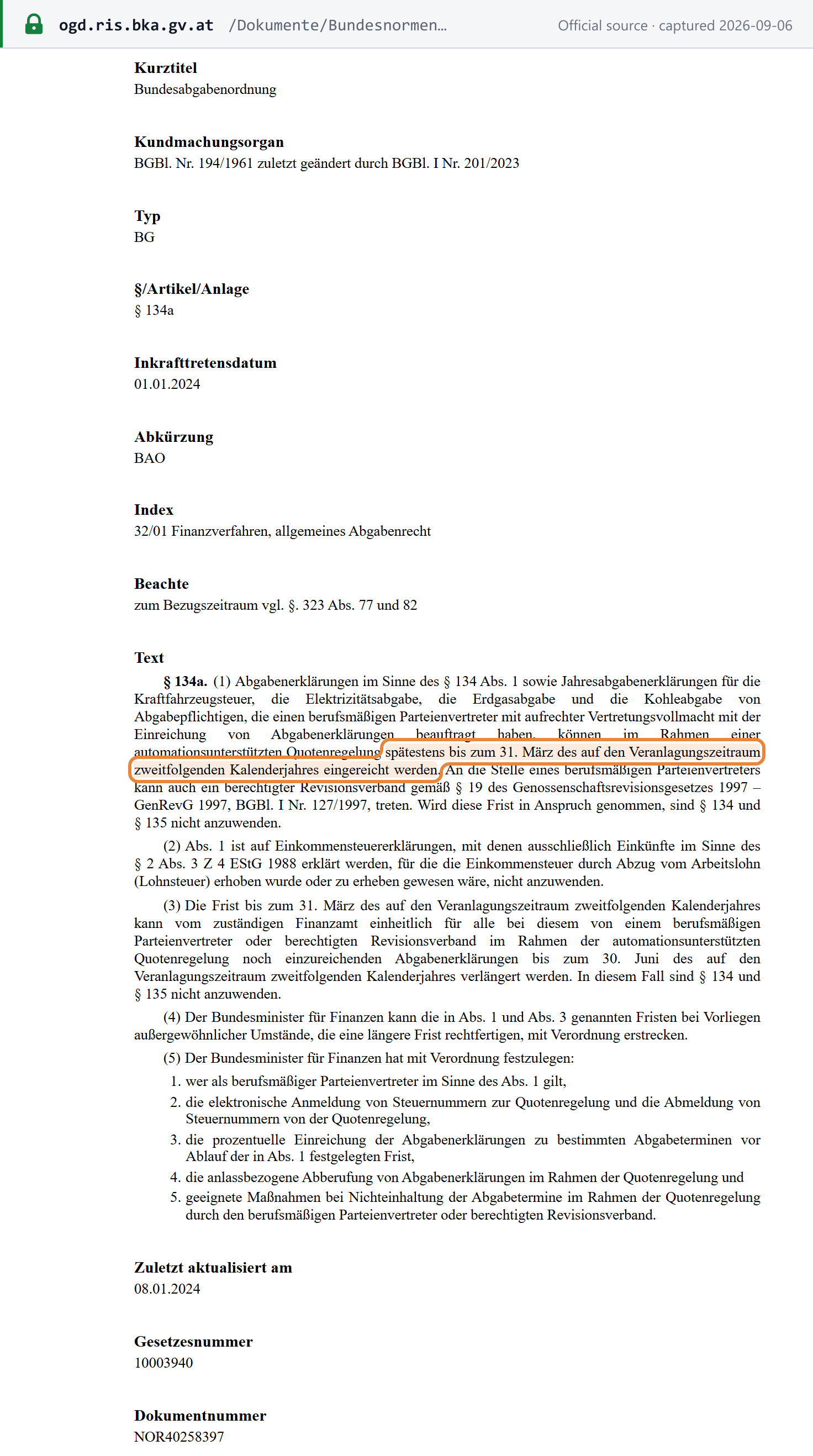
“Abgabenerklärungen im Sinne des § 134 Abs. 1 sowie Jahresabgabenerklärungen für die Kraftfahrzeugsteuer, die Elektrizitätsabgabe, die Erdgasabgabe und die Kohleabgabe von Abgabepflichtigen, die einen berufsmäßigen Parteienvertreter mit aufrechter Vertretungsvollmacht mit der Einreichung von Abgabenerklärungen beauftragt haben, können im Rahmen einer automationsunterstützten Quotenregelung spätestens bis zum 31. März des auf den Veranlagungszeitraum zweitfolgenden Kalenderjahres eingereicht werden. An die Stelle eines berufsmäßigen Parteienvertreters kann auch ein berechtigter Revisionsverband gemäß § 19 des Genossenschaftsrevisionsgesetzes 1997 – GenRevG 1997, BGBl. I Nr. 127/1997, treten. Wird diese Frist in Anspruch genommen, sind § 134 und § 135 nicht anzuwenden.”
Screenshot of Rechtsinformationssystem des Bundes (RIS), Bundeskanzleramt showing the Umsatzsteuererklärung under the Quotenregelung (represented taxpayers) deadline Open full size Captured from Rechtsinformationssystem des Bundes (RIS), Bundeskanzleramt on 2026-09-07
Zusammenfassende Meldung (U13) — monthly

Umsatzsteuer (VAT) — recapitulative statement · Monthly · report / listing

last day of the month after the month ends Verified 2026-09-07
Who files
Businesses on the monthly advance-return period that made intra-Community supplies of goods, call-off stock transfers, or services on which the customer accounts for the VAT
Notes
Due a full month before the VAT return covering the same supplies: August sales go on this statement by 30 September and on the advance return by 15 October. Filing it late is expensive rather than merely untidy — since 2020 an intra-Community supply is zero-rated only if the statement was filed in time, so a late one can turn a zero-rated sale into a 20 per cent liability. If you made none of these supplies in the month, file nothing: there is no nil statement.
Source
UStG 1994 Anhang (Binnenmarkt) Art. 21 Abs. 3 — Zusammenfassende Meldung Rechtsinformationssystem des Bundes (RIS), Bundeskanzleramt
See the source text
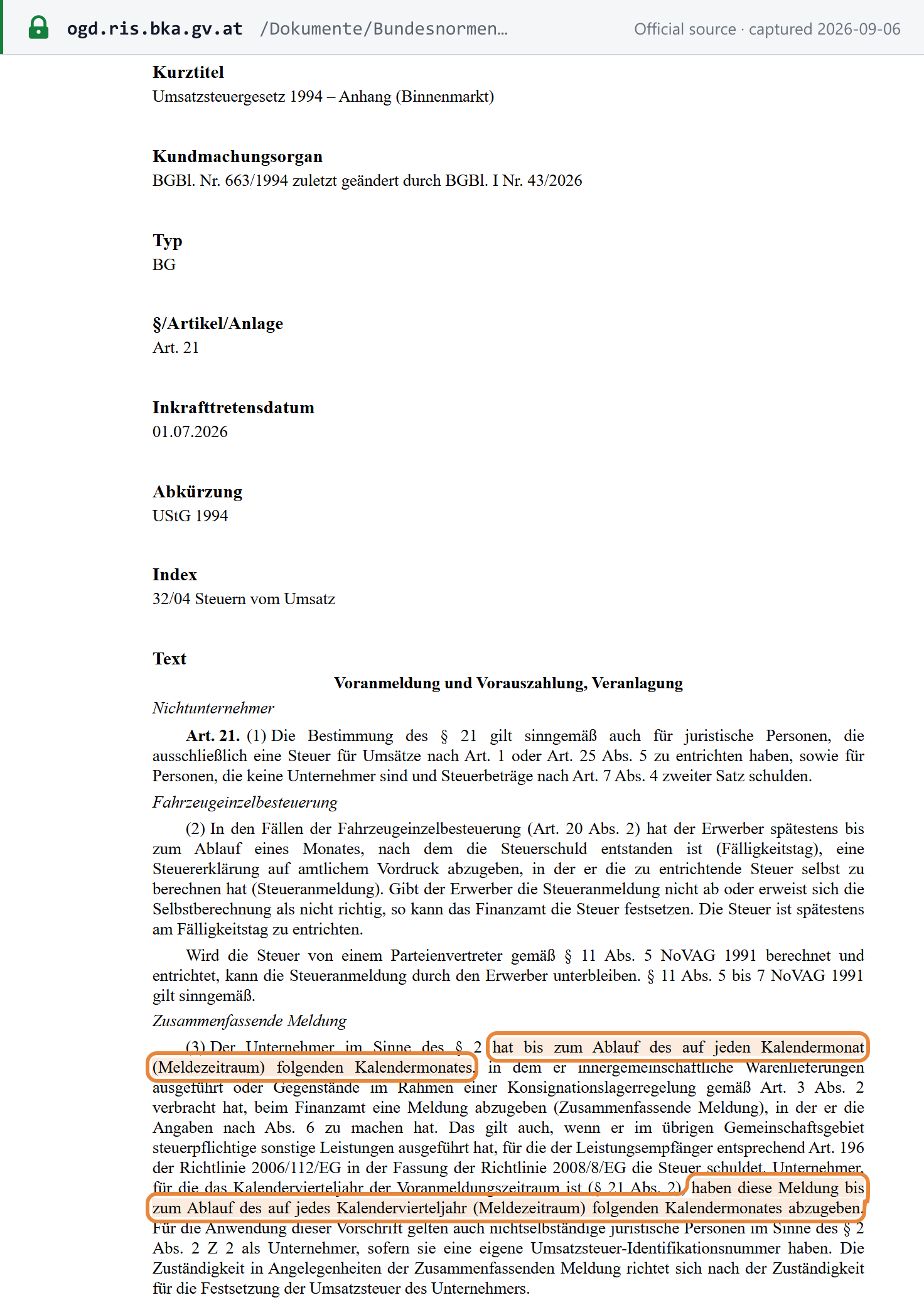
“Der Unternehmer im Sinne des § 2 hat bis zum Ablauf des auf jeden Kalendermonat (Meldezeitraum) folgenden Kalendermonates, in dem er innergemeinschaftliche Warenlieferungen ausgeführt oder Gegenstände im Rahmen einer Konsignationslagerregelung gemäß Art. 3 Abs. 2 verbracht hat, beim Finanzamt eine Meldung abzugeben (Zusammenfassende Meldung), in der er die Angaben nach Abs. 6 zu machen hat. Das gilt auch, wenn er im übrigen Gemeinschaftsgebiet steuerpflichtige sonstige Leistungen ausgeführt hat, für die der Leistungsempfänger entsprechend Art. 196 der Richtlinie 2006/112/EG in der Fassung der Richtlinie 2008/8/EG die Steuer schuldet. Unternehmer, für die das Kalendervierteljahr der Voranmeldungszeitraum ist (§ 21 Abs. 2), haben diese Meldung bis zum Ablauf des auf jedes Kalendervierteljahr (Meldezeitraum) folgenden Kalendermonates abzugeben.”
Screenshot of Rechtsinformationssystem des Bundes (RIS), Bundeskanzleramt showing the Zusammenfassende Meldung (U13) — monthly deadline Open full size Captured from Rechtsinformationssystem des Bundes (RIS), Bundeskanzleramt on 2026-09-07
Zusammenfassende Meldung (U13) — quarterly

Umsatzsteuer (VAT) — recapitulative statement · Quarterly · report / listing

last day of the month after the quarter ends Verified 2026-09-07
Who files
Businesses whose advance-return period is the calendar quarter — prior-year turnover not above EUR 100,000 — that made intra-Community supplies or reverse-charge services
Notes
Quarterly filers get a quarterly statement, due by the end of the month after the quarter — 30 April, 31 July, 31 October and 31 January. You do not choose this cadence separately: it follows whichever advance-return period you are on. And there is no nil statement, so a quarter with no intra-Community supplies needs nothing filed.
Source
UStG 1994 Anhang (Binnenmarkt) Art. 21 Abs. 3 — quarterly Meldezeitraum Rechtsinformationssystem des Bundes (RIS), Bundeskanzleramt
See the source text
“Der Unternehmer im Sinne des § 2 hat bis zum Ablauf des auf jeden Kalendermonat (Meldezeitraum) folgenden Kalendermonates, in dem er innergemeinschaftliche Warenlieferungen ausgeführt oder Gegenstände im Rahmen einer Konsignationslagerregelung gemäß Art. 3 Abs. 2 verbracht hat, beim Finanzamt eine Meldung abzugeben (Zusammenfassende Meldung), in der er die Angaben nach Abs. 6 zu machen hat. Das gilt auch, wenn er im übrigen Gemeinschaftsgebiet steuerpflichtige sonstige Leistungen ausgeführt hat, für die der Leistungsempfänger entsprechend Art. 196 der Richtlinie 2006/112/EG in der Fassung der Richtlinie 2008/8/EG die Steuer schuldet. Unternehmer, für die das Kalendervierteljahr der Voranmeldungszeitraum ist (§ 21 Abs. 2), haben diese Meldung bis zum Ablauf des auf jedes Kalendervierteljahr (Meldezeitraum) folgenden Kalendermonates abzugeben.”
Screenshot of Rechtsinformationssystem des Bundes (RIS), Bundeskanzleramt showing the Zusammenfassende Meldung (U13) — quarterly deadline Open full size Captured from Rechtsinformationssystem des Bundes (RIS), Bundeskanzleramt on 2026-09-07
EU One-Stop-Shop return (Union scheme)

Umsatzsteuer (VAT) — EU-OSS · Quarterly · return filing

last day of the month after the quarter ends Verified 2026-09-07
Who files
Businesses registered for the Union scheme in Austria, for distance sales and B2C services taxed in other member states
Notes
One quarterly return covers every member state you sell into, due by the end of the month after the quarter, with the tax payable by the same day. Two things catch people out. A nil return is compulsory — unlike the recapitulative statement, a quarter with no scheme sales still needs a filing. And the money must go to the dedicated One-Stop-Shop account; a payment to your ordinary tax account cannot be applied to it.
Source
UStG 1994 Anhang (Binnenmarkt) Art. 25a Abs. 3 — EU-OSS Erklärung und Zahlung Rechtsinformationssystem des Bundes (RIS), Bundeskanzleramt
See the source text
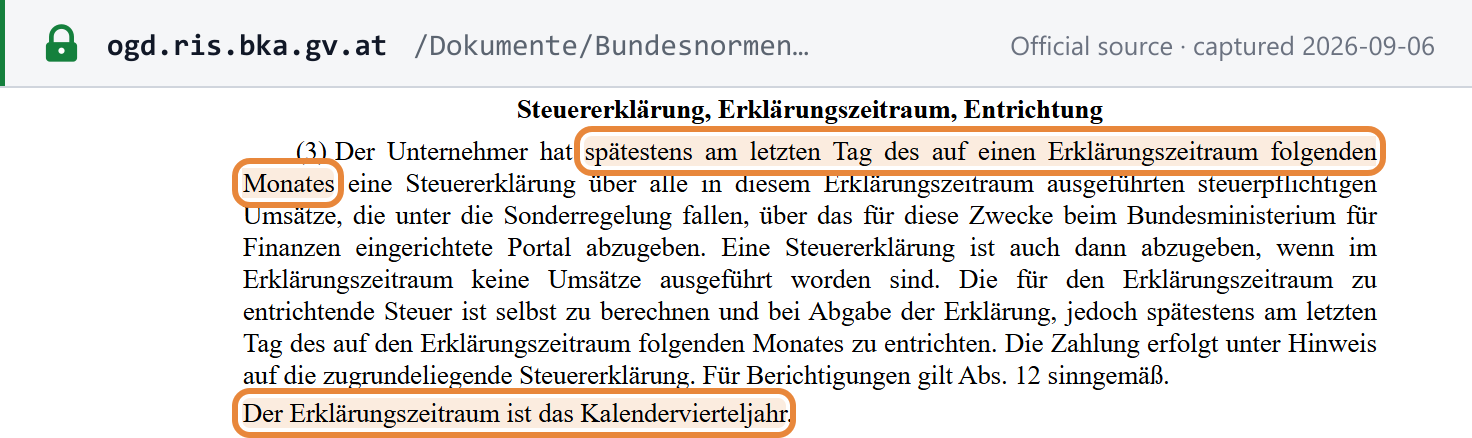
“Der Unternehmer hat spätestens am letzten Tag des auf einen Erklärungszeitraum folgenden Monates eine Steuererklärung über alle in diesem Erklärungszeitraum ausgeführten steuerpflichtigen Umsätze, die unter die Sonderregelung fallen, über das für diese Zwecke beim Bundesministerium für Finanzen eingerichtete Portal abzugeben.”
Screenshot of Rechtsinformationssystem des Bundes (RIS), Bundeskanzleramt showing the EU One-Stop-Shop return (Union scheme) deadline Open full size Captured from Rechtsinformationssystem des Bundes (RIS), Bundeskanzleramt on 2026-09-07
Non-Union One-Stop-Shop return (eVAT)

Umsatzsteuer (VAT) — non-Union OSS · Quarterly · return filing

last day of the month after the quarter ends Verified 2026-09-07
Who files
Businesses established outside the EU that have chosen Austria as their member state of identification for B2C services supplied in the EU
Notes
The non-EU equivalent of the Union scheme, on the same quarterly cycle and the same end-of-following-month date. The statute is explicit that a return is due even for a quarter in which you made no supplies at all, so a dormant quarter is still a filing quarter.
Source
UStG 1994 § 25a Abs. 3 — Sonderregelung für nicht im Gemeinschaftsgebiet ansässige Unternehmer Rechtsinformationssystem des Bundes (RIS), Bundeskanzleramt
See the source text
“Der Unternehmer hat spätestens am letzten Tag des auf einen Erklärungszeitraum folgenden Monates eine Steuererklärung über alle in diesem Erklärungszeitraum ausgeführten steuerpflichtigen Umsätze, die unter die Sonderregelung fallen, über das für diese Zwecke beim Bundesministerium für Finanzen eingerichtete Portal abzugeben. Eine Steuererklärung ist auch dann abzugeben, wenn im Erklärungszeitraum keine Umsätze ausgeführt worden sind. Die für den Erklärungszeitraum zu entrichtende Steuer ist selbst zu berechnen. Der Erklärungszeitraum ist das Kalendervierteljahr.”
Captured from Rechtsinformationssystem des Bundes (RIS), Bundeskanzleramt on 2026-09-07

Import One-Stop-Shop return (IOSS)

Umsatzsteuer (VAT) — IOSS · Monthly · return filing

last day of the month after the month ends Verified 2026-09-07
Who files
Businesses or their intermediaries registered for the import scheme in Austria, for distance sales of imported goods in consignments not exceeding EUR 150
Notes
The import scheme runs MONTHLY where the other two One-Stop-Shop schemes run quarterly — the single most common mistake for a business registered for both. The return covers the sales for which payment was accepted in the month and is due by the end of the next one, and a nil return is compulsory.
Source
UStG 1994 § 25b Abs. 3 — Sonderregelung für den Einfuhr-Versandhandel Rechtsinformationssystem des Bundes (RIS), Bundeskanzleramt
See the source text
“Der Unternehmer oder sein Vertreter hat spätestens am letzten Tag des auf einen Erklärungszeitraum folgenden Monates eine Steuererklärung über alle Umsätze, die unter die Sonderregelung fallen und für die im Erklärungszeitraum die Zahlung angenommen wurde, über das für diese Zwecke beim Bundesministerium für Finanzen eingerichtete Portal abzugeben. Eine Steuererklärung ist auch dann abzugeben, wenn im Erklärungszeitraum keine Umsätze ausgeführt worden sind. Der Erklärungszeitraum ist der Kalendermonat.”
Captured from Rechtsinformationssystem des Bundes (RIS), Bundeskanzleramt on 2026-09-07

Quarterly turnover report under the EU cross-border SME exemption

Umsatzsteuer (VAT) — EU SME scheme · Quarterly · report / listing

last day of the month after the quarter ends Verified 2026-09-07
Who files
Austrian-established businesses using the EU cross-border small-business exemption in other member states, under the EUR 100,000 EU-wide turnover threshold
Notes
Using the cross-border small-business exemption means reporting your turnover in each member state every quarter, within a month of the quarter ending. Separately, if you cross the EUR 100,000 EU-wide threshold you must report the breach within 15 business days — business days, not calendar days, so the real window is about three weeks — together with the value of what you supplied from the start of the quarter up to the moment you crossed it.
Source
UStG 1994 Anhang (Binnenmarkt) Art. 6a Abs. 5 — Meldung des Umsatzes je Mitgliedstaat Rechtsinformationssystem des Bundes (RIS), Bundeskanzleramt
See the source text
“Der Unternehmer hat über das für diese Zwecke beim Bundesministerium für Finanzen eingerichtete Portal für jedes Kalendervierteljahr den Umsatz zu melden, der in den einzelnen Mitgliedstaaten bewirkt wurde. Die Meldung hat binnen eines Monats ab Ende des Kalendervierteljahres zu erfolgen. Wird der Schwellenwert in Abs. 1 überschritten, ist der Unternehmer verpflichtet binnen 15 Werktagen das Überschreiten sowie den Betrag der Lieferungen und sonstigen Leistungen, die seit Beginn des laufenden Kalendervierteljahres bis zum Zeitpunkt des Überschreitens des Schwellenwertes bewirkt wurden, zu melden.”
Captured from Rechtsinformationssystem des Bundes (RIS), Bundeskanzleramt on 2026-09-07

Notification of starting or ceasing a business (BAO § 120)

Umsatzsteuer (VAT) — notification · One-off · registration

within 1 month of starting or giving up a farming, forestry, trade or other self-employed activity, or any change establishing, altering or ending a VAT liability Verified 2026-09-07
Who files
Anyone starting or giving up a farming, forestry, trade or other self-employed activity, and anyone whose circumstances establish, change or end a liability to VAT
Notes
Austria gives you a real countdown rather than a "before you start" rule: one month from the event to notify the tax office responsible for VAT, and the same clock runs when you give the activity up. It is not only about starting — any circumstance that creates, changes or ends your VAT liability is notifiable on the same footing, which catches a change of legal form or address. The small-business threshold is EUR 55,000 of turnover, tested on both the previous calendar year and the current one, and going over it by no more than 10 per cent keeps the exemption to the end of that year rather than ending it on the supply that crossed the line.
Source
BAO § 121 — Frist für die Anzeigen nach §§ 120 und 120a Rechtsinformationssystem des Bundes (RIS), Bundeskanzleramt
See the source text
“Die Anzeigen gemäß den §§ 120 und 120a sind binnen einem Monat, gerechnet vom Eintritt des anmeldungspflichtigen Ereignisses, zu erstatten.”
Captured from Rechtsinformationssystem des Bundes (RIS), Bundeskanzleramt on 2026-09-07

VAT refund application — EU-established claimants

Umsatzsteuer (VAT) — Vorsteuererstattung · Annually · other

30th September each year Verified 2026-09-07
Who files
Businesses established in another EU member state reclaiming Austrian input VAT, applying through their home member state’s portal
Notes
Nine months from the end of the year in which the entitlement arose, so 30 September of the following year, filed through the portal of the member state you are established in rather than directly with Austria. It is a hard deadline: there is no late application.
Source
Verordnung BGBl. Nr. 279/1995 Art. 1 § 3 Abs. 1 — Erstattungszeitraum und Frist Rechtsinformationssystem des Bundes (RIS), Bundeskanzleramt
See the source text
“Der Antrag ist vorbehaltlich des § 28 Abs. 53 Z 1 und 2 UStG 1994 binnen neun Monaten nach Ablauf des Kalenderjahres zu stellen, in dem der Erstattungsanspruch entstanden ist.”
Captured from Rechtsinformationssystem des Bundes (RIS), Bundeskanzleramt on 2026-09-07

VAT refund application — non-EU claimants

Umsatzsteuer (VAT) — Vorsteuererstattung · Annually · other

30th June each year Verified 2026-09-07
Who files
Businesses established outside the EU reclaiming Austrian input VAT, applying on the official form to Finanzamt Österreich
Notes
Businesses from outside the EU get six months, not nine — 30 June of the following year, three months earlier than an EU claimant, and on paper to Finanzamt Österreich rather than through a portal. The shorter window is the part that catches people who assume the EU deadline applies to them.
Source
Verordnung BGBl. Nr. 279/1995 Art. 1 § 3a Abs. 1 — Frist für nicht im Gemeinschaftsgebiet ansässige Unternehmer Rechtsinformationssystem des Bundes (RIS), Bundeskanzleramt
See the source text
“Der Antrag ist binnen sechs Monaten nach Ablauf des Kalenderjahres zu stellen, in dem der Erstattungsanspruch entstanden ist.”
Captured from Rechtsinformationssystem des Bundes (RIS), Bundeskanzleramt on 2026-09-07

Werbeabgabe — monthly self-assessment and payment

Werbeabgabe (advertising duty) · Monthly · payment

15th of the 2nd month after the month ends Verified 2026-09-07
Who files
Providers of advertising services supplied in Austria, once the taxable fees for the assessment period reach EUR 10,000
Notes
The 5 per cent advertising duty is self-calculated and paid on the same 15th-of-the-second-month rhythm as VAT, but only once your taxable advertising fees for the year reach EUR 10,000. Below that the supplies are exempt and no annual return is due either. The duty was narrowed at the end of 2025 rather than abolished, so check whether your services still fall inside it before assuming either way.
Source
Werbeabgabegesetz 2000 § 4 — Erhebung der Abgabe Rechtsinformationssystem des Bundes (RIS), Bundeskanzleramt
See the source text
“Der Abgabenschuldner hat die Abgabe selbst zu berechnen und bis zum 15. des zweitfolgenden Monats nach Entstehen des Abgabenanspruches zu entrichten, sobald die Summe der abgabepflichtigen Entgelte im Veranlagungszeitraum 10 000 Euro erreicht.”
Captured from Rechtsinformationssystem des Bundes (RIS), Bundeskanzleramt on 2026-09-07

Werbeabgabe — annual return

Werbeabgabe (advertising duty) · Annually · return filing

31st March each year Verified 2026-09-07
Who files
Advertising-duty debtors whose Wirtschaftsjahr is the calendar year — the deadline runs three months from YOUR business year end, so a non-calendar year ends elsewhere
Notes
The annual return is due electronically three months after your business year ends, which is 31 March for anyone on the calendar year, and it has to break the figures down by type of advertising service. If your business year ends elsewhere, count three months from your own year end rather than reading the date off this calendar.
Source
Werbeabgabegesetz 2000 § 4 — Erhebung der Abgabe Rechtsinformationssystem des Bundes (RIS), Bundeskanzleramt
See the source text
“Der Abgabenschuldner wird nach Ablauf des Kalenderjahres (Wirtschaftsjahres) zur Werbeabgabe veranlagt. Drei Monate nach Ablauf des Wirtschaftsjahres hat der Abgabenschuldner auf elektronischem Wege eine Jahresabgabenerklärung für das vorangegangene Jahr zu übermitteln. In diese sind die Arten der Werbeleistungen und die darauf entfallenden Entgelte aufzunehmen.”
Captured from Rechtsinformationssystem des Bundes (RIS), Bundeskanzleramt on 2026-09-07

Digitalsteuer — monthly self-assessment and payment

Digitalsteuer (digital services tax) · Monthly · payment

15th of the 2nd month after the month ends Verified 2026-09-07
Who files
Providers of online advertising services within the digital services tax, assessed by the Finanzamt für Großbetriebe
Notes
The 5 per cent digital services tax on online advertising is self-calculated and paid on the same 15th-of-the-second-month rhythm as VAT and the advertising duty. It is administered by the large-business tax office rather than your ordinary one.
Source
Digitalsteuergesetz 2020 § 5 — Erhebung der Steuer Rechtsinformationssystem des Bundes (RIS), Bundeskanzleramt
See the source text
“Der Steuerschuldner hat die Steuer selbst zu berechnen und bis zum 15. des zweitfolgenden Monats nach Entstehen des Steueranspruches zu entrichten.”
Captured from Rechtsinformationssystem des Bundes (RIS), Bundeskanzleramt on 2026-09-07

Digitalsteuer — annual return

Digitalsteuer (digital services tax) · Annually · return filing

31st March each year Verified 2026-09-07
Who files
Digital services tax debtors whose Wirtschaftsjahr is the calendar year — the deadline runs three months from YOUR business year end
Notes
Three months after your business year ends — 31 March for a calendar-year filer. The return has to break down the types of online advertising and the fees for each, and also report your worldwide turnover, which is what the threshold test for the tax runs on.
Source
Digitalsteuergesetz 2020 § 5 — Erhebung der Steuer Rechtsinformationssystem des Bundes (RIS), Bundeskanzleramt
See the source text
“Drei Monate nach Ablauf des Wirtschaftsjahres hat der Steuerschuldner eine Jahressteuererklärung für das vorangegangene Jahr zu übermitteln. In diese sind die Arten der Onlinewerbeleistungen und die darauf entfallenden Entgelte aufzunehmen, darüber hinaus die weltweit erzielten Umsätze nach § 2 Abs. 1 Z 2 lit. a.”
Captured from Rechtsinformationssystem des Bundes (RIS), Bundeskanzleramt on 2026-09-07

Elektrizitätsabgabe — monthly self-assessment and payment

Elektrizitätsabgabe (electricity levy) · Monthly · payment

15th of the 2nd month after the month ends Verified 2026-09-07
Who files
Suppliers of electrical energy and network operators liable under the electricity levy
Notes
Electricity suppliers and network operators work the levy out themselves and pay it by the 15th of the second month after the power was delivered, consumed or passed on — so June falls due on 15 August. The charge sits with the supplier or the network operator, not with the household or business that used the power.
Source
Elektrizitätsabgabegesetz § 5 — Selbstberechnung, Entrichtung und Jahresabgabenerklärung Rechtsinformationssystem des Bundes (RIS), Bundeskanzleramt
See the source text
“Der Abgabenschuldner gemäß § 3 Abs. 1 sowie der Netzbetreiber gemäß § 3 Abs. 2 hat bis zum 15. des auf den Kalendermonat zweitfolgenden Monates (Fälligkeitstag) die Abgabe für die im Kalendermonat gelieferte oder verbrauchte bzw. weitergeleitete Menge elektrischer Energie selbst zu berechnen und zu entrichten.”
Captured from Rechtsinformationssystem des Bundes (RIS), Bundeskanzleramt on 2026-09-07

Erdgasabgabe — monthly self-assessment and payment

Erdgasabgabe (natural gas levy) · Monthly · payment

15th of the 2nd month after the month ends Verified 2026-09-07
Who files
Suppliers of natural gas and network operators liable under the natural gas levy
Notes
The gas levy is charged on quantities delivered, consumed or passed on in a month, and the supplier or network operator both calculates and pays it by the 15th of the second month afterwards. Buying gas does not put you in this row; selling or transporting it does.
Source
Erdgasabgabegesetz § 6 — Selbstberechnung, Entrichtung und Jahresabgabenerklärung Rechtsinformationssystem des Bundes (RIS), Bundeskanzleramt
See the source text
“Der Abgabenschuldner gemäß § 4 Abs. 1 sowie der Netzbetreiber gemäß § 4 Abs. 2 hat bis zum 15. des auf den Kalendermonat zweitfolgenden Monates (Fälligkeitstag) die Abgabe für die im Kalendermonat gelieferte oder verbrauchte bzw. weitergeleitete Menge Erdgas selbst zu berechnen und zu entrichten.”
Captured from Rechtsinformationssystem des Bundes (RIS), Bundeskanzleramt on 2026-09-07

Kohleabgabe — monthly self-assessment and payment

Kohleabgabe (coal levy) · Monthly · payment

15th of the 2nd month after the month ends Verified 2026-09-07
Who files
Suppliers and consumers of coal liable under the coal levy
Notes
Coal delivered or consumed in a month is self-assessed and paid by the 15th of the second month afterwards. This levy has a floor its two siblings do not: an amount below EUR 50 need not be paid. Note also that consumers, and not only suppliers, can be liable here.
Source
Kohleabgabegesetz § 6 — Selbstberechnung, Entrichtung und Jahresabgabenerklärung Rechtsinformationssystem des Bundes (RIS), Bundeskanzleramt
See the source text
“Der Abgabenschuldner gemäß § 4 hat bis zum 15. des auf den Kalendermonat zweitfolgenden Monats (Fälligkeitstag) die Abgabe für die im Kalendermonat gelieferte oder verbrauchte Menge an Kohle selbst zu berechnen und zu entrichten. Beträge unter 50 Euro sind nicht zu entrichten.”
Captured from Rechtsinformationssystem des Bundes (RIS), Bundeskanzleramt on 2026-09-07

Elektrizitätsabgabe — annual return

Elektrizitätsabgabe (electricity levy) · Annually · return filing

30th June each year Verified 2026-09-07
Who files
Electricity levy debtors and network operators
Notes
By 30 June the debtor and the network operator each file a return for the previous calendar year, stating the total electrical energy delivered, consumed or passed on over it. If a professional representative files for you under the quota arrangement your date is much later — 31 March of the second year after the period.
Source
Elektrizitätsabgabegesetz § 5 Abs. 4 — Jahresabgabenerklärung Rechtsinformationssystem des Bundes (RIS), Bundeskanzleramt
See the source text
“Der Abgabenschuldner sowie der Netzbetreiber werden nach Ablauf des Kalenderjahres (Wirtschaftsjahres) zur Abgabe veranlagt. Bis zum 30. Juni eines jeden Jahres hat der Abgabenschuldner bzw. der Netzbetreiber dem Finanzamt eine Jahresabgabenerklärung für das vorangegangene Jahr zu übermitteln. In diese sind die Gesamtmenge der im vergangenen Jahr gelieferten oder verbrauchten bzw. weitergeleiteten Menge elektrischer Energie aufzunehmen.”
Captured from Rechtsinformationssystem des Bundes (RIS), Bundeskanzleramt on 2026-09-07

Erdgasabgabe — annual return

Erdgasabgabe (natural gas levy) · Annually · return filing

30th June each year Verified 2026-09-07
Who files
Natural gas levy debtors and network operators
Notes
The annual return reports the total natural gas delivered, consumed or passed on in the previous year and is due by 30 June. Work to that date unless a tax adviser files for you under the quota arrangement, which pushes it into the following year.
Source
Erdgasabgabegesetz § 6 Abs. 4 — Jahresabgabenerklärung Rechtsinformationssystem des Bundes (RIS), Bundeskanzleramt
See the source text
“Der Abgabenschuldner sowie der Netzbetreiber werden nach Ablauf des Kalenderjahres (Wirtschaftsjahres) zur Abgabe veranlagt. Bis zum 30. Juni eines jeden Jahres hat der Abgabenschuldner bzw. der Netzbetreiber dem Finanzamt eine Jahresabgabenerklärung für das vorangegangene Jahr zu übermitteln. In diese sind die Gesamtmenge der im vergangenen Jahr gelieferten oder verbrauchten bzw. weitergeleiteten Menge Erdgas aufzunehmen.”
Captured from Rechtsinformationssystem des Bundes (RIS), Bundeskanzleramt on 2026-09-07

Kohleabgabe — annual return

Kohleabgabe (coal levy) · Annually · return filing

30th June each year Verified 2026-09-07
Who files
Coal levy debtors
Notes
A return covering the previous calendar year, with the total quantity of coal delivered or consumed, is due by 30 June. The EUR 50 floor that can excuse a monthly payment is about paying, so do not read it as excusing the return.
Source
Kohleabgabegesetz § 6 Abs. 4 — Jahresabgabenerklärung Rechtsinformationssystem des Bundes (RIS), Bundeskanzleramt
See the source text
“Der Abgabenschuldner wird nach Ablauf des Kalenderjahres (Wirtschaftsjahres) zur Abgabe veranlagt. Bis zum 30. Juni eines jeden Jahres hat der Abgabenschuldner dem Finanzamt eine Jahresabgabenerklärung für das vorangegangene Jahr zu übermitteln. In diese sind die Gesamtmenge der im vergangenen Jahr gelieferten bzw. verbrauchten Menge an Kohle aufzunehmen.”
Captured from Rechtsinformationssystem des Bundes (RIS), Bundeskanzleramt on 2026-09-07

Mineralölsteuer — monthly Anmeldung and payment

Mineralölsteuer (mineral oil excise) · Monthly · return filing

25th of the month after the month ends — but the 20th in December Verified 2026-09-07
Who files
Excise debtors removing mineral oil from a tax warehouse or taking it for consumption
Notes
Mineral oil taken out of a tax warehouse or drawn for consumption during a month has to be declared in writing to the customs authority by the 25th of the next, and the duty paid by the same day. One month breaks the pattern in both limbs: the November liability is declared and paid by 20 December, before the year end rather than after it.
Source
MinStG 2022 § 23 Abs. 1 und Abs. 5 — Anmeldung und Fälligkeit Rechtsinformationssystem des Bundes (RIS), Bundeskanzleramt
See the source text
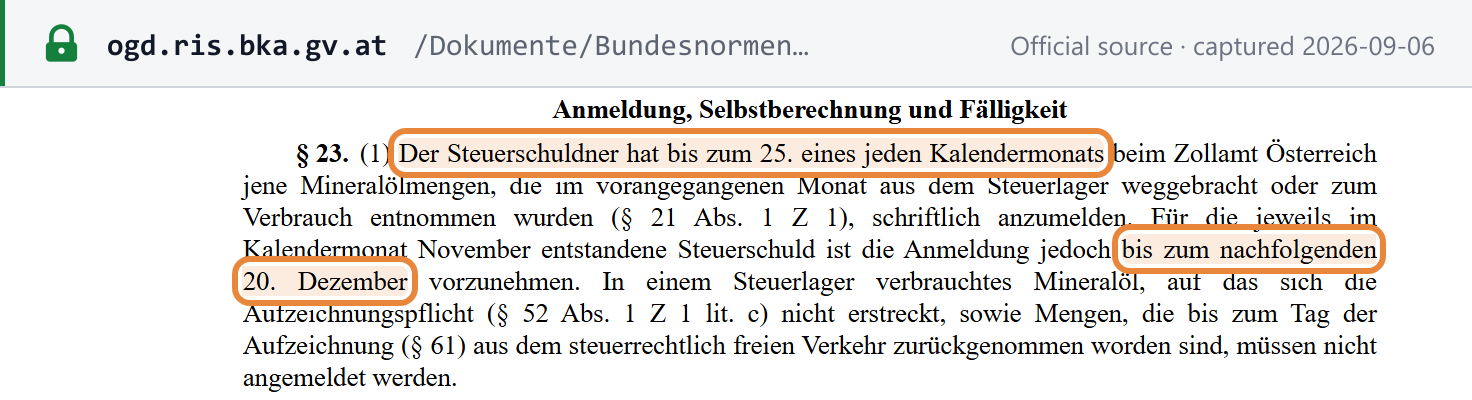
“Der Steuerschuldner hat bis zum 25. eines jeden Kalendermonats beim Zollamt Österreich jene Mineralölmengen, die im vorangegangenen Monat aus dem Steuerlager weggebracht oder zum Verbrauch entnommen wurden (§ 21 Abs. 1 Z 1), schriftlich anzumelden. Für die jeweils im Kalendermonat November entstandene Steuerschuld ist die Anmeldung jedoch bis zum nachfolgenden 20. Dezember vorzunehmen.”
Screenshot of Rechtsinformationssystem des Bundes (RIS), Bundeskanzleramt showing the Mineralölsteuer — monthly Anmeldung and payment deadline Open full size Captured from Rechtsinformationssystem des Bundes (RIS), Bundeskanzleramt on 2026-09-07

Tabaksteuer — monthly Anmeldung and payment

Tabaksteuer (tobacco excise) · Monthly · return filing

25th of the month after the month ends — but the 20th in December Verified 2026-09-07
Who files
Excise debtors removing tobacco products from a tax warehouse or taking them for consumption
Notes
The monthly declaration is due by the 25th and is more detailed than the other excise ones: quantities are split by category, cigarettes also by price band in units, and fine-cut and heated tobacco by price band in grams, with the retail selling prices stated. November again moves forward to 20 December, so December carries two deadlines and neither is the 25th.
Source
TabStG 2022 § 12 Abs. 1 — Anmeldung und Fälligkeit Rechtsinformationssystem des Bundes (RIS), Bundeskanzleramt
See the source text
“Der Steuerschuldner hat bis zum 25. eines jeden Kalendermonats die Tabakwarenmengen, die im vorangegangenen Monat aus dem Steuerlager weggebracht oder zum Verbrauch entnommen wurden (§ 9 Abs. 1 Z 1), nach Gattungen und bei Zigaretten auch nach Preisklassen in Stück sowie bei Feinschnitttabaken und Tabak zum Erhitzen auch nach Preisklassen in Gramm Tabak getrennt und unter Angabe der Kleinverkaufspreise (§ 5) schriftlich anzumelden. Für die jeweils im Kalendermonat November entstandene Steuerschuld ist die Anmeldung jedoch bis zum nachfolgenden 20. Dezember vorzunehmen.”
Captured from Rechtsinformationssystem des Bundes (RIS), Bundeskanzleramt on 2026-09-07

Alkoholsteuer — monthly Anmeldung

Alkoholsteuer (spirits excise) · Monthly · return filing

25th of the month after the month ends Verified 2026-09-07
Who files
Excise debtors removing spirits from a tax warehouse or taking them for consumption
Notes
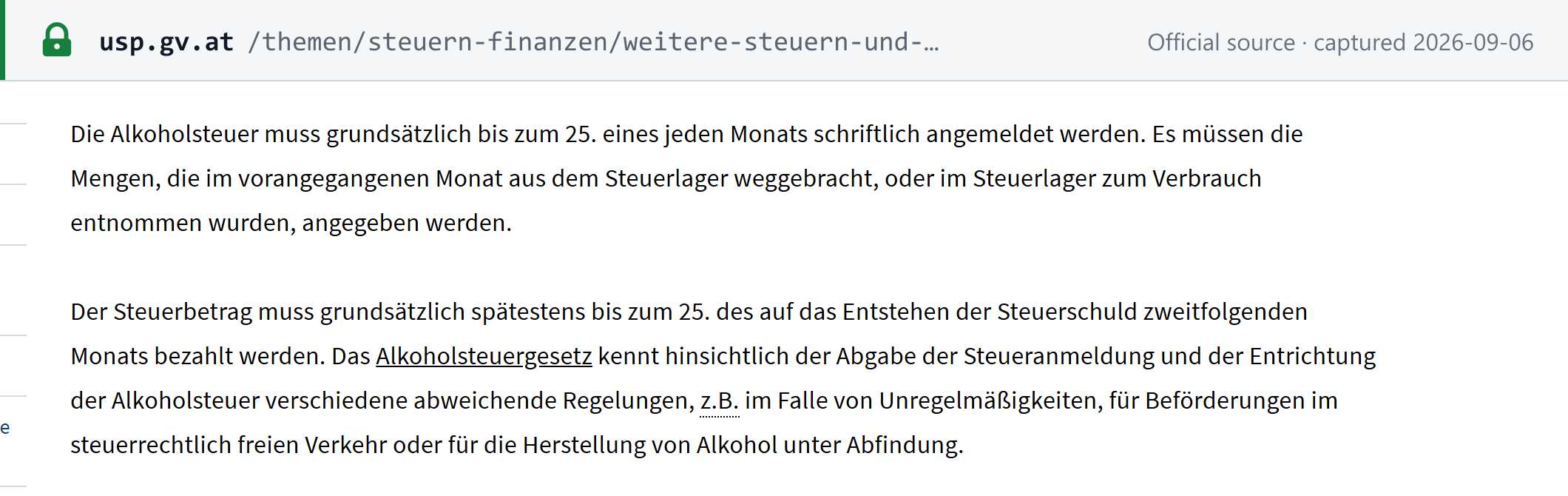
Spirits leaving a tax warehouse or drawn for consumption are declared to the customs authority by the 25th of the following month, and unlike mineral oil and tobacco this duty has no December exception — the November quantities go on the ordinary date. Watch the gap between declaring and paying, though: the duty itself is not payable until the 25th of the month after that, a month later than every other Austrian excise.
Source
AlkStG 2022 § 10 Abs. 1 — Anmeldung und Fälligkeit Rechtsinformationssystem des Bundes (RIS), Bundeskanzleramt
See the source text
“Soweit in diesem Bundesgesetz nicht anderes bestimmt ist, hat der Steuerschuldner bis zum 25. eines jeden Kalendermonats beim Zollamt Österreich die Alkoholmengen, die im vorangegangenen Monat aus dem Steuerlager weggebracht oder zum Verbrauch entnommen wurden (§ 8 Abs. 1 Z 1), schriftlich anzumelden.”
Captured from Rechtsinformationssystem des Bundes (RIS), Bundeskanzleramt on 2026-09-07

Biersteuer — monthly Anmeldung

Biersteuer (beer excise) · Monthly · return filing

25th of the month after the month ends Verified 2026-09-07
Who files
Excise debtors removing beer from a tax warehouse or taking it for consumption
Notes
Beer removed from a tax warehouse in a month is declared by the 25th of the next, separated by tax class rather than as a single total, with the duty payable by the same date. Like spirits and unlike mineral oil and tobacco, there is no December exception here. File even for a month in which nothing left the warehouse — a nil declaration is still required.
Source
BierStG 2022 § 10 Abs. 1 — Anmeldung und Fälligkeit Rechtsinformationssystem des Bundes (RIS), Bundeskanzleramt
See the source text
“Der Steuerschuldner hat bis zum 25. eines jeden Kalendermonats beim Zollamt Österreich die Biermengen, die im vorangegangenen Monat aus dem Steuerlager weggebracht oder zum Verbrauch entnommen wurden (§ 7 Abs. 1 Z 1), nach Steuerklassen getrennt, schriftlich anzumelden.”
Captured from Rechtsinformationssystem des Bundes (RIS), Bundeskanzleramt on 2026-09-07

Normverbrauchsabgabe (NoVA) — monthly Anmeldung

Normverbrauchsabgabe (vehicle consumption levy) · Monthly · return filing

15th of the 2nd month after the month ends Verified 2026-09-07
Who files
Debtors on a first domestic supply, on an intra-Community acquisition by a business, and on a change to the taxable amount
Notes
The vehicle consumption levy runs on the same 15th-of-the-second-month grid as VAT, with the debtor calculating the amount in the declaration itself. It bites on the first domestic supply of a vehicle, on an intra-Community acquisition by a business, and again if the taxable amount changes afterwards.
Source
NoVAG 1991 § 11 Abs. 2 — Anmeldung und Fälligkeitstag Rechtsinformationssystem des Bundes (RIS), Bundeskanzleramt
See the source text
“In den Fällen des § 7 Abs. 1 Z 1, in den Fällen des innergemeinschaftlichen Erwerbs (§ 7 Abs. 1 Z 1a) durch Unternehmer und der Änderung der Bemessungsgrundlage nach § 8 hat der Abgabenschuldner spätestens am 15. Tag (Fälligkeitstag) des auf den Kalendermonat, in dem die Steuerschuld entstanden ist (Anmeldungszeitraum), zweitfolgenden Monats eine Anmeldung einzureichen, in der er den für den Anmeldungszeitraum zu entrichtenden Betrag selbst zu berechnen hat.”
Captured from Rechtsinformationssystem des Bundes (RIS), Bundeskanzleramt on 2026-09-07

Versicherungssteuer — monthly self-assessment and Anmeldung

Versicherungssteuer (insurance premium tax) · Monthly · return filing

15th of the 2nd month after the month ends Verified 2026-09-07
Who files
Insurers, their authorised agents and fiscal representatives liable to account for Austrian insurance premium tax
Notes
Insurance premium tax is self-calculated on premium income and paid by the 15th of the second month after the period, the same grid as VAT. Where the premium income is not yet known the tax is calculated on the probable course of premiums rather than deferred. From 1 January 2027 an electronic declaration must also be filed by that same date.
Source
VersStG 1953 § 8 Abs. 1 — Berechnung, Entrichtung und Anmeldung Rechtsinformationssystem des Bundes (RIS), Bundeskanzleramt
See the source text
“Der zur Entrichtung der Steuer Verpflichtete (Versicherer, Bevollmächtigter, Fiskalvertreter) hat die Steuer spätestens bis zum 15. Tag (Fälligkeitstag) des auf einen Kalendermonat (Anmeldungszeitraum) zweitfolgenden Kalendermonates für den Anmeldungszeitraum nach den Prämieneinnahmen selbst zu berechnen und zu entrichten. Stehen die Prämieneinnahmen der Höhe nach noch nicht fest, so ist die Steuer nach dem wahrscheinlichen Prämienverlauf zu berechnen. Bis zum Fälligkeitstag ist eine elektronische Anmeldung beim Finanzamt Österreich einzureichen.”
Captured from Rechtsinformationssystem des Bundes (RIS), Bundeskanzleramt on 2026-09-07

Alkoholsteuer — payment

Alkoholsteuer (spirits excise) · Monthly · payment

25th of the 2nd month after the month ends Verified 2026-09-07
Who files
Excise debtors on spirits removed from a tax warehouse or taken for consumption — the same population as the declaration, on a date a month later
Notes
Spirits is the one Austrian excise where declaring and paying fall on different dates. The declaration is due on the 25th of the month after the duty arose; the money is not due until the 25th of the month after that. Mineral oil, tobacco and beer all pay on the declaration date, so a process built around any of those will pay this one a month early — which costs nothing but cash flow, unlike the reverse.
Source
AlkStG 2022 § 10 Abs. 2 — Entrichtung Rechtsinformationssystem des Bundes (RIS), Bundeskanzleramt
See the source text
“Der errechnete Steuerbetrag ist bis zum 25. des auf das Entstehen der Steuerschuld zweitfolgenden Kalendermonats beim Zollamt Österreich zu entrichten.”
Screenshot of Rechtsinformationssystem des Bundes (RIS), Bundeskanzleramt showing the Alkoholsteuer — payment deadline Open full size Captured from Rechtsinformationssystem des Bundes (RIS), Bundeskanzleramt on 2026-09-07

Versicherungssteuer — Sondervorauszahlung (annual instalment)

Versicherungssteuer (insurance premium tax) · Annually · payment

15th December each year, for that same year Verified 2026-09-07
Who files
Insurers and their representatives liable for Austrian insurance premium tax, unless the November tax is self-assessed and paid by the same 15 December
Notes
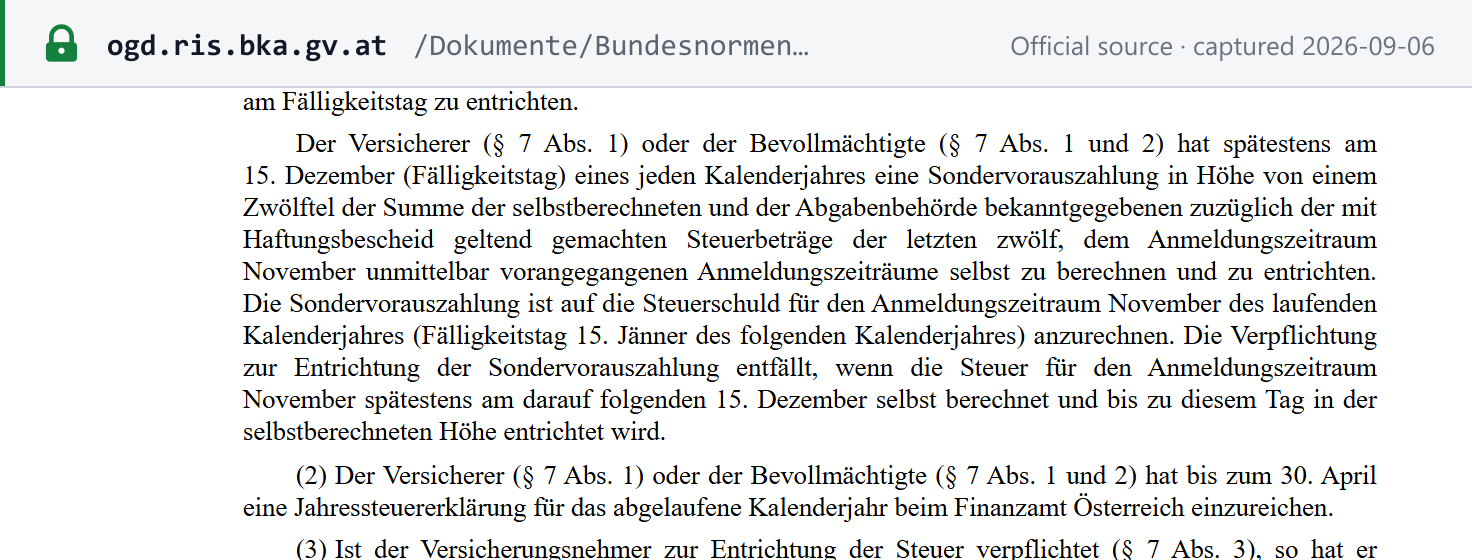
Insurance premium tax carries a once-a-year instalment on top of the monthly cycle, due 15 December and worth one twelfth of the preceding twelve periods. There is a way out: it is not payable if you work out and pay the November tax by that same 15 December instead. An insurer planning only around the twelve monthly dates will not see this one coming.
Source
VersStG 1953 § 8 — Sondervorauszahlung Rechtsinformationssystem des Bundes (RIS), Bundeskanzleramt
See the source text
“Der zur Entrichtung der Steuer Verpflichtete (Versicherer, Bevollmächtigter, Fiskalvertreter) hat die Steuer spätestens bis zum 15. Tag (Fälligkeitstag) des auf einen Kalendermonat (Anmeldungszeitraum) zweitfolgenden Kalendermonates für den Anmeldungszeitraum nach den Prämieneinnahmen selbst zu berechnen und zu entrichten.”
Screenshot of Rechtsinformationssystem des Bundes (RIS), Bundeskanzleramt showing the Versicherungssteuer — Sondervorauszahlung (annual instalment) deadline Open full size Captured from Rechtsinformationssystem des Bundes (RIS), Bundeskanzleramt on 2026-09-07

Versicherungssteuer — annual return

Versicherungssteuer (insurance premium tax) · Annually · return filing

30th April each year Verified 2026-09-07
Who files
Insurers and their representatives liable for Austrian insurance premium tax
Notes
An annual insurance premium tax return for the previous calendar year is due by 30 April. It sits on top of the monthly self-assessments rather than replacing them, and it is a month earlier than the VAT annual return a paper filer would be working to.
Source
VersStG 1953 § 8 — Jahressteuererklärung Rechtsinformationssystem des Bundes (RIS), Bundeskanzleramt
See the source text
“Der zur Entrichtung der Steuer Verpflichtete (Versicherer, Bevollmächtigter, Fiskalvertreter) hat die Steuer spätestens bis zum 15. Tag (Fälligkeitstag) des auf einen Kalendermonat (Anmeldungszeitraum) zweitfolgenden Kalendermonates für den Anmeldungszeitraum nach den Prämieneinnahmen selbst zu berechnen und zu entrichten.”
Screenshot of Rechtsinformationssystem des Bundes (RIS), Bundeskanzleramt showing the Versicherungssteuer — annual return deadline Open full size Captured from Rechtsinformationssystem des Bundes (RIS), Bundeskanzleramt on 2026-09-07

Flugabgabe — monthly Anmeldung and payment

Flugabgabe (air travel levy) · Monthly · return filing

15th of the 2nd month after the month ends Verified 2026-09-07
Who files
Airline operators liable for the Austrian air travel levy on departures from a domestic airport
Notes
The air travel levy runs on the same 15th-of-the-second-month grid as VAT, the advertising duty and the digital services tax: the operator works the levy out, files an electronic declaration with Finanzamt Österreich and pays by the same day. The liability itself arises at the end of the month in which the departure took place.
Source
Flugabgabegesetz § 7 Abs. 2 und Abs. 3 — Anmeldung und Entrichtung Rechtsinformationssystem des Bundes (RIS), Bundeskanzleramt
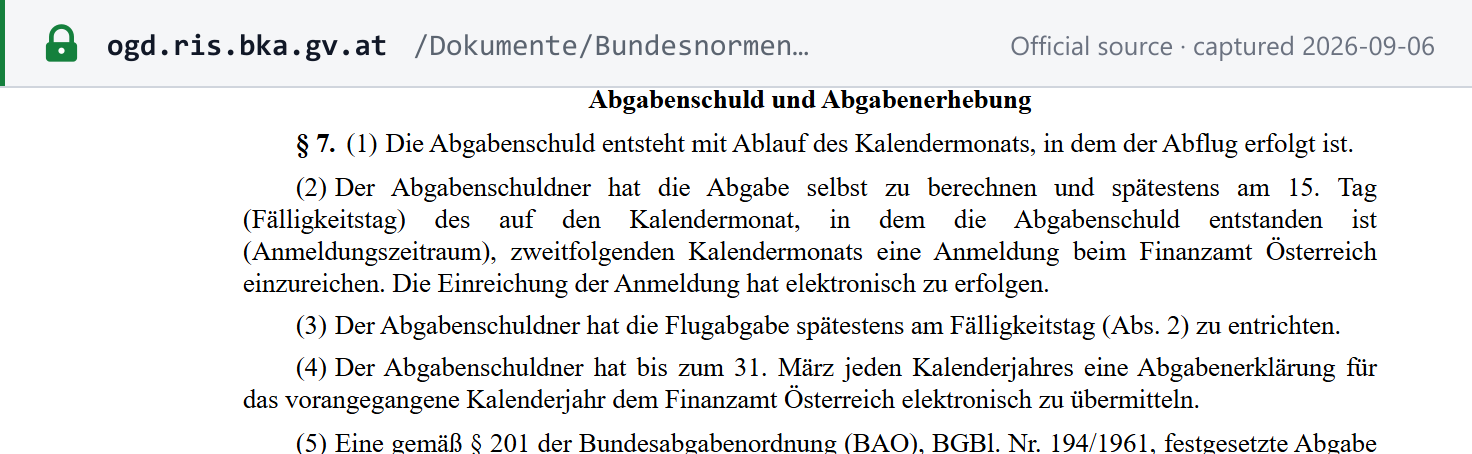
See the source text
“Der Abgabenschuldner hat die Abgabe selbst zu berechnen und spätestens am 15. Tag (Fälligkeitstag) des auf den Kalendermonat, in dem die Abgabenschuld entstanden ist (Anmeldungszeitraum), zweitfolgenden Kalendermonats eine Anmeldung beim Finanzamt Österreich einzureichen.”
Screenshot of Rechtsinformationssystem des Bundes (RIS), Bundeskanzleramt showing the Flugabgabe — monthly Anmeldung and payment deadline Open full size Captured from Rechtsinformationssystem des Bundes (RIS), Bundeskanzleramt on 2026-09-07

Flugabgabe — annual return

Flugabgabe (air travel levy) · Annually · return filing

31st March each year Verified 2026-09-07
Who files
Airline operators liable for the Austrian air travel levy
Notes
An annual return for the previous calendar year is due by 31 March. Unlike the advertising duty and the digital services tax, which count three months from the filer's own business year, this one is fixed to the calendar year — so 31 March is the date for everyone rather than only for calendar-year filers.
Source
Flugabgabegesetz § 7 Abs. 4 — Jahresabgabenerklärung Rechtsinformationssystem des Bundes (RIS), Bundeskanzleramt
See the source text
“Der Abgabenschuldner hat bis zum 31. März jeden Kalenderjahres eine Abgabenerklärung für das vorangegangene Kalenderjahr dem Finanzamt Österreich elektronisch zu übermitteln.”
Screenshot of Rechtsinformationssystem des Bundes (RIS), Bundeskanzleramt showing the Flugabgabe — annual return deadline Open full size Captured from Rechtsinformationssystem des Bundes (RIS), Bundeskanzleramt on 2026-09-07

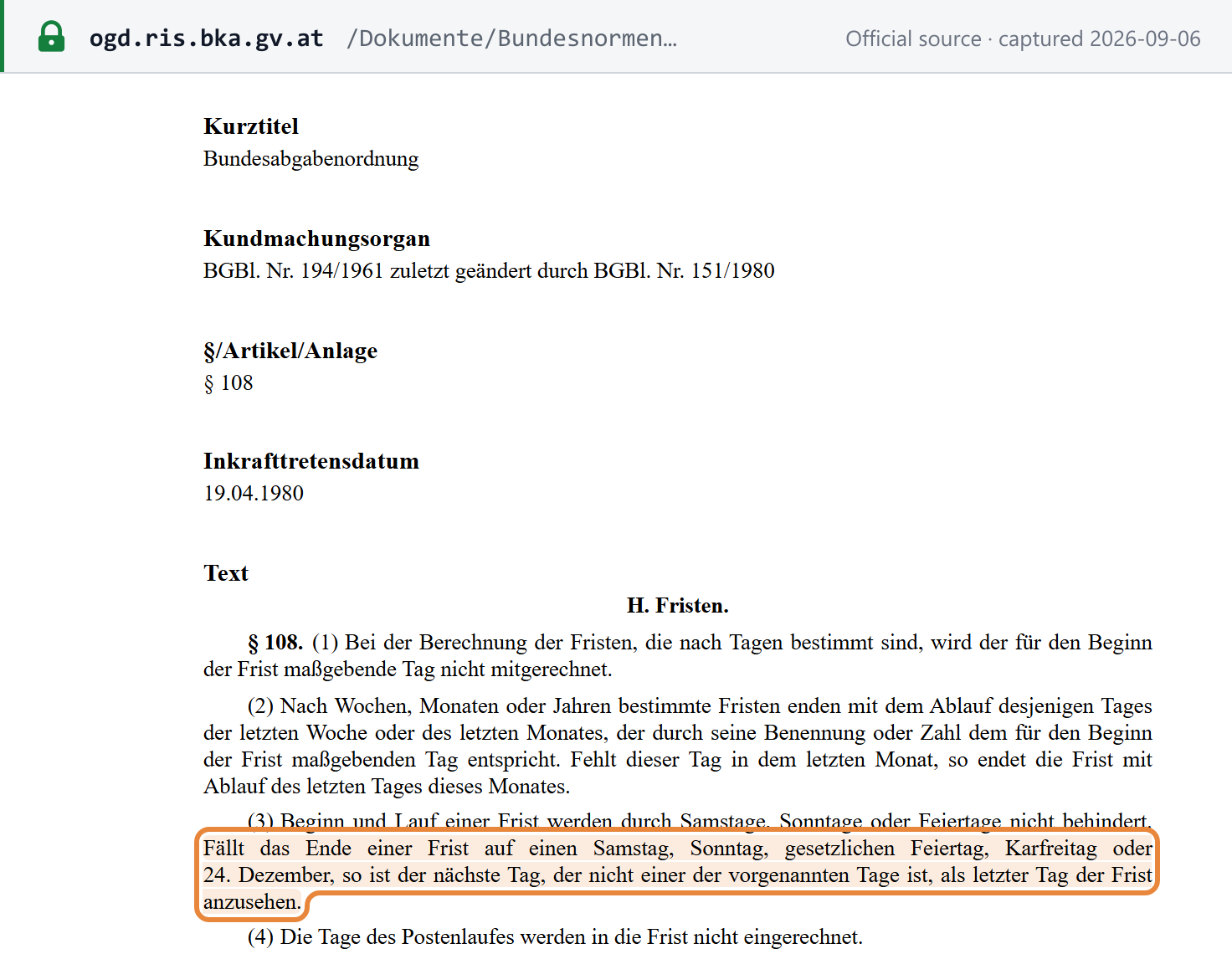
Austria shifts a deadline FORWARD when it lands on a non-working day, and its non-working set is wider than its list of public holidays: the tax code names Good Friday and 24 December separately from the thirteen statutory holidays, so both are in the list here even though Good Friday has not been a public holiday in Austria since 2019. There is no substitution rule — a holiday falling on a Sunday simply coincides with it and creates no replacement weekday. Two separate provisions do the shifting, one for filing deadlines and one for payment due dates, and they agree except on import duties, which do not move at all. A payment credited within three days of the due date carries no legal consequences, but that is a tolerance rather than a later deadline and no date here includes it. Austria publishes a rule rather than a calendar: the tax portal's deadline view is behind the login, and the only dated example the ministry publishes — the June 2026 VAT payment due on 17 August 2026 — is reproduced exactly by the rules on this page. Not covered here, and named so the absence is not silent: import VAT paid through the tax office, whose due date is the later of two dates and one of them depends on when the entry is posted to your own account; the emissions certificate scheme under the NEHG 2022, whose deadlines run from notification of an individual assessment rather than from a period and so cannot be derived; sparkling wine duty, where the rate on sparkling wine itself is nil per hectolitre though the declaration duty survives; and the event-driven excise limbs that run in days or weeks from a removal rather than on a monthly cycle. Motor vehicle tax is left out as a scope call rather than an oversight — it is a recurring vehicle tax rather than a transaction tax, which is also why the quota-arrangement exhibit on this page names it beside three energy levies that do have rows here. Payroll charges, municipal tax and income and corporation tax prepayments share the same 15th and are out of scope for this calendar.

“Beginn und Lauf einer Frist werden durch Samstage, Sonntage oder Feiertage nicht behindert. Fällt das Ende einer Frist auf einen Samstag, Sonntag, gesetzlichen Feiertag, Karfreitag oder 24. Dezember, so ist der nächste Tag, der nicht einer der vorgenannten Tage ist, als letzter Tag der Frist anzusehen.”
Screenshot of the official source stating the rule that governs Austria's deadlines
BAO § 108 Abs. 3 — Fristenende an Samstagen, Sonntagen, gesetzlichen Feiertagen, Karfreitag und 24. Dezember — Rechtsinformationssystem des Bundes (RIS), Bundeskanzleramt, captured 2026-09-07

What this calendar does not list

  • Not applicable E-invoicing / e-reporting cycle — Austria mandates e-invoicing to federal bodies under IKT-Konsolidierungsgesetz § 5 Abs. 2, in force since 1 January 2014, but that duty is invoice-triggered: it governs how an invoice to a federal body is issued and transmitted through ebInterface or PEPPOL, and fixes no periodic submission deadline to any authority. There is therefore no cycle to put on a calendar. No Austrian B2B mandate had been announced as at 2026-09-07 — no ministry announcement, no draft instrument, no consultation draft — so this is not even a dated gap. The only fixed date in play is the EU one, ViDA cross-border digital reporting from 1 July 2030, which is a Directive obligation not yet in Austrian law. Revisit on transposition.

About this calendar

Which Austria tax deadlines does this calendar cover?

35 recurring indirect-tax obligations — Umsatzsteuer (VAT), Werbeabgabe (advertising duty), Digitalsteuer (digital services tax), Elektrizitätsabgabe (electricity levy), Erdgasabgabe (natural gas levy), Kohleabgabe (coal levy) and 7 more returns, payments and related filings — each with the due-date rule, who must file, and the official source that states the deadline. Direct-tax, payroll and company-registry deadlines are out of scope.

How current are these due dates?

Every obligation carries the date it was last verified against its official source (newest: 2026-09-07). Law-change dates come from the weekly Last Week in Taxes scan and link to their full change records.

Do the dates account for weekends and public holidays?

No — the calendar shows the statutory due date. Where the authority shifts deadlines falling on non-working days, the obligation notes say so. Confirm against the linked official source before relying on a date.

Validate tax IDs in 100+ countries

Put these rules into practice — verify VAT, GST, and EIN numbers in real time with the Lookuptax API.