
Germany compliance calendar

10 recurring VAT obligations — returns, payments and listings — each with its due rule and official source, plus the dates new Germany rules take effect.

Mon
Tue
Wed
Thu
Fri
Sat
Sun
31
1
2
3
4
5
6
7
8
9
10
11
Return filing Report / listing Payment Law change takes effect

Dates already include the weekend and public-holiday shift where Germany applies one — 6 of 10 obligations here do. The rest stand as computed, and each obligation's notes say which applies to it and why. Confirm against the linked official source before relying on a date.

Recurring obligations, with sources

Each deadline cites the official text that states it and the date we last verified it.

Umsatzsteuer-Voranmeldung — monthly advance VAT return and payment

VAT · Monthly · return filing

10th of the month after the month ends Verified 2026-08-24
Who files
Businesses whose prior-year VAT exceeded €9,000 (threshold raised from €7,500 for periods from 1 January 2025), plus refund-position businesses opting in under §18(2a) UStG. The advance payment is due the same day (§18(1) UStG).
Notes
A permanent one-month extension (Dauerfristverlängerung, UStDV §46) is available on application, conditional for monthly filers on a special advance payment of 1/11 of the prior year's advance payments. Shelf companies (Vorratsgesellschaften) and shell takeovers (Firmenmantel) file monthly regardless of the thresholds (§18(2) sentence 5).
Source
UStG §18(1)–(2a) — Voranmeldungen und Vorauszahlungen (consolidated statute) gesetze-im-internet.de (Federal Ministry of Justice)
See the source text
“Der Unternehmer hat vorbehaltlich des § 18i Absatz 3, des § 18j Absatz 4, des § 18k Absatz 4 und des § 19 Absatz 1 Satz 2 bis zum zehnten Tag nach Ablauf jedes Voranmeldungszeitraums eine Voranmeldung nach amtlich vorgeschriebenem Datensatz über die amtlich bestimmte Schnittstelle zu übermitteln, in der er die Steuer für den Voranmeldungszeitraum (Vorauszahlung) selbst zu berechnen hat.”
Captured from gesetze-im-internet.de (Federal Ministry of Justice) on 2026-08-24
Umsatzsteuer-Voranmeldung — quarterly advance VAT return and payment

VAT · Quarterly · return filing

10th of the month after the quarter ends Verified 2026-08-24
Who files
The default scheme: businesses whose prior-year VAT was €9,000 or less. At €2,000 or less (raised from €1,000 for 2025) the Finanzamt may waive advance returns entirely, leaving only the annual return.
Notes
The Dauerfristverlängerung one-month extension is also available to quarterly filers, without a special advance payment. Through taxable period 2026, new businesses are assessed on annualised or expected tax rather than filing monthly by default (§18(2) final sentence); the automatic monthly rule for founders resumes in 2027 absent new legislation.
Source
UStG §18(2) — Voranmeldungszeitraum (consolidated statute) gesetze-im-internet.de (Federal Ministry of Justice)
See the source text
“Der Unternehmer hat vorbehaltlich des § 18i Absatz 3, des § 18j Absatz 4, des § 18k Absatz 4 und des § 19 Absatz 1 Satz 2 bis zum zehnten Tag nach Ablauf jedes Voranmeldungszeitraums eine Voranmeldung nach amtlich vorgeschriebenem Datensatz über die amtlich bestimmte Schnittstelle zu übermitteln, in der er die Steuer für den Voranmeldungszeitraum (Vorauszahlung) selbst zu berechnen hat.”
Captured from gesetze-im-internet.de (Federal Ministry of Justice) on 2026-08-24

Sondervorauszahlung — 1/11 special advance payment for the filing extension

VAT · Annually · payment

10th February each year Verified 2026-08-24
Who files
Monthly filers using the Dauerfristverlängerung: 1/11 of the prior year's advance payments, due by the statutory date of the year's first advance return (10 February) even though the January return itself files a month later under the extension; credited back in the December period. Quarterly filers owe none.
Notes
First-time applicants declare and pay it with the extension application, due by the deadline of the first advance return it should cover (UStDV §48(1)).
Source
UStDV § 48 Abs. 2 — Fälligkeit der Sondervorauszahlung; Höhe und Anwendungsbereich in § 47 gesetze-im-internet.de (Federal Ministry of Justice)
See the source text
“Während der Geltungsdauer der Fristverlängerung hat der Unternehmer, der die Voranmeldungen monatlich zu übermitteln hat, die Sondervorauszahlung für das jeweilige Kalenderjahr bis zum gesetzlichen Zeitpunkt der Übermittlung der ersten Voranmeldung zu berechnen, anzumelden und zu entrichten.”
Captured from gesetze-im-internet.de (Federal Ministry of Justice) on 2026-08-24

Umsatzsteuererklärung — annual VAT return

VAT · Annually · return filing

31st July each year Verified 2026-08-24
Who files
All VAT-registered businesses except §19 Kleinunternehmer (since 2025). Due 31 July of the following year when self-prepared (AO §149(2)); the COVID-era extensions have expired, so tax year 2025 is due 31 July 2026.
Notes
Tax-advisor-prepared returns are due the last day of February of the second following year (AO §149(3) Nr. 4) — for tax year 2025, end of February 2027, weekend-shifted. Any balance owed is payable one month after the return reaches the Finanzamt (UStG §18(4)).
Source
AO §149(2)–(3) — Abgabefristen für Steuererklärungen; UStG §18(3) gesetze-im-internet.de (Federal Ministry of Justice)
See the source text
“Soweit die Steuergesetze nichts anderes bestimmen, sind Steuererklärungen, die sich auf ein Kalenderjahr oder auf einen gesetzlich bestimmten Zeitpunkt beziehen, spätestens sieben Monate nach Ablauf des Kalenderjahres oder sieben Monate nach dem gesetzlich bestimmten Zeitpunkt abzugeben.”
Captured from gesetze-im-internet.de (Federal Ministry of Justice) on 2026-08-24

Zusammenfassende Meldung (EC Sales List) — monthly

VAT · Monthly · report / listing

25th of the month after the month ends Verified 2026-08-24
Who files
Businesses whose intra-Community supplies of goods (including §25b(2) triangular supplies) exceed €50,000 in the current or any of the four preceding calendar quarters. Cross-border B2B services under §3a(2) are included in the quarter's final month, unless the filer opts to report them monthly (§18a(3)).
Notes
Filed with the BZSt, not the local Finanzamt; purely informational, no payment attaches. The Dauerfristverlängerung does not extend ZM deadlines (BZSt). An incorrect ZM must be corrected within one month (§18a(10)).
Source
UStG §18a(1) — Zusammenfassende Meldung: monatlicher Meldezeitraum gesetze-im-internet.de (Federal Ministry of Justice)
See the source text
“Der Unternehmer im Sinne des § 2 hat bis zum 25. Tag nach Ablauf jedes Kalendermonats (Meldezeitraum), in dem er innergemeinschaftliche Warenlieferungen oder Lieferungen im Sinne des § 25b Absatz 2 ausgeführt hat, dem Bundeszentralamt für Steuern eine Meldung (Zusammenfassende Meldung) nach amtlich vorgeschriebenem Datensatz über die amtlich bestimmte Schnittstelle zu übermitteln, in der er die Angaben nach Absatz 7 Satz 1 Nummer 1, 2, 2a und 4 zu machen hat.”
Captured from gesetze-im-internet.de (Federal Ministry of Justice) on 2026-08-24

Zusammenfassende Meldung (EC Sales List) — quarterly

VAT · Quarterly · report / listing

25th of the month after the quarter ends Verified 2026-08-24
Who files
Goods suppliers at or under €50,000 per quarter (current and four preceding quarters), and businesses supplying cross-border B2B services under §3a(2) UStG taxed in the customer's member state.
Notes
Crossing €50,000 mid-quarter triggers a ZM for that month and the elapsed months, due the 25th after the breach month. Businesses released from advance returns may file the ZM annually by 25 January, subject to the €200,000 / €15,000 tests (§18a(9)).
Source
UStG §18a(1)–(3) — Zusammenfassende Meldung: vierteljährlicher Meldezeitraum gesetze-im-internet.de (Federal Ministry of Justice)
See the source text
“Der Unternehmer im Sinne des § 2 hat bis zum 25. Tag nach Ablauf jedes Kalendervierteljahres (Meldezeitraum), in dem er im übrigen Gemeinschaftsgebiet steuerpflichtige sonstige Leistungen im Sinne des § 3a Absatz 2, für die der in einem anderen Mitgliedstaat ansässige Leistungsempfänger die Steuer dort schuldet, ausgeführt hat, dem Bundeszentralamt für Steuern eine Zusammenfassende Meldung nach amtlich vorgeschriebenem Datensatz über die amtlich bestimmte Schnittstelle zu übermitteln, in der er die Angaben nach Absatz 7 Satz 1 Nummer 3 zu machen hat.”
Captured from gesetze-im-internet.de (Federal Ministry of Justice) on 2026-08-24

Steuererklärung One-Stop-Shop, EU-Regelung (§ 18j UStG)

VAT — One-Stop-Shop · Quarterly · return filing

last day of the month after the quarter ends Verified 2026-08-23
Who files
Entrepreneurs established in Germany making intra-Community distance sales of goods, or B2C services in EU member states where they are not established; electronic-interface operators deemed to supply; and non-EU-established entrepreneurs holding a facility in Germany, such as a warehouse, from which goods are dispatched to consumers in other member states. One registration covers all member states. Businesses under the EUR 10,000 EU-wide threshold (§ 3a Abs. 5 / § 3c Abs. 4 UStG) may stay out and declare domestically. A nil return (Nullmeldung) is compulsory. Payment falls due on the same date.
Notes
The taxable period is the calendar quarter, so the return is due 30 April, 31 July, 31 October and 31 January for the preceding quarter. This is not the 10th-of-month shape of the domestic Voranmeldung: a reader who assumes German VAT deadlines fall on the 10th will be three weeks out. Payment falls on the same date, but the money must have arrived at the Bundeskasse by then and no direct debit is possible, so a filer relying on one will be late. The deadline does not move when it falls on a weekend or a public holiday — the opposite of the domestic German rule.
Source
Umsatzsteuergesetz § 18j Abs. 4 (One-Stop-Shop, EU-Regelung) Bundesamt für Justiz / Bundesministerium der Justiz (gesetze-im-internet.de)
See the source text
“Ein Unternehmer, der das in Absatz 1 genannte besondere Besteuerungsverfahren anwendet, hat der Finanzbehörde nach Absatz 1 Satz 2 in Verbindung mit Absatz 2 eine Steuererklärung innerhalb eines Monats nach Ablauf jedes Besteuerungszeitraums (§ 16 Absatz 1d Satz 1) nach amtlich vorgeschriebenem Datensatz über die amtlich bestimmte Schnittstelle zu übermitteln.”
Captured from Bundesamt für Justiz / Bundesministerium der Justiz (gesetze-im-internet.de) on 2026-08-23

Steuererklärung One-Stop-Shop, Nicht-EU-Regelung (§ 18i UStG)

VAT — One-Stop-Shop · Quarterly · return filing

last day of the month after the quarter ends Verified 2026-08-23
Who files
Entrepreneurs not established anywhere in the EU who supply services to non-taxable persons in the EU and have chosen Germany as their member state of identification — § 18i Abs. 1 Satz 2 permits a free choice of member state and makes the BZSt the competent German authority. Registration is permitted in only one member state at a time. Nil returns compulsory; payment on the same date.
Notes
The taxable period is the calendar quarter, so the return is due 30 April, 31 July, 31 October and 31 January for the preceding quarter, with payment on the same date. The deadline does not move when it falls on a weekend or a public holiday — the opposite of the domestic German rule. The predecessor scheme, VAT on e-Services, ran to a different deadline — the 20th day after the period — and applies only to taxable periods up to and including Q2 2021.
Source
Umsatzsteuergesetz § 18i Abs. 3 (One-Stop-Shop, Nicht-EU-Regelung) Bundesamt für Justiz / Bundesministerium der Justiz (gesetze-im-internet.de)
See the source text
“Ein Unternehmer, der das in Absatz 1 genannte besondere Besteuerungsverfahren anwendet, hat der Finanzbehörde, bei der er die Teilnahme an dem besonderen Besteuerungsverfahren angezeigt hat, eine Steuererklärung innerhalb eines Monats nach Ablauf jedes Besteuerungszeitraums (§ 16 Absatz 1c Satz 1) nach amtlich vorgeschriebenem Datensatz über die amtlich bestimmte Schnittstelle zu übermitteln.”
Captured from Bundesamt für Justiz / Bundesministerium der Justiz (gesetze-im-internet.de) on 2026-08-23

Steuererklärung Import-One-Stop-Shop (§ 18k UStG)

VAT — Import One-Stop-Shop · Monthly · return filing

last day of the month after the month ends Verified 2026-08-23
Who files
Entrepreneurs making distance sales of goods imported from third territories in consignments of an intrinsic value of at most EUR 150 to consumers in the EU, and electronic interfaces deemed to supply such goods, using Germany as their member state of identification. Open to German-established entrepreneurs; to non-EU-established entrepreneurs whose country of establishment has a mutual-assistance agreement with the EU, which BZSt states is currently NORWAY ONLY; and otherwise to any entrepreneur that appoints a Germany-established Vertreter. Consignments containing excise goods are excluded. Nil returns compulsory; payment on the same date.
Notes
The taxable period is the calendar month, unlike the two quarterly OSS schemes, so the return and the payment are due on the last day of the following month — for the January period that is 28 February, or 29 February in a leap year. Goods declared under IOSS are exempt from import VAT (§ 5 Abs. 1 Nr. 7 UStG). The deadline does not move when it falls on a weekend or a public holiday — the opposite of the domestic German rule.
Source
Umsatzsteuergesetz § 18k Abs. 4 (Import-One-Stop-Shop) Bundesamt für Justiz / Bundesministerium der Justiz (gesetze-im-internet.de)
See the source text
“Ein Unternehmer oder im Auftrag handelnder Vertreter, der das in Absatz 1 genannte besondere Besteuerungsverfahren anwendet, hat der Finanzbehörde nach Absatz 1 Satz 2 in Verbindung mit Absatz 2 eine Steuererklärung innerhalb eines Monats nach Ablauf jedes Besteuerungszeitraums (§ 16 Absatz 1e Satz 1) nach amtlich vorgeschriebenem Datensatz über die amtlich bestimmte Schnittstelle zu übermitteln.”
Captured from Bundesamt für Justiz / Bundesministerium der Justiz (gesetze-im-internet.de) on 2026-08-23

Fragebogen zur steuerlichen Erfassung — Anzeige der Erwerbstätigkeit (AO § 138)

VAT · One-off · registration

within 1 month of the meldepflichtiges Ereignis — opening the Betrieb or Betriebstätte, taking up the freiberufliche Tätigkeit, or (for non-established entrepreneurs) taking up an activity taxable in Germany Verified 2026-08-23
Who files
Anyone opening a Betrieb, a Betriebstätte or a land- und forstwirtschaftlicher Betrieb, or taking up a freiberufliche Tätigkeit — and non-established entrepreneurs taking up an activity taxable in Germany. WHO you notify differs and is easy to get wrong: a gewerblicher Betrieb notifies the GEMEINDE, which forwards to the Finanzamt; a freiberufliche Tätigkeit notifies the Finanzamt directly; a non-established entrepreneur notifies the Finanzamt allocated by the Umsatzsteuer-Zuständigkeitsverordnung. CRITICAL EXCLUSION: an entrepreneur whose German-taxable supplies are declared EXCLUSIVELY under the §§ 18i-18k special schemes — OSS or IOSS — has no § 138 duty in Germany at all, no Fragebogen and no Finanzamt registration.
Notes
The Anzeige under AO § 138 and the Fragebogen zur steuerlichen Erfassung share one trigger and one deadline: within one month of the event. The clock runs from the event itself — opening the Betrieb or Betriebstätte, or taking up the freiberufliche Tätigkeit — not from a Handelsregister entry or a first invoice. Electronic transmission is the default; paper is allowed only on application in a hardship case. An entrepreneur whose German-taxable supplies are declared exclusively under the OSS or IOSS special schemes owes no notification in Germany at all — no Fragebogen and no Finanzamt registration. One supply outside the schemes, such as a domestic sale from German stock or an intra-Community acquisition, reinstates the full duty. The USt-IdNr has no deadline of its own — it is issued on application and is a tick-box inside the Fragebogen — but the BZSt notifies it by post only and forwarding can take some weeks, so allow lead time before a first intra-Community supply.
Source
Abgabenordnung § 138 — Anzeigen über die Erwerbstätigkeit Bundesamt für Justiz (gesetze-im-internet.de)
See the source text
“Mitteilungen nach den Absätzen 1, 1a und 1b sind innerhalb eines Monats nach dem meldepflichtigen Ereignis zu erstatten.”
Captured from Bundesamt für Justiz (gesetze-im-internet.de) on 2026-08-23

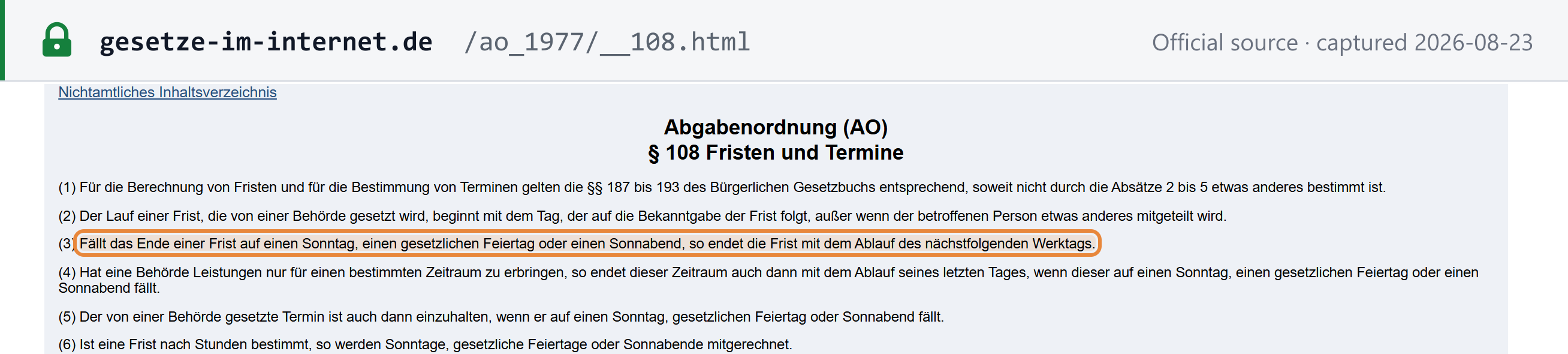
Kleinunternehmer under §19 UStG (prior-year turnover at most EUR 25,000 and current-year at most EUR 100,000) file neither advance returns nor an annual VAT return since 2025. Germany's B2B e-invoicing mandate fixes no periodic submission deadline, so it has no calendar row. Direct-tax and payroll deadlines are out of scope. Three different weekend rules apply here. The domestic obligations — Voranmeldung, Sondervorauszahlung, Jahreserklärung and the Zusammenfassende Meldung — move forward to the next working day when the deadline falls on a Saturday, Sunday or public holiday (AO §108(3)), and so does the one-month registration notification. OSS and IOSS are the opposite: those deadlines do not move at all. The European Commission states it for both the quarterly schemes and the monthly import scheme — 'There is no change to the deadline for the submission of the return if this date falls on the weekend or on a public holiday.' 31 October 2026 and 31 July 2027 are Saturdays and 31 January 2027 is a Sunday, and all three are real OSS deadlines. German public holidays are set per Bundesland rather than nationally, so a domestic date shown here can still land on a holiday in your own state, in which case the true deadline is one or more days later than shown. The error runs in the harmless direction: the displayed date is never later than the real one. OSS and IOSS are administered by the Bundeszentralamt für Steuern through the BZStOnline-Portal (BOP), not by the local Finanzamt and not through ELSTER — an ELSTER certificate can be used to log in to BOP, which is why the two get conflated. The Dauerfristverlängerung cannot extend an OSS or IOSS deadline. Payment coincides with filing in all three schemes, with two German specifics: no direct debit is possible, and the money must have arrived at the Bundeskasse by the deadline rather than merely having been instructed. Corrections to an OSS or IOSS return are never made by amending the original. They are declared in a later return, in a dedicated correction section tagged with the period being corrected, within three years of the last day of the period in which the original was due. Once a business leaves the scheme, corrections go direct to each member state. Nothing here is ending or on hold — the schemes have been live since 1 July 2021.

“Fällt das Ende einer Frist auf einen Sonntag, einen gesetzlichen Feiertag oder einen Sonnabend, so endet die Frist mit dem Ablauf des nächstfolgenden Werktags.”
Screenshot of the official source stating the rule that governs Germany's deadlines
Captured from Bundeszentralamt für Steuern (BZSt) on 2026-08-23

What this calendar does not list

  • Not applicable E-invoicing / e-reporting cycle — Germany's B2B e-invoicing mandate governs how invoices are issued and received (receive-capability since 1 January 2025, issuance obligations phasing in from 2027). It fixes no periodic submission deadline to the tax authority, so there is no filing cycle to place on a calendar.

About this calendar

Which Germany tax deadlines does this calendar cover?

10 recurring indirect-tax obligations — VAT returns, payments and related filings — each with the due-date rule, who must file, and the official source that states the deadline. Direct-tax, payroll and company-registry deadlines are out of scope.

How current are these due dates?

Every obligation carries the date it was last verified against its official source (newest: 2026-08-24). Law-change dates come from the weekly Last Week in Taxes scan and link to their full change records.

Do the dates account for weekends and public holidays?

No — the calendar shows the statutory due date. Where the authority shifts deadlines falling on non-working days, the obligation notes say so. Confirm against the linked official source before relying on a date.

Validate tax IDs in 100+ countries

Put these rules into practice — verify VAT, GST, and EIN numbers in real time with the Lookuptax API.