Bolivia's SIN sets the invoicing procedure for the Ley 1755 five-year IVA exemption on inputs and capital goods
This page records one dated change. For the rules in Bolivia as they stand today, see the Bolivia guide →
- Jurisdiction
- Bolivia
- Tax
- VAT
- Change type
- Update
- Status
- In force
- Impact
- Action required
- Announced
- 9 October 2026
- Effective
- 30 July 2026
- Authority
- Servicio de Impuestos Nacionales (SIN), Bolivia
- Systems
- Invoicing, ERP, Customs, Tax engine
- Verified
- Fetched from official source · high confidence
Importers and first domestic sellers of inputs, seeds, drones, genetics, tools, equipment, capital goods and industrial plants for the agricultural, industrial, construction, transport and mining sectors.
Importers and first-sale wholesalers of the listed goods: confirm the DS 5709 annex covers your goods and issue exempt invoices through the Ley 1755 option.
InvoicingERPCustomsTax engine
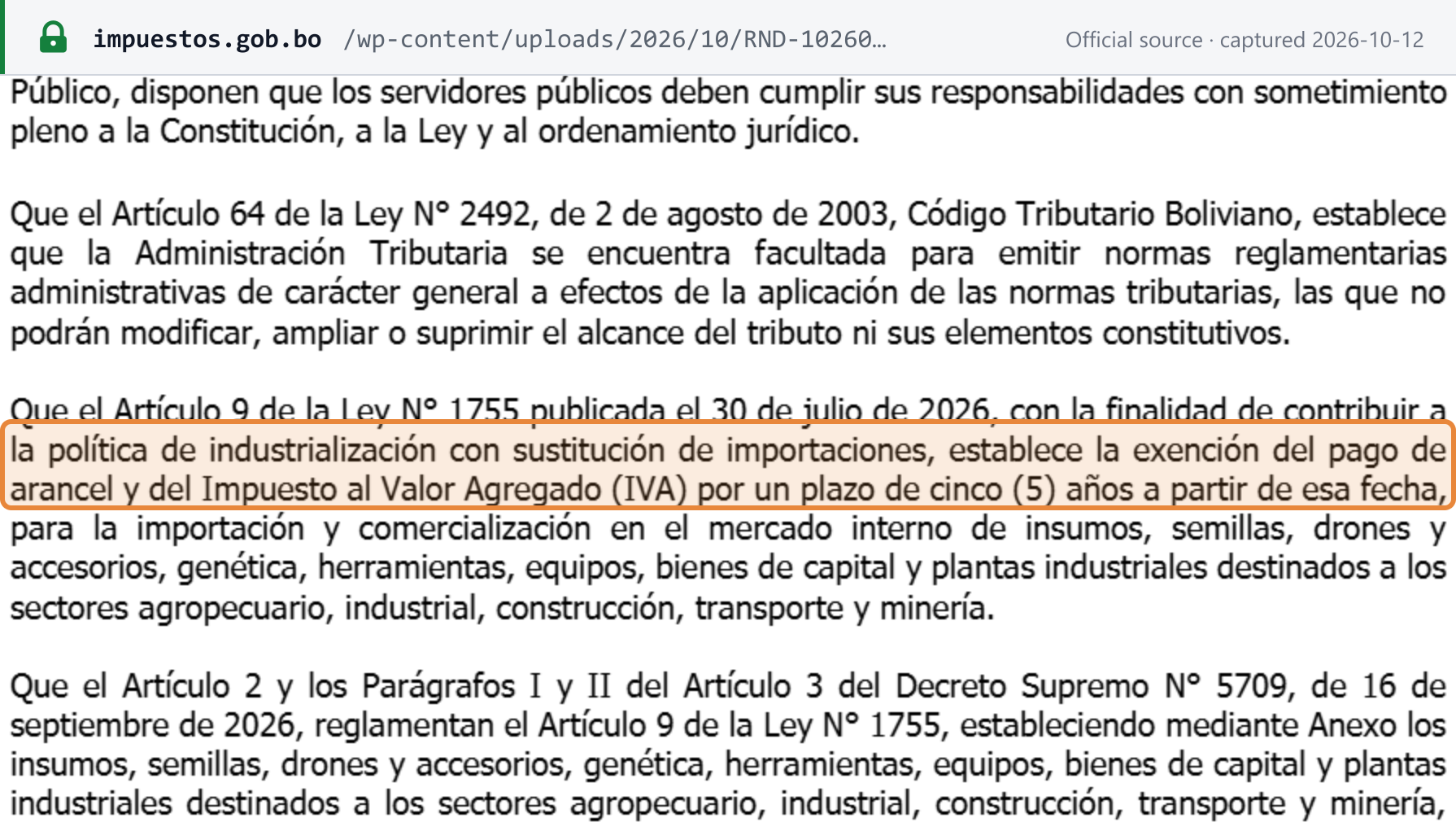
Article 9 of Bolivia's Ley N° 1755 (published 30 July 2026) exempts from customs duty and IVA, for five years from that date, the import and domestic sale of inputs, seeds, drones and accessories, genetics, tools, equipment, capital goods and industrial plants for the agricultural, industrial, construction, transport and mining sectors. Decreto Supremo N° 5709 of 16 September 2026 lists the goods in an annex. SIN Resolución Normativa de Directorio N° 102600000039 (La Paz, 9 October 2026) sets the invoicing procedure: first domestic sellers must issue invoices without fiscal credit through the new option 'Facturación Bienes e Insumos Productivos Ley N° 1755' in the SIN online invoicing module, and may add a dedicated economic activity to the Registro Nacional de Contribuyentes; both are temporary for the duration of article 9.
What changed in detail
Article 9 of Bolivia’s Ley N° 1755, published on 30 July 2026, exempts from customs duty and IVA, for five years from that date, the import and domestic sale of inputs, seeds, drones and accessories, genetics, tools, equipment, capital goods and industrial plants for the agricultural, industrial, construction, transport and mining sectors.
Decreto Supremo N° 5709 of 16 September 2026 lists the goods in an annex.
On 9 October 2026 the Servicio de Impuestos Nacionales issued Resolución Normativa de Directorio N° 102600000039 (La Paz), which sets the invoicing procedure. First domestic sellers must issue invoices without fiscal credit through the new option “Facturación Bienes e Insumos Productivos Ley N° 1755” in the SIN online invoicing module. They may also add a dedicated economic activity to the Registro Nacional de Contribuyentes. Both arrangements are temporary, for the duration of article 9.
What it means
The exemption has been law since 30 July; what changed on 9 October is that sellers now have a defined way to invoice it. A first domestic seller that has been selling listed goods should confirm which invoicing approach it used in the interim.
Because these invoices are issued without fiscal credit, buyers should check whether their pricing or cost models assumed an IVA credit. The eligible goods are those in the annex to Decreto Supremo 5709, not the general sector descriptions in the law, so classification against the annex is the practical risk.
The regime is time-limited: the exemption runs for five years from 30 July 2026.
Proof
Que el Artículo 9 de la Ley N° 1755 publicada el 30 de julio de 2026, con la finalidad de contribuir a la política de industrialización con sustitución de importaciones, establece la exención del pago de arancel y del Impuesto al Valor Agregado (IVA) por un plazo de cinco (5) años a partir de esa fechaArticle 9 of Law No. 1755, published on 30 July 2026, in order to contribute to the import-substitution industrialisation policy, establishes the exemption from payment of customs duty and Value Added Tax (IVA) for a period of five (5) years from that date
 Source snapshot of the official page. Open full size ↗