India's GST Council recommends extending e-invoicing to reverse-charge supplies and imports of services for turnover of Rs 5 crore and above
This change is proposed and is not law. The rules below describe what would change if it is adopted.
This page records one dated change. For the rules in India as they stand today, see the India guide →
- Jurisdiction
- India
- Tax
- GST
- Change type
- E-invoicing
- Status
- Proposed
- Impact
- Plan ahead
- Announced
- 8 October 2026
- Authority
- GST Council / CBIC (Ministry of Finance, Department of Revenue)
- Systems
- ERP, Invoicing, Tax engine, Reporting
- Verified
- Fetched from official source · high confidence
Taxpayers with aggregate annual turnover of Rs 5 crore and above that receive supplies from unregistered persons under reverse charge or import services.
Monitor for the CBIC notification; assess RCM and import-of-services invoice flows for e-invoice (IRN) generation.
ERPInvoicingTax engineReporting
The 57th GST Council meeting (8 October 2026) recommended extending e-invoicing to domestic supplies received from an unregistered person where tax is payable under reverse charge, and to imports of services, for taxpayers with aggregate annual turnover of Rs 5 crore and above. A recommendation only; no notification or effective date issued.
What changed in detail
This is a recommendation only. At its 57th meeting on 8 October 2026 the GST Council recommended extending e-invoicing to domestic supplies received from an unregistered person where tax is payable under the reverse charge mechanism, and to imports of services, for taxpayers with aggregate annual turnover of Rs 5 crore and above.
No notification or effective date has been issued. The recommendation takes legal effect only once a notification is issued.
What it means
The change would put the recipient side of reverse-charge and import-of-services transactions inside the e-invoice (IRN) system, which today is built around the supplier’s outward invoices. Taxpayers above the Rs 5 crore line should map where they self-invoice for reverse-charge purchases and for imported services, because those flows would need a generation step they do not currently have.
With no notification and no date, there is nothing to configure yet. Watch for the CBIC notification, which will fix the start date and any procedural detail.
Proof
extending e-invoicing to domestic supplies received from an unregistered person where the tax is payable under reverse charge mechanism, as well as to the import of services, for taxpayers having aggregate annual turnover of Rs. 5 crore and above.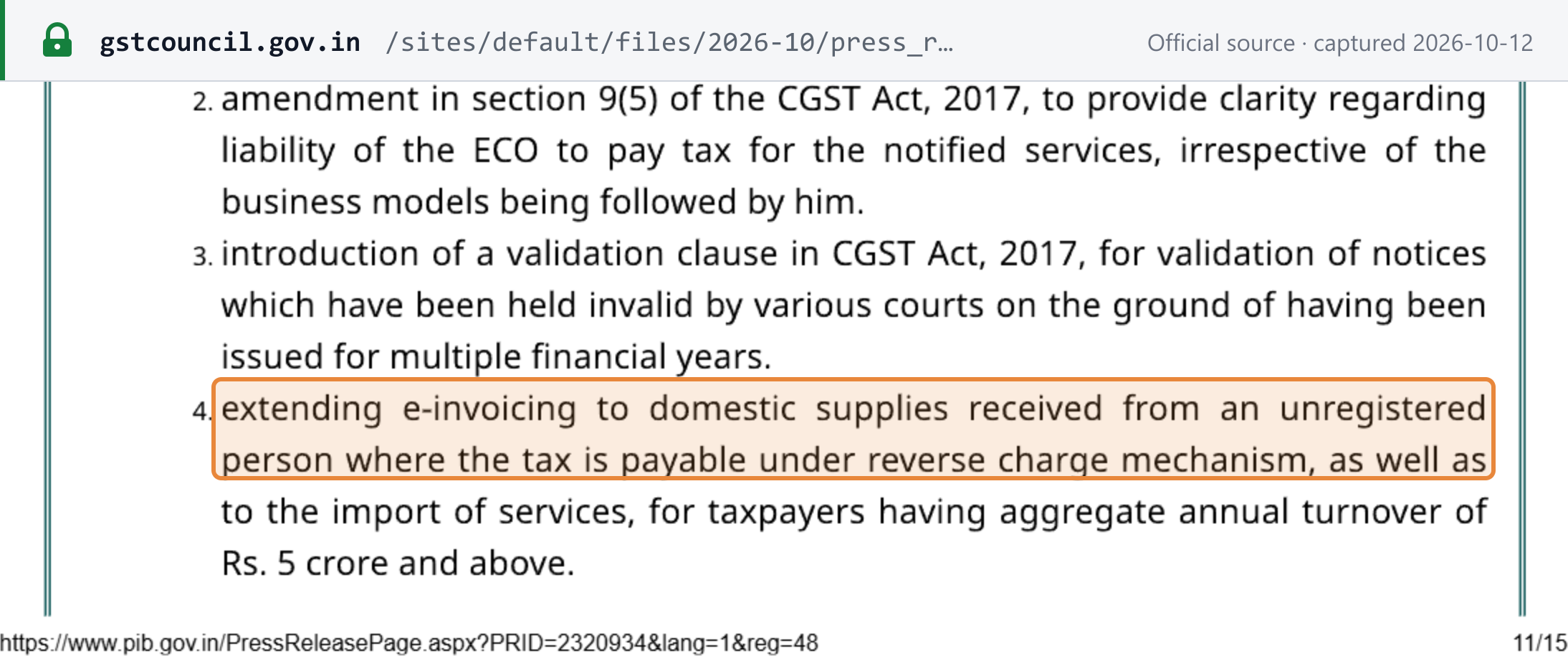 Source snapshot of the official page. Open full size ↗