11 recurring TVA obligations — returns, payments and listings — each with its due rule and official source, plus the dates new France rules take effect.
No obligation here shifts for a weekend or public holiday. Where that is France's own rule the date stands as shown; where a shift exists but is not modelled, the obligation's notes say so. Confirm against the linked official source before relying on a date.
Recurring obligations, with sources
Each deadline cites the official text that states it and the date we last verified it.
12 published dates, 24 Jan 2026 to 24 Dec 2026Verified 2026-08-14
Who files
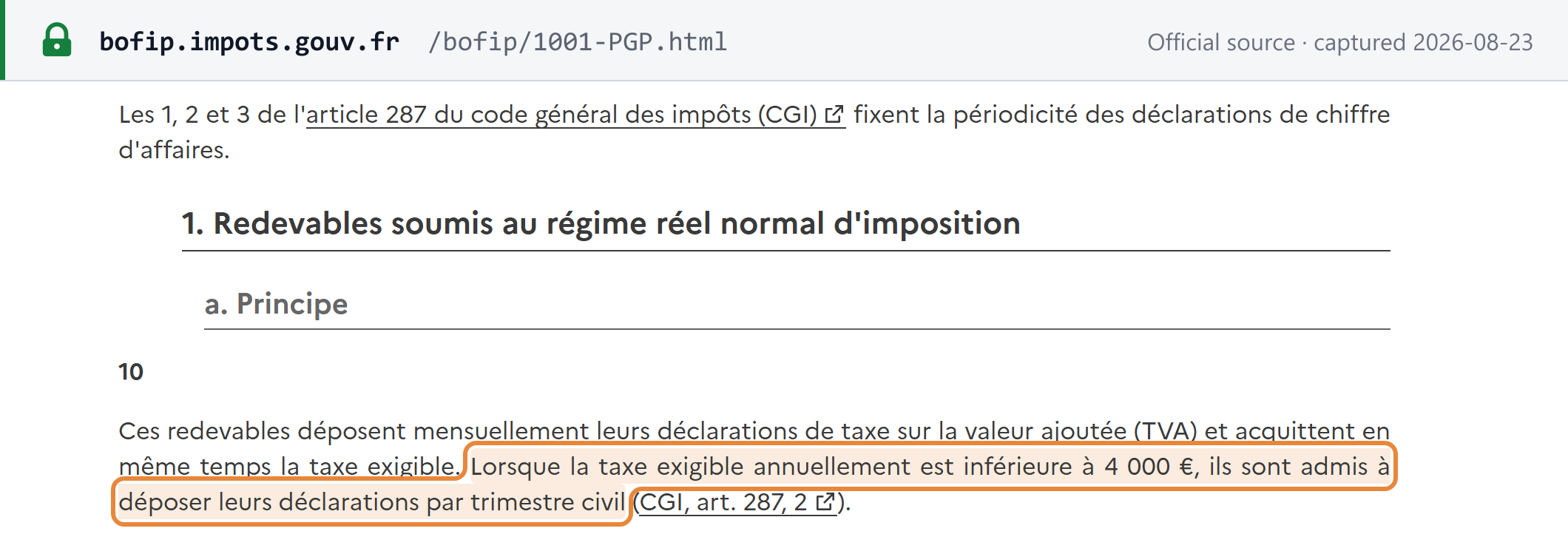
Businesses under the régime réel normal — turnover above €840,000 for goods or €254,000 for services, legally excluded from the régime simplifié, or by option — that file monthly, meaning they have not taken the quarterly option available below €4,000 of annual VAT payable. Payment accompanies the return: CGI article 1692 requires the tax to be paid at the moment of filing, so there is no separate payment date.
Notes
DGFiP publishes this as a window rather than a single date, and the window's closing date is not computable: 24 January and 24 October 2026 are Saturdays yet published unshifted, while August closes on the 25th. Non-established EU businesses identified in France file by the 19th; consolidated-payment groups and returns carrying import VAT file by the 24th.
2 published dates, 5 May 2026 to 4 May 2027Verified 2026-08-14
Who files
Businesses under the régime simplifié d'imposition (RSI), filing form 3517-S for the calendar year. Businesses with a non-calendar financial year file the CA12-E within 3 months of their year end.
Notes
Ending: the régime simplifié is abolished from 1 January 2027 by article 38 of loi n° 2025-127 du 14 février 2025, which repeals CGI articles 302 septies A and 302 septies AA. The CA12 filed in May 2027 for FY2026 is the last one. The deadline is the 2nd jour ouvré after 1 May, so it lands on a different date each year: 5 May 2026, then 4 May 2027. Businesses with a non-calendar financial year file the CA12-E within three months of their year end instead. The régime réel normal has no annual reconciliation return at all; the CA12 is RSI-only.
“si l'exercice correspond à l'année civile (clôture au 31 décembre N), la déclaration de régularisation annuelle doit être télétransmise au plus tard le 2ᵉ jour ouvré qui suit le 1er mai N+1 (formulaire n° 3517-S modèle CA12)”
Captured from DGFiP (impots.gouv.fr) on 2026-08-14
Acomptes de TVA — RSI instalments (form 3514)
TVA · Bi-annually · payment
2 published dates, 24 Jul 2026 to 24 Dec 2026Verified 2026-08-14
Who files
Régime simplifié filers, who pay two instalments toward the annual liability: 55% in July and 40% in December, each calculated on the previous year's tax.
Notes
Ending: these are the last two acomptes. The régime simplifié is abolished from 1 January 2027 by article 38 of loi n° 2025-127 du 14 février 2025, so there is no July 2027 instalment. The instalments do not fall on fixed July and December dates — BOFiP puts them on the same staggered grid as the CA3, so the dates shown are the closing dates of the July and December windows. The 55% and 40% proportions are set out at §170 of the same document.
“Les acomptes semestriels sont versés en juillet et décembre, aux jours prévus au d du 1° du 1 de l'article 39 de l'annexe IV au CGI, en fonction du lieu d'implantation, du numéro d'identification ou de la première lettre du nom du redevable.”
Captured from DGFiP (BOFiP-Impôts) on 2026-08-14
État récapitulatif TVA — intra-EU goods listing
TVA · Monthly · report / listing
12 published dates, 12 Feb 2026 to 13 Jan 2027Verified 2026-08-14
Who files
Businesses making intra-EU supplies of goods, from the first euro — there is no threshold. Filed with the customs administration (DGDDI), which collects it on behalf of DGFiP.
Notes
The rule is the 10th working day of the month following the reference month, and DGDDI publishes the resulting date for every month. Replaced the goods half of the former DEB.
“dans les quinze jours du commencement de ses opérations”
Captured from DGFiP (BOFiP-Impôts) on 2026-08-14
Déclaration de cessation — final return on ceasing or transferring the business
TVA · One-off · registration
within 30 days of the transfer or cessation of the businessVerified 2026-08-14
Who files
Any VAT-registered business ceasing or transferring its activity. Régime réel normal filers have 30 days; régime simplifié filers have 60 days (CGI annexe II article 242 septies).
Notes
The 30-day rule shown is for the régime réel normal. Régime simplifié filers have 60 days — a distinction that becomes moot when that regime is abolished on 1 January 2027.
“En cas de cession ou cessation, les déclarations de chiffres d'affaires doivent être souscrites dans les trente jours de la cession ou la cessation d'activité (CGI, art. 287, 4).”
Captured from DGFiP (BOFiP-Impôts) on 2026-08-14
Déclaration TVA guichet unique — régime de l'Union (OSS UE)
TVA · Quarterly · return filing
last day of the month after the quarter endsVerified 2026-08-23
Who files
Taxable persons established in the EU, with France as member state of identification, making intra-Community distance sales of goods or B2C supplies of services taxable in another member state — plus deemed suppliers (platforms). Filed through the service « Guichet de TVA UE » in the espace professionnel; the competent office is the pôle national Guichet TVA commerce en ligne at Noyon. CGI art. 298 sexdecies G. Payment falls on the same date.
Notes
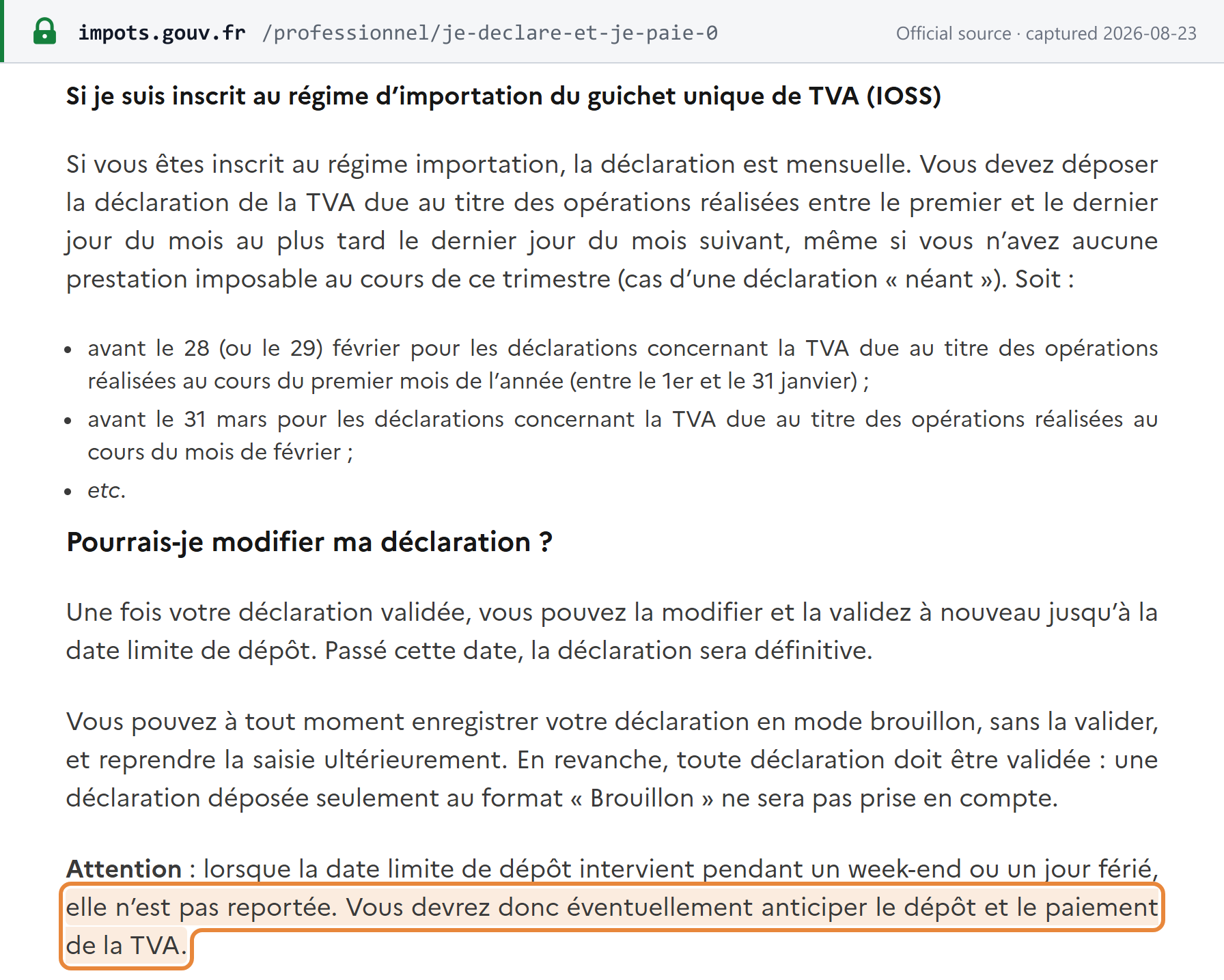
Due 30 April, 31 July, 31 October and 31 January, with payment on the same date. There is no weekend shift: DGFiP states that 'lorsque la date limite de dépôt intervient pendant un week-end ou un jour férié, elle n'est pas reportée', and tells filers to bring the filing and the payment forward. The next-working-day shift that applies to a CA3 does not reach the guichet unique. 31 October 2026 and 31 July 2027 are Saturdays and 31 January 2027 a Sunday; none of them moves. Payment counts on the date de valeur, when the sum reaches the collecting accountant's Banque de France account, and the declaration's numéro de référence unique must go in the transfer's zone motif. Nil returns are compulsory and repeated non-filing risks exclusion from the guichet. The declaration cannot be filed early. Corrections go in a later declaration within three years. Domestic supplies stay on the CA3, and input VAT cannot be deducted through the guichet.
“Si vous êtes inscrit au régime UE ou non-UE (pour des prestations de services ou des ventes à distance intracommunautaires de biens), la déclaration est trimestrielle. Vous devez déposer la déclaration de la TVA due sur les opérations intervenues entre le premier et le dernier jour du trimestre avant la fin du mois suivant le trimestre civil concerné, même si vous n'avez aucune opération imposable au cours de ce trimestre (cas d'une déclaration « néant »).”
Captured from DGFiP (impots.gouv.fr) on 2026-08-23
Déclaration TVA guichet unique — régime hors Union (OSS non UE)
TVA · Quarterly · return filing
last day of the month after the quarter endsVerified 2026-08-23
Who files
Taxable persons NOT established in the EU supplying services to EU consumers, with France as member state of identification. CGI art. 298 sexdecies F. Same deadline as the Union scheme and an entirely different filer population, which is why it is a separate row.
Notes
Due 30 April, 31 July, 31 October and 31 January — the same dates as the Union scheme — with payment on the same date. There is no weekend shift: DGFiP states that 'lorsque la date limite de dépôt intervient pendant un week-end ou un jour férié, elle n'est pas reportée', and tells filers to bring the filing and the payment forward. The next-working-day shift that applies to a CA3 does not reach the guichet unique. 31 October 2026 and 31 July 2027 are Saturdays and 31 January 2027 a Sunday; none of them moves. Payment counts on the date de valeur, when the sum reaches the collecting accountant's Banque de France account, and the declaration's numéro de référence unique must go in the transfer's zone motif. Nil returns are compulsory and repeated non-filing risks exclusion from the guichet. The declaration cannot be filed early. Corrections go in a later declaration within three years. Domestic supplies stay on the CA3, and input VAT cannot be deducted through the guichet.
“Vous devez déposer votre déclaration de TVA par voie électronique via le guichet unique au plus tard le dernier jour du mois qui suit la période concernée. La période de déclaration correspond à un trimestre civil pour le régime non Union (OSS non UE).”
Captured from DGFiP (impots.gouv.fr) on 2026-08-23
last day of the month after the month endsVerified 2026-08-23
Who files
Taxable persons registered for the import scheme with France as member state of identification, for distance sales of imported goods of intrinsic value under EUR 150. Non-EU-established persons must appoint an intermédiaire. CGI art. 298 sexdecies H. Payment falls on the same date.
Notes
The import scheme is monthly: the declaration and the payment are due on the last day of the following month — 28 or 29 February for the January period. There is no weekend shift: DGFiP states that 'lorsque la date limite de dépôt intervient pendant un week-end ou un jour férié, elle n'est pas reportée', and tells filers to bring the filing and the payment forward. The next-working-day shift that applies to a CA3 does not reach the guichet unique. 31 October 2026 and 31 July 2027 are Saturdays and 31 January 2027 a Sunday; none of them moves. Payment counts on the date de valeur, when the sum reaches the collecting accountant's Banque de France account, and the declaration's numéro de référence unique must go in the transfer's zone motif. Nil returns are compulsory and repeated non-filing risks exclusion from the guichet. The declaration cannot be filed early. Corrections go in a later declaration within three years.
“Si vous êtes inscrit au régime importation, la déclaration est mensuelle. Vous devez déposer la déclaration de la TVA due au titre des opérations réalisées entre le premier et le dernier jour du mois au plus tard le dernier jour du mois suivant, même si vous n'avez aucune prestation imposable au cours de ce trimestre (cas d'une déclaration « néant »).”
Open full size Captured from DGFiP (impots.gouv.fr) on 2026-08-23
TVA only — direct tax, payroll (DSN/PASRAU), CFE/CVAE, TGAP, excise and insurance-premium tax appear on the same DGFiP calendrier fiscal but are out of scope here, as are the agricultural VAT regimes, which run their own cycle. Your CA3 due date is personal to you. CGI annexe IV article 39 staggers it by legal form, département and SIREN digits, and your actual date is shown in your espace professionnel. This calendar shows the outer edge of the window DGFiP publishes — the 24th cohort, the latest one — so a filer in the earliest cohort is due nine days before the date shown here. BOI-TVA-DECLA-20-20-10-10 §190 tabulates due days of the 15th, 16th, 17th, 19th, 20th, 21st, 23rd and 24th by département, legal form, surname initial and SIREN band. A deadline falling on a public holiday shifts to the next working day (CGI ann. IV art. 39, 1, 3°). Franchise-en-base businesses that do not import (up to €85,000 goods / €37,500 services, exit at €93,500 / €41,250) have no VAT filing obligation and so appear nowhere here; lower sector-specific thresholds apply to lawyers, authors and performing artists (€50,000 / €55,000 and €35,000 / €38,500). The proposed single €25,000 threshold was repealed outright by loi n° 2025-1044 du 3 novembre 2025, not merely deferred. The régime simplifié is abolished from 1 January 2027 (loi n° 2025-127, article 38), so the CA12 and both acomptes on this calendar are ending obligations. Not shown here: the monthly franchise opt-out under CGI article 293 F, which DGFiP lists on every month's calendar but which is an election rather than a filing; and the one-month extension available to authorised filers under the régime des acomptes provisionnels. From 1 September 2026 the legislative VAT provisions move from the CGI into Book II of the Code des impositions sur les biens et services (CIBS) under Ordonnance n° 2025-1247; existing doctrine remains applicable and article numbers cited here are from the source that states each rule.
What this calendar does not list
Not yet covered E-invoicing / e-reporting cycle — France's e-reporting regime does fix real periodic transmission deadlines, varying by VAT regime (by décade for monthly réel normal filers, monthly for the quarterly option, bimonthly for franchise). It is not in force yet: it starts 1 September 2026 for large enterprises and ETIs and 1 September 2027 for SMEs and micro-enterprises, and DGFiP's own September 2026 calendrier fiscal carries no e-reporting entry. Not modelled until the first cohort is live and DGFiP publishes dated deadlines; the full cadence table is captured in the research brief.
New France rules taking effect
Confirmed changes from the weekly scan — each links to its full record with the official source.
Which France tax deadlines does this calendar cover?
11 recurring indirect-tax obligations — TVA returns, payments and related filings — each with the due-date rule, who must file, and the official source that states the deadline. Direct-tax, payroll and company-registry deadlines are out of scope.
How current are these due dates?
Every obligation carries the date it was last verified against its official source (newest: 2026-08-23). Law-change dates come from the weekly Last Week in Taxes scan and link to their full change records.
Do the dates account for weekends and public holidays?
No — the calendar shows the statutory due date. Where the authority shifts deadlines falling on non-working days, the obligation notes say so. Confirm against the linked official source before relying on a date.