
Malaysia compliance calendar

12 recurring SST (sales and service tax), Service tax, e-Invoicing (MyInvois) and 3 more obligations — returns, payments and listings — each with its due rule and official source, plus the dates new Malaysia rules take effect.

Mon
Tue
Wed
Thu
Fri
Sat
Sun
31
1
2
3
4
5
6
7
8
9
10
11
Report / listing Return filing Law change takes effect

Dates already include the weekend and public-holiday shift where Malaysia applies one — 4 of 12 obligations here do. The rest stand as computed, and each obligation's notes say which applies to it and why. Confirm against the linked official source before relying on a date.

Recurring obligations, with sources

Each deadline cites the official text that states it and the date we last verified it.

SST-02 return and payment — registrants with an even financial-year-end month

SST (sales and service tax) · Every 2 months · return filing

last day of the month after the two-month period ends Verified 2026-08-23
Who files
Registered manufacturers and registered persons whose financial year ends in an EVEN month (February, April, June, August, October or December). RMCD assigns their two-month taxable periods to close in those same even months. Payment falls on the same date — Act 806 s.26(5) and Act 807 s.26(4) both require payment 'not later than the last day on which he is required to furnish the return'.
Notes
The even cohort: registrants whose financial year ends in February, April, June, August, October or December, whose two-month taxable periods close in those same months. Those with an odd financial-year-end month are on the other grid and have their own entry. Return and payment are both due on the last day of the month following the period end. One form, two filings. A person registered under both Acts files the SST-02 twice per period, once per registration number; the form says so bilingually — 'Borang ini hendaklah diisi secara berasingan bagi Cukai Jualan dan Cukai Perkhidmatan / This form must be declared separately for Sales Tax and Service Tax'. Same date, two returns. Nil returns are compulsory (Act 806 s.26(6)). A registered person may apply in writing to the Director General for a taxable period other than the assigned one; payment by instalments exists but needs his approval. A due date falling on the Federal weekly holiday or a Federal public holiday moves to the next day.
Source
Sales Tax Act 2018 [Act 806] s.26(1) Royal Malaysian Customs Department (RMCD)
See the source text
“Every taxable person shall, in respect of his taxable period, account for the sales tax due in a return as may be prescribed and the return shall be furnished to the Director General in the prescribed manner not later than the last day of the month following the end of his taxable period to which the return relates.”
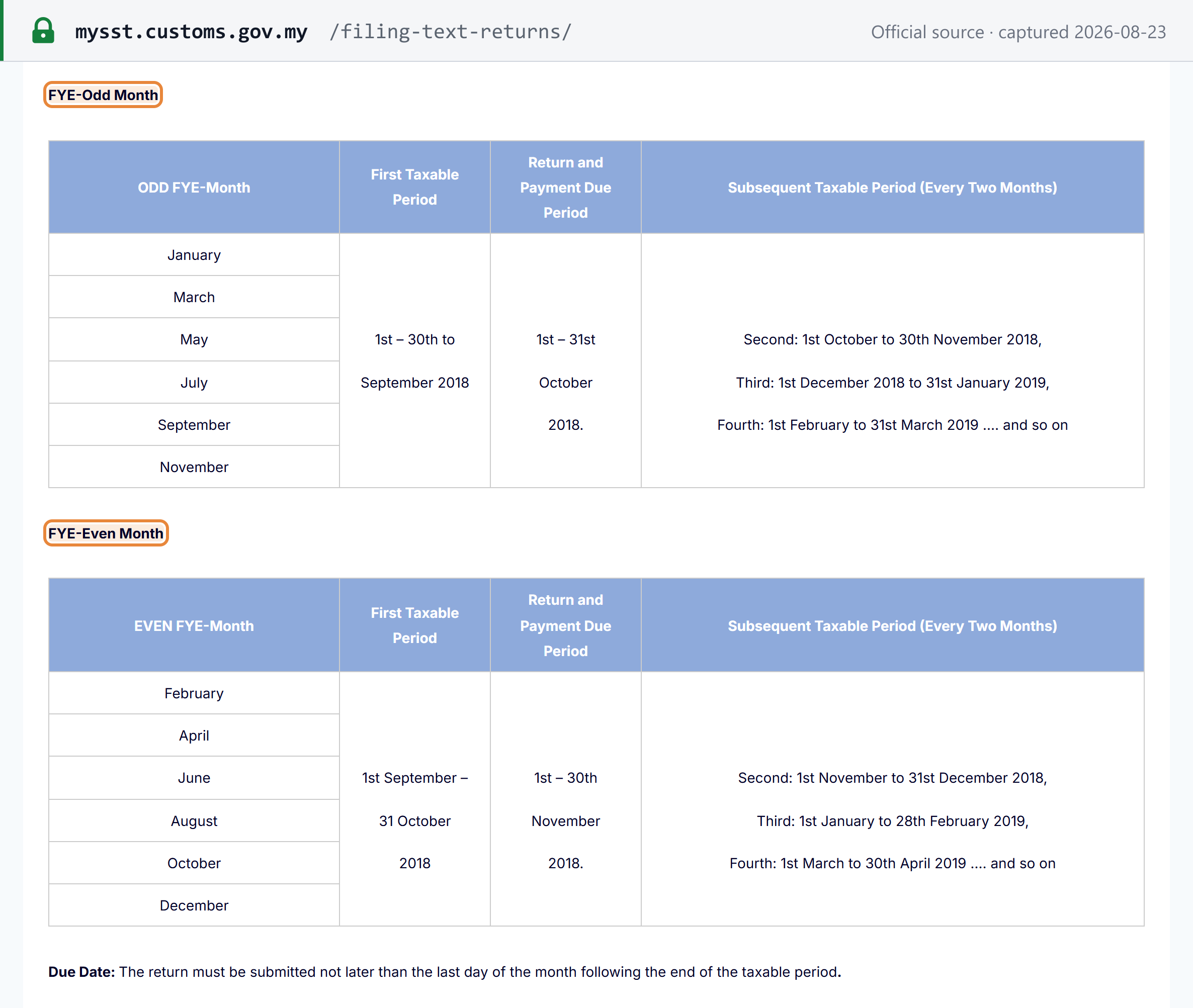
Screenshot of Royal Malaysian Customs Department (RMCD) showing the SST-02 return and payment — registrants with an even financial-year-end month deadline Open full size Captured from Royal Malaysian Customs Department (RMCD) on 2026-08-23
SST-02 return and payment — registrants with an odd financial-year-end month

SST (sales and service tax) · Every 2 months · return filing

last day of the month after the two-month period ends Verified 2026-08-23
Who files
Registered manufacturers and registered persons whose financial year ends in an ODD month (January, March, May, July, September or November). Their two-month taxable periods close in those odd months instead. Same rule, same due date, different grid.
Notes
The odd cohort: registrants whose financial year ends in January, March, May, July, September or November, whose two-month taxable periods close in those same months — a month ahead of the even grid throughout. Return and payment are both due on the last day of the month following the period end. 31 August 2026 is Hari Kebangsaan, so the June–July 2026 period falls due on 1 September 2026 rather than 31 August. One form, two filings. A person registered under both Acts files the SST-02 twice per period, once per registration number; the form says so bilingually — 'Borang ini hendaklah diisi secara berasingan bagi Cukai Jualan dan Cukai Perkhidmatan / This form must be declared separately for Sales Tax and Service Tax'. Nil returns are compulsory (Act 806 s.26(6)). A taxable period other than the assigned one may be applied for in writing, and payment by instalments needs the Director General's approval. A due date falling on the Federal weekly holiday or a Federal public holiday moves to the next day.
Source
Sales Tax Act 2018 [Act 806] s.26(1) Royal Malaysian Customs Department (RMCD)
See the source text
“Every taxable person shall, in respect of his taxable period, account for the sales tax due in a return as may be prescribed and the return shall be furnished to the Director General in the prescribed manner not later than the last day of the month following the end of his taxable period to which the return relates.”
Screenshot of Royal Malaysian Customs Department (RMCD) showing the SST-02 return and payment — registrants with an odd financial-year-end month deadline Open full size Captured from Royal Malaysian Customs Department (RMCD) on 2026-08-23

SST-02A declaration — imported taxable services by a non-taxable person

Service tax · Monthly · return filing

last day of the month after the month ends Verified 2026-08-23
Who files
Any person OTHER than a taxable person who, in carrying on business, acquires an imported taxable service. The declaration period is monthly and runs from whichever is EARLIER of payment for the service or receipt of the supplier's invoice. Payment falls on the same date.
Notes
Anyone other than a registered taxable person who acquires an imported taxable service in carrying on business must declare and pay the service tax on it. The period is monthly and runs from whichever comes first — payment for the service, or receipt of the supplier's invoice — so a filer's month is their own; the general monthly cadence is what is shown here. The declaration and the payment are due on the last day of the month following that month. RMCD applies the forward shift to this form as well as to the SST-02, stating the rule in its guide under a heading that names both forms. So a due date falling on the Federal weekly holiday or a Federal public holiday moves to the next day.
Source
Service Tax Act 2018 [Act 807] s.26A, inserted by Finance Act 2018 [Act 812] s.89 Royal Malaysian Customs Department (RMCD)
See the source text
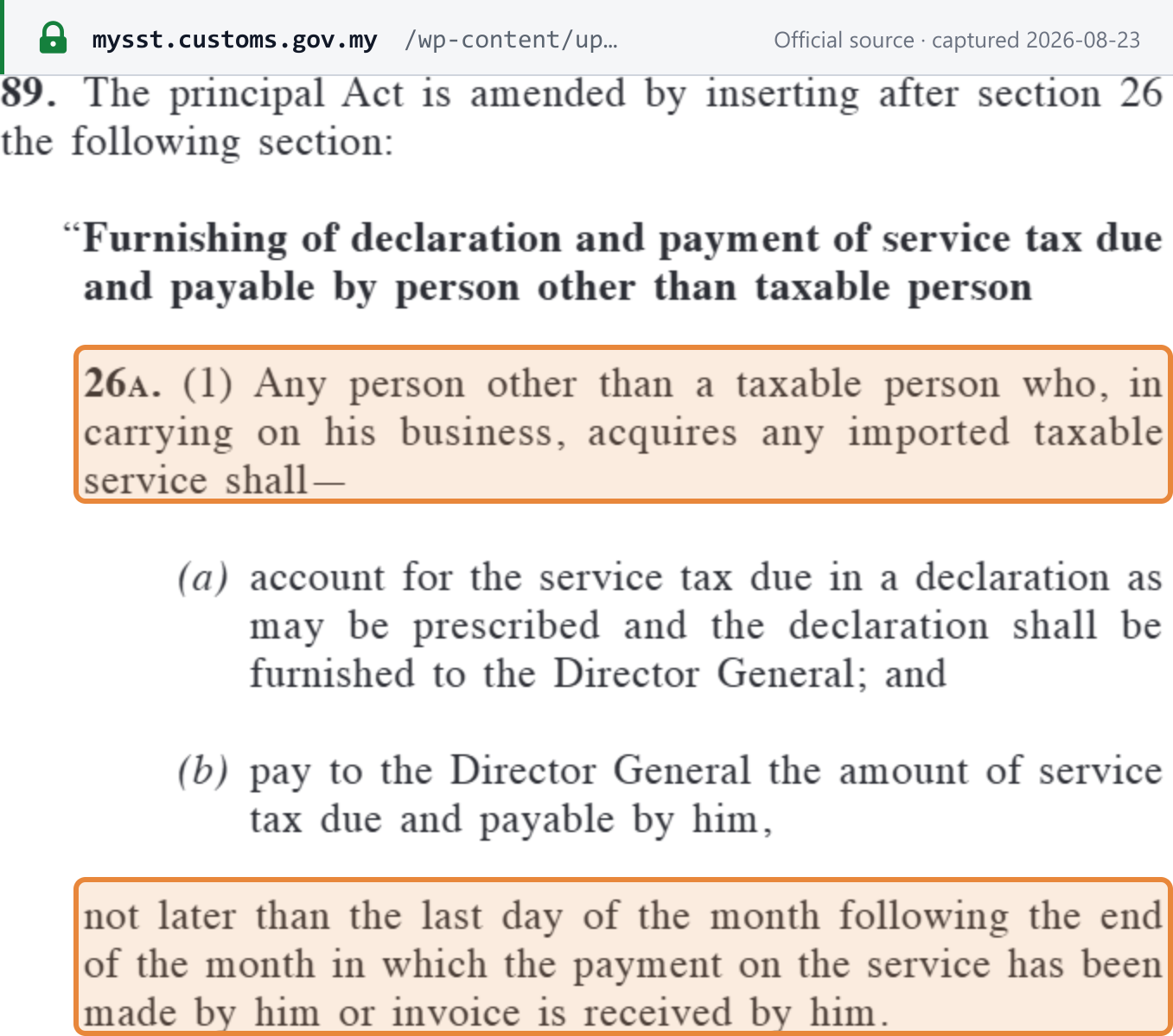
“26a.(1) Any person other than a taxable person who, in carrying on his business, acquires any imported taxable service shall— (a) account for the service tax due in a declaration as may be prescribed and the declaration shall be furnished to the Director General; and (b) pay to the Director General the amount of service tax due and payable by him, not later than the last day of the month following the end of the month in which the payment on the service has been made by him or invoice is received by him.”
Screenshot of Royal Malaysian Customs Department (RMCD) showing the SST-02A declaration — imported taxable services by a non-taxable person deadline Open full size Captured from Royal Malaysian Customs Department (RMCD) on 2026-08-23

DST-02 return and payment — service tax on digital services

Service tax — digital services · Quarterly · return filing

last day of the month after the quarter ends Verified 2026-08-23
Who files
Foreign Registered Persons providing digital services to Malaysian consumers. The taxable period is three months ending on the last day of any month; the default grid for a registrant from the regime's start is calendar quarters. Payment falls on the same date under Act 807 s.56I(1).
Notes
Foreign Registered Persons providing digital services to Malaysian consumers file quarterly, and both the return and the payment are due on the last day of the month following the period end. The calendar-quarter default grid is RMCD's own: the Guide on Digital Service by Foreign Service Provider, paras 13-15, tabulates 'First Taxable Period (Quarterly) January - March 2020; Subsequent Taxable Period April - June 2020; July - September 2020; October - December 2020'. There is no weekend or public-holiday shift on this return, and that is not theoretical: Saturday 31 October 2026 and Sunday 31 January 2027 are both real, unshifted DST-02 deadlines. A Foreign Registered Person who reads the SST-02 rule across will be a day or two late.
Source
Service Tax (Amendment) Act 2019 [Act A1597], inserting ss. 56H and 56I into the Service Tax Act 2018 Royal Malaysian Customs Department (RMCD)
See the source text
“(4) A foreign registered person shall, in respect of his taxable period, account for the service tax due in a return as may be prescribed and the return shall be furnished to the Director General in the prescribed manner not later than the last day of the month following the end of his taxable period to which the return relates.”
Captured from Royal Malaysian Customs Department (RMCD) on 2026-08-23

MyInvois consolidated e-Invoice

e-Invoicing (MyInvois) · Monthly · report / listing

7th of the month after the month ends Verified 2026-08-23
Who files
Suppliers aggregating transactions with buyers who did not request an individual e-Invoice, and the same timing for consolidated SELF-BILLED e-Invoices. Taxpayers with annual turnover under RM 1,000,000 are currently exempt from issuing e-Invoices altogether.
Notes
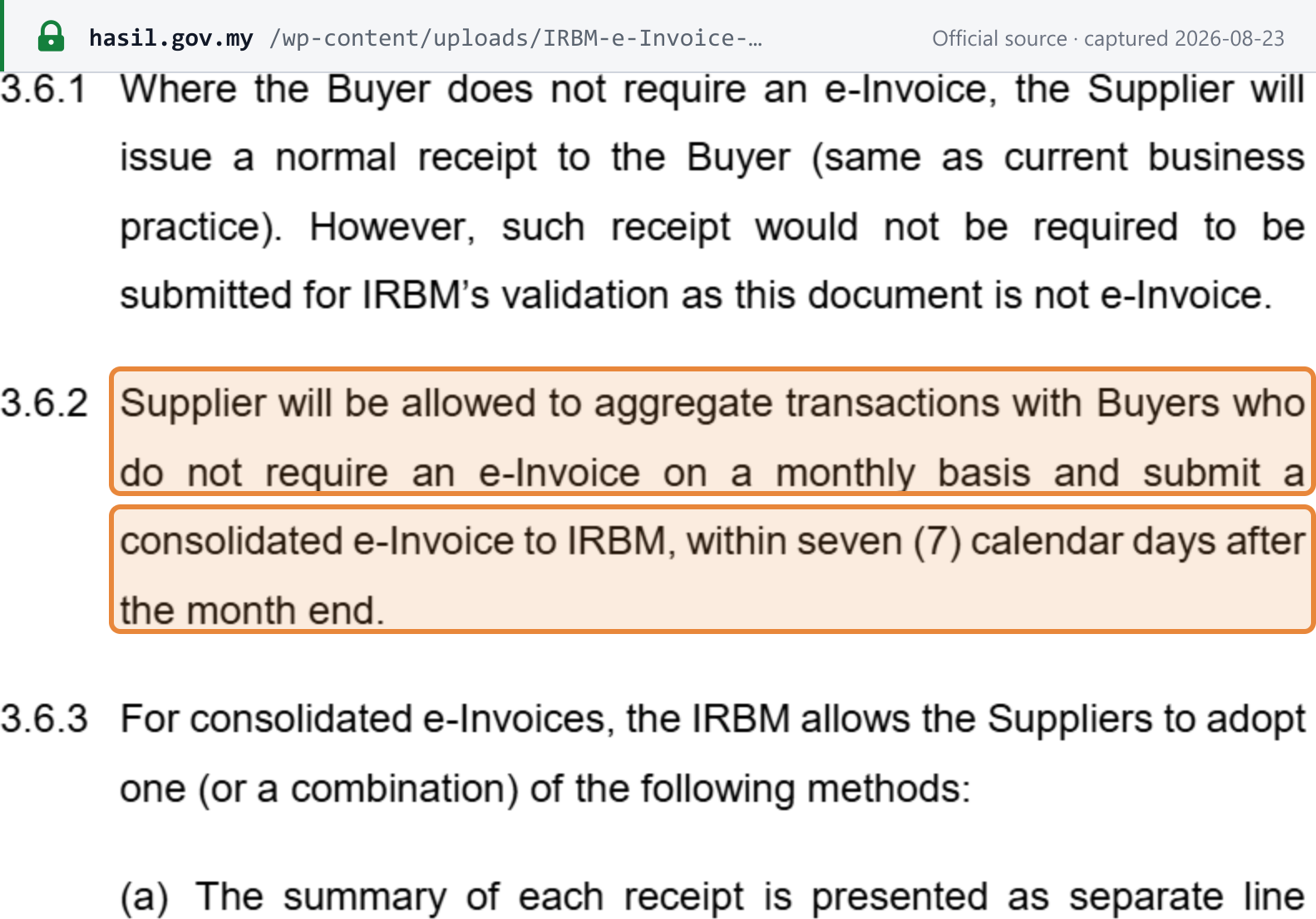
A supplier may aggregate transactions with buyers who did not ask for an individual e-Invoice and submit one consolidated e-Invoice within seven calendar days after the month end; consolidated self-billed e-Invoices run on the same timing. Taxpayers with annual turnover under RM 1,000,000 are currently exempt from issuing e-Invoices at all. Seven calendar days, and no shift: the guideline says 'calendar days' and no source found states a weekend rule for MyInvois, so 7 February, 7 March, 7 June and 7 November 2026 all fall on a weekend and stand. This is an IRBM obligation under s. 134A of the Income Tax Act 1967, not an RMCD one, so the Federal-holiday regulations that govern the SST-02 do not reach it. Rollout by turnover: above RM 100m from 1 August 2024, above RM 25m from 1 January 2025, above RM 5m from 1 July 2025, up to RM 5m from 1 January 2026, and businesses commencing 2023–2025 with turnover of at least RM 1m from 1 July 2026.
Source
IRBM e-Invoice Specific Guideline, Version 4.8, published 7 July 2026, s. 3.6.2 Inland Revenue Board of Malaysia (IRBM / LHDN)
See the source text
“3.6.2 Supplier will be allowed to aggregate transactions with Buyers who do not require an e-Invoice on a monthly basis and submit a consolidated e-Invoice to IRBM, within seven (7) calendar days after the month end.”
Screenshot of Inland Revenue Board of Malaysia (IRBM / LHDN) showing the MyInvois consolidated e-Invoice deadline Open full size Captured from Inland Revenue Board of Malaysia (IRBM / LHDN) on 2026-08-23

MyInvois self-billed e-Invoice — imported goods

e-Invoicing (MyInvois) · Monthly · report / listing

last day of the 2nd month after the month ends Verified 2026-08-23
Who files
Malaysian purchasers importing goods. The clock runs from the month customs clearance is obtained, and the deadline is the end of the SECOND month after it — twice the window of every other MyInvois rule.
Notes
Two months, not one: the imported-goods self-billed e-Invoice is due by the end of the second month following the month customs clearance is obtained, where the imported-services one has a single month. Confusing them gives a filer a month they do not have. No weekend or holiday shift — this is an IRBM obligation, and the RMCD Federal-holiday regulations do not reach it.
Source
IRBM e-Invoice Specific Guideline, Version 4.8, s. 10.4.8 Inland Revenue Board of Malaysia (IRBM / LHDN)
See the source text
“10.4.8 In relation to importation of goods, the Malaysian Purchaser should issue a self-billed e-Invoice latest by the end of the second month following the month of customs clearance is obtained.”
Captured from Inland Revenue Board of Malaysia (IRBM / LHDN) on 2026-08-23

MyInvois self-billed e-Invoice — imported services

e-Invoicing (MyInvois) · Monthly · report / listing

last day of the month after the month ends Verified 2026-08-23
Who files
Malaysian purchasers acquiring services from foreign suppliers. The clock runs from whichever is EARLIER of payment or receipt of the foreign supplier's invoice — expressly the same trigger as the imported-taxable-service rules behind the SST-02A.
Notes
One month, not two — the deliberate contrast with the imported-goods row above. The trigger is the same one the SST-02A uses, so a business acquiring imported services can owe both this e-Invoice and an SST-02A declaration off the same event.
Source
IRBM e-Invoice Specific Guideline, Version 4.8, s. 10.4.9 Inland Revenue Board of Malaysia (IRBM / LHDN)
See the source text
“10.4.9 Meanwhile, in relation to importation of services, self-billed e-Invoice should be issued latest by the end of the month following the month upon (1) payment made by the Malaysian Purchaser; or (2) receipt of invoice from foreign supplier, whichever earlier. The determination of the aforementioned (1) and (2) is in accordance with the prevailing rules applicable for imported taxable service.”
Captured from Inland Revenue Board of Malaysia (IRBM / LHDN) on 2026-08-23

LVG-02 return and payment — sales tax on low value goods

Sales tax — low value goods · Quarterly · return filing

last day of the month after the quarter ends Verified 2026-08-23
Who files
Registered sellers of low value goods sold into Malaysia, registrable at RM 500,000 of such goods in 12 months. Charging began 1 January 2024. The taxable period is three months and payment falls on the same date as the return.
Notes
Registered sellers of low value goods sold into Malaysia file quarterly: the taxable period is three months, and the return and the payment are both due on the last day of the month following it. Registration is required at RM 500,000 of such goods in 12 months, and charging began 1 January 2024. There is no forward shift on this return, so a due date landing on a weekend or a public holiday stands. The low-value-goods version of the shift clause, P.U. (A) 408 reg. 17(3), omits the operative words 'the day immediately after', and it is keyed to holidays 'in the country where the registered seller established' rather than to Malaysian ones.
Source
Sales Tax (Low Value Goods) (Amendment) Regulations 2023 [P.U. (A) 405], reg. 3, substituting reg. 7 of P.U. (A) 408 with effect from 1 January 2024 Royal Malaysian Customs Department (RMCD)
See the source text
“The principal Regulations are amended by substituting for regulation 7 the following regulation: “7. A registered seller shall furnish a return for each taxable period as required under section 26 of the Act in the form and manner as determined by the Director General.””
Captured from Royal Malaysian Customs Department (RMCD) on 2026-08-23

SST registration — application to the Director General

SST (sales and service tax) · One-off · registration

within 1 month of the end of the month in which the person became liable to be registered — the application is due by the last day of the following month (Act 806 s.13(1), Act 807 s.13(1)) Verified 2026-08-23
Who files
Any manufacturer of taxable goods, or any person providing taxable services, whose 12-month historical or forward-looking total crosses the prescribed threshold — RM 500,000 for sales tax, and group-specific thresholds for service tax. Liability arises at the END of the month in which the threshold is crossed; the application is due by the last day of the month after that. Registration then takes effect from the first day of the month following the application.
Notes
A manufacturer of taxable goods, or a provider of taxable services, must apply once their 12-month historical or forward-looking total crosses the threshold — RM 500,000 for sales tax, group-specific thresholds for service tax. Liability arises at the end of the month the threshold is crossed and the application is due by the last day of the month after that, a window running from 30 to 61 days. Registration takes effect from the first day of the month following the application. Service tax thresholds are set per group by the First Schedule to the Service Tax Regulations 2018. P.U. (A) 201/2025 set Group H items 2 to 4 and Group K at RM 1,000,000 from 1 July 2025. Group H is finance: items 2 to 4 are insurance and takaful, and fee- or commission-based financial services. The credit- and charge-card item is item 1 and carries no threshold at all. RMCD's registering-business summary page still shows only Groups A–J and an '8% from 1 Mac 2024' rate line, so it contradicts the current regulations — do not use it as a threshold source.
Source
Sales Tax Act 2018 [Act 806] s.13(1) Royal Malaysian Customs Department (RMCD)
See the source text
“13. (1) Any manufacturer who is liable to be registered under section 12 shall apply to the Director General for registration as a registered manufacturer in the prescribed form not later than the last day of the month following the month in which he is liable to be registered as referred to in paragraph 12(2)(a) or (b).”
Captured from Royal Malaysian Customs Department (RMCD) on 2026-08-23

TTx-03 return and payment — tourism tax

Tourism tax · Quarterly · return filing

last day of the month after the quarter ends Verified 2026-08-23
Who files
Operators of accommodation premises registered for tourism tax. The taxable period is three months ending on the last day of any month. Nil returns are compulsory and payment falls on the same date.
Notes
Operators of registered accommodation premises file quarterly: the taxable period is three months ending on the last day of any month, and the return and the payment are due on the last day of the month following it. Nil returns are compulsory. A due date falling on the Federal weekly holiday or a Federal public holiday moves forward to the next day, under the Tourism Tax Regulations 2017 [P.U. (A) 228] reg. 19(3): 'if the last day falls on the Federal weekly holiday or Federal public holiday, then the last date to receive such return and payment is on the day immediately after the Federal weekly holiday or Federal public holiday.'
Source
Tourism Tax Act 2017 [Act 791], ss. 18 and 19 Royal Malaysian Customs Department (RMCD)
See the source text
“19. (1) Every operator shall, in respect of his taxable period, account for the tourism tax received in a return as may be prescribed and the return shall be furnished to the Director General in the prescribed manner not later than the last day of the month following after the end of the operator's taxable period to which the return relates.”
Captured from Royal Malaysian Customs Department (RMCD) on 2026-08-23

DL-02 return and payment — departure levy

Departure levy · Monthly · return filing

last day of the month after the month ends Verified 2026-08-23
Who files
Registered persons liable to account for the departure levy on passengers leaving Malaysia by air. The period is MONTHLY, not quarterly — a common confusion with the other RMCD levies on this calendar. Payment falls on the same date.
Notes
The period is monthly, where the SST-02 is two-monthly and the TTx-03 and DST-02 are quarterly — a common confusion among the RMCD levies. The return and the payment are due on the last day of the month following the monthly period. There is no forward shift for a weekend or a public holiday. The Departure Levy Regulations 2019 [P.U. (A) 215] carry no shift clause — their reg. 16 covers counter hours, electronic-service hours and office closure only — and Act 813 does not use the word 'holiday' anywhere. So 31 January 2026, 28 February 2026, 31 May 2026, 31 October 2026 and 31 January 2027 all stand as they fall.
Source
Departure Levy Act 2019 [Act 813], ss. 19 and 20 Royal Malaysian Customs Department (RMCD)
See the source text
“19. (1) Every registered person shall— (a) account for the departure levy due on a monthly period in the return as may be prescribed; and (b) furnish the return to the Director General in the prescribed manner not later than the last day of the month following the end of the monthly period to which the return relates.”
Captured from Royal Malaysian Customs Department (RMCD) on 2026-08-23

Tourism tax — digital platform service provider return and payment

Tourism tax — digital platforms · Quarterly · return filing

last day of the month after the quarter ends Verified 2026-08-23
Who files
Digital platform service providers registered for tourism tax — online booking platforms collecting the levy on accommodation. The taxable period is three months ending on the last day of any month, the same shape as the operator's TTx-03. Payment falls on the same date and nil returns are compulsory.
Notes
Digital platform service providers registered for tourism tax — online booking platforms collecting the levy on accommodation — file on the same three-month shape as an operator's TTx-03. s. 20H(1) sets the three-month period, s. 20I(2) puts payment on the return date, and s. 20I(4) makes nil returns compulsory. Unlike the TTx-03, this return takes no forward shift for a weekend or a public holiday: the tourism-tax shift clause at P.U. (A) 228 reg. 19(3) names section 19 of the Act, and this return is filed under section 20I. Its penalty ladder is also not the 10-plus-15-plus-15 that sales tax, service tax and the departure levy use: s. 20I(7) runs 10, then 10, then 10.
Source
Tourism Tax (Amendment) Act 2021 [Act A1633], inserting ss. 20H and 20I into the Tourism Tax Act 2017 Royal Malaysian Customs Department (RMCD)
See the source text
“20i. (1) Every digital platform service provider shall, in respect of his taxable period, account for the tourism tax received in a return as may be prescribed and the return shall be furnished to the Director General in the prescribed manner not later than the last day of the month following after the end of the taxable period”
Captured from Royal Malaysian Customs Department (RMCD) on 2026-08-23

Malaysia's SST runs on staggered two-month taxable periods. RMCD assigns each registrant a grid by their financial-year-end month: an odd month puts the periods on January, March, May, July, September and November, an even one a month later throughout. Either way the return and the payment are due on the last day of the month following the period end. If that day falls on the Federal weekly holiday or a Federal public holiday, it moves forward to the next day. Only federal days count, so state and Federal Territory holidays — 1 February among them — and 1 January leave a deadline where it is. The Friday–Saturday weekend observed in Johor, Kedah, Kelantan and Terengganu changes counter hours, not due dates. The DST-02, the LVG-02 and the three MyInvois obligations take no forward shift at all. Penalty ladders differ by tax: sales tax, service tax and the departure levy run 10 per cent of the unpaid amount, then a further 15, then a further 15, while tourism tax runs 10, then 10, then 10 and stops at 30 per cent.

What this calendar does not list

  • Not applicable Annual or reconciliation return — Malaysia has no annual indirect-tax reconciliation return. Neither the Sales Tax Act 2018 nor the Service Tax Act 2018 provides for one: the two-month SST-02 is the whole cycle, and the only non-periodic return either Act contemplates is the final return on cessation of business. Tested for rather than assumed — there is no Malaysian equivalent of Italy's dichiarazione annuale or Germany's Jahreserklärung.
  • Not applicable Recapitulative listing — There is no recapitulative listing in Malaysian indirect tax. A recapitulative statement is an EU construct for reporting cross-border supplies to other member states within a customs union, and Malaysia is not in one. Nothing in the SST regime requires a periodic listing of counterparties. The MyInvois consolidated e-Invoice might look like one but is not: it aggregates transactions with buyers who did not request an invoice, and it answers the e-invoicing-cadence slot instead.

About this calendar

Which Malaysia tax deadlines does this calendar cover?

12 recurring indirect-tax obligations — SST (sales and service tax), Service tax, e-Invoicing (MyInvois), Sales tax, Tourism tax and Departure levy returns, payments and related filings — each with the due-date rule, who must file, and the official source that states the deadline. Direct-tax, payroll and company-registry deadlines are out of scope.

How current are these due dates?

Every obligation carries the date it was last verified against its official source (newest: 2026-08-23). Law-change dates come from the weekly Last Week in Taxes scan and link to their full change records.

Do the dates account for weekends and public holidays?

No — the calendar shows the statutory due date. Where the authority shifts deadlines falling on non-working days, the obligation notes say so. Confirm against the linked official source before relying on a date.

Validate tax IDs in 100+ countries

Put these rules into practice — verify VAT, GST, and EIN numbers in real time with the Lookuptax API.