Brunei Darussalam TIN & NRIC Guide — ROCBN, Corporate Tax, Withholding
Identification Number (NRIC)
Brunei Darussalam does not issue a standalone Tax Identification Number (TIN) for individuals. Instead, the National Registration Identity Card (NRIC) number serves as the functional TIN equivalent for CRS and international tax reporting. It is issued to citizens, permanent residents, and temporary residents aged 12 and above by the Immigration and National Registration Department.
The NRIC number consists of 8 digits in the format YY-NNNNNN (year of birth + serial number). When reporting for CRS or AEOI purposes, the hyphen is omitted, giving a plain 8-digit string. [1]
Three card types exist, distinguished by their border colour:
- Yellow border — Brunei citizens (aged 12 and above)
- Purple border — Permanent residents (aged 12 and above)
- Green border with purple print — Temporary residents holding immigration passes of 3 months or more
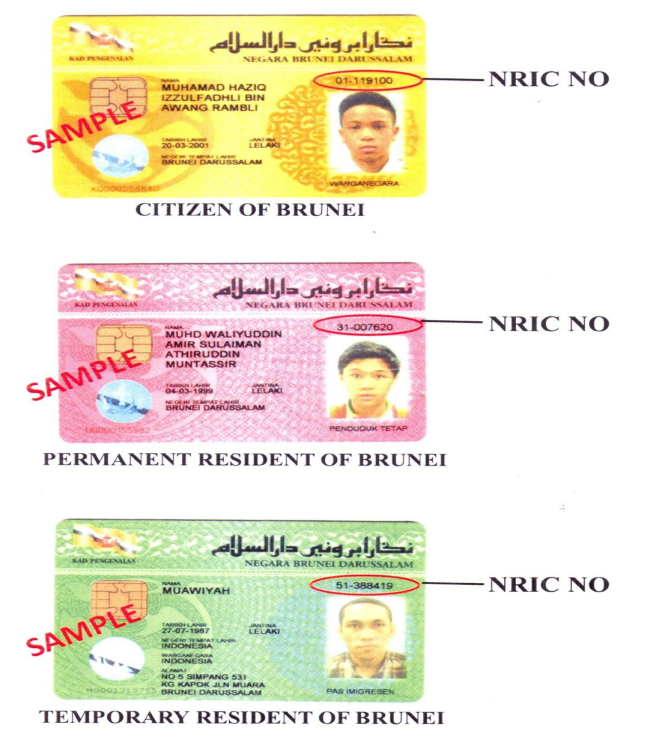 |
| NRIC |
Standard Registration Number (ROCBN)
For entities, Brunei equally has no standalone TIN. The Registry of Companies and Business Names (ROCBN) registration number, issued by the Ministry of Finance and Economy (MOFE), is the recognised TIN equivalent for companies, partnerships, and foreign branches. [1]
Three prefix types exist, determined by entity structure:
| Prefix | Format | Characters | Entity Type |
|---|---|---|---|
| P | PXXXXXXXX | 9 | Sole proprietorships and partnerships registered under the Business Names Act, Chapter 92 (BNA) |
| RC | RCXXXXXXXX | 10 | Private limited companies and public companies incorporated under the Companies Act, Chapter 39 (CA) |
| RFC | RFCXXXXXXXX | 11 | Foreign branches registered under the Companies Act, Chapter 39 |
All ROCBN numbers are issued by the Registry of Companies and Business Names Division within MOFE. Registration and ongoing filings are managed through the One Common Portal (OCP) at ocp.mofe.gov.bn.
Corporate Tax Overview
Brunei's tax system is often misunderstood as "zero tax" — that applies only to individuals and unincorporated businesses. Incorporated entities face meaningful tax obligations.
Who Is Taxed
- RC and RFC entities: Subject to corporate income tax (CIT) at a flat rate of 18.5% on Brunei-sourced chargeable income. [2]
- P-prefix entities (sole proprietorships and partnerships): Not separately taxed — income passes through to the individual owner and is exempt from personal income tax.
- Individuals: No personal income tax, no capital gains tax, no dividend tax.
Exemptions for Small and New Companies
Two statutory CIT exemptions exist that frequently catch foreign investors off-guard: [2]
- SME turnover exemption: Companies with gross annual turnover not exceeding BND 1 million are fully exempt from CIT.
- New company exemption: Newly incorporated companies are exempt on the first BND 100,000 of chargeable income for each of their first three consecutive years of assessment.
These exemptions are cumulative — a new company with turnover under BND 1 million benefits from both.
Filing and Payment Deadlines
Income tax returns, together with audited financial statements and tax computation in MOFE-specified format, must be filed by 30 June of the relevant year of assessment via the OCP portal. The OCP generates a Return ID upon submission; this ID must be quoted on all payments to ensure automatic reconciliation. [3]
Withholding Tax on Non-Residents
Foreign companies supplying services to Brunei entities face withholding tax (WHT) obligations that are commonly overlooked. Since 1 April 2017, MOFE Public Ruling PR-004-2017 sets the following rates: [4]
| Payment Type | WHT Rate |
|---|---|
| Interest | 2.5% (reduced from 15%) |
| Royalties | 10% |
| Management fees | 10% |
| Technical / software services | 10% |
| Dividends | Nil |
The Brunei payer is responsible for withholding and remitting the tax to MOFE within 15 days of the month following the payment. Foreign companies receiving gross payments without WHT deduction may be held jointly liable. Double tax agreement (DTA) rates may reduce these rates — Brunei currently has DTAs in force with the UK, Indonesia, China, Vietnam, and several other jurisdictions. [5]
Pioneer Status and Investment Incentives
Foreign-owned companies in qualifying activities may apply for Pioneer Status under the Investment Incentives Act (Chapter 97), which grants full CIT exemption for: [6]
- 5 years — minimum fixed capital expenditure of BND 500,000
- 8 years — expenditure exceeding BND 2.5 million
- Up to 11 years — for Pioneer Service Companies in qualifying sectors (IT, engineering, R&D)
The exemption covers CIT and import duties on qualifying machinery and raw materials, but does not extend to excise duty. Applications are processed through the Brunei Economic Development Board (BEDB).
Frequently Asked Questions
My bank's CRS form asks for a TIN — what do I put for Brunei residents and Brunei-registered companies?
Brunei does not issue a dedicated TIN for individuals or entities. For CRS self-certification, Brunei citizens and permanent residents must supply their NRIC number (8 digits, hyphen omitted) as the functional TIN equivalent. Brunei-registered companies must use their ROCBN registration number (P-, RC-, or RFC-prefix). Both are formally recognised as TIN equivalents under Brunei's CRS Regulations implementing the Income Tax Act (Chapter 35). If the CRS form requires you to select a TIN type, select "NRIC" for individuals or "ROCBN" for entities — do not leave the field blank, as financial institutions are required to obtain this information or flag the account for enhanced due diligence. [1] [7]
My company is incorporated in Brunei — is it really subject to corporate tax even though Brunei is known as a "no-tax" country?
Yes. The "no-tax" reputation applies only to individuals and sole proprietors. Incorporated companies (RC-prefix) and foreign branches (RFC-prefix) pay CIT at 18.5% on Brunei-sourced chargeable income, administered by MOFE's Revenue Division. Two exemptions can eliminate the liability entirely: companies with annual gross turnover not exceeding BND 1 million are fully exempt, and newly incorporated companies are exempt on the first BND 100,000 of chargeable income for their first three consecutive years of assessment. Sole proprietorships and partnerships (P-prefix) are not separately taxed — their income is treated as personal income of the owner, which itself is not taxed in Brunei. [2] [3]
What are the penalties if a Brunei company misses the 30 June corporate tax return deadline?
Failure to file a complete income tax return — including audited financial statements and the tax computation in MOFE's mandated format — by 30 June is a criminal offence under the Income Tax Act (Chapter 35). On conviction, the company faces a fine of up to BND 10,000 and, in default of payment, imprisonment for up to 12 years. Separately, tax remaining unpaid 30 days after the Notice of Assessment attracts a 5% late-payment surcharge, increasing by 1% per month after 60 days, capped at 12% total. Effective for year of assessment 2022 onwards, MOFE also requires submission of a general ledger and tax schedules in a prescribed format — omitting these renders the return incomplete and triggers the same filing penalty. [3] [8]
Does Brunei withhold tax on payments sent to foreign (non-resident) companies — or is it truly zero?
Brunei does levy withholding tax (WHT) on certain payments to non-residents. Since 1 April 2017 under MOFE Public Ruling PR-004-2017: interest is taxed at 2.5% (reduced from 15%), royalties at 10%, and management fees and technical service fees at 10%. No WHT applies to dividends. The Brunei payer must withhold and remit to MOFE within 15 days of the month following payment. Foreign suppliers who receive full gross payments without WHT being deducted remain jointly liable. If your home country has a double tax agreement (DTA) with Brunei, treaty rates may reduce or eliminate these charges — but the reduced rate must be claimed before payment, not retrospectively. [4] [9]
A foreign-owned company incorporating in Brunei must have a resident director — what counts as "ordinarily resident"?
This is one of the most common blockers for foreign entrepreneurs. The Companies Act requires that if a Brunei private limited company has only two directors, at least one must be ordinarily resident in Brunei; if there are more than two directors, at least two must be ordinarily resident. For foreign branches (RFC), a local agent with a registered Brunei office address is mandatory in addition to the resident director requirement. "Ordinarily resident" generally requires holding a valid immigration pass that permits long-term stay (e.g., an employment pass or permanent residence) — a tourist visa does not qualify. Foreign investors who cannot personally satisfy this requirement typically appoint a professional nominee director through a licensed corporate services provider. This arrangement is legal but requires a formal nominee agreement and written disclosure to ROCBN. [10] [11]
Can a foreign-owned company in Brunei get a corporate tax holiday, and how does Pioneer Status work?
Yes. Under the Investment Incentives Act (Chapter 97), companies in qualifying activities may apply for Pioneer Status, which grants full CIT exemption for 5 years (minimum fixed capital expenditure of BND 500,000) or 8 years (expenditure exceeding BND 2.5 million). Pioneer Service Companies engaged in IT services, engineering, or R&D can have their relief period extended to up to 11 years. The exemption covers CIT and import duties on qualifying machinery and raw materials, but does not extend to excise duty. There is no automatic entitlement — applications must be submitted to the Brunei Economic Development Board (BEDB) before operations commence, and approval is not guaranteed. Pioneer Status does not exempt the company from WHT obligations on payments to non-resident related parties. [6] [8]
Related Resources
- Malaysia TIN number guide — ASEAN neighbour with MyKad/TIN system and mandatory e-invoicing from 2024
- Singapore TIN number guide — Compare Brunei's regime with Singapore's UEN and GST registration thresholds
- Indonesia TIN number guide — NPWP system and withholding obligations for regional cross-border transactions
- UAE TIN number guide — Another zero-personal-income-tax jurisdiction with corporate tax from 2023
How Lookuptax can help you?
Lookuptax VAT validation revolutionizes VAT number validation with its robust platform, empowering businesses to seamlessly verify VAT numbers across over 100 countries. Our cutting-edge technology ensures accurate and efficient validation, reducing errors and enhancing compliance.