Israel TIN Number Guide — Mispar Zehut, Osek Murshe & H.P. Company Number
Mispar Zehut (Teudat Zehut — Personal Identity Number)
Every Israeli citizen and permanent resident is assigned a personal identity number — Mispar Zehut (מספר זהות), inscribed on the Teudat Zehut identity card. The Ministry of the Interior issues this number at birth or upon first registration.
Format: 9 digits total — a 1-digit prefix, 7 sequential digits, and a final check digit. Leading zeros are added to bring shorter legacy numbers to the full 9-digit length. The check digit is computed using the Luhn mod-10 algorithm: alternate digits from the right are doubled; any doubled result exceeding 9 is reduced by 9; the entire digit sum must be divisible by 10 for the number to be valid.
The Mispar Zehut appears on the Teudat Zehut card, Israeli passports, and is required for virtually every interaction with government, banking, employment, and healthcare systems. Foreigners who receive permanent residency also receive a Mispar Zehut; temporary residents and work-visa holders do not.
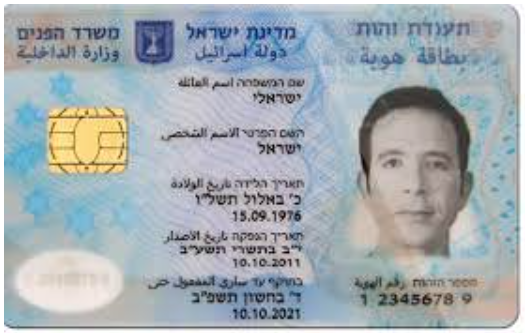 |
| Mispar Zehut (Teudat Zehut) |
H.P. Company Number (TIN for Legal Entities)
Israeli companies registered with the Israeli Corporations Authority (Rashut HaTaagidim) receive a 9-digit company registration number — commonly referred to as the H.P. number (from the Hebrew Hevra Pratit, private company). This number serves as the corporate TIN.
Format: 9 numeric digits with no internal separators or embedded meaning. For VAT-registered companies, the Israel Tax Authority uses the same 9-digit number as the VAT registration identifier. Incorporated companies are identifiable because the first digit is always 5; partnerships and other entities use different leading digits.
The H.P. number appears on the Certificate of Incorporation (Teudat Hitaagdut), all tax filings, VAT returns, and must be printed on every tax invoice (heshbonit mas) issued by the company. A company's registration details — including its H.P. number and registered status — can be searched publicly through the Israeli Corporations Authority register.
VAT Status: Osek Murshe and Osek Patur
Israel's VAT system creates two categories of self-employed dealers and small businesses:
| Category | Hebrew | Description |
|---|---|---|
| Osek Murshe | עוסק מורשה | Authorized dealer — must charge 18% VAT, file VAT returns, and may reclaim input VAT |
| Osek Patur | עוסק פטור | Exempt dealer — below turnover threshold, does not charge VAT, cannot reclaim input VAT |
The VAT registration threshold for Osek Patur is NIS 120,000 per year (adjusted to NIS 122,833 from 2026). Exceeding this threshold triggers a mandatory conversion to Osek Murshe. Certain professions — lawyers, accountants, doctors, architects, and engineers among them — are permanently barred from Osek Patur status regardless of income.
Foreign companies doing business in Israel must register as Osek Murshe from the first taxable transaction, with no minimum threshold. See the FAQ below for foreign registration requirements.
Israeli E-Invoicing: Mispar Haktzaat (Allocation Number)
Israel has implemented a Continuous Transaction Controls (CTC) clearance model known as the Israeli Invoices Model. Before issuing a qualifying B2B tax invoice, the supplier must submit invoice data to the Israel Tax Authority's SHAAM platform (via API or web portal) and obtain a unique allocation number (mispar haktzaat — מספר הקצאה). This number must appear on the issued invoice.
Clearance thresholds:
| Period | Threshold (pre-VAT) |
|---|---|
| From January 2025 | NIS 20,000 |
| From January 2026 | NIS 10,000 |
| From June 2026 | NIS 5,000 |
Invoices above the threshold issued without a valid allocation number are disqualified: the buyer loses the right to deduct input VAT entirely on that transaction, making the full VAT amount an irrecoverable cost. This is the primary enforcement lever — it incentivises buyers to reject non-compliant invoices from suppliers.
Suppliers can request allocation numbers and buyers can verify invoice validity through the Israel Tax Authority's online service.
How Lookuptax can help you in VAT validation?
Lookuptax VAT validation revolutionizes VAT number validation with its robust platform, empowering businesses to seamlessly verify VAT numbers across over 100 countries. Our cutting-edge technology ensures accurate and efficient validation, reducing errors and enhancing compliance.
Frequently Asked Questions
What happens if an Osek Patur exceeds the annual turnover threshold, and can the collected income be kept?
Once an Osek Patur (exempt dealer) crosses the NIS 120,000 annual turnover threshold (NIS 122,833 from 2026), they must immediately notify the VAT office and convert to Osek Murshe status from the date of the breach. The critical trap: invoices already issued under Osek Patur status were issued without VAT, but the now-mandatory Osek Murshe status means VAT is owed retroactively on all income from the crossing date. Because those amounts cannot be reclaimed from customers after the fact, the dealer must pay the VAT liability out of their own pocket. To return to Osek Patur, the business must remain below the threshold for two consecutive years. Certain professions — including lawyers, doctors, architects, and engineers — are permanently ineligible for Osek Patur status regardless of turnover. [1] [2]
Does a foreign company selling into Israel need to register for VAT, and is a local representative mandatory?
Yes on both counts. Under the Israeli Value Added Tax Law, a foreign entity conducting business or activity in Israel must register for VAT with no minimum revenue threshold — the obligation arises from the first taxable transaction. Registration is done via Form 22 (Application to open a VAT file for a foreign trader) with the Israel Tax Authority. Within 30 days of commencing activity, the foreign company must also appoint a local representative who is an Israeli resident; that representative becomes jointly liable for all VAT obligations, including filing returns, remitting tax, and responding to audits. Required registration documents include an apostilled certificate of incorporation, proof of business activity in Israel, passports of directors, and a notarised power of attorney for the representative. Failure to register triggers penalties plus the VAT liability itself. [3] [4]
Does Israel require foreign digital service providers to register for VAT on B2C sales to Israeli consumers?
Not yet under a standalone B2C-digital regime. Israel proposed legislation in the 2023–2024 budget cycle that would impose VAT registration obligations on foreign providers selling digital services (streaming, SaaS, apps) directly to Israeli consumers, but the Knesset did not enact it and the proposal remained pending as of early 2026. Under current law, when a foreign provider sells digitally to a VAT-registered Israeli business (Osek Murshe), the Israeli buyer accounts for VAT via the reverse charge mechanism. When selling B2C to unregistered Israeli consumers, no Israeli VAT registration is currently required of the foreign provider — though this changes if the draft law is eventually passed. Foreign companies with a physical presence or employees in Israel are already subject to full VAT registration from their first taxable transaction. [5] [6]
What is the Israeli e-invoicing allocation number (mispar haktzaat), and what happens to a buyer's VAT deduction without one?
Israel has implemented a continuous transaction controls (CTC) clearance model called the Israeli Invoices Model. Before sending a qualifying tax invoice, the supplier must submit the invoice data to the Israel Tax Authority's SHAAM platform — via API or web portal — and receive a unique allocation number (mispar haktzaat). The threshold requiring clearance is NIS 20,000 before VAT as of January 2025, falling to NIS 10,000 from January 2026 and NIS 5,000 from June 2026. If a supplier issues a qualifying invoice without the allocation number, the buyer loses the right to deduct input VAT on that transaction entirely — the full VAT amount becomes an irrecoverable cost to the purchasing business. The supplier can request allocation numbers and verify invoice details through the Israel Tax Authority online service. [7] [8]
How does an Israeli business or its foreign partner obtain a reduced withholding tax certificate, and what is the default rate?
Israeli payers are legally required to withhold income tax at source from payments for services, royalties, and rent. Without an exemption certificate, the default withholding rate on service payments to Israeli residents can reach 30–35%, and payments to foreign residents on royalties are subject to a standard 25% rate (reducible under an applicable double-tax treaty). To obtain a lower rate, the payee applies to the Israel Tax Authority. Foreign residents use Form 114 (Claim for Reduced Rate of Withholding Tax / Exemption), submitted to the relevant assessing officer with supporting documentation. For ongoing business payments, the Israel Tax Authority's confirmation system (System 1000, accessible via the itc-gmishurim service) provides withholding rate certificates to payers. The certificate specifies the approved reduced rate and validity period; the payer must retain it to justify the reduced deduction in any audit. [9] [10]