Poland TIN number guide
PESEL
Starting from September 1st, 2011, Poland officially recognizes the PESEL number as the tax identification number for natural persons not engaged in business activities or registered for value added tax. The PESEL, an 11-digit numeric identifier, uniquely distinguishes individuals registered in the PESEL database, part of the Common Electronic System of Population Register. Information within this system originates from municipal offices' databases, housing municipal registration records.
The PESEL register has been operational since 1977, housing data of individuals permanently residing in Poland, as well as those with temporary residence exceeding 3 months. Additionally, it includes individuals applying for identity cards, passports, or requiring a social security number as per Polish law. The issuance of PESEL numbers falls under the jurisdiction of the Ministry of Internal Affairs. This structured system ensures efficient tax identification for individuals in Poland.
PESEL Format
-
The PESEL format consists of 11 characters structured as [C1, C2, C3, C4, C5, C6, C7, C8, C9, C10, C11], where each C1 to C11 represents a numeric value. The range for these characters is numeric.
-
The PESEL follows specific rules:
- C1-C2 signify the last two digits of the year of birth.
- C3-C4 denote the month of birth. For birthdates between 1900 and 1999, no modification to C3-C4 is made. For other birthdates:
- 1800-1899: The month field increases by 80.
- 2000-2099: The month field increases by 20.
- 2100-2199: The month field increases by 40.
- 2200-2299: The month field increases by 60.
- The method of coding the month of birth allows for distinguishing at least five centuries.
- The following months in different centuries are represented by specific numbers.
-
The PESEL also includes:
- C5-C6 representing the day of birth.
- C7-C9 denoting an ordinal number.
- C10 indicating the sex, with digits 0, 2, 4, 6, 8 for females and digits 1, 3, 5, 7, 9 for males.
-
To calculate the check digit:
- Multiply the values of each position by the corresponding weight.
- Add up the results.
- Deduct the sum from 10 to obtain the check digit.
-
For example: 02070803628 represents a person born on July 8, 1902, identified as female.
-
01=0, 23=6, 07=0, 79=63, 01=0, 83=24,07=0, 39=27, 61=6 23=6;
-
0+6+0+3+0+4+0+7+6+6=32;
-
10-2=8; Following the calculation steps, the check digit is determined to be 8.
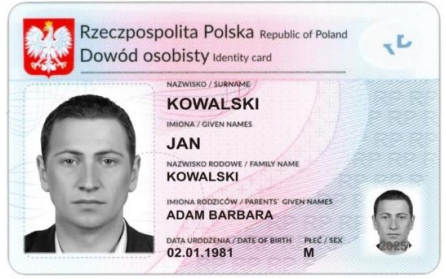 | 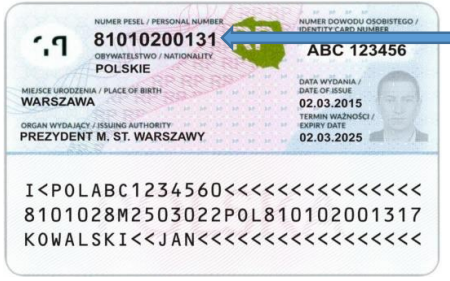 |
| PESEL on Poland ID Card -front | PESEL on Poland ID Card -back |
Numer Identyfikacji Podatkowej (NIP)
Since September 1, 2011, Poland has implemented the issuance of TINs (Numer Identyfikacji Podatkowej or NIP) to various entities, including individuals, legal entities, non-legal entities, and other applicable entities, as per Polish regulations defining them as taxpayers or contributors to social security and health insurance. However, TINs assigned before August 31, 2011, are recognized as tax identification numbers under the regulations outlined in the Act of July 29, 2011, governing registration and identification. Consequently, decisions regarding the allocation of such tax identification numbers remain valid.
NIP Format
TIN Format: The TIN structure follows a specific format represented as [C1, C2, C3, C4, C5, C6, C7, C8, C9, C10], where each C1 to C10 represents a character.
Numeric Range: Each character (C1 to C10) within the TIN format falls within a numeric range.
Syntax: RULE for C10:
- The values of each position are multiplied by their corresponding weights:
- C1: 6
- C2: 5
- C3: 7
- C4: 2
- C5: 3
- C6: 4
- C7: 5
- C8: 6
- C9: 7
- The results of these multiplications are summed up.
- The modulo 11 of the previous sum is obtained.
- The remainder serves as the check digit (if the remainder is 10, the TIN is deemed invalid).
SAMPLE: For example, consider TIN 2234567895:
- Calculating the products: 26=12, 25=10, 37=21, 42=8, 53=15, 64=24, 75=35, 86=48, 9*7=63.
- Summing up these products: 12+10+21+8+15+24+35+48+63=236.
- Obtaining the modulo 11 of the sum: 236 % 11 = 5.
- The check digit is determined as 5.
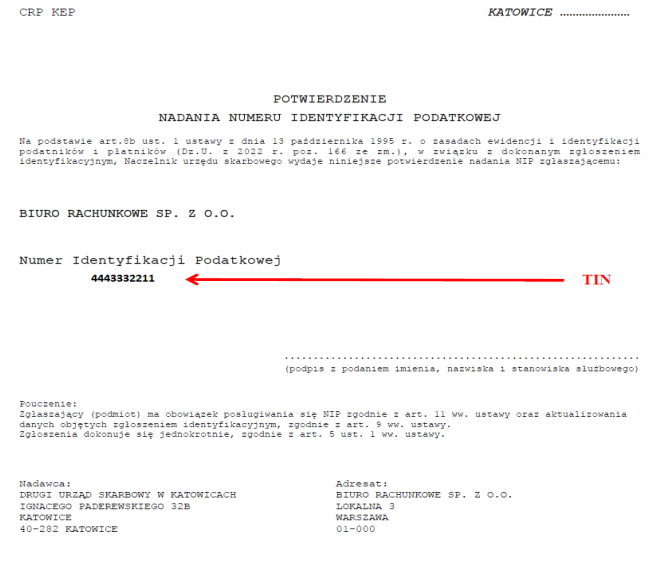 |
| NIP for Entities |
Official Database
Example : 5272525357
KRS (Krajowy Rejestr Sądowy) Number
The KRS, known as the National Court Register Number in Poland, is a distinctive identifier allocated to legal entities, including companies, partnerships, and associations, upon registration in the National Court Register. This registry provides comprehensive details about the structure, governance, and financial status of these entities. Managed by the National Court Register (Ministerstwo Sprawiedliwości), the KRS serves as a vital repository of legal and financial data, facilitating easy access to essential information about registered entities.
Example : 0000268708
REGON
The REGON (Rejestr Gospodarki Narodowej) serves as the comprehensive registry for national economic entities within the Republic of Poland. Established for statistical purposes, this registry is overseen by the Main Statistics Office of Poland - GUS.
The identification number for entities within the national economy comprises 9 digits, allocated to legal persons, organizational entities lacking legal personality, or natural persons engaged in economic activities. The initial eight digits form an ordinal, while the ninth digit acts as a validation code.
For local units, the identification number spans 14 digits. The first nine digits correspond to the ID number of the legal person, organizational entity without legal personality, or natural person conducting economic activities that established the local unit. Subsequently, four digits represent the ordinal assigned to the local unit, with the fourteenth digit serving as a validation code for the entire local unit number.
Example : 140762164
How Lookuptax can help you in VAT validation?
Lookuptax VAT validation revolutionizes VAT number validation with its robust platform, empowering businesses to seamlessly verify VAT numbers across over 100 countries. Our cutting-edge technology ensures accurate and efficient validation, reducing errors and enhancing compliance.
Frequently Asked Questions
I am a foreigner employed in Poland — should I use PESEL or NIP on my tax return?
Since 2012, individual employees and persons without registered business activity use their PESEL number as the sole tax identifier for personal income tax (PIT) purposes in Poland. NIP is reserved for entrepreneurs, VAT payers, and legal entities. If you have worked in Poland for more than two months and registered your stay, a PESEL is assigned automatically and must appear on your PIT return — submitting a NIP instead causes the return to be rejected or misrouted. Only apply for a NIP via form NIP-7 if you operate as self-employed, a sole trader, or a VAT taxpayer without a PESEL entitlement. [1] [2]
Does a foreign company with no Polish establishment need to register for VAT before making its first taxable sale in Poland?
Yes. Poland applies a nil registration threshold for non-established businesses — unlike Polish residents who have a PLN 200,000 annual exemption. Any single taxable transaction (import, local supply, intra-EU movement, or use of a domestic warehouse) triggers an immediate obligation to register for VAT and obtain a NIP. The foreign entity submits form NIP-2 (company) or NIP-7 (individual) together with form VAT-R and an extract from the home-country business register. Failure to register before the first supply exposes the company to back-VAT assessment plus penalty interest. [1] [2]
Why is my Polish client withholding 20% from my invoice, and how do I reduce it?
Under Article 21(1) of the Corporate Income Tax Act, Polish payers must withhold tax at 20% on payments to non-residents for royalties, know-how licences, consulting, management, and other specified intangible services — unless a double-tax treaty (DTT) provides a lower rate or full exemption. To claim DTT relief, the foreign payee must supply a valid tax residency certificate issued by their home-country tax authority before payment. Without that certificate, the Polish payer is legally obliged to apply the full 20% rate, and the Supreme Administrative Court confirmed in August 2025 (case II FSK 47/23) that no substitute document is accepted. Submit the certificate promptly to avoid the default rate. [1] [2]
My invoice exceeds PLN 15,000 and includes goods from Annex 15 — what must I do to avoid a 30% penalty?
When a B2B invoice gross value exceeds PLN 15,000 and at least one line item appears on Annex 15 of the VAT Act (sensitive goods such as steel, electronics, fuel, and construction services), the seller must print the annotation "mechanizm podzielonej płatności" on the invoice and the buyer must pay via a split-payment bank transfer that routes the VAT portion to the seller's dedicated VAT account. The seller's NIP is mandatory in the payment message. Non-compliance — either omitting the annotation or paying outside split payment — triggers an additional liability of 30% of the VAT amount on those line items for both parties. The mandatory split-payment regime is confirmed extended until 28 February 2028. [1] [2]
When does KSeF mandatory e-invoicing apply, and what happens if my ERP is not ready on time?
Poland's Krajowy System e-Faktur (KSeF) became mandatory in two phases: from 1 February 2026 for businesses whose 2024 sales (including VAT) exceeded PLN 200 million, and from 1 April 2026 for all other VAT-registered entities. Micro-enterprises follow from 1 January 2027. From 1 February 2026, all VAT-registered businesses must also accept KSeF-issued invoices regardless of their own phase. Formal financial penalties for non-compliant invoice issuance take effect from 1 January 2027, giving businesses a grace window — but non-KSeF invoices issued during the grace period carry a higher evidentiary burden in VAT audits and may delay refunds. The NIP number is the primary identifier embedded in every KSeF document. [1] [2]