Saudi Arabia TIN number guide
Tax Identification Number (TIN)
The Tax Identification Number (TIN) is issued by the General Authority for Zakat and Tax (GAZT) to all taxpayers and withholding entities, including government ministries, agencies, and departments, in Saudi Arabia. Once issued, the TIN remains valid for as long as the taxpayer is operational. It serves as the unique identifier for the taxpayer and is utilized for all applicable taxes.
The structure of the Saudi Tax Identification Number (TIN) is as follows:
- The first digit represents the GCC Member State.
- The next eight digits comprise a serial number.
- The final digit is a check digit.
Example : 3002707692
 |
| VAT registration certificate with TIN in Sauidi Arabia |
The Tax Identification Number (TIN) can be found on various official documents such as TAX, Zakat, excise tax, or VAT Certificates and invoices. With the forthcoming implementation of VAT in 2018, Saudi Arabia will include the TIN on relevant documents. Additionally, the TIN appears in communications between the General Authority for Zakat and Tax (GAZT) and taxpayers, as well as on any documents issued by GAZT to taxpayers.
For individuals without a TIN, official identification documents like the Saudi national ID or residency ID for non-Saudis serve as alternatives. If the physical Saudi national ID is unavailable for verification, a copy of the national ID along with Saudi passport verification becomes necessary.
VAT number
Businesses in Saudi Arabia are assigned a VAT number, a 15-digit identifier provided by ZATCA (Zakat, Tax and Customs Authority). The VAT number's structure comprises various elements:
- The first digit denotes the GCC Member State.
- The following eight digits form a serial number.
- The subsequent digit serves as a check digit.
- The next three digits represent the taxpayer's subsidiaries.
- The final two digits indicate the tax type.
Individuals in Saudi Arabia are issued a 12-digit personal Tax Identification Number (TIN), known locally as the "National ID" or "Iqama" in Arabic. The TIN consists of:
- The first two digits indicating the individual's region of residence.
- The following 10 digits comprising a unique identification number assigned by ZATCA.
Example : 300000432310003
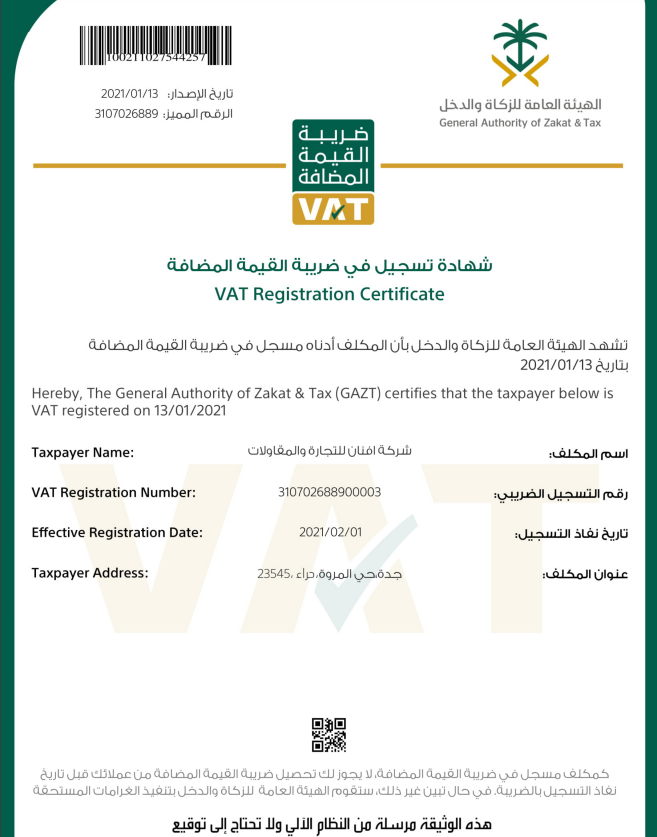 |
| VAT registration certificate in Sauidi Arabia |
How Lookuptax can help you in VAT validation?
Lookuptax VAT validation revolutionizes VAT number validation with its robust platform, empowering businesses to seamlessly verify VAT numbers across over 100 countries. Our cutting-edge technology ensures accurate and efficient validation, reducing errors and enhancing compliance.
Frequently Asked Questions
Does a foreign company selling digital services to Saudi consumers need to register for VAT even with zero Saudi revenue at launch?
Yes — there is no minimum turnover threshold for non-resident suppliers of electronically supplied services (ESS). VAT registration with ZATCA becomes mandatory within 30 days of the very first B2C supply to a Saudi consumer, regardless of amount. [1] B2B cross-border sales are handled by the reverse-charge mechanism, so the Saudi business customer accounts for VAT and the foreign supplier bears no Saudi VAT liability on those transactions. For B2C, the standard 15% VAT rate applies from day one, and a local tax representative must be appointed during registration. Failure to register before the first sale is a compliance violation subject to ZATCA penalties. [2]
How are Zakat and Corporate Income Tax split in a company with both Saudi and foreign shareholders?
ZATCA applies a proportional apportionment: the Saudi and GCC shareholders' share of the Zakat base is subject to Zakat at 2.5%, while the foreign shareholders' share of net taxable profit is subject to Corporate Income Tax (CIT) at 20%. [3] The two taxes are calculated on entirely different bases — Zakat is computed on equity, retained earnings, and certain liabilities (not just profits), so a loss-making year still generates a Zakat liability if the Zakat base is positive. Both obligations are filed separately with ZATCA. Mixed-ownership joint ventures frequently under-report Zakat by mistakenly applying CIT logic to the Saudi share; ZATCA audits specifically look for this. [4]
What withholding tax rate applies when a Saudi company pays a foreign service provider, and when is it due?
Withholding tax (WHT) rates depend on payment type: royalties and management fees carry 15–20%, rent and dividends 5%, and most other services sourced in the Kingdom 15%. [5] The Saudi-resident payer, not the foreign recipient, is responsible for deducting and remitting WHT to ZATCA within the first 10 days of the following month. Late payment attracts a penalty of 1% of unpaid tax per 30-day period, plus an additional 25% surcharge if ZATCA determines the delay constitutes tax evasion. Foreign suppliers should gross up invoices to account for expected WHT deductions, as the net received will be lower than the invoice face value. [6]
Which businesses are now inside Phase 2 of ZATCA's Fatoora e-invoicing mandate, and what does clearance require?
Phase 2 (the "Integration Phase") rolls out in waves based on annual VAT revenue. As of 2026, Wave 22 (SAR 1–1.25 million turnover, deadline 31 December 2025), Wave 23 (SAR 750,000–1 million, deadline 31 March 2026), and Wave 24 (SAR 375,000–750,000, deadline 30 June 2026) are in scope. [7] For standard B2B/B2G invoices, real-time clearance is required: the invoice XML must be submitted to the Fatoora portal and a Cryptographic Stamp ID (CSID) returned before the invoice is issued to the buyer. A cleared invoice cannot be reused — rejected invoices require a new UUID and invoice counter value. Simplified B2C invoices must be reported to ZATCA within 24 hours. [8]
Can Saudi-resident subsidiaries of the same group file a single VAT return as a VAT group?
Yes. Under the VAT Implementing Regulations, ZATCA permits VAT grouping where all members are legal residents of Saudi Arabia, all carry on an economic activity, and at least one member independently exceeds the mandatory registration threshold (SAR 375,000 annual taxable supplies). [9] The group is treated as a single taxable person — intra-group transactions are disregarded for VAT, and the group files one combined return netting the output and input VAT of all members. Control is defined as more than 50% ownership or voting rights. Non-resident entities cannot join a Saudi VAT group even if they have a branch in the Kingdom, and each member remains jointly and severally liable for the group's VAT obligations. [10]