How to verify RNC in Dominican Republic?
RNC check on Impuestos Internos website
The RNC (Registro Nacional de Contribuyentes) is the Dominican Republic's taxpayer identification number, issued by the DGII (Dirección General de Impuestos Internos — Internal Revenue). The DGII portal provides free, instant RNC verification by number, cédula, or company name.
- Access the Tool: Go to the DGII RNC Consultation Portal.
- Enter Search Terms: Search by RNC number (9 digits for legal entities, e.g.
133-03201-5), 11-digit cédula (for natural persons), or company name. All three search modes are supported. - Review the Result: A successful lookup returns:
- ID/RNC
- Company name
- Tradename
- Category
- Payment regime (Régimen Ordinario or RST — see FAQ below)
- State (Active, Suspendido, Dado de Baja)
- Economic activity
- Local Management
- Electronic Billing authorization
- VHM Marketing Licenses
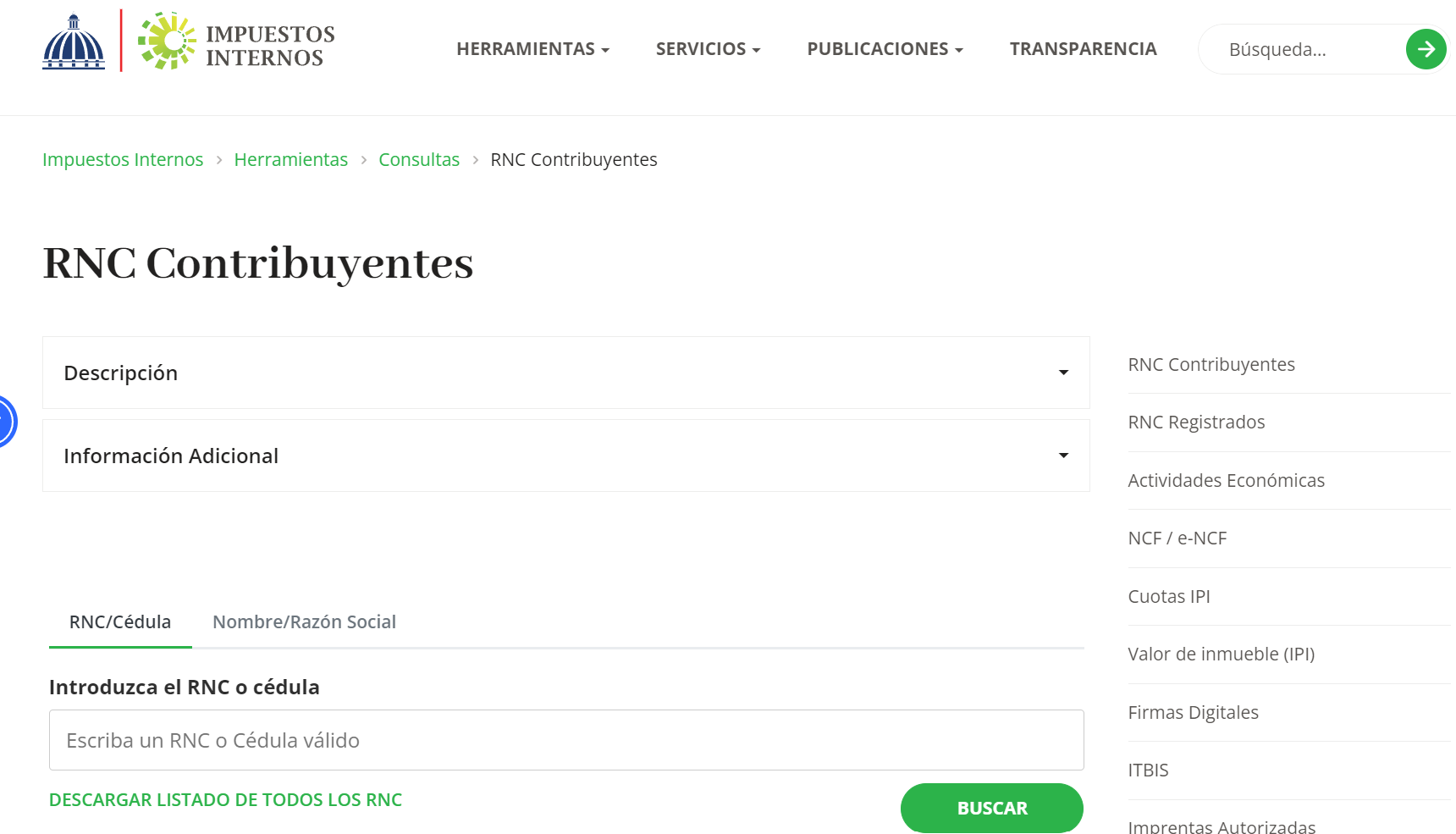 |
| RNC Verification on DGII |
Example RNC numbers: 133-03201-5, 132-37391-1
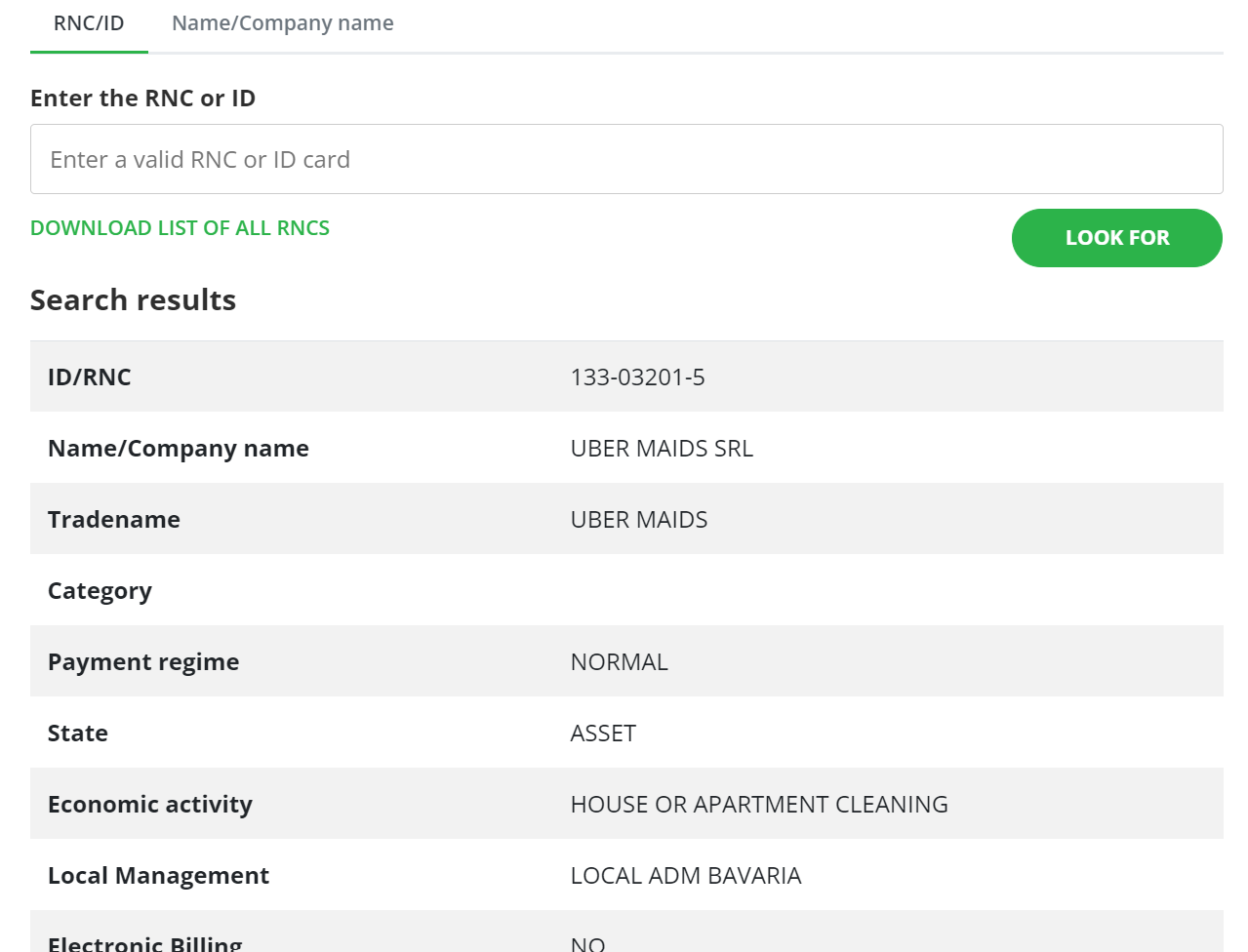 |
| Successful RNC Verification on DGII |
The Estado (State) field is critical for compliance. Only an Active RNC permits valid invoice issuance and ITBIS credit. A Suspendido status means outstanding tax returns; a Dado de Baja status means permanent deregistration. See the FAQ below for buyer consequences.
Frequently Asked Questions
When does a natural person use their cédula as their tax ID vs. needing a separate 9-digit RNC?
For Dominican citizens and resident individuals, the 11-digit cédula de identidad y electoral is itself the tax ID — it functions as the RNC for natural persons. No separate number is issued. The distinction that matters is registration status: all individuals are automatically listed in the DGII registry as "Registrados," but anyone conducting a regular economic activity — freelancing, operating a business, issuing recurring invoices — must activate their profile as a "Contribuyente" through the DGII's Virtual Office (Oficina Virtual), which triggers periodic tax filing obligations (income tax, ITBIS if applicable). A 9-digit RNC is only issued to legal entities (companies, NGOs, branches) and to foreigners who lack a Dominican cédula. When you look up an individual on the DGII portal and see their 11-digit cédula returned, that is the correct tax ID. [1]
What does the "Payment Regime" field in the DGII lookup mean, and does it affect my obligations when paying that supplier?
The Payment Regime field shows one of two classifications. Régimen Ordinario means the supplier files full monthly and annual tax returns — the standard regime for most companies. Régimen Simplificado de Tributación (RST) means the supplier is a smaller taxpayer under Decree 265-19, with annual gross income below approximately RD$11.1 million (2024 income threshold). The RST classification has a direct impact on you as the buyer: when a non-RST legal entity buys goods or services from an RST-registered supplier, the buyer must withhold 100% of the ITBIS shown on the invoice and remit it directly to the DGII, because RST contributors cannot credit or deduct ITBIS themselves. RST invoices must visibly state "Contribuyente Acogido al Régimen Simplificado de Tributación." Checking the regime field before processing a supplier payment prevents incorrect ITBIS treatment and potential penalties. [1]
Does having an RNC automatically mean a company is registered for ITBIS?
No. An active RNC does not automatically confer ITBIS collector status. ITBIS (Impuesto sobre Transferencias de Bienes Industrializados y Servicios) registration is a separate step: once an entity holds an RNC, it must declare which economic activities it carries out, and only if those activities involve taxable transfers of goods or services does the entity become an ITBIS taxpayer. There is no minimum-revenue threshold to trigger ITBIS registration in the Dominican Republic. The DGII RNC lookup does not return a dedicated "ITBIS registered: yes/no" field. The closest proxy is the Economic Activity field, which reveals whether the declared business involves goods or services subject to ITBIS at 18%. For conclusive ITBIS verification, request a DGII-issued tax compliance certificate (Certificación de Cumplimiento) directly from the supplier, or check their Electronic Billing field — entities authorized for e-CF issuance must be current on all tax obligations. [1]
Does a foreign company operating in the Dominican Republic need its own RNC?
Yes. Any foreign company engaging in regular commercial activity in the Dominican Republic — whether through a subsidiary (sociedad dominicana) or a registered branch (sucursal) — must obtain an RNC. The Mercantile Registry under Law 3-02 on Commercial Registration is a prerequisite: the company must first register with the local Chamber of Commerce (Cámara de Comercio), then present that registration to DGII. Required documents include: apostilled and Spanish-translated copies of the foreign incorporation certificate, a Certificate of Validity from the country of origin, a notarized power of attorney designating a Dominican legal representative, and passports of board members. Processing time for the DGII step is approximately 10 business days. Foreign companies conducting only isolated or occasional transactions are exempt from this requirement under Law 3-02, but that exemption does not cover income earned from Dominican sources, which remains subject to 27% withholding tax. [1] [2]
What does "Estado: Suspendido" mean, and can I safely process invoices from a suspended RNC holder?
"Suspendido" means the DGII has administratively suspended the taxpayer's RNC, most commonly because they have not filed tax returns for 18 or more consecutive months (under Norma General 04-23). A suspended entity cannot obtain new fiscal receipt sequences (comprobantes fiscales / e-NCF) from DGII. The critical buyer consequence: that entity cannot deduct the expense or credit the ITBIS while suspended, and you cannot report that purchase on Form 606 using standard fiscal credit NCF types — exposing you to audit risk. Reactivation requires the supplier to file outstanding declarations for the last three years; no penalty fee applies and reactivation is automatic the following business day. A separate status, "Dado de Baja" (deregistered), is permanent and cannot be reversed through the self-service process. [1]
How does the RNC connect to the Dominican Republic's e-CF electronic invoicing mandate?
The Electronic Billing field in the DGII RNC lookup indicates whether the taxpayer has been authorized to issue e-CF (Comprobantes Fiscales Electrónicos). Every valid e-CF must carry the issuer's RNC and an e-NCF sequence assigned exclusively by DGII — which first validates the issuer's active RNC. Law 32-23 (enacted May 2023) made e-CF mandatory in phases: large national taxpayers by May 2024, large local and medium taxpayers by November 2025 (extended via Notice 12-25 from May 2025), and small, micro, and unclassified taxpayers by May 15, 2026. A supplier still issuing paper NCF after their applicable deadline is non-compliant, and those invoices carry audit risk as deductible expenses for the buyer. Unlike the old NCF system, e-CF is digitally signed, transmitted to DGII in real time, and validated against the issuer's active RNC and authorized e-NCF range. [1] [2]
When paying a Dominican supplier, does their RNC status affect the withholding tax rates I must apply?
Yes, directly. The supplier's RNC status and registration type determine both ITBIS and income-tax withholding treatment. Payments to non-resident entities without a Dominican RNC are subject to 27% income-tax withholding (final). For resident suppliers under RST, buyers in Régimen Ordinario must withhold 100% of invoiced ITBIS. For most corporate-to-corporate services, 30% of ITBIS is withheld and remitted. If the DGII lookup shows the RNC is Suspendido or Dado de Baja, processing their invoices through standard accounts-payable workflows creates deduction-disallowance risk. For payment processors, Norma General 06-23 requires withholding 18% ITBIS on the full invoiced amount when the affiliate lacks a valid active RNC — vs. the reduced 2% for registered suppliers. Double Tax Treaties may reduce rates for non-resident payments where applicable. [1] [2]
How Lookuptax can help you in RNC validation?
Lookuptax RNC validation revolutionizes RNC number validation with its robust platform, empowering businesses to seamlessly verify RNC numbers across over 100 countries. Our cutting-edge technology ensures accurate and efficient validation, reducing errors and enhancing compliance.