How to verify VATIN in Oman?
This post is also available in: Español|中文|Deutsch|Português|Français
VATIN verification on TaxOman website
You can check the validity of a VATIN on the TaxOman website for free. You can access the VATIN lookup service here. Using this tool you can search for a company by the VATIN. This lookup tool also supports search by Tax Card Number.
To verify an Oman VATIN:
- Go to the TaxOman Tax Data Validation portal.
- Enter the VATIN (e.g.
OM1100000300) or the related Tax Card Number. - Submit — the result appears with a timestamp.
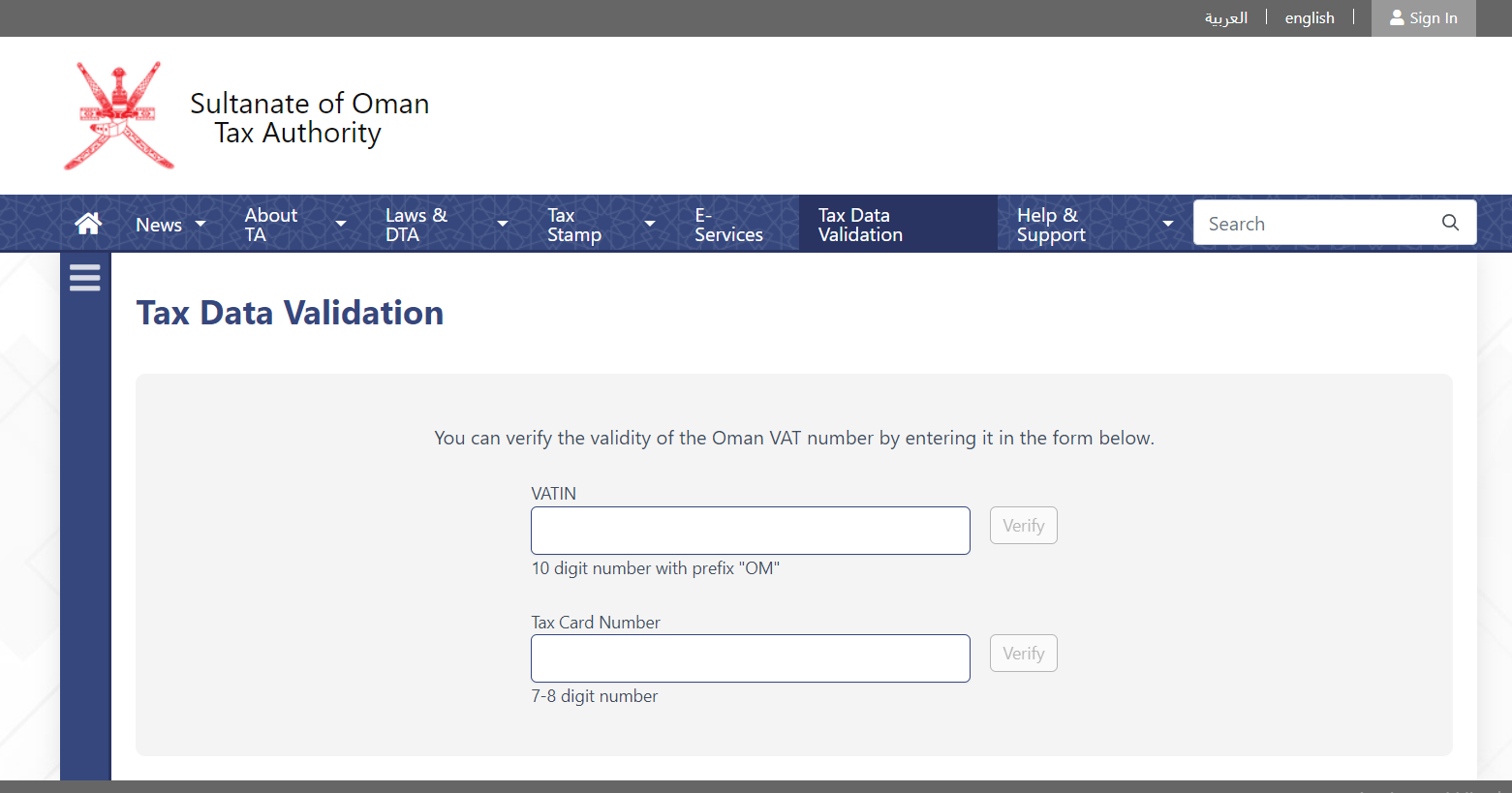 |
| VATIN lookup |
Example VATIN: OM1100000300
A successful verification of the VATIN on the TaxOman lookup tool will return the following details:
- Name
- VATIN
- Effective Date
- Timestamp
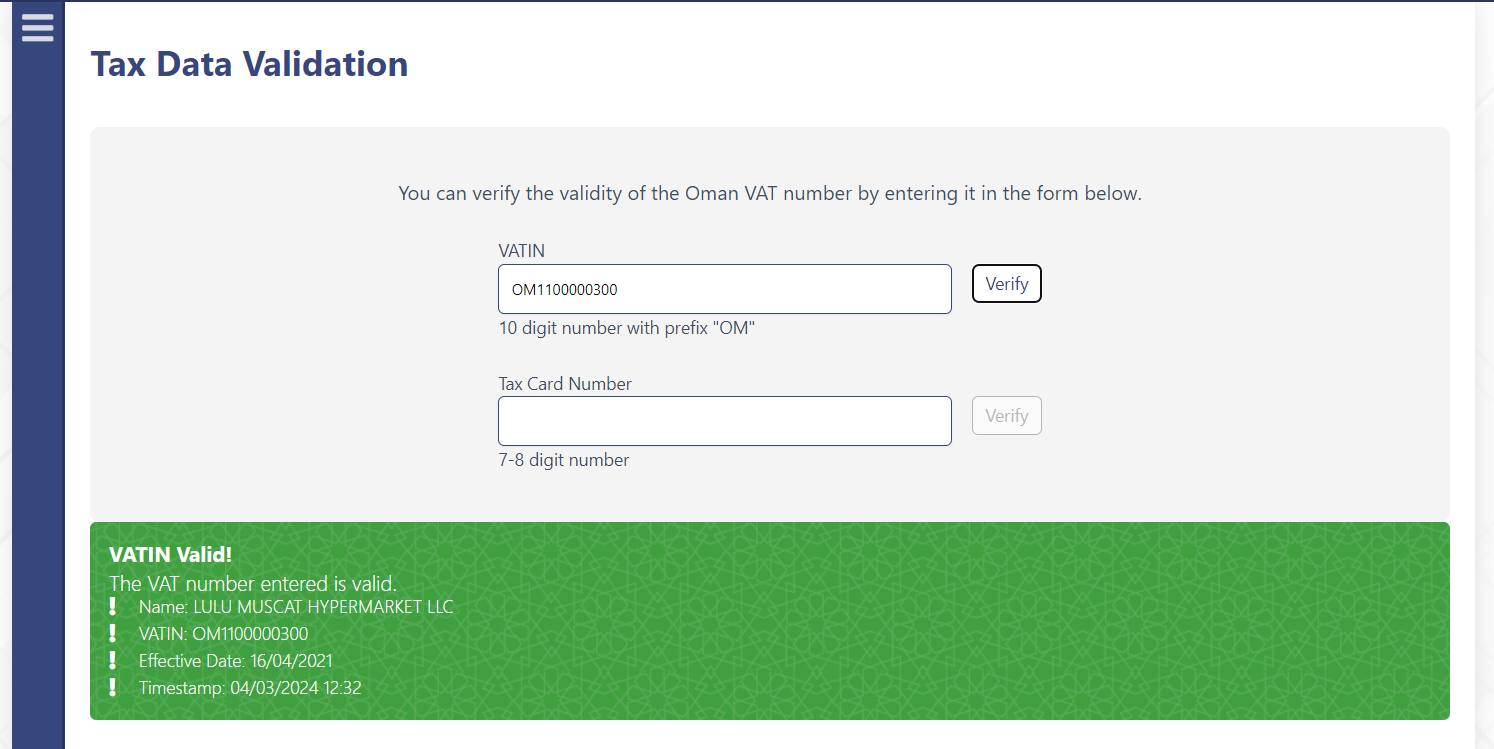 |
| Successful VATIN Verification |
For more details on Oman tax identifiers, see our Oman Tax ID Guide.
Frequently Asked Questions
What is the format of an Oman VATIN, and how is it structured?
An Oman VATIN is 12 characters: OM prefix followed by 10 digits (e.g. OM1100000300). The OM prefix distinguishes it from other GCC VAT systems. The numeric portion is assigned sequentially by the Oman Tax Authority (OTA). The VATIN must appear on all VAT invoices alongside the 5% tax rate and VAT amount in OMR. [1]
What does the "Effective Date" mean in the VATIN verification result?
The Effective Date is when the supplier's VAT registration became active — the date they were legally authorized to charge Oman VAT and issue VAT invoices. For input tax credit (ITC) purposes: any VAT charged on an invoice dated before the supplier's Effective Date cannot be claimed as ITC, because the supplier was not registered at that time. Always confirm the Effective Date when verifying VATINs for new suppliers. [1]
My Oman supplier's VATIN is not found on the TaxOman portal — what should I do?
Possible causes: (1) Format issue — try searching by Tax Card or TIN if the VATIN search fails; (2) New registration lag — new VAT registrations may take 3–7 days to appear in the public portal; (3) Deregistered — the supplier may have deregistered voluntarily or due to non-compliance; (4) Wrong number — confirm from the supplier's OTA-issued VAT registration certificate. If genuinely not found, treat the invoice as non-VAT and do not claim ITC. [1]
Can I claim input tax credits on VAT paid to a supplier whose VATIN I have not verified?
Under Oman's VAT Law (Royal Decree 121/2020), ITC can only be claimed on VAT from registered suppliers. The OTA may disallow credits where the supplier's VATIN was not active, and the payer bears responsibility for verification. Keep the TaxOman verification result (with its timestamp) as audit evidence for each supplier. For ongoing supplier relationships, periodically re-verify the VATIN to confirm continued active registration. [1]
Are GCC VAT numbers (Oman, Saudi, UAE) interchangeable?
No. Each GCC country has its own independent VAT system. Oman VAT (5%, OM + 10 digits), Saudi Arabia VAT (15%, 15-digit TIN), and UAE VAT (5%, 15-digit TRN) are entirely separate — being registered in one country does not confer any VAT status in another. Businesses operating across multiple GCC countries must register separately in each and maintain distinct VATINs. [1]
What must an Oman VAT invoice include for ITC to be valid?
A valid Oman VAT invoice must include: (1) "Tax Invoice" in Arabic and/or English; (2) Supplier name, address, and VATIN; (3) Invoice date and unique sequential number; (4) Customer name and address; (5) Description of goods/services, quantity, unit price; (6) Total before VAT; (7) VAT rate (5%) and VAT amount in OMR; (8) Total including VAT. For B2B ITC claims, the buyer's VATIN should also be included. Simplified invoices (without buyer details) are permitted for retail sales under OMR 500. [1]
How Lookuptax can help you in VAT validation?
Lookuptax VAT validation revolutionizes VAT number validation with its robust platform, empowering businesses to seamlessly verify VAT numbers across over 100 countries. Our cutting-edge technology ensures accurate and efficient validation, reducing errors and enhancing compliance.