Malaysia TIN Number Guide — Nombor Pengenalan Cukai (NPC)
This post is also available in: 中文
Nombor Pengenalan Cukai (NPC)
Malaysia's Tax Identification Number (TIN) is administered by the Inland Revenue Board of Malaysia (IRBM), known locally as Lembaga Hasil Dalam Negeri (LHDN). The official Malay name is Nombor Pengenalan Cukai (NPC). Every individual and entity with tax obligations in Malaysia must hold a TIN, which is used across income tax filings, payroll deductions (PCB/MTD), and the MyInvois e-Invoice system.
Individual TIN Format (IG Prefix)
Individual TINs begin with the prefix IG followed by 9–11 numeric digits, giving a total length of 11–13 characters.
| Example | Characters |
|---|---|
| IG115002000 | 11 |
| IG4040080091 | 12 |
| IG56003500070 | 13 |
Important prefix change (effective 1 January 2023): LHDN converted all individual taxpayer prefixes from the legacy codes SG (non-business income) and OG (business income) to the unified IG prefix. The numeric portion of the TIN is unchanged. Any billing system, ERP, or payroll platform still holding SG or OG prefixed numbers must update them before submitting documents to the MyInvois portal, which validates TINs in real time. [1]
Non-Individual TIN Format (Entity Codes)
Non-individual TINs consist of a letter code followed by 8–11 numeric digits, totalling 11–12 characters. From 2023, a trailing "0" was appended to existing numbers, extending many to 12 characters.
| Entity Type | TIN Code | Example |
|---|---|---|
| Companies | C | C20880050010 |
| Cooperative Societies | CS | — |
| Partnerships | D | D4800990020 |
| Employers | E | E91005500060 |
| Associations | F | F10234567090 |
| Non-Resident Public Entertainers | FA | — |
| Limited Liability Partnerships | PT | — |
| Trust Bodies | TA | — |
| Unit Trusts / Property Trusts | TC | — |
| Business Trusts | TN | — |
| Real Estate Investment Trusts / Property Trust Funds | TR | — |
| Deceased Person's Estate | TP | — |
| Hindu Joint Families | J | — |
| Labuan Entities | LE | — |
TIN Lookup
The Nombor Pengenalan Cukai can be searched free of charge at the MyTax portal (mytax.hasil.gov.my) under the e-Daftar menu. Registration applications for individuals are processed online only from 1 January 2024 and are typically completed within three working days. [2]
National Registration Identity Card Number (NRIC / MyKad)
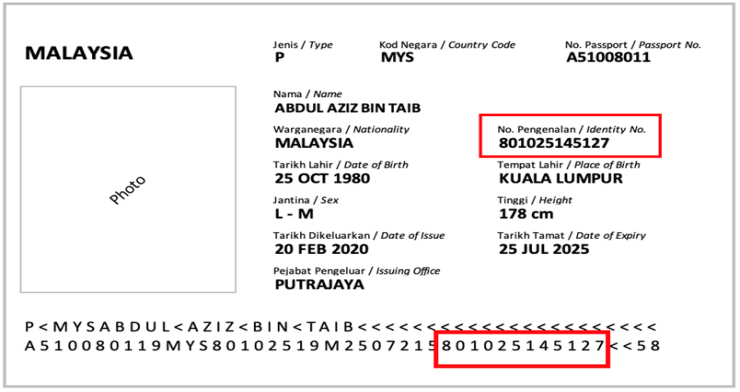
The NRIC Number (MyKad number) is a unique 12-digit number issued to Malaysian citizens and permanent residents. LHDN uses the NRIC as a taxpayer identifier in the absence of a formal TIN — for example, when a taxpayer has not yet registered but must be identified on a payroll or withholding return.
The NRIC appears on the Malaysian identity card (MyKad) and on the data page of the Malaysian passport.
NRIC format: YYMMDD-PB-XXXX
YYMMDD— date of birthPB— state and place of birth code (two digits)XXXX— unique sequence with last digit encoding gender (odd = male, even = female)
 |
| NRIC on Passport |
SST Registration Number
The Sales and Service Tax (SST) Registration Number is a 15-character alphanumeric identifier issued by the Royal Malaysian Customs Department (RMCD).
Format: W24-1808-32000049
The middle section encodes the year and month of registration. The SST rate on taxable services is 8% (increased from 6% on 1 March 2024). Foreign digital service providers are registered separately through the MySToDS portal and receive a distinct Foreign Registered Person (FRP) reference number rather than a standard SST number.
For verification of company registration numbers, RMCD's companion identifier is the SSM Registration Number issued by Suruhanjaya Syarikat Malaysia — see the Malaysia Registration Number verification guide.
MyInvois e-Invoice System
Malaysia's national e-invoicing mandate requires qualifying taxpayers to submit invoices through the MyInvois platform operated by LHDN. The system validates the buyer's and seller's TINs via API before issuing a validated QR-coded e-Invoice. Rollout is phased by annual turnover:
| Phase | Annual Turnover | Effective Date |
|---|---|---|
| 1 | Above RM 100 million | 1 August 2024 |
| 2 | RM 25 million – RM 100 million | 1 January 2025 |
| 3 | RM 5 million – RM 25 million | 1 July 2025 |
| Exempt | Below RM 1 million | Exempt |
Businesses with turnover below RM 1 million are exempt from the e-Invoice mandate. [3]
How Lookuptax can help you in VAT validation?
Lookuptax VAT validation revolutionizes VAT number validation with its robust platform, empowering businesses to seamlessly verify VAT numbers across over 100 countries. Our cutting-edge technology ensures accurate and efficient validation, reducing errors and enhancing compliance.
Frequently Asked Questions
Why does my e-Invoice submission to MyInvois get rejected for an invalid TIN when the number looks correct?
The most common cause is submitting an individual TIN with the legacy SG or OG prefix. From 1 January 2023, LHDN converted all individual taxpayer prefixes to IG — so SG12345678 becomes IG12345678 while the numeric digits stay unchanged. If your billing system still stores the old prefix, MyInvois returns a validation error and rejects the document outright. LHDN recommends calling the Validate Taxpayer TIN API before every submission to detect stale prefixes in real time. [1] [4]
Do foreign digital service providers need to register with Malaysian Customs even with no office in Malaysia?
Yes. The Service Tax on Digital Services (SToDS) applies to any foreign provider whose annual value of digital services to Malaysian consumers exceeds RM 500,000 — regardless of physical presence. Registration through the MySToDS portal is mandatory at that threshold, and the current rate is 8% (raised from 6% on 1 March 2024). The tax covers both B2C and B2B transactions, so foreign SaaS sellers cannot assume that billing a Malaysian company exempts them. Non-registration exposes the provider to fines of up to RM 50,000 or up to three years' imprisonment per offence. [5] [6]
What withholding tax must a Malaysian company deduct when paying a non-resident for contract services?
Under Section 107A of the Income Tax Act 1967, a resident payer making a contract payment to a non-resident contractor for services performed in Malaysia must withhold 10% on account of the contractor's tax and an additional 3% on account of the contractor's employees — a combined 13%. Both amounts must be remitted to LHDN within one month of payment. If the payer fails to withhold and remit, LHDN can disallow the expense deduction and impose a penalty of up to 45% of the under-declared tax under ITA subsection 113(2). [7] [8]
A foreign employee worked in Malaysia for 170 days — should the employer use the resident or non-resident PCB rate?
The employer must use the non-resident flat rate of 30%. Malaysia's tax residency test under Section 7 of the Income Tax Act 1967 requires physical presence of at least 182 days in the calendar year. An employee who logs 170 days — even across multiple visits — does not qualify and is assessed as a non-resident with no entitlement to personal reliefs or progressive tax bands. Applying the resident PCB tables to a non-resident constitutes under-withholding, which can attract penalties of RM 200 to RM 20,000 for each incorrect deduction. The separate 90-day rule applies only to individuals who were already tax-resident in three of the four preceding years. [9] [8]
Does the MyInvois e-Invoice mandate apply to small businesses and sole traders?
The mandate is phased by annual turnover. Taxpayers above RM 100 million were required from 1 August 2024; those between RM 25 million and RM 100 million from 1 January 2025; those between RM 5 million and RM 25 million from 1 July 2025. Businesses with annual turnover below RM 1 million are currently exempt from issuing e-Invoices. Buyers have 72 hours after validation to request rejection with a stated reason; suppliers then have 72 hours to cancel and reissue. Effective 1 January 2026, individual e-invoices are mandatory for transactions above RM 10,000, and consolidated invoices are no longer permitted for those transactions. [3] [4]