Peru TIN number guide
This post is also available in: Español
Registro Único del Contribuyente (RUC)
In Peru, individuals, legal entities, and other entities adhere to the guidelines set by the Single Taxpayers' Registry Law, specifically Legislative Decree 943 (governed by Superintendence Resolution No. 210-2004/SUNAT). Registration in the Single Taxpayers' Registry (RUC) is a mandatory step for obtaining tax registration. The National Superintendence of Customs and Tax Administration (SUNAT) is responsible for overseeing and managing this registry.
RUC Format The RUC in Peru is an 11-digit identifier, organized into distinct structures: a) For individuals using DNI for identification: Prefix 10 + DNI + verification digit. b) Individuals using other identity documents: Prefix 15 + random number + verification digit. c) Legal entities: Prefix 20 + random number + verification digit.
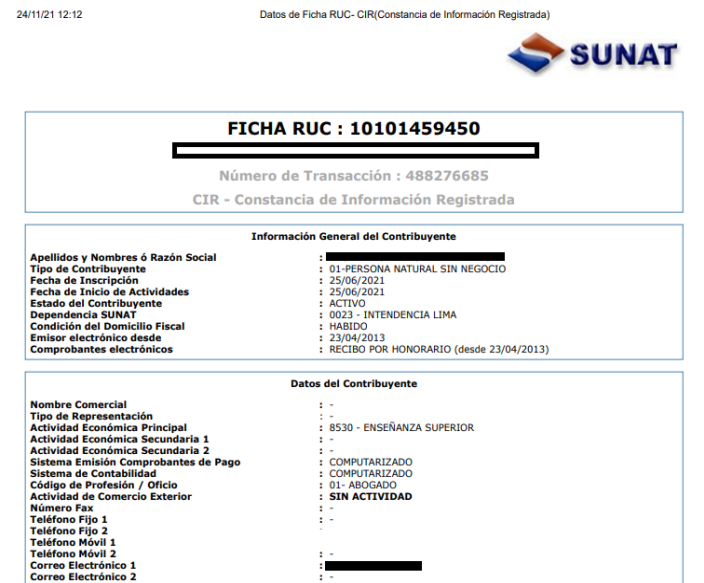 |
| Registered Information Voucher (CIR) |
Official Database RUC Search
How Lookuptax can help you in VAT validation?
Lookuptax VAT validation revolutionizes VAT number validation with its robust platform, empowering businesses to seamlessly verify VAT numbers across over 100 countries. Our cutting-edge technology ensures accurate and efficient validation, reducing errors and enhancing compliance.
Frequently Asked Questions
Can a foreigner register for a RUC before obtaining a residence visa, or is there a Migraciones–SUNAT catch-22?
This is a documented blocker for foreigners applying for an independent-worker (trabajador independiente) residence visa: Migraciones may require a personal RUC number as part of the application, yet SUNAT will only issue a RUC to foreigners who already hold a valid carné de extranjería or residence document. SUNAT offices have confirmed the conflict exists. The practical workaround is to apply first for a work permit or temporary residency category that does not require a pre-existing RUC, obtain the carné de extranjería, and then register with SUNAT in person — online RUC registration for foreigners is no longer available and must be done at a SUNAT service center (Centro de Servicios al Contribuyente) with the identity document and a utility bill. [1] [2]
Do non-resident digital service platforms need to register for a RUC and collect Peru's IGV?
Yes. Under Legislative Decree No. 1623, effective 1 December 2024, non-domiciled providers of digital services (streaming, SaaS, online advertising, cloud storage, etc.) sold to Peruvian consumers must register in the RUC via SUNAT Virtual and collect 18% IGV at the point of payment. No physical address in Peru is required, and registration does not create a permanent establishment. The collected tax must be declared and remitted in PEN or USD within the first ten business days of the following month. Failure to register exposes the provider to Peruvian infringement penalties. [3] [4]
Why does a Peruvian business refuse to pay an invoice when the supplier's RUC shows "Baja de Oficio"?
SUNAT can unilaterally set a RUC to "Baja de Oficio Provisional" (provisional cancellation by official action) if it presumes the taxpayer has ceased activity — for instance due to missed filings. While in this state the holder cannot legally issue electronic invoices (facturas electrónicas), and buyers correctly reject such documents because the CDR (Constancia de Recepción) from SUNAT will return a "Rechazada" status. To unblock payments, the supplier must reactivate the RUC at a SUNAT center before re-issuing the invoice. Buyers can verify live RUC status at the official portal before accepting any invoice. [5] [6]
What income tax is withheld from payments made by Peruvian companies to non-domiciled foreign service providers?
Peruvian companies paying non-domiciled entities for services rendered must withhold Peruvian income tax at source before remitting funds abroad. The standard rate is 30% on gross Peruvian-source income for most services and royalties. Technical assistance services qualify for a reduced 15% rate if the service is economically used in Peru and properly documented. Dividends carry a separate 5% withholding. Interest paid to unrelated foreign lenders under arm's-length conditions is taxed at 4.99%. Non-domiciled recipients do not file annual returns; the Peruvian payer is fully responsible for the withholding and remittance to SUNAT. [7] [8]
Which tax regime should a small Peruvian business choose after the proposed elimination of RER and Régimen MYPE Tributario?
The Peruvian government proposed consolidating the four existing regimes — NRUS, RER, Régimen MYPE Tributario, and Régimen General — into two from 2025 onward: a reformed NRUS (for micro-enterprises with gross income up to 19 UIT ≈ S/ 97,850 per year) and the General Regime for everyone else. Businesses currently in the RER or MYPE Tributario should check their annual gross income against the new UIT-based threshold and assess whether they qualify for the simplified NRUS (single monthly quota, no books required) or must move to the General Regime (full accounting, 29.5% corporate income tax). SUNAT's Emprender portal publishes the current regime comparison and automatic-transition rules. [9] [10]