How to verify EORI Number in EU?
This post is also available in: 中文|Deutsch|Français
The EORI number, an abbreviation for Economic Operators Registration and Identification number, is a crucial identifier required for customs clearance within the European Union's customs territory. This mandatory EORI registration number is essential for various customs operations, including importing goods to the EU, exporting from the EU, and transit movements across EU member states.
This unique EORI identification number is assigned to economic operators and individuals engaging in international trade with the EU. Any business or individual with an establishment in the European Union, as well as those outside the EU territory involved in EU customs activities, needs to obtain an EORI number to comply with regulations and facilitate smoother cross-border trade processes.
EORI verification on European Commission website
EORI number search option is available for free on the European Commission website. You can access the EORI search here. You can search a business by its EORI number in this registry.
Example EORI: FI2655044-9, NL863997260, NL812544353, DE5834171
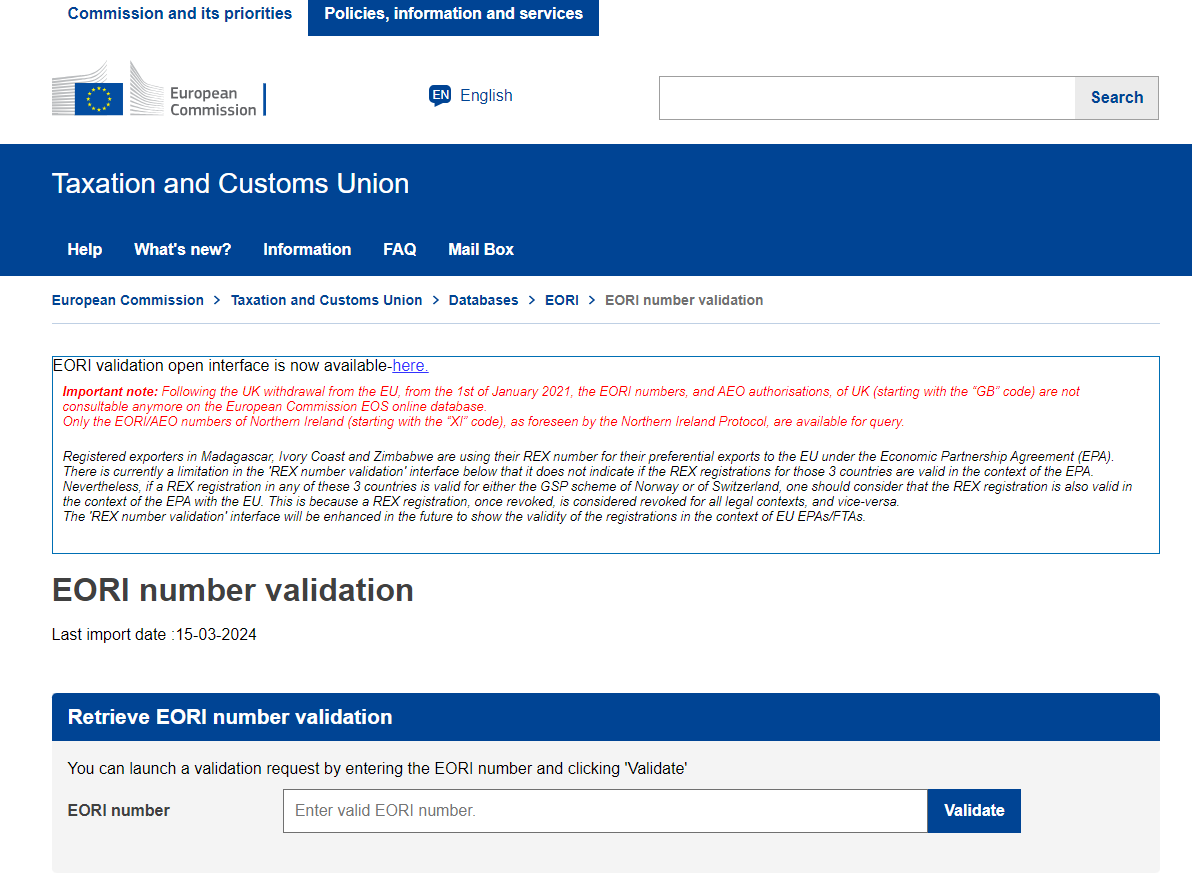 |
| EORI Verification in EU |
A successful verification of the EORI on the EORI lookup tool will return the following details
- Request date
- Status - This EORI number is valid or invalid
- EORI Name
- Address
- Street number
- Postal code
- City
- Country name
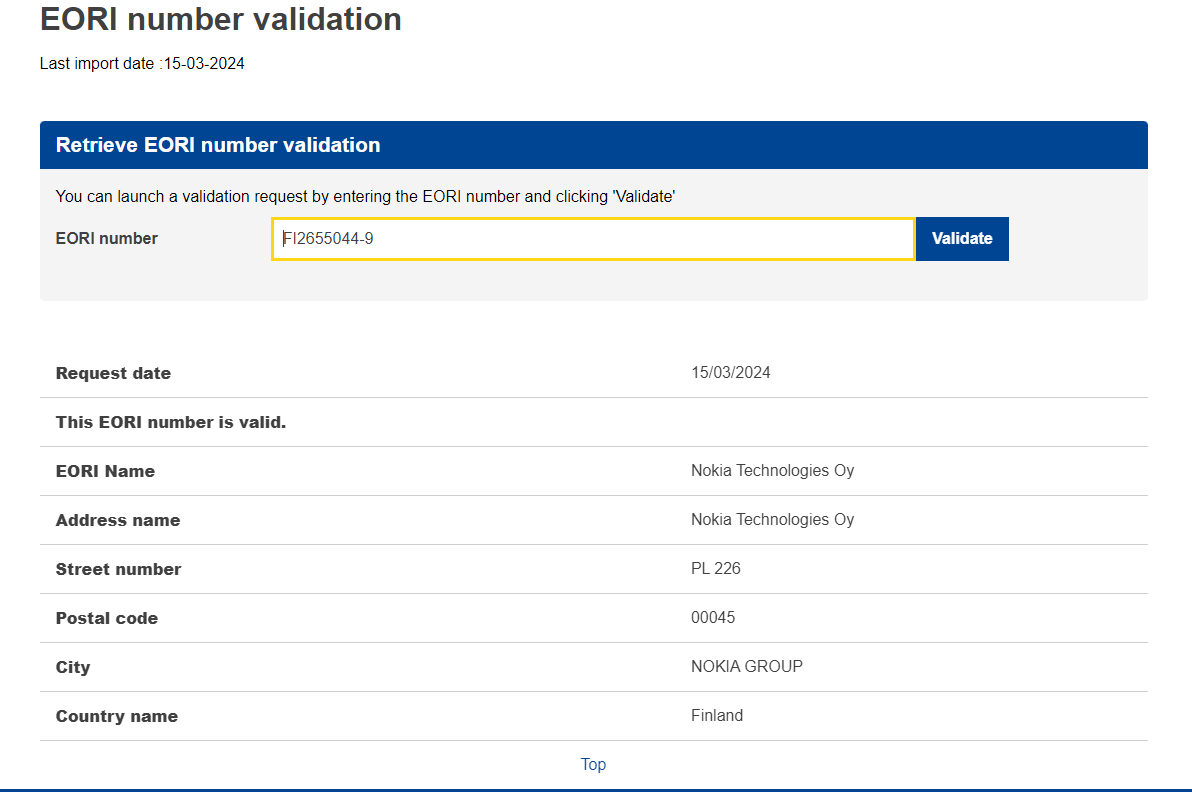 |
| Successful EORI Verification |
Frequently Asked Questions
What is the difference between an EORI number and a VAT number, and which one is required for EU customs declarations?
An EORI number is specifically required for customs declarations when importing from or exporting to the EU, governed by the EU Customs Code (Regulation 952/2013). A VAT number identifies a business for EU tax purposes. They are different identifiers: a business can have a VAT number without an EORI (no customs activity) and an EORI without a VAT number (non-VAT-registered importers). For customs clearance of any goods entering or leaving the EU, an EORI is mandatory — the VAT number alone is not sufficient. [1]
My non-EU company ships goods to EU customers — do I need my own EORI or can I use a freight forwarder's?
Under DDP Incoterms (seller responsible for customs), non-EU sellers need their own EU EORI. Under DAP/DDU Incoterms, the EU buyer handles customs using their own EORI. Freight forwarders can act as indirect customs representatives using their own EORI, but they become jointly liable for customs debt. As of July 2021, the IOSS/OSS scheme changed VAT collection for e-commerce but did not eliminate the EORI requirement for customs declarations on goods above €150 in value. [1] [2]
The European Commission EORI lookup shows an EORI as valid, but UK customs rejected it — why?
Since Brexit (1 January 2021), UK EORI numbers (starting with GB) and EU EORI numbers are separate registers. An EU EORI is not valid for UK customs, and a GB EORI is not valid for EU customs. Businesses trading between the UK and EU need both a GB EORI (from HMRC) and an EU EORI (from an EU member state). The European Commission portal only covers EU member states — it does not return results for UK GB numbers. [1] [2]
What is the correct EORI format structure?
EU EORI numbers consist of the 2-letter ISO country code followed by up to 15 alphanumeric characters. Country-specific patterns: DE: DE + 15 digits; FR: FR + SIRET (14 digits); NL: NL + 9 digits; FI: FI + 7 digits + hyphen + check digit (e.g. FI2655044-9). Most EU member states use their local business registration number as the EORI suffix. If a supplier provides an EORI without the 2-letter country prefix, it is not a valid EORI. [1]
Can an EORI number be revoked, and what happens to customs declarations filed with a revoked EORI?
Yes. Customs authorities can revoke an EORI if the operator ceases to exist, fails registration conditions, or provided false information. The EU portal shows revoked EORIs as "invalid." Customs declarations filed after revocation are non-compliant and can result in goods being held at customs, penalties, and duty liability for all parties involved. Businesses should periodically re-verify their own EORI and those of customs agents acting on their behalf. [1]
Is EORI verification sufficient for AEO status checks?
No — EORI verification and AEO (Authorised Economic Operator) status are separate checks. The EORI portal confirms basic registration details but not AEO status. AEO status grants customs simplifications and must be verified separately through the European Commission's AEO public list on the EU Customs Trader Portal (CTP). [1]
How Lookuptax can help you in VAT validation?
Lookuptax VAT validation revolutionizes VAT number validation with its robust platform, empowering businesses to seamlessly verify VAT numbers across over 100 countries. Our cutting-edge technology ensures accurate and efficient validation, reducing errors and enhancing compliance.