Montenegro TIN number guide
Poreski Identifikacioni Broj (PIB)
The VAT number in Motenegro is called Poreski Identifikacioni Broj (PIB). It consists of 8 digits.
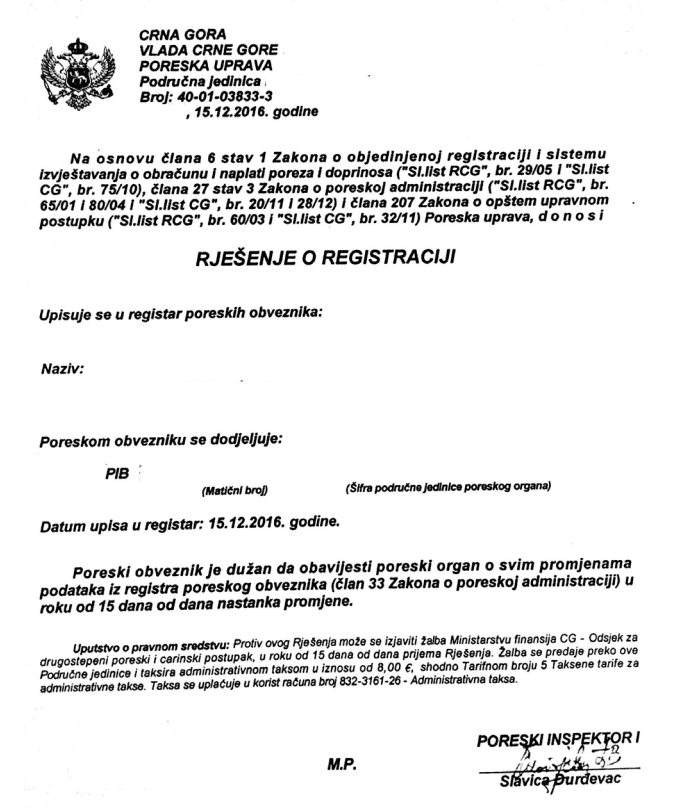 |
| Registration certificate |
How Lookuptax can help you in VAT validation?
Lookuptax VAT validation revolutionizes VAT number validation with its robust platform, empowering businesses to seamlessly verify VAT numbers across over 100 countries. Our cutting-edge technology ensures accurate and efficient validation, reducing errors and enhancing compliance.
Frequently Asked Questions
Can a foreign company obtain a Montenegrin PIB without establishing a legal entity?
Yes. Foreign legal entities that generate Montenegrin-source income — for example through a branch, representative office, or permanent establishment — must register with the Central Register of Business Entities (CRPS) and will receive a PIB automatically upon registration. Foreign individuals who need a PIB for property ownership or income tax obligations obtain one separately from the Tax Administration (Poreska uprava) by submitting a JPR form together with a passport and proof of income. Importantly, a JMBG (the 13-digit personal citizen number) is only issued to foreign nationals who hold a Montenegrin residence permit; it cannot substitute for a PIB in business contexts. [1] [2]
Does a non-resident SaaS provider need to register for PDV (VAT) in Montenegro before making the first sale?
Yes — for B2C sales. Under Montenegro's VAT Law (Zakon o PDV), non-resident providers of electronically supplied services to Montenegrin consumers must register for PDV from their very first sale, with no minimum turnover threshold. The general EUR 30,000 annual threshold applies only to domestic businesses. Once registered, the standard 21% PDV rate applies to all B2C digital transactions. For B2B supplies, the reverse-charge mechanism shifts the obligation to the Montenegrin business customer, so no non-resident registration is required. Non-resident providers with no physical presence in Montenegro must appoint a local tax representative to complete registration. [3] [4]
What withholding tax rate applies when a Montenegrin company pays royalties or consulting fees to a non-resident?
Montenegro levies a flat 15% withholding tax (WHT) on most categories of income paid to non-residents, including dividends, interest, royalties, capital gains, rental income, and fees for consulting, market research, and audit services. A punitive 30% WHT applies if the payment is made to an entity in a jurisdiction classified as a tax haven. Relief is available under Montenegro's double tax treaties (DTTs): for example, treaty rates on dividends can fall to 5–10% and royalties to 0% for eligible residents of treaty countries, provided the non-resident supplies a tax residency certificate. Montenegro ratified the OECD BEPS Multilateral Convention in December 2025. [5] [6]
Is electronic fiscalization mandatory for all businesses in Montenegro, and does it affect invoice validity?
Yes. Montenegro mandates real-time electronic fiscalization for all businesses that issue receipts for cash or card transactions. Every sale must be processed through certified fiscal software that digitally signs the receipt and transmits transaction data to the Tax Administration at the moment of sale. Fiscalized receipts are legally required to display the PIB of the seller, a unique fiscal receipt number (IIC/EIC code), a QR code, and the applicable PDV breakdown. Issuing a non-fiscalized receipt is a compliance violation. Separately, mandatory B2G e-invoicing is expected between 2025–2026, with B2B e-invoicing to follow, aligned with Montenegro's EU accession commitments. [7] [8]
What penalties apply for issuing invoices that omit the PIB or contain PDV errors?
Under Montenegro's Law on Tax Procedure, a company that issues invoices without the mandatory PIB or with incorrect PDV information faces fines of EUR 3,000 to EUR 10,000. Individual entrepreneurs face fines of EUR 1,000 to EUR 4,000, and the responsible person within a company can be personally fined EUR 800 to EUR 2,000. VAT-registered invoices must show the seller's PIB, the buyer's PIB for B2B transactions, the PDV rate applied, the PDV amount, and the net and gross prices. Repeated violations can trigger a tax audit. Businesses operating below the EUR 30,000 VAT threshold are not required to show PDV on invoices but must still include their PIB. [9] [10]