Pakistan TIN number guide
CNIC
The Computerized National Identity Card (CNIC) provides individuals with official identification as Pakistani citizens
CNIC Format
The CNIC number, a 13-digit identifier in the format XXXXX-XXXXXX-X, holds valuable information when broken down as follows:
a. 1st digit: The initial digit denotes the province of the CNIC holder. For example, in the format 3XXXXX-XXXXXX-X, the '3' indicates the holder belongs to the Punjab province. i. 1 for KPK ii. 2 for FATA iii. 3 for Punjab iv. 4 for Sindh v. 5 for Balochistan vi. 6 for Islamabad vii. 7 for Gilgit Baltistan
b. 2nd digit: Represents the division.
c. 3rd digit: Indicates the district of the division.
d. 4th digit: Designates the tehsil (sub-district).
e. 5th digit: Assigned for the union council number.
f. Next 7 digits: These seven digits (between the two dashes) constitute the family number, unique for each family. All family members, linked by blood relationships, share the same middle code, forming a family tree.
g. Last digit: The final digit, ranging from 1 to 9, holds gender information. Odd numbers (1, 3, 5, 7, 9) signify the holder is male, while even numbers (2, 4, 6, 8) indicate the holder is female.
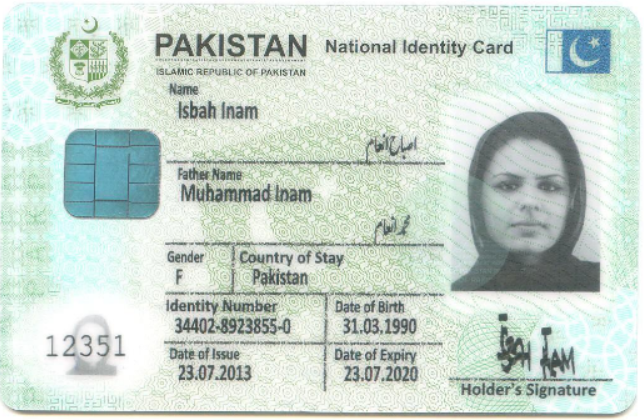 |
| CNIC Card |
National Tax Number or Registration Number(NTN)
In Pakistan, the individuals possessing the Computerized National Identity Card (CNIC) issued by the National Database and Registration Authority are assigned the CNIC number as their National Tax Number or Registration Number. For companies and associations of persons (AOP), the allocation of a National Tax Number or Registration Number occurs when they electronically enroll on the FBR Iris portal. Non-resident individuals without a CNIC are identified by their passport number, which serves as their NTN or Registration Number.
NTN format
NTN or Registration Number for AOP and Company is the 7 digits NTN received after e-enrollment.
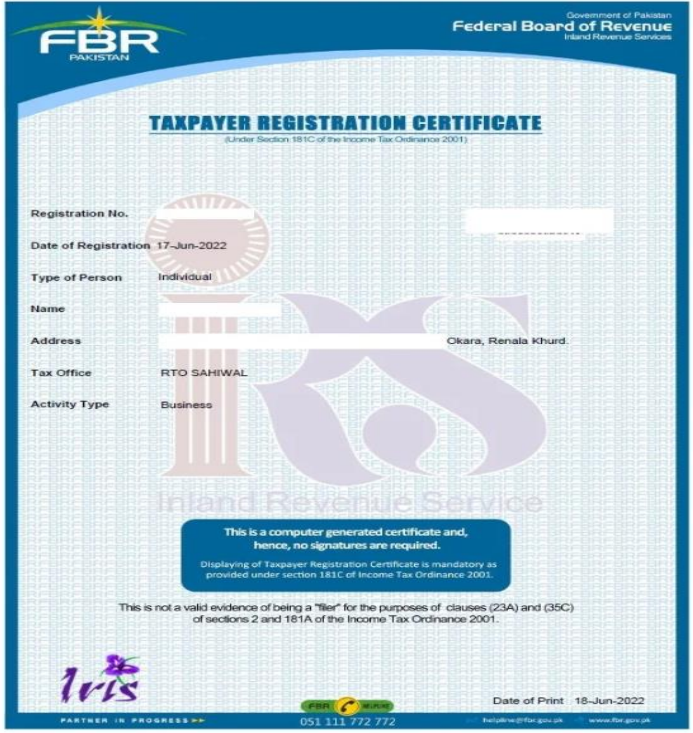 |
| Registration Certificate |
Official database - Taxpayer verification
How Lookuptax can help you in VAT validation?
Lookuptax VAT validation revolutionizes VAT number validation with its robust platform, empowering businesses to seamlessly verify VAT numbers across over 100 countries. Our cutting-edge technology ensures accurate and efficient validation, reducing errors and enhancing compliance.
Frequently Asked Questions
What happens to all my financial transactions if I am not on the Active Taxpayer List?
Absence from the FBR Active Taxpayer List (ATL) triggers elevated withholding tax rates on virtually every major transaction under the Income Tax Ordinance, 2001. Non-filers pay 0.6% on cash withdrawals above PKR 50,000 per day (versus 0.15% for filers), 12% advance tax on property purchases under Section 236K (versus 3% for filers), 11% on property sales under Section 236C (versus 5% for filers), and up to 40% on bank profit/interest income. Banks are also authorised to restrict account operations for non-ATL persons. To rejoin the ATL after a missed return deadline, a surcharge of PKR 1,000 (individuals), PKR 10,000 (AOPs), or PKR 20,000 (companies) must be paid under Section 182A before your status is restored. [1] [2]
A non-resident foreign national has no CNIC — what serves as their NTN for Pakistani tax purposes?
For non-resident individuals who do not hold a Pakistani CNIC, the passport number is used as the NTN or Registration Number, as confirmed by FBR's own e-enrollment rules. Foreign nationals must e-enroll on the IRIS portal (iris.fbr.gov.pk) providing their passport number, nationality, active email address, and Pakistani contact details. On successful enrollment, the passport number becomes the taxpayer's unique identifier in FBR systems. Overseas Pakistanis holding a NICOP (National Identity Card for Overseas Pakistanis) use the NICOP's 13-digit number instead. Non-residents deriving Pakistan-sourced income — rent, dividends, business profits, or property gains — are subject to withholding tax and may need to file an annual return even without a CNIC. [3] [4]
Does a Pakistani freelancer or IT company really pay zero income tax on foreign client payments?
Under Section 65F of the Income Tax Ordinance, 2001, exporters of computer software, IT services, and IT-enabled services are eligible for a 100% tax credit against income tax — effectively zero net tax — provided at least 80% of export proceeds are remitted into Pakistan through normal banking channels in foreign exchange. If the 80% remittance condition is not met, a 1% final withholding tax under Section 154A applies instead. The credit is contingent on filing an annual income tax return, submitting withholding tax statements for the prior tax year, and filing sales tax returns for corresponding periods. The FBR has clarified that this relief applies regardless of whether the entity is a registered company, AOP, or individual freelancer with an NTN. [5] [6]
What is Section 7E "deemed income" on property, and who must pay it even if the property generates no rent?
Section 7E of the Income Tax Ordinance, 2001 deems that every resident individual earns income equal to 5% of the fair market value of immovable property located in Pakistan, and taxes that deemed income at 20% — resulting in an effective charge of 1% of fair market value annually. The levy applies when the aggregate fair market value of all properties owned exceeds PKR 25 million as of 30 June. Key exemptions include: one self-occupied residential house (the primary residence), agricultural land (unless classified as a farmhouse exceeding 5,000 sq ft covered area on more than 2,000 sq yards), and properties already yielding rental income declared in the return. ATL non-filers should note that Tenth Schedule obligations can still require return filing even when Section 7E itself would not apply. [7] [8]
Can a company or AOP complete NTN e-enrollment on IRIS without a Pakistani mobile SIM, and how long does it take?
Companies and AOPs obtain their 7-digit NTN exclusively through FBR's IRIS portal (iris.fbr.gov.pk) e-enrollment — there is no paper application route for entities. The process requires the applicant's CNIC (for the authorised representative), business registration details, and an active email address; OTP verification can be completed by email if a local Pakistani mobile number is not available. Processing is typically immediate upon successful form submission, and the NTN certificate is downloadable from IRIS the same day. If CNIC data does not match NADRA records — a common complaint — the enrollment is blocked and the applicant must visit a Regional Tax Office (RTO) with original CNIC and registration documents to correct the discrepancy manually before online enrollment can proceed. [9] [10]