Panama TIN number guide
Registro Único de Contribuyente (RUC)
The Single Taxpayer Registry (Registro Único de Contribuyente, RUC) functions as the unique Tax Identification Number for both Panamanian individuals and legal entities. This individualized RUC serves to identify and differentiate natural or legal persons specifically for tax purposes. The absence of this identification number restricts stakeholders from engaging in any commercial transactions within Panama. It's crucial to emphasize that, although conducting economic activities in Panama requires a RUC, every registered Legal Person, regardless of operational status in the Republic of Panama, must possess a RUC.
For natural persons, the RUC is comprised of their personal identity card number, along with a check digit (dígito verificador, DV) assigned by the General Directorate of Revenue (Dirección General de Ingresos, DGI). Conversely, for legal persons, the RUC corresponds to their designated registration number at the Public Registry (Registro Público). This is followed by a combination of other registry numbers provided by the Public Registry Office, such as microjacket, roll, or image, or alternatively, by the year of incorporation, also accompanied by a DV.
In Panama, the Tax Identification Number, known as RUC (Registro Único de Contribuyentes), is allocated upon request from the General Directorate of Revenue under the Ministry of Economy and Finance. Individuals residing in Panama have the option to request either an RUC or NT (Número Tributario).
The assigned RUC is exclusive and cannot be transferred, providing a unique identifier for each taxpayer. Any modifications to the RUC data must be promptly communicated to the DGI (Dirección General de Ingresos). The RUC remains valid as long as the taxpayer is active and requires notification to the DGI in the event of dissolution, elimination, death, or any other relevant circumstances.
RUC Format
Individuals are identified as Natural Persons through their personal identity card number, which includes an assigned DV (Verification Digit). For instance, 8-100-678 with DV: 90. The initial number designates the province or region (1-13) of the taxpayer's birth.
The length of a Natural Person's RUC (Registro Único de Contribuyentes) can vary, and future structures may include 6, 7, 8, or more characters. Examples of RUC structures for natural persons may follow formats such as:
- X-XX-XXX DV
- X-XXX-XXX DV
- X-XXX-XXXX DV
- For Panamanian citizens by birth, the key number of the applicant's province of birth is used, followed by the volume and entry in which it appears registered in the Civil Registry. For example: 8-926-1601
- Panamanians born abroad will bear the letters (PE), followed by the volume and entry in which it appears registered in the Civil Registry. For example: PE-5-687.
- Naturalized Panamanians will bear the letter (N), followed by the volume and entry in which the definitive letter of nature is registered in the Civil Registry. For example: N-19-473
- For foreigners legally domiciled in the country, the letter (E) will be used, followed by the code number of the province where the application originated and finally the number of the application's entry order. For example: E-8-74258
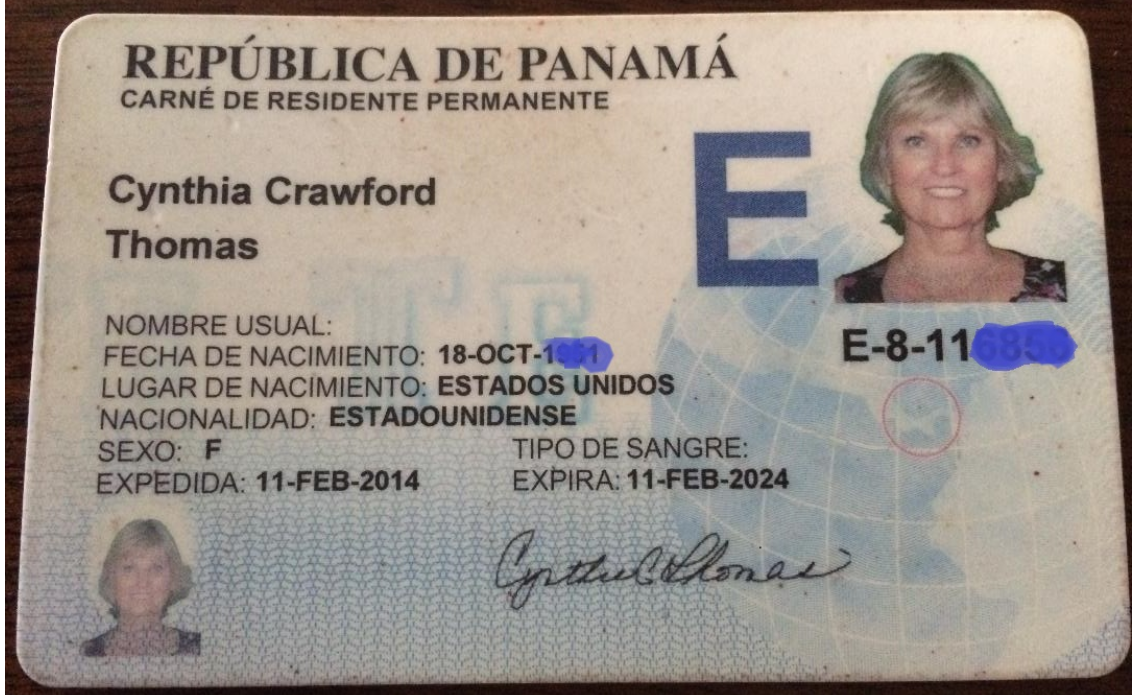 |
| ID card |
• For Legal Persons, the identification is based on the registration number assigned by the Public Registry, accompanied by a designated DV (Verification Digit). In cases of companies registered before 1985, the entry may include numbers, periods, and/or other characters. An illustration is 4789-321-1515 with DV: 85.
The RUC's new structure, implemented in Q3 2014, follows Real Folio-2-YYYY or Real Folio-3-YYYY, determined by the type of company. Consecutive to the FOLIO, one series is for Commercial Companies (2), and another for Non-Commercial Companies (3), with YYYY representing the company's registration year.
The Real Folio-2-YYYY format applies to various company types, including Limited Liability, Anonymous Society, Limited Partnership by Shares, Simple Limited Partnership, Branches or Agencies of Foreign Companies, and Collective Societies. An example is 155986022-2-2019 with DV: 12.
On the other hand, the Real Folio-3-YYYY structure is designated for Private Interest Foundations, Non-profit Associations, and Civil Partnerships. For instance, 26631254-3-2020 with DV: 78.
The sequential Folio comprises 9 digits for commercial companies and 8 digits for non-commercial companies. It is consecutive, incremental, and expected to expand over time, offering a dynamic framework for efficient identification.
Official database - RUC Search
Número de identificación tributario (NIT)
In Panama, the Tax Identification Number (TIN), known as RUC (Registro Único de Contribuyentes), is of utmost significance. The Tax Identification Number (número de identificación tributario, NIT) serves as the access code for managing online procedures and services provided by the General Directorate of Revenue via its website. This unique key or password is personal, non-transferable, and recognized by the DGI for all electronic signature purposes. Safeguarding its privacy is the responsibility of the taxpayer. It's crucial to differentiate this private number, the NIT, from the RUC, often interchangeably referred to as the Tax Identification Number or TIN.
Número Tributario (NT)
For individuals with a migratory lifestyle unable to fulfill the registration criteria for a natural person's RUC, a Tax Number (Número Tributario, NT) becomes their essential identifier for tax-related matters. Foreign natural persons' RUC is distinguished by the prefix NT.
In situations involving Legal Persons lacking Legal Status due to birth under special laws, a Tax Number (NT) is allocated to identify the taxpayer and their responsibility before the Tax Administration. It's crucial to note that Tax Numbers (NT) should always be complemented with a DV for comprehensive identification.
NT Format
For foreigners residing in Panama, the RUC corresponds to the Tax Number, designated by the DGI and indicated with the letters NT. For instance: 3-NT-3-33 DV: 45. In every instance, the DV is a two-digit number.
For Estates (Fincas), before Executive Decree 847 of October 20, 2014, their RUC comprised the estate number and the location code. The first digit of the location code signifies the province of the property. For example: 000001-8001 (8 = Panama Province).
With the introduction of the Electronic Registry Enrolment System, new Estates originating from this system will be identified with a Real Electronic Folio Number, devoid of details like volume, document, roll, etc. The new Electronic Real Folios (FINCAS) resulting from segregations will consist of 8 digits.
How Lookuptax can help you in VAT validation?
Lookuptax VAT validation revolutionizes VAT number validation with its robust platform, empowering businesses to seamlessly verify VAT numbers across over 100 countries. Our cutting-edge technology ensures accurate and efficient validation, reducing errors and enhancing compliance.
Frequently Asked Questions
Can a foreigner get a Panama RUC without a Cédula, and is a local accountant mandatory?
Foreigners who cannot obtain a Panamanian Cédula register under the NT (Número Tributario) pathway instead. The DGI processes RUC-NT applications online through the e-Tax 2.0 portal — registration itself is free. Required documents include a valid passport, a current migratory movement certificate issued by the National Migration Service, proof of taxable income (a notarized contract, invoices, or a certified public accountant's certification), and a recent utility bill showing the applicant's address. Foreign documents must be apostilled and translated into Spanish. Hiring a Panamanian CPA is not legally mandatory, but many expats do so because the apostille and translation requirements create practical barriers to self-filing. [1] [2]
Does Panama's territorial tax system really mean all my foreign income is tax-free after I register my RUC?
The territorial principle (Article 694 of the Fiscal Code) exempts income derived from activities conducted entirely outside Panama — but several traps catch new residents by surprise. First, if a Panamanian company distributes dividends funded by foreign-source income, a 5% dividend withholding applies. Second, companies under the SEM (Sede de Empresas Multinacionales) multinational headquarters regime enjoy a reduced 5% corporate income tax rate on qualifying income only if they satisfy OECD-aligned economic substance requirements (adequate staff, operating expenses, and decision-making in Panama); failure to demonstrate substance reverts the rate to the standard 25%. Third, income with both Panamanian and foreign components is apportioned — the Panamanian portion remains taxable. [3] [4]
What ITBMS (VAT) registration threshold applies to my RUC, and are professional service providers exempt from it?
The B/.36,000 annual gross income threshold exempts most small traders from mandatory ITBMS registration — but it does not apply to professional service providers, importers, or technology and digital service businesses, who must register and collect ITBMS at 7% from their very first transaction, regardless of revenue. The standard rate is 7%; alcoholic beverages and hotel accommodation attract 10%, and tobacco 15%. Monthly ITBMS returns are due by the 15th of the following month; quarterly filing is available for qualifying professional service providers. A business that crosses B/.36,000 mid-year must register before the next monthly return cycle. [5] [6]
My foreign company invoices a Panamanian client for services — why are they withholding 12.5% from my payment?
Panamanian payers are legally required to withhold income tax when remitting fees for services to non-resident foreign entities. The mechanism is a 25% income-tax rate applied to 50% of the gross remittance, yielding an effective 12.5% withholding. The payer separately withholds the ITBMS component (6.5421% of invoice value) and remits it directly to the DGI within 10 days of settlement. If your Panamanian client fails to withhold and remit, they lose the deduction on that expense. Non-resident service providers with a RUC can credit the withheld income tax against any Panama-source income tax liability; those without a RUC have no mechanism to recover it. [7] [8]
When must a Panama RUC holder switch to SFEP electronic invoicing through a PAC, and what happens if they miss the deadline?
Panama's SFEP (Sistema de Facturación Electrónica de Panamá) has been mandatory for all new RUC registrations since 2023. From 1 January 2026, Resolution No. 201-6299 (2025) requires every taxpayer issuing more than 100 invoices per month or generating annual income above B/.36,000 to route all electronic invoices exclusively through a DGI-authorized PAC (Proveedor Autorizado de Comprobantes). Invoices issued outside the SFEP framework are not legally valid fiscal documents: customers cannot claim ITBMS input credits on them, and the issuer faces fines. Taxpayers below both thresholds may continue using the DGI's free invoicing tool. The XML invoice must carry a qualified electronic signature (FEA); contingency-mode issuance is permitted when the PAC is unavailable, but the invoice must be validated within the contingency window or it is rejected. [9] [10]