Qatar TIN number guide
Personal Identification Number (PIN)
Individuals in Qatar who do not engage in industrial, commercial, craft, or professional activities as defined by Article 1 of the Income Tax Law (ITL) are distinguished by their Personal Identification Number (PIN) for Qatari nationals and their residence permit number for foreign residents in Qatar.
Residence Permit Number
Assigned to foriegn residents in Qatar.
Taxpayer Identification Number (TIN)
Any taxpayer engaging in an activity or earning taxable income must undergo registration with the GTA (General Tax Authority) and file an application for a Tax Identification Number (TIN) with the GTA. This TIN does not expire and remains valid for as long as the firm is licensed and continues to conduct their licensed activities. At present, the QFC only has corporate income tax, thus, the TIN is only for corporate tax purposes. There are no individual QFC taxpayers. Consequently, the following individuals and entities are identified by their TINs:
- Natural persons involved in industrial, commercial, craft, or professional activities.
- Legal entities incorporated in or having their place of effective management in the State of Qatar.
- Entities established within the Free Zone of Qatar Science and Technology Park (QSTP).
TIN Format For individuals and entities under the jurisdiction of the GTA, the Tax Identification Number (TIN) is comprised of 10 digits, commencing with the digit 5, denoting Qatar's affiliation with the Gulf Cooperation Council (GCC). The subsequent 9 digits are algorithmically generated and include a check digit.
For entities under the jurisdiction of QFCA, the TIN structure follows the format T00000, with the zeroes representing the QFC License Number assigned to firms. Therefore, a QFC firm with License Number 00001 would have T00001 as its TIN.
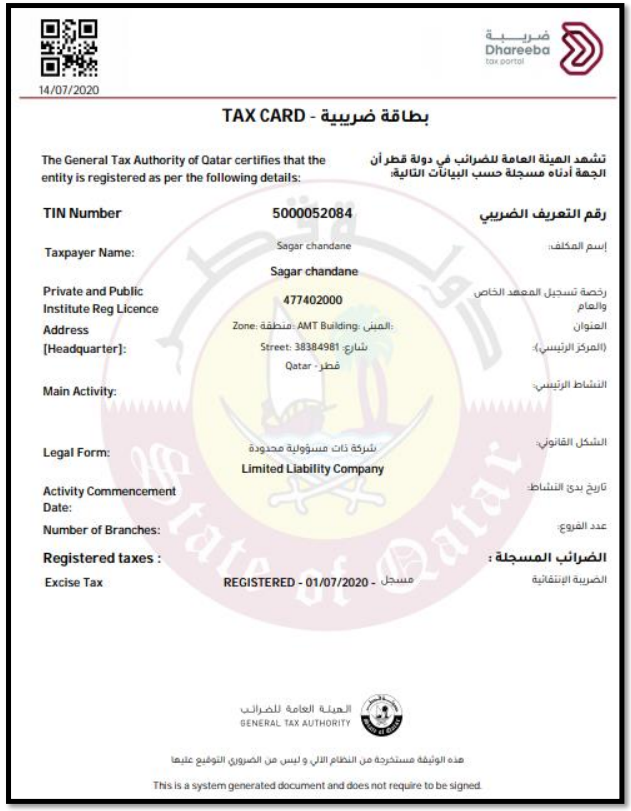 |
| TIN on Qatar Tax Card |
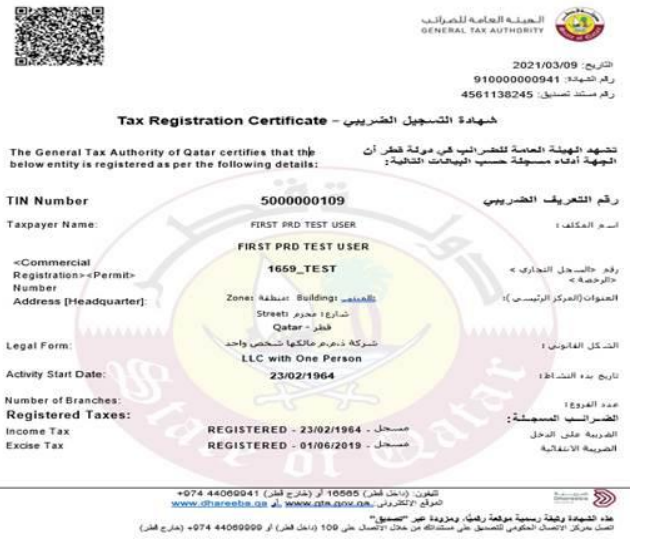 |
| Registration Certificate |
Note that the TIN is distinct from the Commercial Registration (CR) number issued by the Ministry of Commerce and Industry (MOCI) — for guidance on looking up and verifying a company's CR, see our Qatar CR number verification guide. Companies may also hold a QCCI membership number issued by the Qatar Chamber of Commerce and Industry; to look up a business by that identifier, see our guide to verifying Qatar QCCI membership numbers.
Special Registration Number
For the purpose of fulfilling withholding tax (WHT) obligations, specific individuals and entities are distinguished by a unique registration number:
- Ministries.
- Governmental bodies.
- Public authorities and institutions.
- Tax-exempt associations, professional associations, and private foundations registered with the Ministry of Administrative Development, Labor and Social Affairs (ADLSA).
- Tax-exempt private institutions of public benefit registered with the Ministry of Justice (MOJ).
- Tax-exempt charitable associations and charitable private foundations registered with the Regulatory Authority for Charitable Activities (RACA).
How Lookuptax can help you in VAT validation?
Lookuptax VAT validation revolutionizes VAT number validation with its robust platform, empowering businesses to seamlessly verify VAT numbers across over 100 countries. Our cutting-edge technology ensures accurate and efficient validation, reducing errors and enhancing compliance.
Frequently Asked Questions
My foreign company has no Qatari partners — do I still owe corporate income tax in Qatar?
Yes. Qatar's 10% corporate income tax exemption applies only to entities wholly owned by Qatari nationals or GCC nationals meeting residency conditions. Any foreign-owned share of profits in a Qatar-registered company is taxable at 10%. Branches of foreign companies operating in Qatar are also fully subject to corporate income tax on Qatar-sourced income. The exemption does not apply based on the type of activity alone — foreign ownership determines taxability. Believing Qatar is a completely tax-free jurisdiction is the single most common compliance mistake that results in unregistered entities facing back-taxes, interest, and penalties. [1] [2]
What is the penalty for missing the 60-day tax card registration deadline on Dhareeba?
Businesses must register with the GTA and apply for a tax card via the Dhareeba portal within 60 days of either commencing activities or completing commercial registration with the Ministry of Commerce and Industry — whichever comes first. Missing this deadline triggers a QAR 20,000 penalty for failure to register or maintain a valid tax card. The GTA can also suspend the company's commercial registration until compliance is achieved. Foreign branches face the same deadline and must additionally submit audited financial statements signed by a Qatar-registered auditor with their annual tax declaration. [1] [3]
Why is my Qatari client deducting 5% from my invoice even though I performed the service outside Qatar?
Qatar imposes a 5% withholding tax (WHT) on payments for services "used, consumed, or exploited" in Qatar — regardless of where the service was physically performed. This "consumption test" means foreign suppliers providing consulting, software licences, royalties, commissions, or any service consumed by a Qatar-based customer are subject to WHT, even if delivery happened entirely offshore. The Qatari payer must remit the withheld amount to the GTA by the 16th of the following month. Relief under a double tax treaty is available but requires a pay-and-reclaim mechanism: the payer withholds upfront and you apply separately to the GTA for a refund. [4] [5]
What is the difference between a GTA TIN and a QFC TIN, and does it matter for invoicing?
It matters significantly. Entities licensed through the Qatar Financial Centre (QFC) receive a TIN in the format T00000 (where the digits are the QFC licence number) and are governed exclusively by the QFC Tax Authority — not the GTA. GTA-registered entities hold a 10-digit TIN beginning with 5. Although both regimes apply a 10% corporate income tax rate, they use different filing systems, accounting standard rules, and audit procedures. A QFC-licensed firm cannot file via Dhareeba and must use the QFC's own tax portal. Mixing up the two TIN formats on contracts or invoices can cause payment processing and withholding compliance errors for your counterparty. [1] [6]
Do importers of tobacco, energy drinks, or carbonated beverages need a separate excise tax registration in addition to the corporate TIN?
Yes. Qatar's Excise Tax Law (Law No. 25 of 2018, in force since 1 January 2019) requires any person engaged in importing, producing, or warehousing excise goods to register separately with the GTA for excise tax purposes — a corporate TIN alone does not cover this obligation. Excise tax rates are 100% on tobacco and energy drinks, and 50% on carbonated beverages. Quarterly returns and payments are mandatory. Since April 2024, the GTA has enforced a mandatory Digital Tax Stamp system on tobacco products; goods lacking the stamp are treated as non-compliant, exposing importers and retailers to seizure and penalties regardless of whether excise tax was paid. [7] [8]