Romania TIN number guide
Personal Identification Number (CNP)
Natural persons in Romania are assigned a Personal Identification Number (CNP) by the Ministry of Internal Affairs, which also functions as a Tax Identification Number (TIN) utilized by the tax administration. It is also known as Cod Numeric Personal.
CNP Format CNP consists of 1 block of 13 digits
Structure: TIN Format [C1, C2, C3, C4, C5, C6, C7, C8, C9, C10, C11, C12, C13] Where C1 to C13 represent characters. Structure: Range C1, C2, C3, C4, C5, C6, C7, C8, C9, C10, C11, C12, C13 All are numeric. Structure: Rules for C1: Within the range 1 to 9:
- 1 is assigned to males born between 1900 and 1999.
- 2 is assigned to females born between 1900 and 1999.
- 3 is for males born between 1800 and 1899.
- 4 is for females born between 1800 and 1899.
- 5 is for males born between 2000 and 2099.
- 6 is for females born between 2000 and 2099.
- 7 is for foreign males with temporary residence in Romania.
- 8 is for foreign females with temporary residence in Romania.
- 9 is for foreign citizens. C2, C3: Represent the last two digits of the year (00 to 99). C4, C5: Indicate the month (1 to 12). C6, C7: Represent the day of the month (1 to 31, depending on the month and year). C8, C9: County or district code (ranging from 01 to 47, and 51 to 52). Structure: Sample TIN: 8001011234567
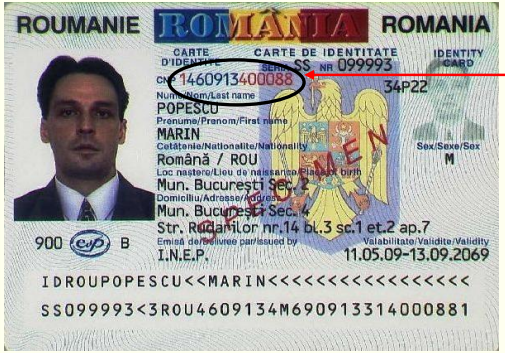 |
| CNP on ID card |
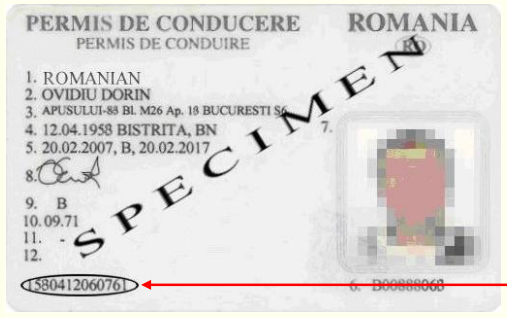 |
| Driving license |
Codul de înregistrare fiscală (CIF)
Tax Identification Number (TIN) for non-resident taxpayers in Romania is exclusively issued by the Tax Administration for tax-related matters. It is known as Codul de înregistrare fiscală(CIF).
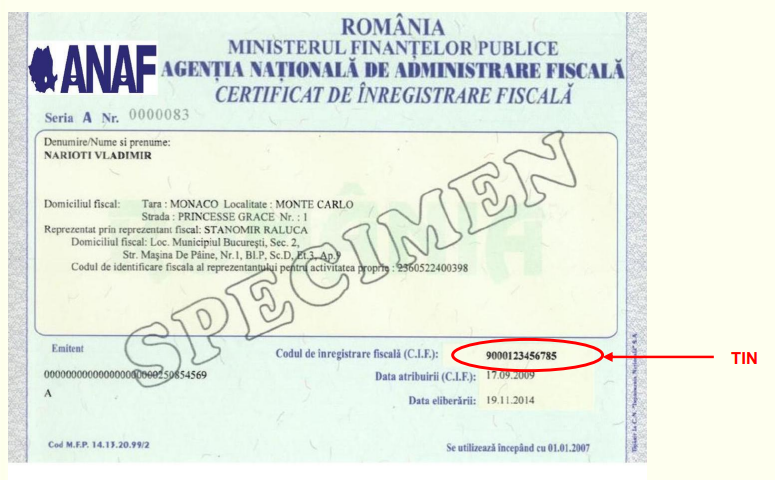 |
| CIF on Certificate for Tax Registration |
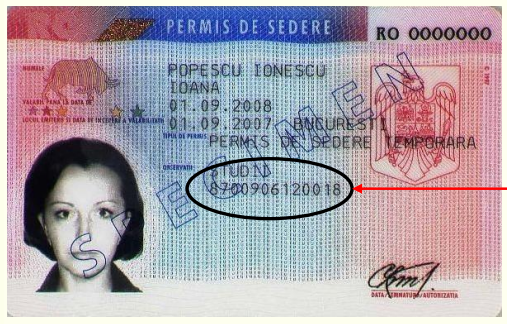 |
| Residence Permit |
Official database CIF search
Tax Identification Number (TIN)
The Tax Administration issues the Tax Identification Number (TIN) for non-natural entities in Romania. Its format comprises a single block of digits, ranging from 2 to 10 numerals.
TIN Format Structure: TIN2 Format [C1, C2, C3, C4, C5, C6, C7, C8, C9, C10, C11, C12, C13] Where C1 to C13 represent characters. Structure: Range C1, C2, C3, C4, C5, C6, C7, C8, C9, C10, C11, C12, C13 All are numeric. Structure: Rules for TIN2: C1: 9 C2: 0 C3: 0 C4: 0 C5 to C12: Each can take a value between 0 to 9. Structure: Sample TIN2: 900012345678.
Codul unic de identificare (CUI)
Until 2007, the term CUI (Unique Registration Code) was employed, after which the term CIF (Fiscal Registration Code) became prevalent. The distinction lies in the purpose for which this code is solicited. The legal entity providing the tax certificate determines whether the code is designated as CUI or CIF. The Romanian Codul Unic de Înregistrare (CUI) consists of 8 digits in the format NNN NNN NN, optionally preceded by the prefix RO. It is allocated to companies mandated to register with the Romanian Trade Register.
Official database CUI Search
Frequently Asked Questions
As a foreigner without Romanian residency, do I get a CNP or a NIF, and what is the difference?
CNP (Cod Numeric Personal) is issued by the Ministry of Internal Affairs only to individuals with the right of residence in Romania — EU/EEA citizens who have registered their residency and non-EU nationals holding a residence permit. Foreigners who have no residency right but need to carry out economic activities in Romania (buying property, earning rental income, conducting business) must instead obtain a NIF (Numărul de Identificare Fiscală) issued by ANAF. The application requires Form 030 submitted in person at an ANAF office or through a notarised proxy. Once you obtain a residency right and a CNP, the NIF becomes redundant — the CNP serves as your tax identifier from that point. [1] [2]
Why does my software validator reject the CUI of a Romanian company that claims to be legitimate?
Approximately 30% of Romanian companies are not registered for VAT and therefore do not have an "RO"-prefixed CIF/VAT number — they only hold a bare CUI (Cod Unic de Înregistrare). Many third-party validation libraries and ERP integrations silently fail on non-VAT CUIs because they only verify against the VIES or the ANAF TVA register, which lists only VAT-registered entities. A valid non-VAT company CUI will return no result from those sources even though the company is legally active. To verify a non-VAT company, use the Ministry of Finance's CUI lookup at mfinante.gov.ro, which covers all Trade Register entries regardless of VAT status. [3] [4]
What penalty applies if a Romanian B2B invoice is not submitted through RO e-Factura from July 2024 onwards?
Under Law 296/2023 as amended by Emergency Ordinance 115/2023, both issuers and recipients of B2B invoices are subject to a fine equal to 15% of the total invoice value if the invoice is not transmitted through the RO e-Factura platform. The mandate covers all Romanian-established businesses and non-resident entities registered for VAT in Romania. The 15% fine is applied to each non-compliant invoice individually, with no cap — a single large invoice can generate a significant liability. Non-resident VAT registrants who previously used paper or PDF invoices must now connect to the SPV portal and route all domestic B2B invoices through the system. [5] [6]
Does a non-resident company with only a Romanian VAT registration also have to file SAF-T (Form D406)?
Yes. Starting January 1, 2025, non-resident taxpayers holding only a Romanian VAT registration number — with no permanent establishment in Romania — must submit a simplified SAF-T D406 file covering their Romanian sales and purchase invoices. The obligation was extended to this group under ANAF Order 407/2025 (Official Gazette no. 310/8 April 2025). The simplified file excludes general ledger and fixed-asset sections but must include all invoices reported under the Romanian VAT registration. Submission frequency mirrors VAT return frequency (monthly or quarterly). Failure to submit on time triggers fines of RON 1,000–5,000 (approximately €200–€1,000 depending on taxpayer category). [7] [8]
When does a Romanian micro-enterprise lose its preferential 1% or 3% tax rate, and what triggers mandatory exit?
A micro-enterprise (impozit pe veniturile microîntreprinderilor) qualifies for 1% tax on turnover if annual revenues do not exceed €60,000 and it operates outside restricted sectors; 3% applies above that threshold up to the ceiling. The ceiling itself is shrinking: €500,000 through 2024, dropping to €250,000 from 1 January 2025 and then to €100,000 from 1 January 2026. Exit is also triggered mid-year if the company exceeds the applicable ceiling — it switches to standard 16% corporate income tax from the quarter of the breach. Additionally, companies whose shareholders hold more than 25% in more than three other Romanian micro-enterprises cannot use the regime, and companies deriving over 20% of revenue from management or consultancy are excluded entirely. [9] [10]
How Lookuptax can help you in VAT validation?
Lookuptax VAT validation revolutionizes VAT number validation with its robust platform, empowering businesses to seamlessly verify VAT numbers across over 100 countries. Our cutting-edge technology ensures accurate and efficient validation, reducing errors and enhancing compliance.