Saint Kitts and Nevis TIN number guide
Tax Identification Number (TIN)
A Tax Identification Number (TIN) is exclusively issued by the Saint Christopher and Nevis Inland Revenue Department (SKNIRD), the jurisdiction's Tax Administration. Individuals, legal persons, or entities become eligible for a TIN upon registration if they are subject to the licenses and taxes administered by the SKNIRD.
Issued TINs are permanent and remain unchanged under any circumstances. Many tax documents issued by the SKNIRD, including Remittance/Tax Return Forms, Statements, and Demand Notices, prominently display the TIN and/or a Tax Account. The Tax Account is a fusion of the TIN and the tax type number, with the last two digits representing the tax type number and the preceding digits representing the TIN. For example, if a taxpayer's TIN is 99999, Corporate Income Tax documents will display 9999904; Value Added Tax documents will display 9999945, and Withholding Tax documents will display 9999936.
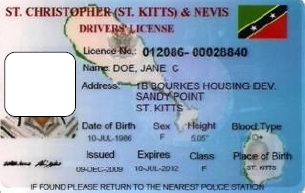
The Tax Identification Numbers (TINs) are prominently featured on St. Christopher (St. Kitts) & Nevis Driver’s Licences, appearing as the initial sequence of digits in the Licence No. before the hyphen. Additionally, the VAT TIN consists of the fundamental TIN number, with an additional numeric digit ranging from 1 to 9 appended at the end.
List of all vat registrants are published on the SKNIRD site. You can check the list here
 |
| Driving License |
Frequently Asked Questions
Saint Kitts and Nevis has no income tax — does that mean my business pays no taxes?
No. The "zero income tax" claim applies only to personal income tax on salaries, dividends, and investment income for individuals. Businesses still face several taxes: an Unincorporated Business Tax (UBT) of 4% of gross revenue for sole traders and partnerships not registered under the Companies Act; VAT at 17% on supplies of goods and services above the registration threshold; corporate income tax of 33% for resident companies; and customs duties on imported goods. A business operating without registering for the applicable taxes risks assessments, penalties, and interest from the SKNIRD. [1] [2]
At what point must a business register for VAT, and what is the split threshold?
The SKNIRD applies two separate thresholds. If your taxable supplies consist primarily of goods, you must register once cumulative 12-month turnover exceeds EC$150,000. If you provide taxable services — including professional fees, commercial leases, and time-share leases — the threshold is lower at EC$96,000 over any rolling 12-month period. Exceeding either threshold triggers a mandatory registration obligation; operating above it without a VAT TIN exposes you to back-assessed VAT, a 10% late-registration penalty, and interest. Voluntary registration below the threshold is permitted. [1] [2]
Do I need a TIN even if I only obtained CBI citizenship but am not a tax resident of Saint Kitts and Nevis?
A TIN is issued only to persons who are liable for a licence or tax administered by the SKNIRD. CBI citizenship alone — without economic activity, property, or employment in the federation — does not create a tax liability and therefore does not require a TIN. However, if you subsequently open a bank account, rent or own property, conduct business, or become a tax resident (183+ days per year), you must register with the SKNIRD. Financial institutions in Saint Kitts and Nevis are required under FATCA and CRS to collect TINs from account holders who are tax-resident in a reportable jurisdiction. [1] [2]
Is withholding tax deducted from payments made to non-resident suppliers and contractors?
Saint Kitts and Nevis imposes a 15% withholding tax on dividends, interest, and royalties paid by resident entities to non-residents from sources within the federation. This is a commonly misunderstood point: the 15% rate applies to passive income flows, not to arm's-length service fees paid to foreign contractors under a service contract. Withholding tax returns and payment to the SKNIRD are due within 15 days of the payment date. Non-residents receiving passive income should verify whether a Tax Information Exchange Agreement (TIEA) or double tax treaty between Saint Kitts and Nevis and their home country provides a reduced rate. [1] [2]
What TIN reporting obligations apply to financial institutions under CRS and FATCA?
All financial institutions registered in Saint Kitts and Nevis — including banks, investment entities, and certain insurers — must enrol in the SKNIRD's AEOI portal and file annual FATCA and CRS reports. FATCA reporting for the 2024 period is due by 29 August 2025; the CRS deadline was extended to 15 July 2025. Institutions must collect and validate the TIN (or functional equivalent) of each account holder who is a tax resident of a reportable jurisdiction. Failure to enrol or file on time triggers compliance notices from the SKNIRD. Institutions that no longer meet the FATCA/CRS obligations can apply for deregistration via the updated AEOI portal process issued in February 2025. [1] [2]
How Lookuptax can help you in VAT validation?
Lookuptax VAT validation revolutionizes VAT number validation with its robust platform, empowering businesses to seamlessly verify VAT numbers across over 100 countries. Our cutting-edge technology ensures accurate and efficient validation, reducing errors and enhancing compliance.