How to verify PST in Canada (British Columbia)?
PST verification on eTaxBC website
British Columbia's Provincial Sales Tax (PST) is a 7% provincial tax separate from the federal GST/HST. PST registration is administered by the BC Ministry of Finance through the eTaxBC portal — independent of CRA GST registration. The eTaxBC PST Number Verification Service lets you confirm a supplier's PST registration for free.
- Access the Tool: Go to the eTaxBC PST Number Verification Service.
- Enter Both Required Fields: Enter the supplier's PST number (format
XXXX-XXXX, e.g.,1247-7834) and their 9-digit CRA Business Number (BN, e.g.,786568113). Both fields are mandatory — the tool cannot verify a PST number without the matching BN. - Review the Result: A successful verification confirms the PST number is valid and returns:
- Business Number
- PST Number
- Confirmation: PST number is valid
- Search Date
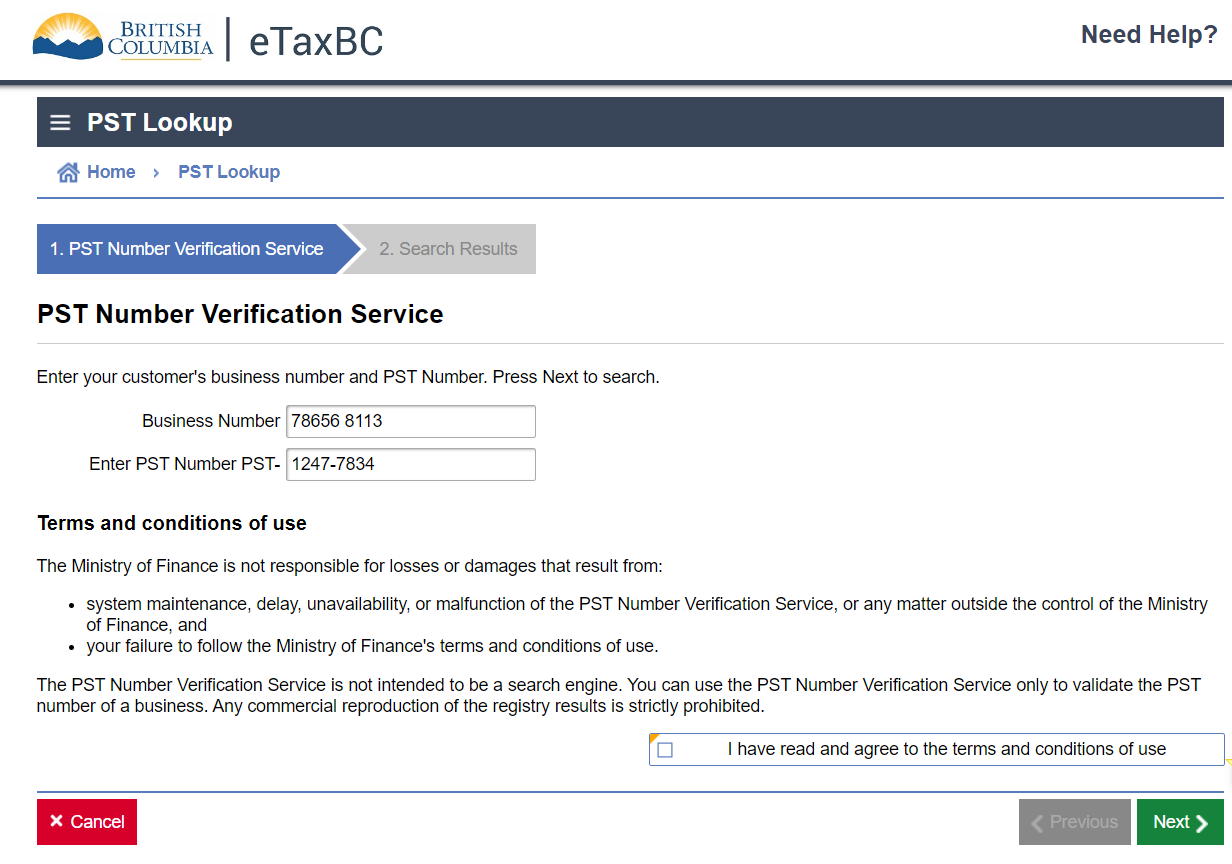 |
| PST lookup — British Columbia |
- Example PST number:
1247-7834 - Example BN:
786568113
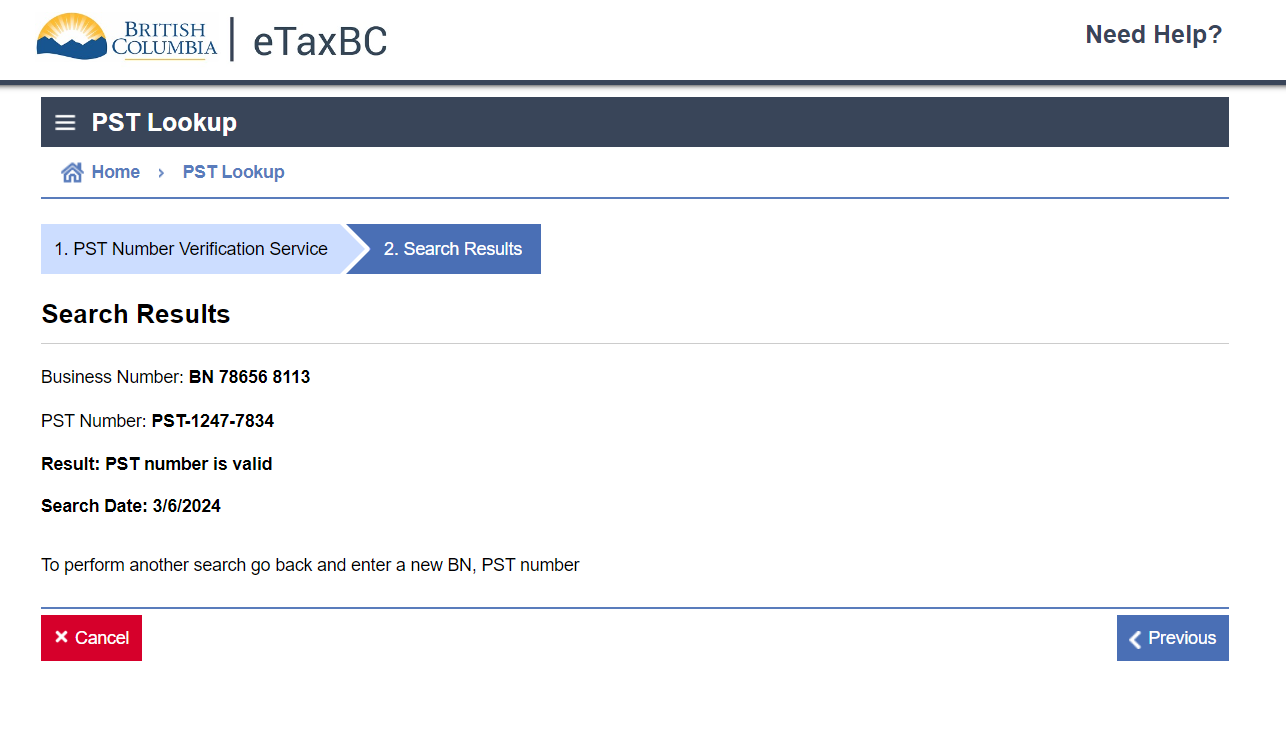 |
| Successful PST Verification on eTaxBC |
For more details on Canadian tax IDs, see our Canada Tax ID Guide.
Frequently Asked Questions
I'm registered for GST — does that mean I'm also registered for BC PST?
No. GST (federal) and BC PST (provincial) are entirely separate tax systems administered by different governments. Registering with the CRA for a GST/HST number creates no PST registration or collection obligation. BC PST is administered by the BC Ministry of Finance, and you must register through the eTaxBC portal independently. Many BC businesses that provide only services (legal, accounting, consulting) are GST-registered but legitimately do not hold a PST number — which is why the eTaxBC tool requires both the PST number and the Business Number to return a result. [1] [2]
Why does eTaxBC return "No Match Found" when I enter a supplier's PST number?
The eTaxBC PST Number Verification Service requires both the PST number (format XXXX-XXXX) and the 9-digit CRA Business Number (BN) to match exactly for the same registrant. "No Match Found" typically means one of three things: (1) the BN entered does not correspond to the PST number — these must belong to the same registrant; (2) there is a typo in either field (the BN is a 9-digit CRA number, not to be confused with the 4-digit PST account suffix); or (3) the business cancelled its PST registration and the account is no longer active. If you are certain the numbers are correct, contact the BC Ministry of Finance at 1-877-387-3332 to confirm active status. [1]
I'm an out-of-province or foreign seller shipping goods into BC — when must I register for PST?
Effective April 1, 2021, BC introduced an economic nexus threshold for out-of-province sellers. If your gross revenue from taxable sales of goods, software, or telecommunication services to BC customers exceeds CAD $10,000 in the preceding 12 months — or you reasonably expect to exceed it in the next 12 months — you must register for BC PST through eTaxBC and collect 7% PST on those BC sales. This applies to both Canadian sellers in other provinces and foreign (non-Canadian) businesses. There is no small-seller exemption that overrides this for software or digital services sellers. [1] [2]
Does BC PST apply to SaaS, cloud software, and digital subscriptions?
Yes — and the rules expanded significantly in 2024. BC's 2024 Budget (effective February 22, 2024) broadened the definition of "software" under the Provincial Sales Tax Act to explicitly include SaaS, IaaS, APIs, rights to use coded instructions, and rights to receive software updates under optional maintenance agreements. This followed the BC Supreme Court ruling in Hootsuite Inc. v. British Columbia, which had narrowly defined "software" in a way that left many cloud services untaxed. Post-2024, almost all subscription-based software and cloud computing services sold to BC customers are subject to 7% PST. Foreign SaaS providers selling to BC customers above the CAD $10,000 threshold must register for BC PST through eTaxBC even with no physical presence in Canada. [1] [2]
My customer claims a PST exemption (resale, manufacturing, farming) — what documentation do I need, and what happens if it's missing in an audit?
If you grant a PST exemption at the point of sale, you must retain specific documentation proving the exemption applies — otherwise the BC Ministry of Finance can assess you for the uncollected PST, plus penalties and interest, as if the exemption was never granted. For reseller exemptions, the customer must provide their valid PST number or a completed Certificate of Exemption – General (FIN 490). For manufacturing/production machinery (PM&E), the customer must confirm the goods are used primarily and directly in manufacturing. For farming exemptions, customers must present a BC Agriculture Council Farmer Identity Card or a completed FIN 458 declaration. If a customer cannot provide documentation at the time of sale, you must charge PST — but if they provide it within 180 days of purchase, you may refund or credit the PST charged. [1]
I sell through Amazon and Etsy — does the marketplace collect PST on my behalf?
It depends on the platform. Amazon, Etsy, and Airbnb are classified as online marketplace facilitators under BC PST rules (effective July 1, 2022), meaning they are legally responsible for collecting and remitting 7% PST on taxable sales made through their platforms. Sellers on these platforms are not required to collect PST on marketplace sales, though they may still need a PST registration for sales made through other channels (own website, physical store, direct invoicing). Shopify is not a marketplace facilitator — it provides e-commerce infrastructure but does not act as the seller of record. Shopify store operators must register for BC PST through eTaxBC themselves, and their PST number will appear on the eTaxBC verification tool. [1]
What typically triggers a BC PST audit, and what records must a business keep?
BC Ministry of Finance auditors may select businesses based on industry risk profiles, discrepancies between PST returns and GST/HST filings, tips or third-party information, or random selection during sector-wide campaigns. Common audit findings include: PST charged at the wrong rate, exemptions granted without proper documentation, and failure to self-assess PST on goods purchased from out-of-province vendors who did not charge BC PST. Businesses must retain all PST-related records for at least 5 years, including sales invoices, exemption certificates (FIN 490, FIN 458), purchase records, and eTaxBC filing history. If an exemption certificate cannot be produced during an audit, the full PST will be assessed against the seller. [1]
How Lookuptax can help you in PST validation?
Lookuptax PST validation revolutionizes PST number validation with its robust platform, empowering businesses to seamlessly verify PST numbers across over 100 countries. Our cutting-edge technology ensures accurate and efficient validation, reducing errors and enhancing compliance.