Austria Tax ID & UID Number Guide (ATU Format, Validation, Registration)
Austria uses three main tax identifiers that serve distinct purposes. Understanding which number is required in which context prevents invoice rejections, VIES lookup failures, and registration delays that regularly trip up foreign businesses entering the Austrian market.
Firmenbuchnummer
The Firmenbuchnummer is the Commercial Register Number assigned by Austrian courts. It appears in the public Firmenbuch (commercial register) and identifies legal entities such as GmbH and AG companies for corporate law purposes — it is not a tax number and is not used on VAT invoices.
Format
| Entity type | Structure | Example |
|---|---|---|
| Head office | Up to 6 digits + 1 letter (not case-sensitive) | 123456a |
| Registered branch | Up to 6 digits + 1 letter + up to 3 digits | 123456a001 |
The Firmenbuchnummer is publicly searchable via the Firmenbuch online portal (firmenbuch.at).
Abgabenkontonummer (Tax Account Number)
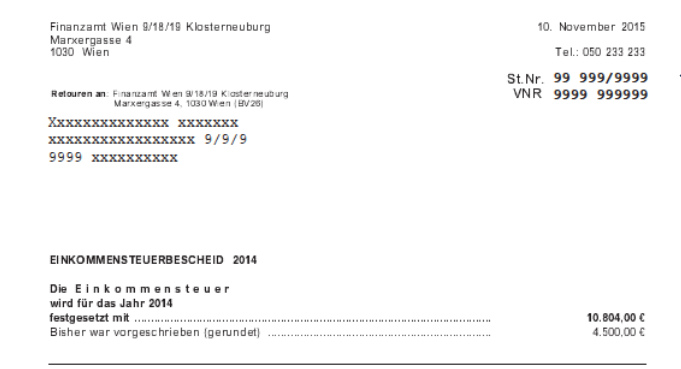
The Abgabenkontonummer is the tax account number assigned to individuals and legal entities for income tax, corporation tax, and other direct-tax purposes. In everyday usage it is called the Steuernummer — the two terms refer to the same number and are used interchangeably, which causes significant confusion for newcomers.
Format
The Abgabenkontonummer is a 9-digit number: 2 digits for the issuing Finanzamt (Finanzamtsnummer) followed by 7 digits for the taxpayer (including a check digit).
Structure: FF NNNNNP — where FF = Finanzamt code, NNNNNN = subject digits, P = check digit.
 |
The Abgabenkontonummer is managed through FinanzOnline (finanzonline.at), Austria's e-tax portal. From 1 October 2025 login requires two-factor authentication via ID Austria or equivalent.
Umsatzsteuer-Identifikationsnummer (UID)
The UID is Austria's VAT Identification Number for intra-EU transactions. It is mandatory on all B2B invoices for goods and services supplied across EU member-state borders and must be validated before applying zero-rate (reverse-charge) treatment.
Format
The UID follows the format ATU + 8 digits (11 characters total):
| Part | Value | Notes |
|---|---|---|
| Country code | AT | Always uppercase |
| VAT indicator | U | Stands for Umsatzsteuer |
| Serial digits | XXXXXXXX | 8 numeric digits; last digit is a check digit |
Regex: ^ATU\d{8}$
Valid example: ATU12345678
Common format errors that trigger automatic rejection:
AT12345678— missing theUATU1234567— only 7 digits (too short)ATU 1234 5678— spaces are not permittedU12345678— missing country code (this is the format some ERP systems like Tryton store internally after strippingAT)
The UID is verifiable via the EU's VIES system or Austria's FinanzOnline portal. Newly issued UIDs take several business days to propagate to VIES — do not issue invoices claiming a UID that cannot yet be confirmed on VIES, as this voids the recipient's input-tax deduction right.
For bulk lookups or API-based verification, LookupTax validates Austrian UID numbers in real time against both FinanzOnline and VIES.
Gemeindenummer
The Gemeindenummer is a municipality identifier used for administrative and statistical purposes. It does not appear on tax invoices or VAT registrations and is not a business tax identifier.
Frequently Asked Questions
My Austrian client suddenly deducted 20% from my invoice — what is section 99 EStG withholding?
When a non-resident individual or company provides certain services in Austria — commercial consulting, technical consultancy, market research, or artistic performances — the Austrian client must withhold a 20% income-tax advance under § 99 of the Einkommensteuergesetz (EStG) and remit it to the Finanzamt by the 15th of the following month. The deduction applies to the gross payment including reimbursed expenses. [1] If your home country has a double-tax treaty (DTA) with Austria, you can eliminate the deduction by providing your client with Form ZS-QU 1 (natural persons) or ZS-QU 2 (legal persons) — a residence certificate issued by your foreign tax office. Without this certificate the Austrian client bears personal liability for the unwithheld amount. [2]
I crossed the Kleinunternehmer threshold mid-year — do I owe VAT on all my previous invoices?
From 1 January 2025 the Austrian small-business VAT exemption (Kleinunternehmerregelung) threshold is €55,000 gross annual turnover, replacing the old €35,000 net figure. [3] If you exceed €55,000 by more than 10% in a calendar year (revenue tops €60,500), VAT liability is applied retroactively to all transactions in that entire calendar year — not just to transactions after the breach. If you exceed the limit by 10% or less, the exemption holds through year-end but is lost from 1 January of the next year. Businesses must file Umsatzsteuererklärungen for the affected year and retroactively charge VAT on previously exempt invoices — a significant cash-flow shock that catches many sole traders off guard. [4]
As an EU company, can I use Austria's small-business exemption without getting a full Austrian UID?
Yes — since 1 January 2025 EU-based businesses may apply Austria's VAT small-business exemption for Austrian sales without full local UID registration, provided two simultaneous tests are met: (1) Austrian domestic turnover must not exceed €55,000 in the current or prior calendar year, and (2) total EU-wide turnover must not exceed €100,000 in the current or prior calendar year. [5] You must first notify your home-country tax authority, which then issues an SME identification number carrying the suffix -EX. The exemption is only valid once this -EX number is issued; invoicing Austrian customers as VAT-exempt before receiving it is non-compliant. Exceeding either threshold — even briefly — terminates the exemption for the remainder of that calendar year. [6]
How do I get an Austrian UID as a non-established foreign company, and why does it take so long?
Non-resident businesses that must charge Austrian VAT apply to Finanzamt Österreich, Dienststelle Graz-Stadt — not the nearest local Finanzamt — by submitting Form Verf 19 with supporting documents by post. [7] The process typically takes 7–8 weeks; there is no statutory deadline forcing the Finanzamt to issue the UID faster. Newly issued UIDs take additional business days to propagate to VIES. Issuing invoices citing a UID before it appears in VIES voids your customer's input-tax deduction right, creating audit exposure for both parties. To manage FinanzOnline access from outside Austria, foreign natural persons and sole traders can book a video identification appointment with the BMF — this delivers login credentials during the video call without requiring travel to Austria. [8]
Does Austria's cash register obligation (Registrierkassenpflicht) apply to my business if I occasionally accept cash?
The Registrierkassenpflicht applies to any business whose net annual turnover exceeds €15,000 and whose cash receipts in that year exceed €7,500 — both thresholds must be breached simultaneously. [9] Qualifying businesses must use a tamper-proof electronic cash register meeting the RKSV (Registrierkassensicherheitsverordnung) technical standard, registered via FinanzOnline. From 1 January 2026 the outdoor/market-stall "cold hands" exemption threshold was raised to €45,000 annual revenue. Foreign businesses with a taxable presence in Austria are subject to the same obligation as domestic ones; operating without a compliant system is a financial administrative offence under the Bundesabgabenordnung (BAO). [10]
My ERP system stores the Austrian VAT number as U12345678 (without "AT") — is that correct?
This is a known ERP integration pain point. Some accounting platforms (including Tryton) strip the two-letter country code and store only U12345678 internally, while official Austrian and EU systems — including VIES and FinanzOnline — require the full ATU12345678 format. [11] When the system outputs the number to an invoice or a VIES API call, it must reattach the AT prefix — otherwise the number fails format validation before any checksum or registration check is even attempted. Verify your ERP's VAT number output template for Austrian counterparties, and confirm the full ATU\d{8} pattern appears on all cross-border invoices. [12]
Related Resources
- How to verify an EU VAT number via VIES — step-by-step VIES lookup guide covering all EU member states including Austria
- Switzerland UID number guide — neighboring DACH-region tax identifier with a different format (
CHE-XXX.XXX.XXX) - Germany TIN number guide — German Umsatzsteuer-ID (DE + 9 digits) often confused with Austrian ATU format
- EU EORI number verification guide — required alongside UID for Austrian customs and import/export declarations
How Lookuptax can help you ?
Lookuptax VAT validation revolutionizes VAT number validation with its robust platform, empowering businesses to seamlessly verify VAT numbers across over 100 countries. Our cutting-edge technology ensures accurate and efficient validation, reducing errors and enhancing compliance.