Azerbaijan TIN (VOEN) Guide — Format, Validation & Registration
Tax Identification Number (TIN) — VOEN
Azerbaijan's Tax Identification Number is known locally as the VÖEN (Vergi Ödəyicisinin Eyniyyət Nömrəsi, meaning "Taxpayer Identification Number"). It is the single unique identifier used across all taxes, customs obligations, and electronic government services in the Republic of Azerbaijan.
As stipulated in Article 13.2.4 of the Tax Code of the Republic of Azerbaijan, a taxpayer is defined as any individual who is obliged to pay taxes on the taxable entities specified under the Tax Code. Under Article 34.6, the State Tax Service under the Ministry of Economy is the sole authority responsible for issuing VOENs, which are allocated to both legal entities and natural persons engaged in entrepreneurial activity.
Format and Structure
The VOEN is a 10-digit numeric code. Treat it as a string, not an integer, because leading zeros are valid — for example, 0200432771 is a correctly formed VOEN. Stripping the leading zero reduces the number to 9 digits and breaks all downstream validation.
The digit positions carry specific meanings:
| Digits | Meaning |
|---|---|
| 1–2 | Territorial administrative unit (region) code |
| 3–8 | Sequential serial number assigned at registration |
| 9 | Check digit, calculated by a MOD-11 algorithm applied to the first 8 digits |
| 10 | Legal status indicator: 1 = legal entity; 2 = natural person |
Regex pattern: ^\d{10}$
The MOD-11 checksum uses weights [4, 56, 19, 50, 57, 84, 93, 47] applied to digits 1–8; the remainder determines digit 9. Any system that validates the VOEN must handle the number as a zero-padded 10-character string.
PIN (Personal Identification Number): Individuals also hold a 7-character alphanumeric PIN. It does not contain the letter "O" — only the digit "0". For old passports and National IDs, the PIN is the last 7 characters before the < symbol; for new passports and National IDs it is labelled "Personal No."
Example — individual:
- TIN:
1 5 2 5 8 5 5 8 5 2 - PIN:
5VBK5VR
Example — legal person:
- TIN:
1 3 2 5 6 7 8 8 5 1
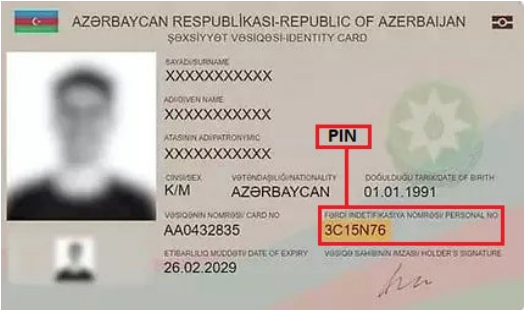 | 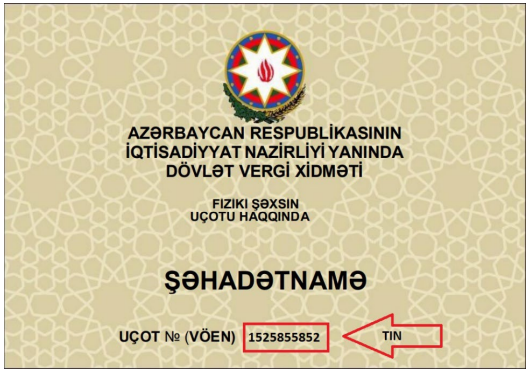 |
| New National ID | TIN Individuals |
 |
| TIN for Entities |
Registration
Citizens and resident entrepreneurs can register online at the e-taxes.gov.az portal using an Asan Imza mobile digital signature. Registration is instant for most individual entrepreneurs (fərdi sahibkar), and no physical office address is required — a residential address is accepted. For foreign nationals registering a sole proprietorship, a migration service license and valid identity documents are required before the tax authority will assign a VOEN.
VAT Threshold
Businesses whose cumulative gross revenue over any consecutive 12-month period does not exceed AZN 200,000 may operate under the simplified tax regime at 2% of turnover, avoiding VAT registration. Exceeding AZN 200,000 triggers mandatory VAT registration at 18% and corporate profit tax at 20%.
Official Verification
Official database — TIN search
For developer integrations requiring bulk lookups, see the LookupTax Azerbaijan TIN verification guide.
Frequently Asked Questions
Why does my VOEN validation fail even though the number came directly from the Azerbaijani tax portal?
The most common cause is a stripped leading zero. Some systems store the VOEN as an integer, which silently removes any leading 0, converting a 10-digit code to 9 digits. Every VOEN must be stored and transmitted as a zero-padded 10-character string. [1] The official OECD guidance on Azerbaijani TINs confirms the format is strictly 10 digits. [2] If the number passes length validation but still fails the checksum, verify that digit 9 was computed using a MOD-11 algorithm with the weights [4, 56, 19, 50, 57, 84, 93, 47] — the algorithm is not published in official Azerbaijani government documentation and was reconstructed through independent analysis. Digit 10 must be either 1 or 2; any other value indicates a data-entry error.
Do foreign companies selling digital services to Azerbaijani consumers need a VOEN, and when does registration become mandatory?
Yes. Non-resident providers of electronic services (SaaS, streaming, apps, online marketplaces) selling to Azerbaijani B2C customers — those not registered as VAT payers — must register with the State Tax Service and charge 18% VAT once annual sales into Azerbaijan exceed the AZN equivalent of USD 10,000. [3] Registration must be completed electronically within 30 days of crossing that threshold. The amendments entered into force on 1 January 2026, with a phased implementation deadline of 23 August 2026 for full compliance. Purely B2B supplies — where the Azerbaijani buyer holds their own VOEN — fall outside the mandatory collection obligation. Consulting, legal, financial, accounting, design, and engineering services delivered via email are explicitly excluded from the "electronic commerce" scope. [4]
Why does my Azerbaijani client withhold tax from payments, and what are the applicable rates?
Azerbaijan imposes withholding tax (WHT) on payments made by resident payers to non-residents whose income is not attributable to a permanent establishment in Azerbaijan. Standard domestic rates under the Tax Code are: dividends 5%, interest 10%, royalties 14%, rental income 14%, risk insurance or reinsurance 4%, telecommunications and international transport 6%, and all other Azerbaijan-source income 10%. [5] Azerbaijan has tax treaties with 53 active partner countries; where a treaty rate is lower than the domestic rate, the treaty rate applies — but only if the non-resident provides a certificate of tax residence from their home jurisdiction to the Azerbaijani payer before payment is made. Failure to present the residency certificate in time results in the full domestic rate being withheld and a subsequent refund claim process. [6]
Can a business that never crosses the VAT threshold use the simplified tax regime instead of registering for VAT?
Yes. Businesses and sole entrepreneurs (fərdi sahibkar) whose cumulative gross revenue over any consecutive 12-month period does not exceed AZN 200,000 may elect to pay simplified tax (sadələşdirilmiş vergi) at 2% of turnover. They avoid 18% VAT and 20% corporate profit tax entirely. [7] Simplified taxpayers still receive a VOEN — the regime changes how tax is calculated, not whether registration is required. Key exclusions: producers of excise goods, sellers of gold or fur products, and wholesale traders cannot use the simplified regime regardless of revenue. Exceeding AZN 200,000 triggers automatic transition to the standard VAT and profit-tax regime. From 1 January 2024, simplified-tax payers may also deduct 25% of mandatory state social insurance paid for themselves from their simplified tax bill. [8]
Is an Asan Imza mobile digital signature mandatory for submitting e-invoices (elektron qaimə-faktura), and what happens if a B2B invoice is sent on paper instead?
Yes. Since 1 April 2017, all VAT-registered entities and taxpayers covered by Article 218.1.2 of the Tax Code must issue invoices exclusively as e-invoices through the e-taxes.gov.az portal or the offline eFP software. [9] Every e-invoice must carry a qualified electronic signature — either an Asan Imza mobile certificate or a standard e-signature. A paper invoice issued by an entity legally required to use e-invoicing has no legal effect: the recipient cannot claim an input VAT deduction from it, and the issuer is exposed to administrative penalties. Foreign branch offices face a practical blocker: obtaining Asan Imza requires an Azerbaijani mobile SIM and a local identity document, so branches that have not completed local SIM registration cannot independently sign e-invoices. [10]
Do companies registered inside the Alat Free Economic Zone (AFEZ) still need a VOEN, and do they pay standard Azerbaijani taxes?
AFEZ-registered entities are incorporated through the AFEZ Authority rather than the standard State Tax Service channel, but they are still assigned a taxpayer identification number for customs and reporting purposes. [11] The substantive difference is the incentive package: AFEZ investors are exempt from VAT, corporate profit tax, withholding tax on dividends, property tax, and land tax for the duration of their investor agreement. Employees earning up to AZN 8,000 per month are exempt from personal income tax, and social contributions for foreign skilled staff are optional. Companies operating both inside the AFEZ and in the broader Azerbaijani market through a separate entity must maintain separate accounting records — the incentives apply strictly to AFEZ-scope activities. [12]
Related Resources
- How to verify a TIN number in Azerbaijan — step-by-step walkthrough of the official e-taxes.gov.az portal checker
- Armenia TIN number guide — neighbouring Caucasus country with a comparable 8-digit TIN structure
- Georgia TIN number guide — another South Caucasus jurisdiction frequently compared with Azerbaijan for regional business setup
- Turkey TIN number guide — major trading partner; understanding Turkish VKN is often relevant for Azerbaijani cross-border transactions
- EU VAT VIES verification guide — for Azerbaijani businesses trading with EU counterparties and needing to validate EU VAT numbers
How Lookuptax can help you in VAT validation?
Lookuptax VAT validation revolutionizes VAT number validation with its robust platform, empowering businesses to seamlessly verify VAT numbers across over 100 countries. Our cutting-edge technology ensures accurate and efficient validation, reducing errors and enhancing compliance.