Belgium TIN Guide — Numéro National, Ondernemingsnummer & BTW/TVA Format
Belgium uses three overlapping tax identifiers: the Numéro National / Rijksregisternummer for natural persons, the Ondernemingsnummer / Numéro d'entreprise for businesses registered in the Crossroads Bank of Enterprises (CBE/KBO), and the BTW/TVA number — the VAT identifier — which is the enterprise number preceded by the country prefix BE. Understanding which number applies in which context, and how each is validated, avoids invoice rejections and compliance penalties.
Numéro National (NN) / Rijksregisternummer
The National Number is the primary personal tax identifier for Belgian residents. It is an 11-digit number structured as YYMMDD-XXX-CC, where:
- YYMMDD — date of birth (two-digit year, month, day)
- XXX — sequence number distinguishing people born on the same day (odd for males, even for females)
- CC — two-digit checksum
Checksum algorithm (mod 97): Divide the first 9 digits by 97 and subtract the remainder from 97. The result must equal the last two digits. For persons born in 2000 or later, prefix the 9 digits with the digit 2 before applying the modulo — this produces a different checksum to distinguish 20XX birth dates from 19XX dates without changing the visible format.
The number appears on the back of the official Belgian identity card (eID) and on the Social Security Card issued to foreign residents.
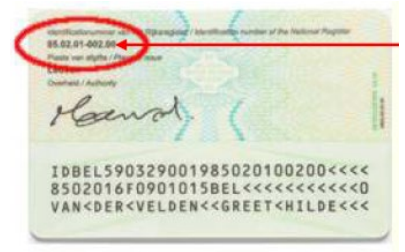 | 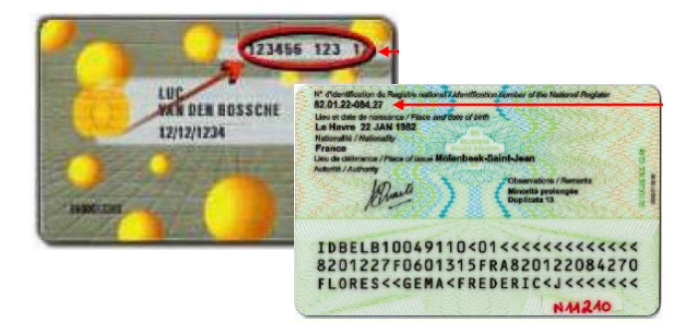 |
| Official identity card (back side) only for Belgians citizens | Social Security Card for foreign residents |
BIS Number for Non-Residents
Individuals not registered in the National Register — frontier workers, short-term foreign employees, and foreign property owners — receive a BIS number (bisnummer / numéro Bis). It uses the same 11-digit structure as the Rijksregisternummer but the month digits in positions 3–4 are increased by 20 (if the person's sex is known) or 40 (if unknown). This makes BIS numbers arithmetically distinguishable without requiring a separate format. Non-residents who have Belgian-source income but no Belgian employer must contact FPS Finance directly to obtain a BIS number before filing a non-resident income tax return on form 276.2.
Ondernemingsnummer / Numéro d'entreprise
The enterprise number is a 10-digit identifier always beginning with 0 or 1, with the last two digits acting as a check number. It is assigned by and recorded in the Banque Carrefour des Entreprises (BCE) / Kruispuntbank van Ondernemingen (KBO) — the Crossroads Bank of Enterprises managed by the FPS Economy. The register is publicly accessible via the CBE Public Search portal.
Format example: 0999.999.999 or 1999.999.999
You can also verify a Belgian enterprise number step-by-step using the official CBE search interface.
BTW/TVA Number (VAT Number)
The Belgian VAT number is the enterprise number preceded by the country code BE, giving a 12-character string:
Format: BE + 10 digits (e.g., BE0999999999, BE1999999999)
Mod-97 checksum: The last two digits of the 10-digit numeric portion satisfy:
97 − (first 8 digits mod 97) = last 2 digits
Older Belgian enterprises held 9-digit company numbers; a leading zero was prepended during the 2005 format migration, so both BE0 and BE1 prefixes are now in circulation. A number failing the mod-97 check is structurally invalid regardless of VIES status. New enterprises allocated numbers starting with BE1 are valid — software that only accepts BE0 prefixes must be updated.
On invoices and official correspondence the number may appear as plain BE0999999999, as TVA BE0999999999 (French), or as BTW BE0999999999 (Dutch) — all three forms are equivalent.
To validate an active Belgian VAT number against the EU database, see how to verify a VAT number in Belgium.
2026 Mandatory B2B E-Invoicing
From 1 January 2026, all Belgian VAT-liable enterprises must exchange structured electronic invoices via the Peppol network for domestic B2B transactions. The EN 16931-compliant format (UBL 2.1 via Peppol BIS Billing 3.0) requires the supplier's BTW/TVA number in BE+10-digit format as a mandatory field. Invoices without a correctly formatted VAT number will be technically rejected by Peppol access points. A tolerance period applied for January–March 2026; enforcement of sanctions resumed from 1 April 2026.
For neighboring country TIN structures, see the Netherlands TIN guide and the Luxembourg TIN guide.
Frequently Asked Questions
Does a non-EU company need a fiscal representative and a bank guarantee to get a Belgian BTW/TVA number?
Yes — both are mandatory for non-EU businesses. A company established outside the EU that makes taxable supplies in Belgium must appoint a Belgian-resident fiscal representative who is jointly and severally liable for all VAT, interest, and penalties. [1] The representative must also lodge a bank guarantee with the Belgian Treasury covering the estimated VAT liability, with a statutory minimum of €7,500 and a maximum of €1,000,000. EU-established companies can register directly without a fiscal representative and face no registration threshold — the obligation arises from the first taxable transaction. [2]
I can no longer log into Intervat with my Isabel or GlobalSign certificate — what do I do?
As of 31 January 2024, FPS Finance removed support for Isabel and GlobalSign commercial certificates on all its e-services, including Intervat. [3] Non-residents without a Belgian eID or an eIDAS-compatible national identity credential must now register through ForReg, FPS Finance's alternative validation procedure, which does not require travel to Belgium. [4] Once ForReg access is granted, users can file VAT returns, submit client listings, and manage registrations through Intervat. Accounting software that relied on Isabel certificates must migrate to the new authentication flow before filing deadlines, or returns will be technically rejected.
My validation software rejects Belgian VAT numbers starting with BE1 — is the number actually invalid?
No — the number is valid. Belgium expanded its enterprise number allocation scheme so that new entities may receive numbers beginning with 1 instead of 0, producing BTW/TVA numbers in the form BE1xxxxxxxxx. [5] Validation libraries and ERP systems that hard-code a check for BE0 as the only valid prefix will incorrectly flag these numbers. The structural test remains the same mod-97 checksum on the 10-digit numeric portion. Confirm the number is active via the EU VIES portal or the CBE Public Search before concluding it is fraudulent. [6]
Does my construction subcontractor invoice need special wording to apply the Belgian VAT reverse charge?
Yes — since 1 January 2023 the reverse charge on immovable property work (the co-contractor / medecontractant regime) is mandatory whenever the customer holds a Belgian VAT number and submits periodic VAT returns, including foreign contractors registered in Belgium. [7] Every invoice must carry the declaration: "Reverse charge. In the absence of an objection in writing within one month of receipt of the invoice, the customer is deemed to acknowledge that he is a taxable person required to submit periodic returns. If that condition is not fulfilled, the customer is liable for the tax, interest, and fines due." Omitting this statement or incorrectly charging 21% BTW/TVA instead of applying the reverse charge exposes the supplier to penalties and may require a corrective credit note. [8]
What is the 3-month deadline for the Belgian expatriate tax regime (BBIB), and what happens if it is missed?
Under the special tax regime for inbound taxpayers (BBIB/RSII) introduced on 1 January 2022, the employer must file an electronic application with FPS Finance within three months of the employee's first working day in Belgium. [9] Missing this deadline is definitively and irreversibly inadmissible — there is no appeal or late-filing correction mechanism. The regime allows employers to grant a tax-free recurring expense allowance of up to 35% of gross salary (capped at €90,000 per year), so a missed deadline costs the employee and employer this benefit entirely. Eligibility also requires a minimum annual gross salary of €70,000 and a 60-month prior period with no Belgian tax residency or employment within 150 km of the border. [10]
How does a non-resident without a Numéro National obtain a Belgian tax identifier to file an income tax return?
Individuals not registered in Belgium's National Register are assigned a BIS number (bisnummer / numéro Bis) — an 11-digit identifier structured like the Rijksregisternummer but with the month-of-birth digits increased by 20 (if sex is known) or 40 (if sex is unknown). [11] If you have Belgian-source income but no Belgian employer to request the BIS number on your behalf, contact FPS Finance directly before filing the non-resident income tax return (form 276.2 / Formulier 276.2). Frontier workers, short-term foreign employees, and foreign property owners in Belgium are the most common cases requiring this path. [12]
Does a foreign SaaS company selling to Belgian consumers need a Belgian BTW/TVA number or is OSS sufficient?
OSS is sufficient for most cases. EU-based digital service providers can account for Belgian VAT through the EU One Stop Shop regime once their cross-border B2C sales exceed the €10,000 EU-wide threshold — no Belgian VAT number is required. [13] Non-EU companies selling digital services (SaaS, streaming, e-books) to Belgian consumers must register under the Non-Union OSS in any EU member state and need not obtain a local Belgian BTW number. The obligation begins from the first euro of sales to Belgian consumers — there is no country-level registration threshold for non-EU suppliers. A direct Belgian registration is only required if the company also stores goods in Belgium, has a fixed establishment there, or engages in transactions outside the OSS scope. [14]
Related Resources
- How to verify a VAT number in Belgium — step-by-step guide to VIES validation for Belgian BTW/TVA numbers
- How to verify an Enterprise Number in Belgium — CBE Public Search walkthrough for Ondernemingsnummer lookups
- Netherlands TIN guide — BSN and RSIN identifiers for Belgium's largest trading partner
- Luxembourg TIN guide — NIF structure for cross-border Benelux operations
How Lookuptax can help you ? Lookuptax VAT validation revolutionizes VAT number validation with its robust platform, empowering businesses to seamlessly verify VAT numbers across over 100 countries. Our cutting-edge technology ensures accurate and efficient validation, reducing errors and enhancing compliance.