Mexico TIN number guide
This post is also available in: Español
Clave en el Registro Federal de Contribuyentes - RFC
The Mexican Tax Administration Service issues a distinct identifier, known as Clave en el Registro Federal de Contribuyentes (RFC), to each individual or legal entity registered in the system. The structure of the RFC varies based on the taxpayer type, distinguishing between individuals and legal entities as outlined in Mexican tax regulations. According to these laws, only individuals and legal entities meeting specific criteria, such as filing periodic tax returns or issuing digital tax invoices, are mandated to register for a Taxpayer Identification Number (TIN).
Furthermore, legal entities and individuals falling under the requirement to open a financial account in Mexican financial institutions must also register for a TIN. Additionally, individuals of legal age (18 years old) are obligated to register in the Federal Taxpayer Registry, irrespective of their engagement in business activities.
Entities further have the responsibility to submit notifications, as specified in the Federal Fiscal Code, regarding their legal representatives, partners, and shareholders.
RFC Format
Individuals in Mexico are assigned a 13-character identifier, comprising 4 letters followed by 6 digits and 3 alphanumeric characters. The initial 4 letters represent the name, followed by 6 digits indicating the date of birth, and the last 3 characters are check digits.
For entities, the identifier is 12 characters long, consisting of 3 letters followed by 6 digits and 3 alphanumeric characters. The first 3 letters pertain to the name, the subsequent 6 digits indicate the date of incorporation, and the final 3 characters are check digits.
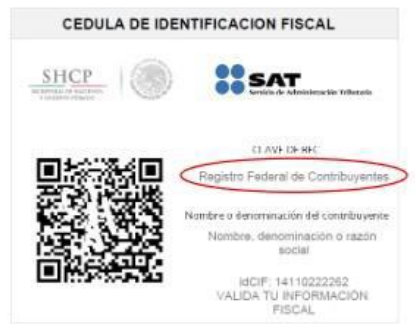 |
| TAX IDENTIFICATION CARD |
How Lookuptax can help you in VAT validation?
Lookuptax VAT validation revolutionizes VAT number validation with its robust platform, empowering businesses to seamlessly verify VAT numbers across over 100 countries. Our cutting-edge technology ensures accurate and efficient validation, reducing errors and enhancing compliance.
Frequently Asked Questions
Can I get an RFC in Mexico on a tourist visa or FMM permit?
No. A tourist permit (FMM) does not qualify you to register for an RFC. You must hold a valid Temporary Resident Card, Permanent Resident Card, or Humanitarian Visitor Card issued by the Instituto Nacional de Migración (INM) before SAT will process your application. Since most Mexican banks now require an RFC and a Constancia de Situación Fiscal to open accounts, foreign visitors on FMMs face a hard blocker: no residency card means no RFC, and no RFC means no bank account. The solution is to first complete the INM residency process, then book a SAT appointment (via citas.sat.gob.mx) and attend in person with your CURP, residency card, passport, and proof of address. [1] [2]
Why does CFDI 4.0 keep rejecting my invoice with error CFDI40145 or CFDI40147?
These are the two most common CFDI 4.0 stamping errors. CFDI40145 fires when the recipient's legal name (Nombre/Razón Social) does not match the SAT registry exactly — even a missing accent mark, an extra comma, or including "S.A. de C.V." when it was registered without it triggers rejection. CFDI40147 fires when the recipient's postal code (DomicilioFiscalReceptor) does not match the code on their Constancia de Situación Fiscal. Both fields became mandatory and strictly validated when CFDI 4.0 became compulsory in April 2023. The fix is to ask your client for a fresh copy of their Constancia and copy the name and postal code character-for-character into your billing system. [3] [4]
What happens if an individual RFC holder exceeds the RESICO income ceiling of MXN 3.5 million?
RESICO (Régimen Simplificado de Confianza) is available only to individuals with prior-year gross income at or below MXN 3,500,000. If you exceed this ceiling during a tax year, the SAT automatically migrates you to the general activity regime (Título IV, Capítulo II, Sección I of the ISR Law), which carries higher progressive rates and full bookkeeping obligations — effective from the month in which you crossed the threshold, not just the following year. You must also begin charging and remitting IVA on your invoices immediately. The SAT's pre-filled monthly declarations will stop reflecting RESICO rates, and any monthly payments calculated at the lower RESICO rate before the threshold breach will need to be reconciled. You can re-enroll in RESICO in future years once income falls back within the limit. [5] [6]
What are the penalties for not enabling or ignoring the SAT Buzón Tributario?
The Buzón Tributario is SAT's mandatory digital mailbox for official notifications, audits, and legal summons. Under Articles 86-C and 86-D of the Código Fiscal de la Federación, failing to enable the Buzón Tributario or failing to register and maintain valid contact methods carries a fine of MXN 3,850 to MXN 11,540. More critically, if the SAT sends an audit notice or a requerimiento through the Buzón and you do not respond within the legal deadline (typically 15 business days), the authority can proceed as if you received it — meaning audits and penalties can advance uncontested. The enforcement deadline for fines has been extended to January 1, 2027, per the 2026 Fiscal Miscellaneous Resolution. [7] [8]
Why is my e.firma (FIEL) blocking CFDI stamping and SAT portal access, and how do I renew it?
The e.firma is a 4-year digital certificate required to stamp CFDIs, file annual declarations, access the SAT portal, and sign legal documents. When it expires, all those operations are blocked simultaneously — a common surprise for small businesses that miss the renewal window. If your certificate expired less than one year ago, you can renew it online using the SAT's Certifica desktop application (available for Windows, macOS, and Linux at sat.gob.mx) without an in-person appointment. If it expired more than one year ago, an in-person SAT appointment is mandatory to reapply from scratch. In October 2024, a SAT system incident caused widespread "Certificado Revocado" and "FIEL Caducó" errors affecting customs and trade operations, even for valid certificates, highlighting the dependency the entire compliance chain has on this single credential. [9] [10]