China TIN number guide — USCC, Citizen ID & Tax Registration
This post is also available in: Español
Uniform Social Credit Code (USCC)
China's primary tax identifier for businesses is the Uniform Social Credit Code (统一社会信用代码, USCC) — an 18-character alphanumeric code printed on every company's Business License. Introduced by national standard GB/T 32100-2015 and effective from October 2015, the USCC replaced three separate legacy certificates (business registration, organization code, and tax registration number) through the "Three Certificates in One" reform. The transition was completed by end-2017; any entity still presenting a legacy 15-digit TIN has not completed the mandatory conversion and cannot legally issue invoices (fapiao).
China's tax identifiers are also listed in the worldwide directory of VAT and tax ID names.
USCC Format — 18 characters
| Position | Length | Content |
|---|---|---|
| 1 | 1 char | Registration authority code (e.g., "1" = market regulators, "5" = Ministry of Civil Affairs) |
| 2 | 1 char | Entity type code (e.g., "1" = enterprise) |
| 3–8 | 6 digits | GB/T 2260 administrative division code (province → city → county) |
| 9–17 | 9 chars | Organization code (alphanumeric, excluding I, O, Z, S, V) |
| 18 | 1 char | Check digit (ISO 7064, MOD 31-3 algorithm) |
The character set uses Arabic numerals and uppercase Latin letters only, deliberately excluding I, O, Z, S, and V to prevent visual confusion. Format-valid codes are not the same as registered codes — structural checks pass locally, but actual registration status must be verified against the National Enterprise Credit Information Publicity System (GSXT) at gsxt.gov.cn.
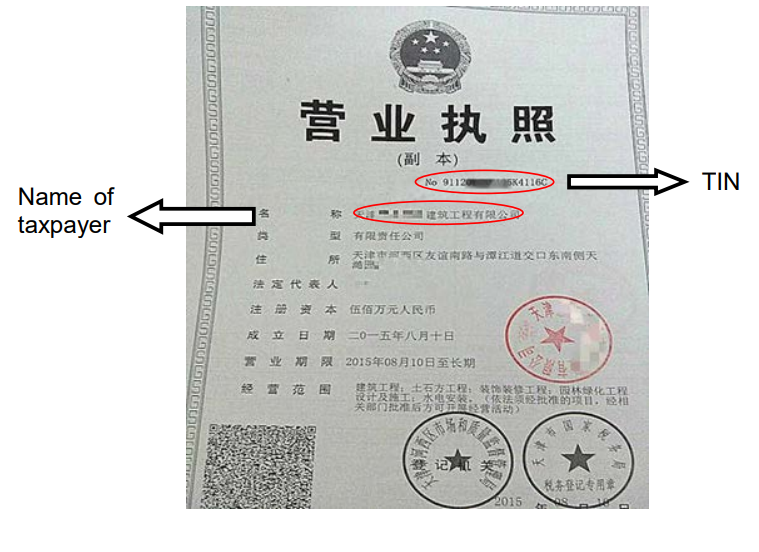 |
| Business License |
Legacy 15-Digit TIN
Before 2015, businesses held a separate 15-digit Tax Registration Number assigned by the State Taxation Administration (STA). This number combined a 6-digit region code with a 9-digit organization identifier. The legacy format is now obsolete: banks, customs authorities, and e-commerce platforms will reject it for new transactions. If a supplier provides a 15-digit number, request the current 18-character USCC from their updated Business License before proceeding with procurement or invoicing.
Individual ID Number (居民身份证)
For individuals using a Chinese Resident Identity Card, the TIN is the 18-digit ID card number (居民身份证号码). The structure encodes region, birthdate, a sequential code, and a checksum:
| Position | Content |
|---|---|
| 1–6 | Administrative region of household registration (hukou) |
| 7–14 | Date of birth in YYYYMMDD format |
| 15–17 | Sequential code (odd = male, even = female) |
| 18 | Check digit (ISO 7064:1983 MOD 11-2) |
For foreign individuals who use a passport or other foreign identity document, the TIN is assigned by the local tax office. In many regions, the passport number itself is accepted as a provisional TIN until a formal registration number is issued.
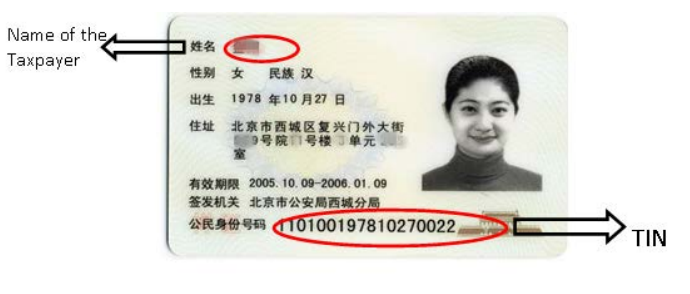 |
| Chinese ID card |
Verification
To verify a business USCC, search the National Enterprise Credit Information Publicity System at gsxt.gov.cn by either the company's full Chinese legal name or its 18-character USCC. The portal displays registration status, legal representative, business scope, and establishment date. For tax-specific verification, the STA portal at chinatax.gov.cn provides supplementary lookup tools. The e-fapiao verification portal at inv-veri.chinatax.gov.cn allows verification of individual invoices using the invoice number and verification code.
Frequently Asked Questions
A supplier gave us a 15-digit number instead of 18 characters — is it still valid and can we claim input VAT?
A 15-digit number is a pre-2015 Tax Registration Number that should have been converted to an 18-character USCC by the end of 2017. It is no longer valid for issuing fapiao or claiming input VAT, and customs and banking systems will reject it. The entity either ceased operations before completing the mandatory migration or has not updated its records — both are red flags. Request the current Business License showing the 18-character USCC before processing any purchase orders or VAT deduction claims. You can cross-check the USCC independently on the GSXT portal at gsxt.gov.cn without relying on the supplier's self-declaration. [1] [2]
My Chinese partner demands a Special VAT Fapiao but we only have a General VAT Fapiao device — what is the difference and can we switch?
Special VAT Fapiao (专用发票) allows the buyer to deduct input VAT, making it mandatory for B2B procurement; General VAT Fapiao (普通发票) carries no input-tax credit. The STA assigns fapiao type entitlement at registration: only general VAT taxpayers (一般纳税人) with annual taxable sales above RMB 5 million can apply for the special-type device. Small-scale taxpayers (小规模纳税人) are restricted to general fapiao. Reclassification requires at least 12 consecutive months of operating history and a clean compliance record; the application is submitted to the local tax bureau which then re-issues the fapiao entitlement. [3] [4]
Since December 2024, is paper fapiao still legally valid, and what does the e-fapiao mandate mean for companies that have not upgraded?
China's STA launched nationwide fully digitalized e-fapiao (全面数字化的电子发票) on 1 December 2024. Paper fapiao remains legally valid during a phased transition running through late 2025, with sector-specific deadlines — railway and aviation paper receipts are phased out from 1 October 2025. General businesses must migrate their issuing and receiving workflows to the STA's national e-invoice platform or via API integration. Companies that miss the transition cannot issue legally compliant invoices or claim input VAT on purchases, creating immediate payment disputes with Chinese buyers and audit exposure. The new e-fapiao is verified through the STA portal at inv-veri.chinatax.gov.cn using the invoice number and verification code. [5] [6]
Does the 10% withholding tax on royalties and service fees paid to a foreign company apply automatically, and how is a treaty rate claimed?
Yes — under China's Enterprise Income Tax Law, the STA withholds 10% at source on dividends, interest, royalties, and capital-gains payments from Chinese entities to non-resident enterprises with no permanent establishment in China. The rate applies automatically unless the foreign payee self-assesses treaty eligibility before payment and provides the withholding agent with the required STA declaration form. Under STA Announcement [2015] No. 60, pre-approval was abolished and replaced with self-declaration, but the foreign company must retain all supporting documentation for post-filing audit. If 10% has already been deducted and a lower treaty rate applies, a refund claim must be filed with the local tax authority — a process that routinely takes six to twelve months. [7] [8]
An expat has lived in China for six consecutive years — does worldwide income become taxable in year seven, and how is the clock reset?
Under the Individual Income Tax reform effective 1 January 2019, a non-domiciled individual who meets the 183-day annual residency threshold in each of six consecutive years becomes liable for Chinese IIT on worldwide income from the seventh year onward. The six-year count resets to zero if the individual spends more than 30 consecutive days outside China in any single tax year. Because the reformed rule only started counting from 2019, 2025 is the earliest year this threshold can be triggered for a continuous resident. Strategically scheduling a trip of at least 31 consecutive days in any year before the seventh resets the cycle, deferring worldwide taxation indefinitely. [9] [10]
A foreign individual opening a Chinese bank account is asked for a TIN — which number applies and what happens under CRS reporting?
Chinese banks must collect TINs for all account holders under the Common Reporting Standard due-diligence rules that China adopted in May 2017. For Chinese citizens, the TIN is the 18-digit Resident Identity Card number. For foreign nationals, the bank expects the TIN issued by the individual's country of tax residence — typically an SSN, national tax number, or equivalent. Foreign nationals resident in China who lack a home-country TIN should present their passport number, which local tax offices in most regions accept as a provisional identifier pending formal STA assignment. Year-end account balances and income data are then exchanged automatically with the relevant foreign tax authority under the AEOI framework. [11] [12]
As a foreign digital platform operator, does China's Decree No. 810 require me to collect TINs from my Chinese sellers?
Yes. State Council Decree No. 810, issued on 20 June 2025, requires all internet platforms — including those incorporated outside China that facilitate transactions with domestic sellers — to collect and verify seller TINs, report identity and revenue data to the STA, and in some cases withhold and remit taxes on behalf of individual practitioners. Offshore platforms had to register basic platform information by 30 July 2025 and submit the first batch of verified seller identity and revenue data by 31 October 2025. Platforms that fail to comply face penalties and may have accounts suspended by the STA. The rules mirror the OECD Model Reporting Rules for Digital Platforms. [13] [14]
Related Resources
- Hong Kong TIN guide — SAR-specific business registration and profits tax numbers
- Singapore TIN guide — UEN structure for companies trading across the China–ASEAN corridor
- Worldwide VAT and tax ID names — full directory of tax ID terminology by country
- What is input tax credit? — explains VAT deduction mechanics relevant to fapiao claims
- Reverse charge explained — cross-border service tax mechanics for payments to Chinese entities
How Lookuptax can help you ?
Lookuptax VAT validation revolutionizes VAT number validation with its robust platform, empowering businesses to seamlessly verify VAT numbers across over 100 countries. Our cutting-edge technology ensures accurate and efficient validation, reducing errors and enhancing compliance.