Latvia TIN — Personas kods & PVN number guide
Personas kods (Personal Identity Number)
The Latvian personal identity number — personas kods — is the primary Tax Identification Number (TIN) for individuals. It consists of 11 digits and is issued by the Office of Citizenship and Migration Affairs (PMLP). All individual TINs align with their personas kods, making it a single identifier for tax, social insurance, and civil registration purposes.
Two co-existing formats
Latvia operates two valid personas kods formats simultaneously. Which format you hold depends on when you were registered in the Register of Natural Persons.
Old format (issued up to 30 June 2017)
The classic format encodes the holder's date of birth in the first six digits, followed by a century digit and four random/checksum digits:
DDMMYY-CXXXX
| Position | Meaning |
|---|---|
| DD | Day of birth |
| MM | Month of birth |
| YY | Year of birth (last two digits) |
| C | Century digit: 0 = 19th century, 1 = 20th century, 2 = 21st century |
| XXXX | Four digits (serial + checksum) |
Example: 121212-XXXXX — a person born 12 December 2012.
New format (issued from 1 July 2017)
From 1 July 2017, Latvia switched to privacy-preserving codes that contain no date-of-birth information. All new registrants in the Register of Natural Persons receive a code beginning with "3":
32XXXX-XXXXX
- The first digit is always
3. - The second digit is a system-generated random digit between
2and9. - Digits 3–11 are random numbers between
0and9. - The first six digits may be hyphenated from the remaining five.
Example: 38XXXX-XXXXX (X replaces actual numbers for data protection)
Individuals who held an old-format code before July 2017 may voluntarily exchange it once, free of charge, for a new-format code via PMLP. Both formats are legally valid TINs for CRS, FATCA, and domestic tax purposes.
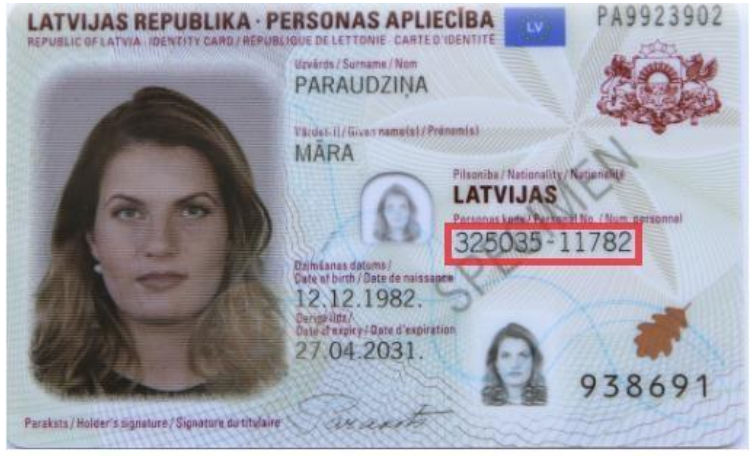 | 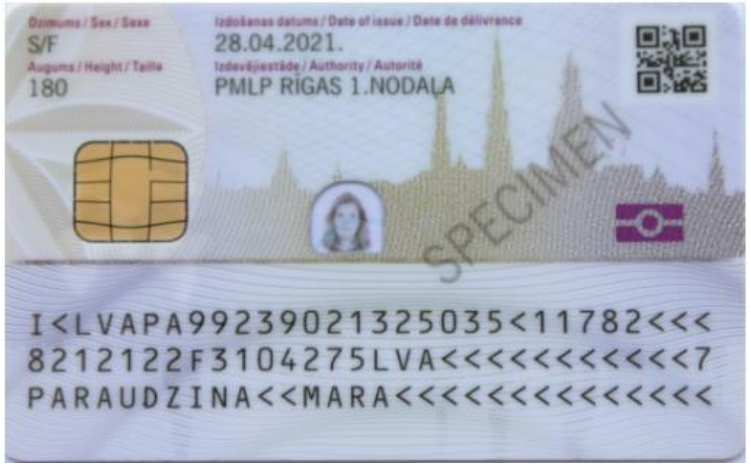 |
| ID card | |
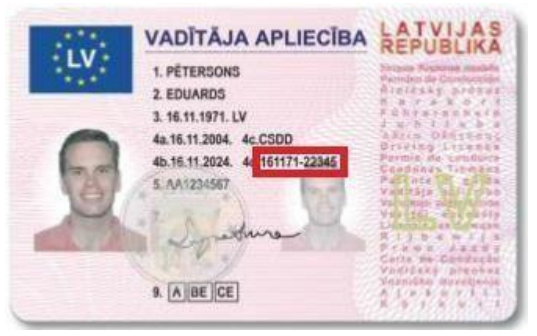 |
| Driving License |
PVN Number (VAT Registration Number)
The Latvian VAT registration number is called the PVN maksātāja numurs (PVN number). It is issued by the State Revenue Service (VID — Valsts ieņēmumu dienests) and takes the format:
LV + 11 digits
Example: LV40003521600
For individuals, the 11-digit portion is identical to their personas kods (without the hyphen). For legal entities, the VID assigns a distinct 11-digit registration number.
Verification — Check any PVN number against the official VID register: PVN maksātāja numurs search. Latvian VAT numbers are also verifiable through the EU VIES portal using the LV prefix.
VAT registration threshold — From 1 January 2025, mandatory registration is triggered at €50,000 of combined taxable and specified non-taxable turnover (certain exempt supplies such as real estate sales, residential letting, insurance, financial and fund-management services, and statutory land-use fees) within a calendar year. If the threshold is exceeded by no more than €5,000, registration may be deferred: the application is due by 30 November and registration takes effect from 1 January of the next year (VAT Law s.59(4), (6); s.67). Businesses established outside the EU have no threshold and must register before their first taxable supply in Latvia, unless the customer accounts for the VAT under the reverse charge (s.63). Businesses established in another EU member state may use the €50,000 threshold unless their EU-wide turnover exceeded €100,000 in the current or previous year (s.61(11)–(12)). [9] For rates, invoicing and filing rules, see the Latvia VAT guide.
Entity TINs
The State Revenue Service issues TINs for legal entities using distinct number ranges:
| Entity type | TIN structure |
|---|---|
| General entities | 9000xxxxxxx |
| Register of Enterprise — category A | 4000xxxxxxx |
| Register of Enterprise — category B | 5000xxxxxxx |
E-Invoicing Status
Latvia's e-invoicing mandate has been phased in over several years:
- 1 January 2025 — B2G mandatory: all suppliers billing public-sector budget institutions must issue structured e-invoices in EN 16931 / Peppol BIS Billing 3.0 XML format through a channel the parties agree — the official e-address, an e-invoice service provider or operator, or another agreed channel (Cabinet Regulation 749, points 4–5). PDF and paper invoices are no longer accepted for public-sector transactions. For B2G contracts concluded by 31 December 2024 the obligation applied no later than 1 January 2026 (Accounting Law transitional provision 9).
- 1 January 2026 — e-invoice data for G2G, B2G and G2B invoices must be sent to VID within five working days; businesses may also submit B2B e-invoice data to VID voluntarily (Cabinet Regulation 749). [10]
- 1 January 2028 — B2B mandatory: the Saeima's June 2025 amendment to the Accounting Law deferred the original 2026 B2B deadline by two years.
For detailed implementation guidance, see the global e-invoicing status tracker.
Frequently Asked Questions
My personas kods starts with "32" and some online services don't recognise it — why?
Since 1 July 2017, Latvia issues privacy-preserving personal codes beginning with "3" to all newly registered persons — these codes contain no date-of-birth information. [1] Legacy systems that validate personas kods by checking for a recognisable DDMMYY date in positions 1–6 will reject new-format codes entirely, even though those codes are legally valid. Smart-ID's documentation acknowledges that new-format code holders who register via bank-link authentication are limited to a Basic account — restricting access to non-banking e-services — and must instead use in-person ID-card or biometric registration to unlock full-access. For CRS/FATCA purposes the new code is your TIN exactly as printed; financial institutions worldwide are obliged to accept both formats. [2] If a bank or portal rejects your code, request escalation citing your Register of Natural Persons entry. You are also entitled to one free format change back to an old-format code via PMLP.
From 1 January 2026, can foreign nationals without Latvian eID still log in to VID's EDS tax portal?
Yes, but only under a specific carve-out. From 1 January 2026, standard EDS access requires a qualified electronic identification tool — Smart-ID (qualified tier), a Latvian eID card, eParaksts mobile, or approved internet banking. [3] However, foreign nationals who have no legal connection to Latvia and cannot obtain a foreigner's eID card retain the right to access EDS using the VID-issued username and password after that date — the VID has explicitly carved out this exception. [4] If you currently file under a VID-issued credential, verify with VID before year-end whether you qualify; if not, you must authorise a domestic representative (prokūrists or pārstāvis) to file on your behalf before the deadline. Internet banking authentication is removed as a method at the end of 2026, narrowing options further.
Since 2025, which transactions count toward Latvia's €50,000 VAT registration threshold — and what happens if I missed the January 15 deadline?
From 1 January 2025, the €50,000 mandatory VAT registration threshold is calculated on a broader base: businesses must include certain non-taxable transactions — such as real estate sales, residential letting, insurance, financial and fund-management services, and statutory land-use fees — alongside standard taxable turnover when assessing whether they have crossed the limit. [5] If you exceeded the combined threshold in 2024 and submitted your registration by 15 January 2025, VAT liability begins from the date of inclusion in the VAT register. If you missed that deadline, VID treats VAT as due retroactively from 1 January 2025 on all taxable transactions — meaning you may owe 21% VAT on invoices already issued without VAT. [6] Separately, a €5,000 tolerance applies: if the threshold is exceeded by no more than €5,000 in a calendar year, you may defer registration by applying by 30 November, and registration then takes effect from 1 January of the next year (VAT Law s.59(4), (6)). [9]
When does Latvia's domestic reverse charge apply to construction invoices, and what happens if my subcontractor is not VAT-registered?
Under Section 142 of the Value Added Tax Law, the reverse charge applies to construction and installation services when both the supplier and recipient are VAT-registered persons and the supply occurs within Latvia. [6] The contractor (recipient) must self-assess VAT in their return; the subcontractor issues an invoice without VAT noting "reverse charge applies." If your subcontractor is not VAT-registered, the mechanism does not apply: the subcontractor must charge 21% VAT normally, and the contractor recovers it as input VAT in the usual way. Issuing a reverse-charge invoice when one party is unregistered — or failing to apply reverse charge when both are registered — constitutes an invoicing error subject to administrative penalties. [7] Always verify the subcontractor's VAT status via the VID PVN register before issuing any invoice.
Latvia's B2B e-invoicing was supposed to be mandatory from January 2026 — has that deadline changed, and what is actually required right now?
Yes, the B2B mandate was postponed. On 5 June 2025, the Saeima approved amendments to the Accounting Law deferring mandatory B2B structured e-invoicing from 1 January 2026 to 1 January 2028. [8] What is already mandatory as of 1 January 2025 is B2G invoicing: any supplier billing a public-sector budget institution must issue an electronic invoice in EN 16931 / Peppol BIS Billing 3.0 XML format through a channel the parties agree — the official e-address, an e-invoice service provider or operator, or another agreed channel (Cabinet Regulation 749, points 4–5) — PDF and paper invoices are no longer accepted for these transactions. Contracts concluded by 31 December 2024 had until 1 January 2026. Since 1 January 2026, e-invoice data for G2G, B2G and G2B invoices must be sent to VID within five working days, and businesses may submit B2B e-invoice data to VID voluntarily. [10] [8] Businesses that were preparing ERP integrations for the 2026 deadline should continue — 2028 arrives quickly — but there is no legal obligation on B2B invoicing until that date.
Related Resources
- Latvia VAT guide — rates, registration, invoicing and e-invoicing
- How to verify an EU VAT number via VIES
- How to verify an EU EORI number
- Lithuania TIN — Asmens kodas & PVM guide
- Estonia TIN — Isikukood & KMKR guide
- Global e-invoicing status tracker
- VAT registration thresholds worldwide
- Worldwide directory of VAT and tax ID names
How Lookuptax can help you in VAT validation?
Lookuptax VAT validation revolutionizes VAT number validation with its robust platform, empowering businesses to seamlessly verify VAT numbers across over 100 countries. Our cutting-edge technology ensures accurate and efficient validation, reducing errors and enhancing compliance.