Germany Tax ID Numbers — IdNr, Steuernummer, USt-ID and W-IdNr Explained
This post is also available in: Español|中文|Deutsch
Germany uses four separate tax identification numbers, each serving a different purpose. Confusing them is the single most common reason invoices get rejected and VAT deductions get denied. This guide covers the format, legal basis, and correct use case for each.
Steuerliche Identifikationsnummer (IdNr / Steuer-ID)
The Federal Central Tax Office (Bundeszentralamt für Steuern, BZSt) assigns a permanent personal tax identification number — the Steueridentifikationsnummer, colloquially called Steuer-ID or IdNr — to every individual registered in Germany. It is issued automatically after you register your address (Anmeldung) at the local registration office (Einwohnermeldeamt), and arrives by post within two to four weeks.
Format: 11 digits. The first digit is never zero. No two consecutive digits in positions 1–10 are the same. The 11th digit is a check digit calculated using ISO 7064 Mod 11,10. Example: 86095742719. [1]
Legal basis: § 139b Abgabenordnung (AO). [1]
Key facts:
- Assigned once for life; it does not change if you move, marry, or change your name.
- Survives 20 years after the holder's death.
- Used exclusively for income tax (Einkommensteuer) — never for VAT transactions.
- Must not appear on business invoices. Putting your personal IdNr on an invoice is a compliance error that exposes private data.
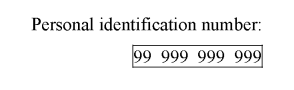 |
| Steuerliche Identifikationsnummer |
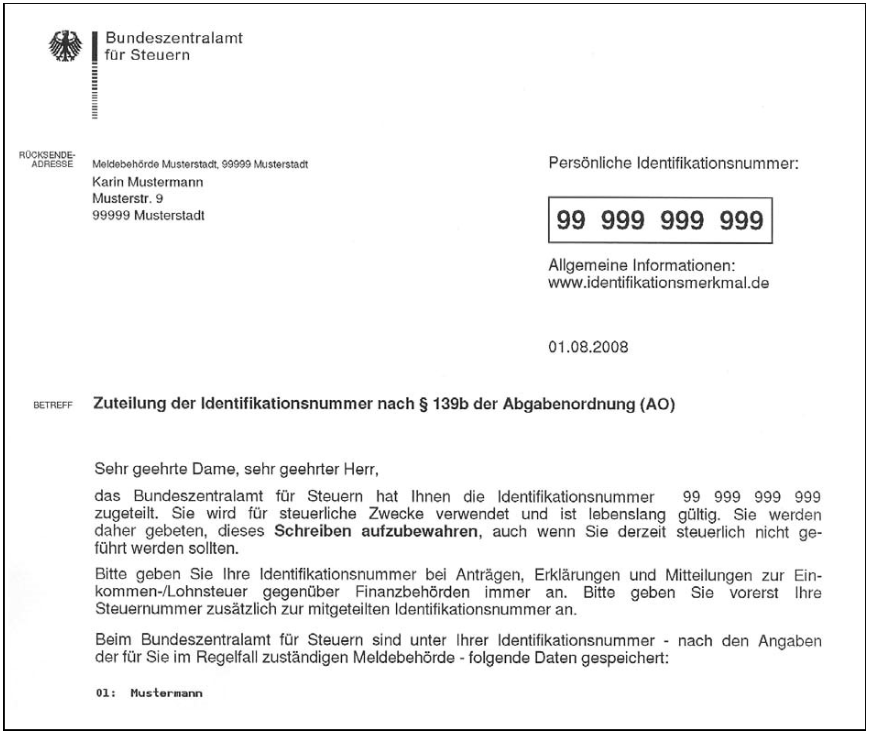 |
| Steuerliche Identifikationsnummer |
Steuernummer
The Steuernummer (tax number) is issued by the local Finanzamt responsible for the taxpayer's registered address. It is the primary identifier used for all domestic tax filings — income tax returns, VAT advance notices (Umsatzsteuer-Voranmeldungen), and business correspondence with the tax office.
Format: 10 or 11 digits in local notation (e.g., 12/345/67890) or 13 digits in unified federal format (e.g., 3012034567890). The first two digits of the federal format encode the Bundesland: for example, 11 is Berlin, 21 is Schleswig-Holstein, 30 is Brandenburg. [2]
Key facts:
- Not permanent — it changes whenever you move to an area served by a different Finanzamt, even within the same city.
- Freelancers and sole traders obtain it by submitting the Fragebogen zur steuerlichen Erfassung (ELSTER questionnaire) to their local Finanzamt. Processing takes 4–8 weeks and the number arrives by post.
- Businesses with multiple locations may hold several Steuernummern simultaneously (one per Finanzamt jurisdiction).
- Must appear on domestic B2B invoices under § 14 UStG, either alone or alongside the USt-ID.
- Must also appear in the Impressum (legal notice) of every German business website.
Why do both the IdNr and the Steuernummer exist? The Steuer-ID (IdNr), introduced in 2008, was designed to modernise tax administration and eventually replace the Steuernummer for income tax purposes. The transition is ongoing: during the current period, both numbers may be required in correspondence with the Finanzamt. The Steuernummer remains the operative filing identifier for businesses and freelancers until further notice.
Umsatzsteuer-Identifikationsnummer (USt-IdNr)
The USt-IdNr is Germany's VAT identification number, issued by the BZSt — separate from the Finanzamt that issues the Steuernummer.
Format: DE prefix followed by 9 digits. Example: DE123456789. Checksum: ISO 7064 Mod 11,10. [3]
Key facts:
- Mandatory for any business conducting intra-EU B2B transactions. Without it, the reverse-charge mechanism cannot apply and your customer cannot reclaim input VAT.
- Non-residents face a zero registration threshold: a foreign business must register for German VAT — and obtain both a Steuernummer and then a USt-IdNr — before its first taxable transaction in Germany. [3]
- Verification: use the BZSt's eVatR portal (evatr.bff-online.de/eVatR) for both simple and qualified (qualifizierte Bestätigung) confirmation under § 18e UStG.
- The USt-IdNr is not affected by address moves — it remains constant unlike the Steuernummer.
Official verification portal: evatr.bff-online.de/eVatR
Wirtschafts-Identifikationsnummer (W-IdNr)
The W-IdNr is a new permanent business identifier introduced under § 139c AO. The BZSt began assigning it in November 2024 — automatically, without application required — starting with VAT-registered businesses. Phase 2 (all other economically active entities) began in Q3 2025. [4]
Format: DE prefix followed by 9 digits — identical structure to the USt-IdNr but a distinct number allocated specifically for the W-IdNr.
Key facts:
- Unlike the Steuernummer, it does not change when a business relocates, solving the Finanzamt-district problem permanently.
- Businesses that already hold a USt-IdNr receive their W-IdNr notification via ELSTER, not by post — check your ELSTER mailbox proactively.
- W-IdNr becomes mandatory on invoices from 1 January 2027.
- During the transition period (2025–2026) invoices may legally show the Steuernummer, USt-ID, or W-IdNr — any one satisfies § 14 UStG.
| Identifier | Digits | Issued By | Changes on Move? | Invoice Use |
|---|---|---|---|---|
| IdNr (Steuer-ID) | 11 | BZSt | No | Never |
| Steuernummer | 10–13 | Finanzamt | Yes | Domestic B2B |
| USt-IdNr | DE + 9 | BZSt | No | Intra-EU B2B |
| W-IdNr | DE + 9 | BZSt | No | Mandatory from 2027 |
Frequently Asked Questions
Which tax number goes on a German invoice — Steuernummer, USt-ID, or the new W-IdNr?
For domestic B2B invoices, display your Steuernummer (e.g. 12/345/67890) or your USt-ID (DE + 9 digits) — either satisfies § 14 UStG. For intra-EU B2B transactions, the USt-ID is required so the buyer can apply the reverse-charge mechanism; the Steuernummer alone is not acceptable for cross-border EU invoices. The personal IdNr (11-digit lifelong individual number) must never appear on business invoices. The W-IdNr, rolling out from November 2024, becomes a mandatory invoice field from 1 January 2027; during the 2025–2026 transition any of the three business identifiers satisfies the legal requirement. [5] [6]
What happens to my Steuernummer when I move to a different Finanzamt district, and how do I avoid invoice rejections?
Your Steuernummer is tied to the Finanzamt covering your registered address, so it changes whenever you move to a different district — even within the same city. Invoices carrying the old Steuernummer after the move create an auditable mismatch that can cause denied input-VAT deductions for your customers during a Betriebsprüfung. The fix: notify your new Finanzamt immediately, wait for the new number by post (2–6 weeks), then update all invoice templates, your Impressum, and any connected e-invoicing systems. Your USt-IdNr and IdNr remain unaffected. The incoming W-IdNr — permanent and address-independent — will eventually eliminate this problem entirely for businesses once the 2027 mandate takes effect. [4] [6]
I lost my Steuer-ID letter — can I retrieve my IdNr online?
No online display is possible for data-protection reasons: the BZSt will only communicate your IdNr by post. If you cannot locate your number in previous tax assessments, payslips, or your ELSTER account, submit a re-notification request through the BZSt's official online form (available on bzst.de under "New notification of the tax identification number"). The BZSt sends the letter to your current Anmeldung address; allow up to three weeks. If nothing arrives after three months, submit a written follow-up request with your full name, address, date and place of birth to the BZSt. [7] [8]
What are the exact XRechnung/ZUGFeRD e-invoicing deadlines, and does the mandate apply to foreign sellers?
The mandate was introduced by the Wachstumschancengesetz (March 2024) and covers domestic B2B transactions between VAT-registered businesses established in Germany. Phase 1 (1 January 2025): every German business must be able to receive structured e-invoices (XRechnung or ZUGFeRD 2.1+, compliant with EN 16931). Phase 2 (1 January 2027): businesses with prior-year turnover above €800,000 must also issue structured e-invoices. Phase 3 (1 January 2028): all remaining businesses must issue them. Cross-border B2B transactions (intra-EU or non-EU) are explicitly outside this mandate. Kleinunternehmer under § 19 UStG are exempt from the issuing obligation but must still be able to receive e-invoices. Simple PDFs no longer qualify once the issuing deadline applies. For format and implementation details, see the Germany e-invoicing guide. [9] [6]
Why does the BZSt qualified confirmation (qualifizierte Bestätigung) return a name mismatch for a valid EU VAT number?
The BZSt provides two verification levels under § 18e UStG. The simple check (einfache Bestätigung) confirms only number validity. The qualified check additionally compares trade name, legal form, town, postcode, and street against the issuing member state's VIES data. A "does not match" result is common and does not indicate fraud — it typically reflects minor inconsistencies such as GmbH abbreviated versus spelled out, umlaut encoding (ä vs ae), or a stale address in the partner country's register. The BZSt cannot disclose the stored data; ask your supplier to provide their exact registered details. Retaining the BZSt confirmation printout provides legal safe-harbour documentation regardless of outcome. A simple check must precede any qualified check. [10] [11]
Does a Kleinunternehmer need a USt-ID if they sell digital services to EU customers?
As of 1 January 2025, Kleinunternehmer thresholds under § 19 UStG are €25,000 net in the prior year and €100,000 net in the current year. Below these limits, no VAT applies on domestic sales and no USt-ID is required for purely domestic transactions. The cross-border trap: if total B2C sales of digital services or goods to other EU countries exceed €10,000 per calendar year, VAT becomes due in each customer's country — the Kleinunternehmer exemption does not apply at EU level. At that point the business must either register in each destination country or enrol in the One-Stop-Shop (OSS) via the BZSt, which requires a USt-ID. From 2025 the new EU-KU-Regelung (European small business scheme) allows German Kleinunternehmer to claim exemption in other EU states up to a €100,000 EU-wide cap, but BZSt OSS portal registration is still required to use it. [12] [13]
Related Resources
- Germany VAT country guide
- Germany e-invoicing (XRechnung/ZUGFeRD) guide
- Worldwide directory of VAT and tax ID names
- VAT registration thresholds worldwide
How Lookuptax can help you ?
Lookuptax VAT validation revolutionizes VAT number validation with its robust platform, empowering businesses to seamlessly verify VAT numbers across over 100 countries. Our cutting-edge technology ensures accurate and efficient validation, reducing errors and enhancing compliance.