Netherlands TIN number guide
Citizen service number (BSN)(Burgerservicenummer)
The Citizen Service Number (BSN) is an exclusive personal identifier assigned to individuals registered in the Personal Records Database (BRP). Automatic allocation of a BSN occurs for every individual upon registration with the BRP.A BSN is comprised of 9 digits.The citizen service number has replaced the tax and social insurance number (sofinummer).
BSN Format The Dutch Tax Identification Number (TIN) consists of 9 digits, for example, 999999999. It adheres to specific validation rules and a check digit verification process outlined as follows:
The TIN always comprises 9 digits: N1, N2, N3, N4, N5, N6, N7, N8, N9, where N9 serves as the check digit.
Algorithm for check digit calculation: ((N19) + (N28) + (N37) + (N46) + (N55) + (N64) + (N73) + (N82)) modulo 11 Check digit (N9) equals the remainder from the above algorithm.
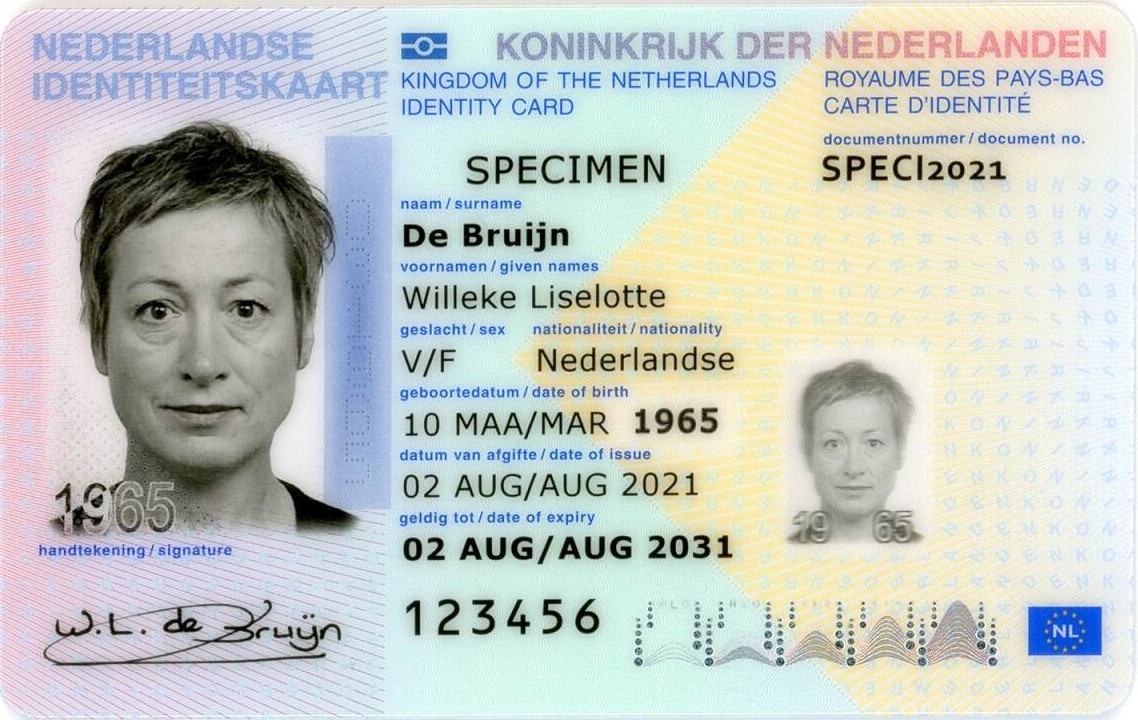 | 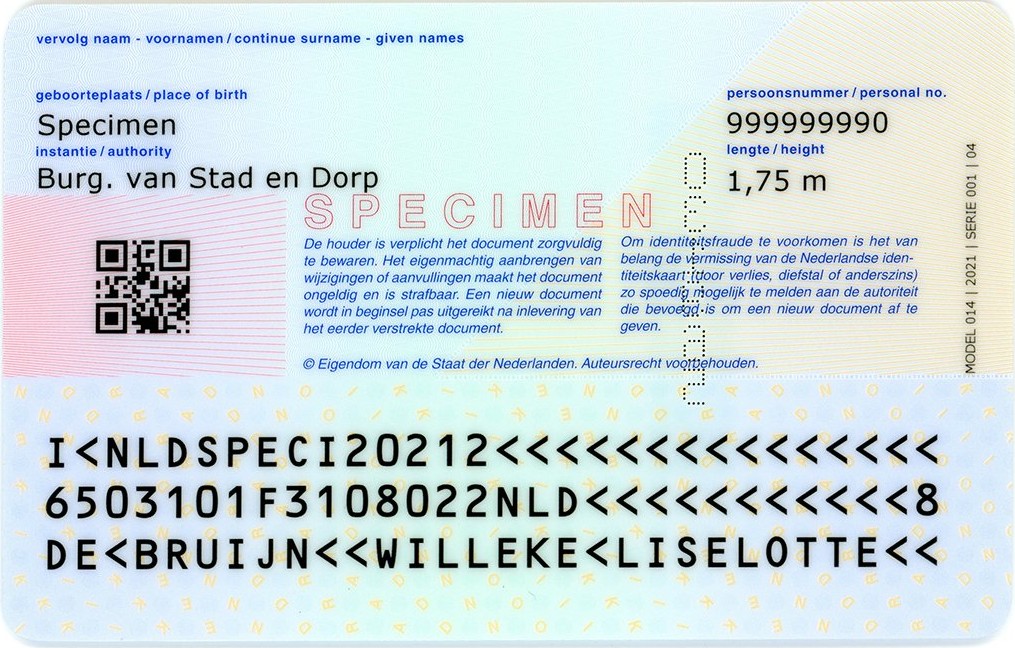 |
| ID card Front | ID card Back |
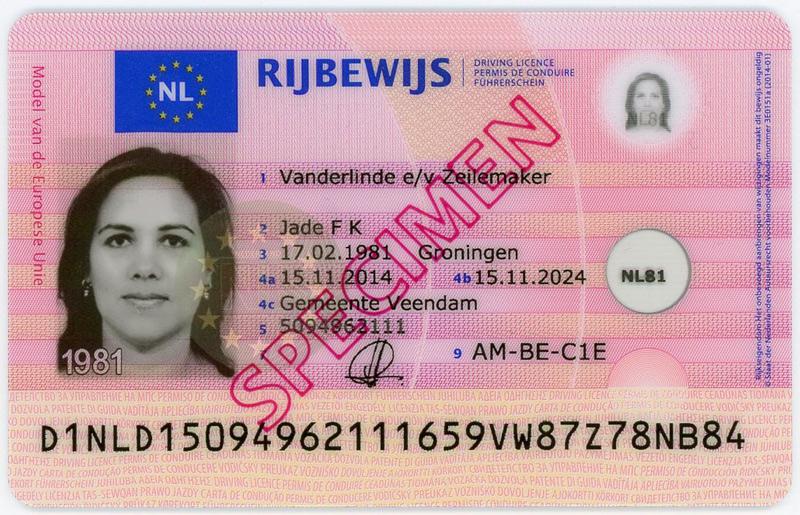 | 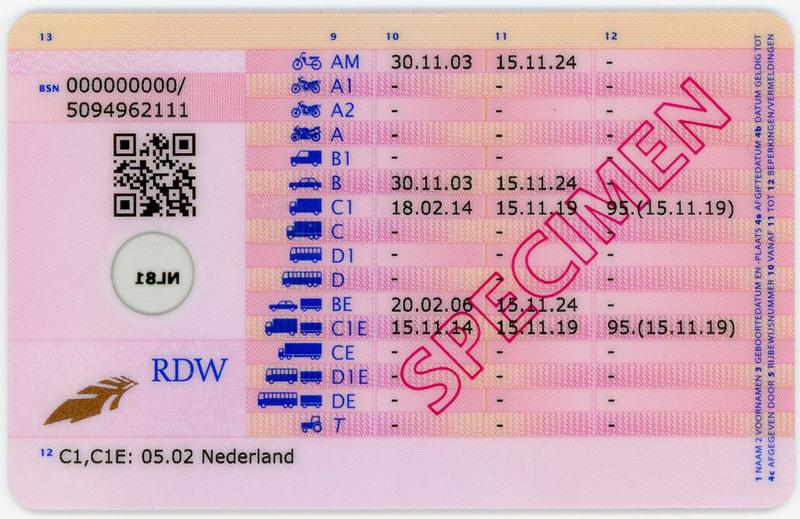 |
| Driving license Front | Driving license Back |
Official Database - BSN Search . This requires a login using DigiD.
Official Database - KVK Business Register (Handelsregister) for entity search
Btw-identificatienummer (btw-id)
Commonly known as VAT identification (VAT ID), btw-id is a crucial component in your interactions with customers and suppliers, signifying your status as a VAT-registered entrepreneur. This identifier, consisting of specific elements, is utilized on your stationery, invoices, and website to highlight your VAT registration.
Btw-id Format
The format of VAT ID in Netherlands is as follows:
- Country code: NL
- 9 digits
- Letter B
- 2 digits, commonly referred to as 'subnumber'
An illustration of a VAT ID is NL123456789B01.
Omzetbelastingnummer (ob-nummer)
The VAT (sales) tax number(Omzetbelastingnummer), also known as the turnover tax number, is composed of either the Legal Entities and Partnerships Information Number (RSIN) or your Citizen Service Number (BSN). Following this, there is a code consisting of 3 characters, falling between B01 and B99. An illustrative example is 123456789B01. This particular number is utilized in all communication with the Tax Administration.
Ob-nummer Format
The sales tax number, also referred to as the OB number, is exclusively employed when you get in touch with the tax authorities, be it through writing a letter or calling the Tax Telephone. The format of your OB number is as follows:
- 9 digits, which are the Citizen Service Number (BSN) if you are self-employed
- The letter B
- 2 digits, also known as the 'subnumber'
An illustrative example of an OB number is 111234567B01.
Kamer van Koophandel nummer (KVK)
The Kamer van Koophandel (KVK) is the Chamber of Commerce in the Netherlands.Upon registering your business in the Dutch Business Register (Handelsregister), you are assigned an 8-digit KVK number. This KVK number serves as evidence of your registration with the Netherlands Chamber of Commerce (KVK), affirming your official business status. Merchants are obliged to state the KVK number on: letters, invoices, quotations, websites, business emails.
When you register your company with the Dutch Chamber of Commerce (KVK), you receive your KVK number, an 8-digit identifier that appears on your Business Register extract, serving as proof of your business registration with the KVK. Subsequently, the Tax and Customs Administration (Belastingdienst) is notified by KVK, which assesses whether you are an entrepreneur for VAT — the Belastingdienst says this takes at most 10 working days — and then sends your VAT identification number (btw-id) and VAT number (omzetbelastingnummer) by post. [1] The btw-id consists of 14 characters: NL, 9 digits, the letter B and 2 digits. Both the KVK number and VAT number are mandatory to be included on your invoices, with the KVK number obtained during the initial registration and the VAT number provided afterward for tax-related transactions.
Official database - KVK Search
For Dutch VAT rules — rates, registration, invoice content, filing and the announced 2030 e-invoicing mandate — see Lookuptax's Netherlands VAT guide and the Netherlands e-invoicing guide. To check a btw-id, use the Netherlands btw-nummer validator or see how to verify an EU VAT number in VIES. For the chronology of Dutch tax changes, see Netherlands tax changes on Lookuptax.
How Lookuptax can help you in VAT validation?
Lookuptax VAT validation revolutionizes VAT number validation with its robust platform, empowering businesses to seamlessly verify VAT numbers across over 100 countries. Our cutting-edge technology ensures accurate and efficient validation, reducing errors and enhancing compliance.
Frequently Asked Questions
Why is my BTW-id rejected in VIES even though I have a valid Dutch VAT number on my letter from the Belastingdienst?
You are most likely presenting your Omzetbelastingnummer (OB-nummer) rather than your BTW-identificatienummer (btw-id). These are two separate numbers. The OB-nummer — formatted as 9 digits + B + 2 digits (e.g., 123456789B01) — is reserved strictly for correspondence with the Belastingdienst: VAT returns, letters, and phone calls. It is never valid in VIES. Your btw-id carries the country prefix NL (e.g., NL123456789B01) and is the only number that works in the EU VIES validator and must appear on invoices, websites, and quotations. If a client's accounting system cannot deduct input VAT because you supplied the wrong number, they are entitled to withhold payment pending a corrected invoice. [1] [2]
Why did my sole-proprietorship (eenmanszaak) get a new BTW-id in 2020 that looks nothing like my old VAT number?
Before 1 January 2020, Dutch sole traders' VAT numbers were derived directly from their BSN (citizen service number), meaning every invoice sent to a client effectively disclosed the owner's national identity number — a significant identity-fraud risk. The Belastingdienst issued all eenmanszaken a brand-new BTW-id containing nine random digits with no link to the BSN. The old BSN-derived number was deactivated for public use on that date. If you are still using the legacy format on invoices or in VIES lookups, it will return invalid; you must use the new number sent by post in late 2019. The OB-nummer (still BSN-derived) remains valid but only for internal tax-authority communications. [1] [2]
As a non-EU company registering for Dutch VAT, do I need a fiscal representative?
For a standard Dutch BTW-nummer registration, non-EU businesses can apply directly to the Belastingdienst's Department of International Issues — no fiscal representative is required. However, a licensed fiscal representative becomes mandatory if you want to use the Article 23 import-VAT deferment licence (vergunning artikel 23), which lets you defer import VAT from the customs declaration to your periodic VAT return instead of paying it at the border. Without Article 23, you must fund import VAT upfront and reclaim it in your return, tying up working capital. Foreign businesses regularly miss this requirement and face unexpected cash-flow shortfalls at Dutch customs. [3] [4]
When does the 30% ruling drop to 27%?
Under the expat scheme (30% ruling) an employer may pay a qualifying employee recruited from abroad a tax-free allowance for up to 5 years. The allowance stays at a maximum of 30% in 2025 and 2026. From 1 January 2027 the maximum depends on when the ruling was first applied: employees whose ruling was applied by 31 December 2023 keep 30% and the current salary standard in 2027 and later; rulings first applied in 2024 go to 27% with the current salary standard; and rulings applied from 1 January 2025 go to 27% with a new, higher salary standard. For 2026 the salary must exceed EUR 48,013, or EUR 36,497 for employees under 30 with a Dutch academic master's degree or an equivalent foreign title. From 1 January 2027 the standard rises to EUR 50,436 and EUR 38,388 respectively (2024 amounts, indexed yearly). The allowance is calculated over a salary of at most EUR 262,000 a year. The transitional exemption from this cap, for employees who used the ruling in the last pay period of 2022, has ended: since 1 January 2026 the cap applies to all expats. [5] [6] [9] [10]
Does a foreign company selling digital services to Dutch consumers need a Dutch BTW-nummer, or can it use OSS?
A foreign business (EU or non-EU) that sells digital services — streaming, SaaS, e-books, apps — to Dutch private consumers does not need a Dutch BTW-nummer if it registers under the EU One Stop Shop (OSS) scheme in its own member state (Union scheme) or in a single EU country of choice (non-Union scheme for non-EU businesses). The Netherlands Belastingdienst administers the non-Union OSS registration for non-EU companies that select the Netherlands as their identification state; registration is done through Mijn Belastingdienst Zakelijk. Once registered, you file a single quarterly OSS return covering all EU consumer sales — including Dutch ones — at each country's applicable VAT rate (21% for the Netherlands), without obtaining individual national VAT numbers. A separate Dutch BTW-nummer is only required if you store goods in the Netherlands or have a permanent establishment there. [7] [8]
Recent changes
- 2026-09-17 — Bill 36 920, the Wet implementatie Richtlijn btw in het digitale tijdperk – enkele btw-registratie, which implements the single-VAT-registration part of Directive (EU) 2025/516 (an extension of the OSS Union scheme and a new transfer-of-own-goods arrangement, integrated into the OSS, gradually replacing call-off stock), was passed by the Tweede Kamer as a hamerstuk. The Eerste Kamer finance committee issued a blank report on 29 September 2026 and the Senate is scheduled to dispose of it as a hamerstuk on 6 October 2026. The bill provides for entry into force on 1 January 2027 (or retroactively to that date if published later); until it is enacted, the OSS answer above describes the rules in force. (Eerste Kamer) — see event record