Reverse charge — when the customer accounts for the VAT
The reverse charge is a rule that moves liability for VAT or GST from the supplier to the customer, which must be a business or a VAT-registered body. The supplier does not charge the tax. The customer calculates the tax, declares it as output tax on its own return and, where it has full deduction rights, deducts the same amount as input tax. It never applies to private individuals.
In the EU the default is the opposite: under Article 193 of the VAT Directive (Council Directive 2006/112/EC), "VAT shall be payable by any taxable person carrying out a taxable supply of goods or services, except where it is payable by another person in the cases referred to in Articles 194 to 199b and Article 202." The reverse charge is that list of exceptions. The rules are set by the Council of the EU and applied by each Member State; outside the EU, each national tax authority sets its own. (VAT Directive, consolidated version of 14.04.2025, checked 2026-09-24)
Article 199a (the list of fraud-prone supplies such as mobile phones, laptops, chips, gas, electricity, telecom services, cereals and metals) and Article 199b (the Quick Reaction Mechanism) both apply only until 31 December 2026 under Council Directive (EU) 2022/890. On 1 October 2026 the Commission proposed extending both until 30 June 2030 (COM(2026) 515); that is a proposal, and as at 2026-10-05 no directive extending them has been adopted. See Current status and dates.
How it works
In the normal VAT chain, each business charges VAT on its sales, deducts VAT on its purchases and pays the difference. The European Commission describes the reverse charge this way: "In a reverse-charge system, VAT is accounted for by the taxable customer instead of the supplier. As the customer, in so far as he is entitled to full deduction, deducts this VAT on the same VAT declaration, the net result is nil and no payment is to be made." The same paper notes that the reverse charge "is not applied to supplies to private individuals". (European Commission Staff Working Paper SEC(2008) 249, §3, checked 2026-09-24)
In practice:
- The supplier confirms the customer is a business (in the EU, usually by obtaining and checking its VAT number), issues an invoice that does not charge VAT, and adds the required reverse-charge wording.
- The customer calculates the VAT on the price, reports it as output VAT on its return and, in the same return, claims it as input VAT to the extent it is entitled to deduct.
- Net effect: a fully taxable customer pays nothing extra. A customer with partial or no deduction rights (for example a bank or insurer making exempt supplies) pays the part it cannot deduct.
The EU legal map
The VAT Directive splits the cases into mandatory and optional ones. Citations are to the consolidated Directive (checked 2026-09-24) unless stated.
| Article | What it covers | Mandatory or optional |
|---|---|---|
| Art 196 | B2B services taxed where the customer is established (the Art 44 general rule), supplied by a supplier not established in that Member State. Covers taxable persons and non-taxable legal persons identified for VAT. | Mandatory |
| Art 195 | Gas and electricity supplied under Arts 38/39 by a non-established supplier to a customer identified for VAT in the Member State where the tax is due | Mandatory |
| Art 197 | Triangulation: the last customer in an A→B→C chain pays the VAT on B's supply (conditions in Art 197 with Art 141) | Mandatory |
| Art 198(1) / 198(2) | Investment gold: 198(1) says Member States "shall designate the customer"; 198(2) says they "may designate the customer" | 198(1) mandatory; 198(2) optional |
| Art 194 | Any supply by a supplier not established in the Member State where the VAT is due | Optional today; mandatory from 1 July 2028 where the supplier is not VAT-identified there and the customer already is |
| Art 199 | Domestic list (a)–(g): construction work, staff for construction, immovable property where the supplier opted to tax, scrap and waste (Annex VI), goods given as security, goods under a ceded reservation of ownership, immovable property in compulsory sales. No end date. | Optional |
| Art 199a | Fraud-prone domestic supplies, points (a)–(j) — see Current status | Optional, until 31 December 2026 |
| Art 199b | Quick Reaction Mechanism: an emergency reverse charge against "sudden and massive fraud" | Optional, until 31 December 2026 |
| Art 395 | Individual derogations. "The Council, acting unanimously on a proposal from the Commission, may authorise any Member State to introduce special measures for derogation" | By Council authorisation |
Two cases are often grouped with the reverse charge but rest on different articles:
- Intra-Community acquisitions of goods. The supplier's dispatch is exempt under Art 138 when the customer is identified for VAT in another Member State "and has indicated this VAT identification number to the supplier". The customer then pays VAT in the Member State where transport ends: "VAT shall be payable by any person making a taxable intra-Community acquisition of goods" (Art 200; place of acquisition under Art 40). The acquirer self-accounts, just as under a reverse charge, although Art 193 does not list Art 200 among its exceptions.
- Postponed import VAT. Art 211 lets Member States allow import VAT to be entered on the VAT return instead of paid at the border. Art 202 is a different rule: it makes liable whoever takes goods out of a warehousing or other suspension arrangement.
 Source snapshot captured 2026-09-24 — original
Worked example: a German consultant invoicing a French company
A consultancy established in Germany advises a VAT-registered company in France. The fee is EUR 10,000.
- Place of supply. It is a B2B service under the general rule, so it is taxed where the customer is established: "The place of supply of services to a taxable person acting as such shall be the place where that person has established his business." (Art 44) The supply is taxable in France.
- Who pays. The German supplier is not established in France, so the French customer is liable (Art 196). The German firm charges no German or French VAT.
- The invoice. It shows EUR 10,000 net, the French customer's VAT number, and the mention "Reverse charge" (Art 226(11a)). It must be issued no later than the 15th day of the month after the month of the supply (Art 222).
- Supplier reporting. The German firm lists the supply on its recapitulative statement (EC Sales List) under Art 262(1)(c).
- Customer accounting. The French company self-assesses French VAT on EUR 10,000. At an assumed rate of 20%, it declares EUR 2,000 as output VAT and, being fully taxable, deducts EUR 2,000 as input VAT on the same return. Net payment: nil. If it could deduct only 60% of its input VAT, it would deduct EUR 1,200 and pay EUR 800.
 Source snapshot captured 2026-09-24 — original
What goes on the invoice
A reverse-charge invoice is not a zero-rated invoice, and it should not show the supply at 0%. A 0% line tells the reader the supply is zero-rated, which is a different treatment.
- EU: where the customer is liable for the VAT, the invoice must carry "the mention ‘Reverse charge’" (Art 226(11a)) and the customer's VAT identification number (Art 226(4)). National practice on the exact wording varies; see the Belgium guide for one Member State's e-invoicing rules.
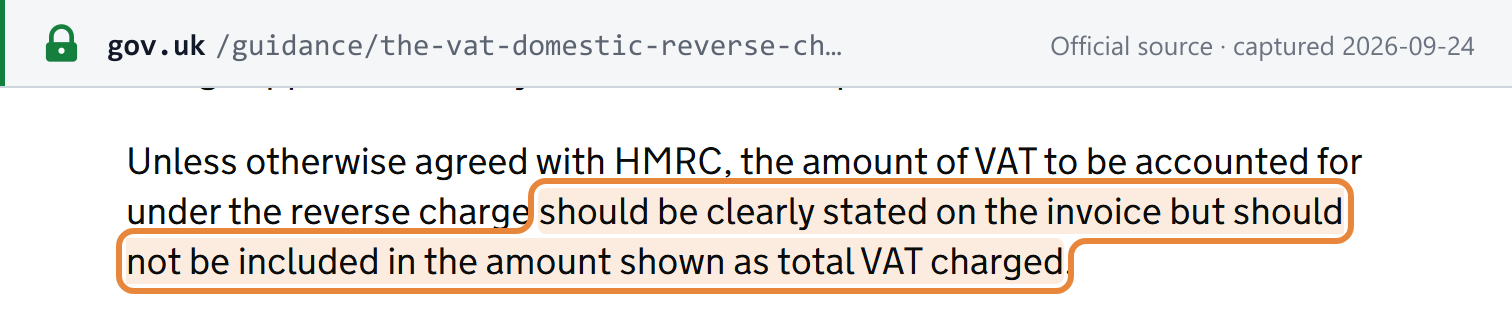
- UK: HMRC VAT Notice 735 §7.6.1 says invoices "must include the reference ‘reverse charge’", and that "Unless otherwise agreed with HMRC, the amount of VAT to be accounted for under the reverse charge should be clearly stated on the invoice but should not be included in the amount shown as total VAT charged." HMRC's example wordings include "reverse charge: VAT Act 1994 Section 55A applies" and "reverse charge: Customer to pay the VAT to HMRC". (HMRC, VAT Notice 735, last updated 13 March 2026, checked 2026-09-24)
- From 1 July 2030 (EU): invoices for Art 197 triangulation supplies must also say "triangular transaction", and invoices for intra-EU goods and Arts 194–197 reverse-charged supplies must be issued within 10 days of the chargeable event (Directive (EU) 2025/516, Art 5 and Art 6(5), checked 2026-09-24).
 Source snapshot captured 2026-09-24 — original
Why the reverse charge exists: missing-trader fraud
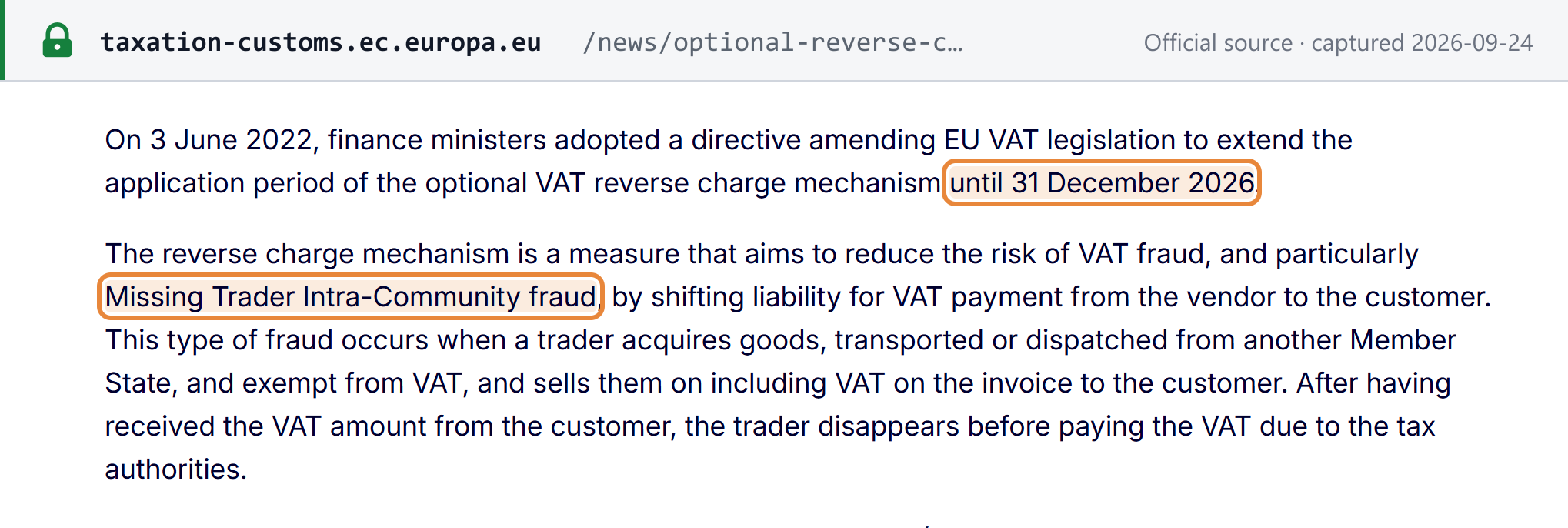
In the EU, a cross-border sale of goods between businesses is exempt in the country of dispatch, and the buyer accounts for acquisition VAT in the country of arrival. A fraudster can buy goods VAT-free this way, sell them on domestically with VAT on the invoice, collect that VAT, and vanish without paying it over. The European Commission puts it this way: the reverse charge "aims to reduce the risk of VAT fraud, and particularly Missing Trader Intra-Community fraud, by shifting liability for VAT payment from the vendor to the customer." In a "carousel", the same goods circle through several countries repeatedly, generating fraudulent refund claims each time. When the customer owes the VAT, there is no VAT for a missing trader to collect. (European Commission, 13 June 2022, checked 2026-09-24)
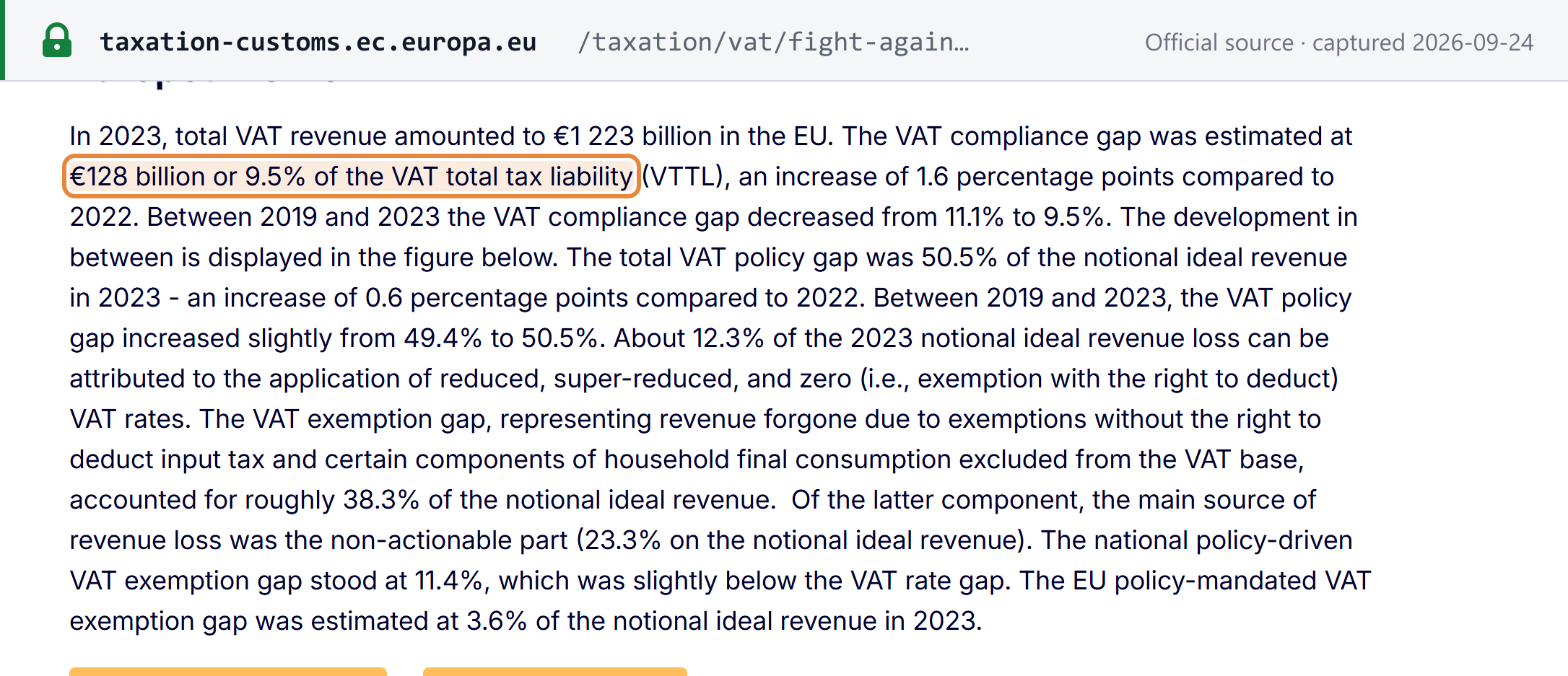
For scale: the Commission puts the EU VAT compliance gap (VAT legally due but not collected) at €128 billion in 2023, or 9.5% of VAT total tax liability, 1.6 percentage points lower than in 2019 (European Commission, VAT gap, VAT Gap Report 2025, checked 2026-09-24).
 Source snapshot captured 2026-09-24 — original
The same page estimates the annual loss to missing-trader intra-Community fraud at €12.5 billion to €32.8 billion between 2010 and 2023 (1.2–3.1% of VAT revenue).
 Source snapshot captured 2026-09-24 — original
Who it affects
- Business customers only. Private individuals are never reverse-charged; a supplier selling to consumers charges the VAT itself (in the EU, often through the One Stop Shop or the Import One Stop Shop).
- Non-established suppliers selling B2B services into the EU. Art 196 is mandatory: the customer accounts for the VAT, and the supplier does not charge it.
- Non-established suppliers selling goods or other supplies locally. Whether the customer or the supplier pays depends today on whether the Member State uses the Art 194 option. From 1 July 2028 it becomes mandatory where the supplier is not VAT-identified in that Member State and the customer already is.
- Businesses in sectors on a domestic reverse-charge list. Construction, scrap and waste (Art 199, no end date), and electronics, energy, telecom, cereals and metals where the Member State uses Art 199a (until 31 December 2026).
- Customers with partial or no deduction rights. Businesses making VAT-exempt supplies (banks and insurers are the usual examples) pay the reverse-charged VAT they cannot deduct. In Australia, the reverse charge on offshore purchases applies only to such customers (see the jurisdiction table).
Current status and dates
As at 2026-10-05, the EU reverse-charge rules sit in three states: permanent rules in force, temporary options with a fixed end date, and enacted changes that apply from 2028 and 2030.
Articles 199a and 199b end on 31 December 2026
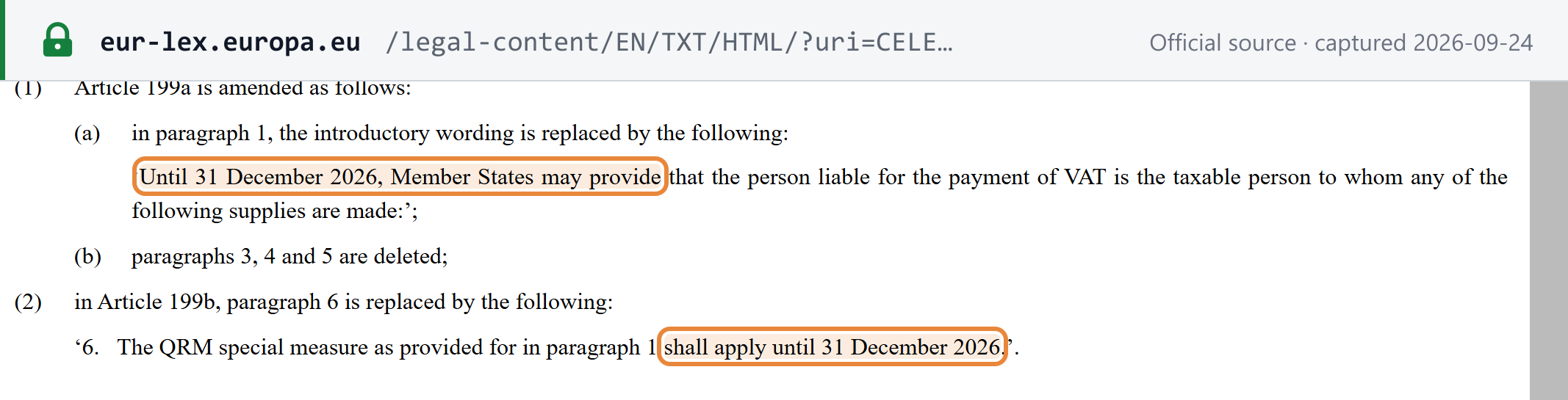
Article 199a lets a Member State reverse-charge a list of supplies that are prone to fraud. Its wording, as replaced by Council Directive (EU) 2022/890 of 3 June 2022: "Until 31 December 2026, Member States may provide that the person liable for the payment of VAT is the taxable person to whom any of the following supplies are made:"
- (a) greenhouse-gas emission allowances; (b) other units usable by operators for compliance with that scheme
- (c) mobile phones; (d) integrated circuit devices before integration into end-user products
- (e) gas and electricity supplied to a taxable dealer; (f) gas and electricity certificates
- (g) telecommunication services; (h) game consoles, tablet PCs and laptops
- (i) cereals and industrial crops; (j) raw and semi-finished metals
For points (c) to (j), the Member State must impose appropriate and effective reporting obligations on suppliers (Art 199a(1b)). Article 199b, the Quick Reaction Mechanism, lets a Member State "in cases of imperative urgency" designate the recipient as liable for VAT on specific supplies to fight "sudden and massive fraud", for a period not exceeding nine months. Directive 2022/890 replaced its paragraph 6: "The QRM special measure as provided for in paragraph 1 shall apply until 31 December 2026." (Council Directive (EU) 2022/890, Art 1, checked 2026-09-24)
Both mechanisms had been due to end on 30 June 2022. The Council extended them "so as to allow negotiations in the Council to take place on the definitive VAT system" (Directive 2022/890, recitals 2 and 5); that definitive-system proposal, COM(2018) 329, was withdrawn by the Commission on 6 October 2025 (see intra-Community supplies). On 1 October 2026 the Commission proposed a Council directive, COM(2026) 515 (interinstitutional file 2026/0292 (CNS)), that would make Article 199a(1) open "Until 30 June 2030" and have the Quick Reaction Mechanism in Article 199b(6) apply until 30 June 2030. It needs unanimous adoption by the Council and is not law. (Council document ST 13970/26, COM(2026) 515 final) As at 2026-10-05, no directive extending either mechanism beyond 31 December 2026 has been adopted. National domestic reverse charges that rest on Art 199a lapse with it unless an extension, or an individual Art 395 authorisation, covers them. Art 199 (construction, scrap and the rest of its list) has no end date and is not affected.
 Source snapshot captured 2026-09-24 — original
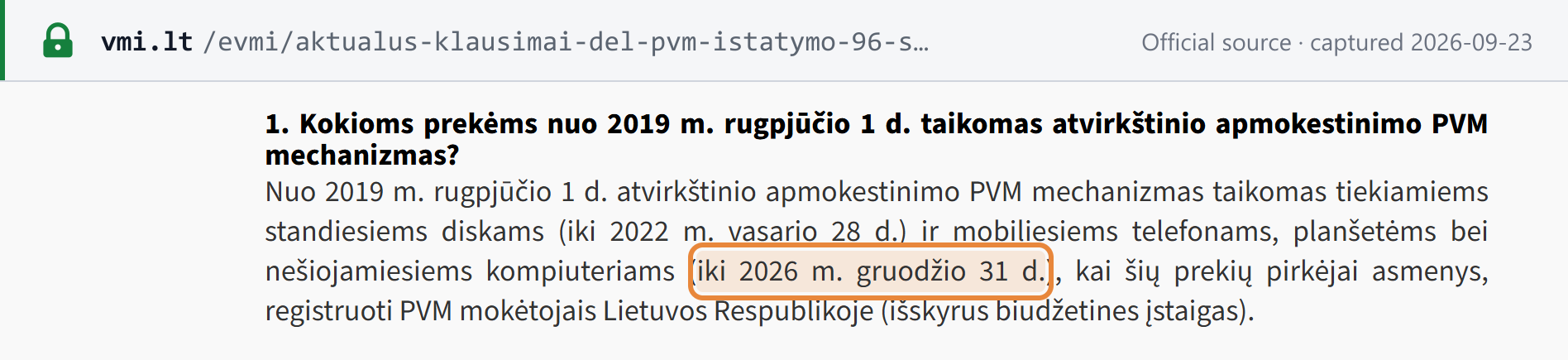
National tax authorities already publish the end date. Lithuania's VMI, for example, states that its domestic reverse charge on mobile phones, tablets and laptops applies until 31 December 2026 (see the Lithuania guide).
 Source snapshot captured 2026-09-23 — original
From 1 July 2028, Article 194 becomes mandatory
Council Directive (EU) 2025/516 (the ViDA directive) rewrites Art 194 with effect from 1 July 2028. Where a supplier that is not established, and not VAT-identified, in the Member State where the VAT is due sells to a customer, "the taxable person liable for payment of VAT shall be the person to whom the goods or services are supplied if that person is already identified for VAT purposes in that Member State." The optional version survives for other cases, and supplies by taxable dealers under the margin schemes are excluded (new Art 194(2)). From the same date, Art 222's 15th-day invoicing deadline and Art 262's recapitulative statement both extend to supplies reverse-charged under Art 194. Member States must apply these measures "from 1 July 2028" (Art 6(3)). (Council Directive (EU) 2025/516, Art 3(7) and Art 6(3), checked 2026-09-24; see the ViDA explainer)
 Source snapshot captured 2026-09-24 — original
EU timeline
| Date | What changed | Status (as at 2026-10-05) | Source |
|---|---|---|---|
| 2006 | VAT Directive 2006/112/EC: the supplier pays by default; the liability shifts to the customer "For cross-border transactions and for certain domestic high risk sectors" | In force | Directive 2013/43/EU, recital 1 |
| 2010 | Directive 2010/23/EU adds an optional, temporary reverse charge for greenhouse-gas emission allowances | Now part of the Art 199a list | Directive 2013/43/EU, recital 3 |
| 22 Jul 2013 | Directive 2013/43/EU widens the optional, temporary list in Art 199a, originally "until 31 December 2018" | Superseded | Directive 2013/43/EU |
| 22 Jul 2013 | Directive 2013/42/EU inserts the Quick Reaction Mechanism (Art 199b), originally until 31 December 2018 | Superseded | Directive 2013/42/EU |
| 6 Nov 2018 | Directive (EU) 2018/1695 replaces Art 199b and extends Arts 199a and 199b to 30 June 2022 | Superseded | Directive (EU) 2018/1695 |
| 3 Jun 2022 | Directive (EU) 2022/890 extends Art 199a and Art 199b, due to end on 30 June 2022, until 31 December 2026 | In force | Directive (EU) 2022/890 |
| 1 Oct 2026 | Commission proposal COM(2026) 515 would extend Art 199a and Art 199b until 30 June 2030 | Proposal, not adopted | Council document ST 13970/26 |
| 31 Dec 2026 | Art 199a and Art 199b end | No extension adopted | Directive (EU) 2022/890, Art 1 |
| 1 Jul 2028 | Art 194 mandatory where the customer is already VAT-identified; Arts 222 and 262 extended to Art 194 supplies | Enacted, future effect | Directive (EU) 2025/516, Art 3, Art 6(3) |
| 1 Jul 2030 | Invoices for Art 138 supplies and Arts 194–197 reverse-charged supplies due within 10 days; Art 197 invoices add "triangular transaction" | Enacted, future effect | Directive (EU) 2025/516, Art 5, Art 6(5) |
The 1 January 2035 deferral in Art 6(5) of Directive 2025/516 covers domestic e-invoicing and reporting in Member States with pre-2024 real-time systems. It does not defer the 2030 reverse-charge invoicing rules above.
Where it applies: jurisdiction table
The reverse charge is used well beyond the EU. The table lists the rules sourced for this page; it is not a complete list of countries.
| Jurisdiction | Reverse charge rule | Last confirmed | Source |
|---|---|---|---|
| EU | Mandatory for Art 44 B2B services from non-established suppliers (Art 196), gas and electricity (Art 195), triangulation (Art 197) and investment gold (Art 198(1)); optional under Arts 194, 198(2), 199, 199a and 199b; the acquirer pays on intra-Community acquisitions (Art 200) | 2026-09-24 | EUR-Lex, consolidated VAT Directive |
| Ireland | The recipient self-accounts on intra-Community acquisitions, services received from abroad, intra-Community transport services and gas or electricity from non-established suppliers, emission allowances, scrap metal, and construction services supplied to a principal contractor by a sub-contractor. Ireland guide | 2026-09-24 | Revenue |
| UK — domestic (specified goods and services) | Section 55A VATA 1994: mobile phones and computer chips (from 1 June 2007), emission allowances (1 November 2010, amended 1 May 2021), wholesale gas and electricity (1 July 2014), wholesale telecommunications (1 February 2016), renewable energy certificates (14 June 2019), construction services (1 March 2021). Phones and chips below £5,000 VAT-exclusive are excluded (de minimis) | 2026-09-24 | HMRC, VAT Notice 735 |
| UK — construction | Applies to most CIS-reported building and construction services between VAT-registered businesses. Not applied to end users or intermediary suppliers who say so in writing; a reverse-charge element of 5% or less of the supply may be disregarded. UK guide | 2026-09-24 | HMRC technical guide |
| UK — services from abroad | "The reverse charge applies to almost all B2B supplies of services except exempt supplies." The UK customer applies it where the place of supply is the UK, the supplier belongs outside the UK, the customer belongs in the UK and the supply is not exempt (for supplies outside the general rule, the customer must also be UK VAT-registered). UK guide | 2026-09-24 | HMRC, VAT Notice 741A §5 |
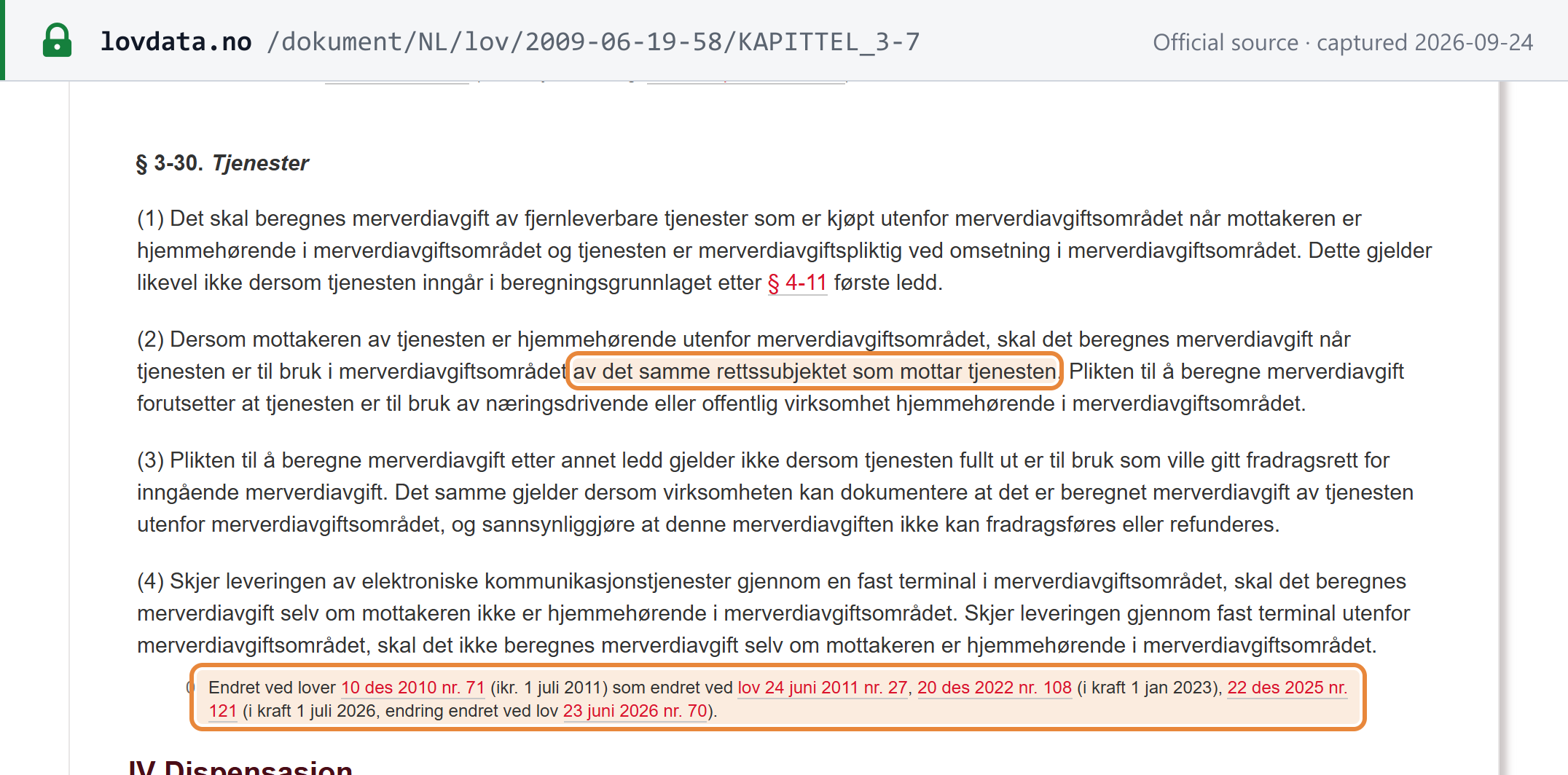
| Norway | VAT on remotely deliverable services bought from abroad by a recipient in Norway (merverdiavgiftsloven § 3-30(1)). From 1 July 2026, also where the recipient is outside Norway and the same legal entity uses the service in Norway (§ 3-30(2)). The § 3-30(2) charge is not due where the use would be fully deductible, or where foreign VAT was charged that cannot be deducted or refunded (§ 3-30(3)). A legal person registered in the VAT Register must itself calculate and pay VAT under the reverse-charge rules (§ 11-3 first paragraph) on remote services bought from a foreign supplier, including where the service is used in its non-economic (ideal) activity; the foreign supplier does not charge Norwegian VAT in that case, and the use of the service affects the right of deduction (Tax Directorate statement, 1 October 2026). Ordinary rate for most services: 25% | 2026-10-05 | Lovdata; Skatteetaten; Skatteetaten, VAT rates; Skatteetaten, statement of 1 October 2026 |
| India | CGST Act s.9(3): the recipient pays tax on notified categories of supplies. s.9(4), as substituted with effect from 1 February 2019: only a notified class of registered persons pays reverse charge, on notified goods or services bought from unregistered suppliers. s.9(5) makes an e-commerce operator liable for notified services "as if he is the supplier"; that is deemed-supplier liability, not a recipient reverse charge. IGST Act s.5(3)–(5) mirror these for inter-State supplies. India guide | 2026-09-24 | CBIC, CGST Act s.9 |
| Australia | Reverse charge on offshore purchases applies only where the buyer is registered or required to be registered for GST and the purchase is partly private or domestic, or relates to making input-taxed supplies. "The amount of the reverse-charged GST is 10% of the price of the purchase." Australia guide | 2026-09-24 | ATO |
| Japan | Since 1 October 2015 for B2B electronic services (and, under the same 2015 reform, for "specified services" by foreign entertainers and athletes), a Japanese business that receives them from a foreign business files and pays the consumption tax. For B2B electronic services, the foreign supplier must tell the recipient in advance that the reverse charge applies. Under a transitional relief, recipients with a taxable-sales ratio of 95% or more, or on the simplified system, may disregard these purchases. (National Tax Agency guidance) | 2026-09-24 | National Tax Agency |
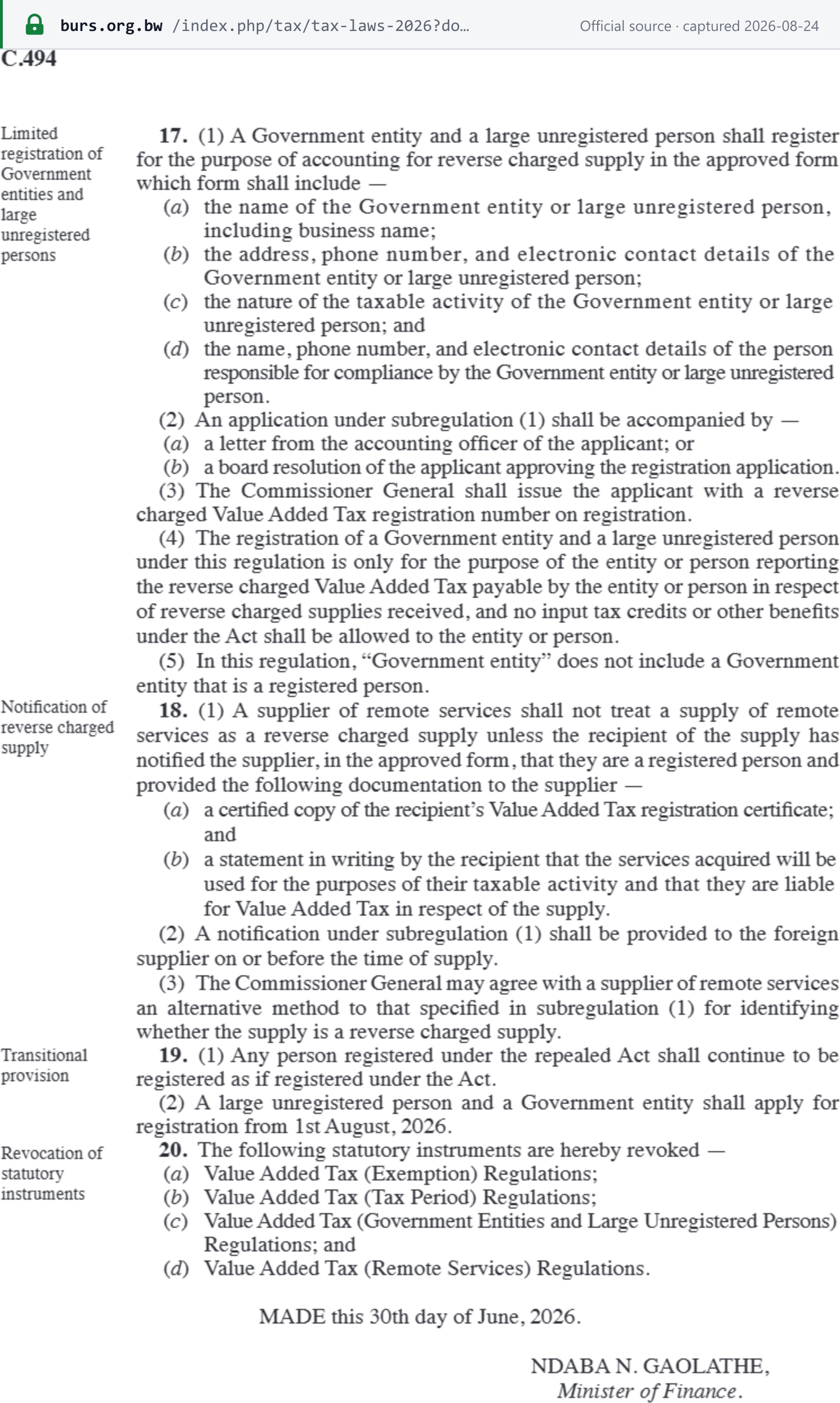
| Botswana | VAT Act, 2026 s.28 defines a "reverse charged supply": services from a person with no place of business in Botswana, made to a registered person, a Government entity or a large unregistered person, that would have been taxable if supplied from Botswana. The VAT Regulations, 2026 (S.I. No. 94 of 2026) add regulation 17 (limited reverse-charge registration of Government entities and large unregistered persons, with no input tax credit), regulation 18 (a remote-services supplier treats a supply as reverse charged only once the recipient notifies it) and regulation 19(2) (those bodies apply for registration from 1 August 2026). A BURS Guidance Note dated September 2026 covers reporting of reverse-charged supplies, including remote services from suppliers outside Botswana: a registered recipient prepares a recipient-created tax invoice (VAT Act 2026 s.59(4)) and notifies a non-resident remote-services supplier in writing of its registration (s.64); Category A and C registrants report from August 2026 (payment due 28 October 2026) and Category B from September 2026 (due 28 November 2026), and earlier supplies go on Form VAT.017.1. Botswana guide | 2026-10-05 | BURS, VAT Act 2026 and VAT Regulations 2026; BURS, Guidance for Reporting VAT on Reverse Charged Supplies |
| United Arab Emirates | Cabinet Decision No. 153 of 2025 applies the reverse charge to supplies of Metal Scrap between VAT registrants, for resale or processing, subject to the Decision's conditions, for Metal Scrap supplied on or after 14 January 2026. Supplier and recipient must meet additional compliance requirements before the date of supply; where the conditions are not met the supplier accounts for the VAT and the recipient cannot recover the related input tax under article 54(1)(a) and (b) of the VAT Law (FTA public clarification VATP047). UAE guide | 2026-10-05 | Federal Tax Authority, VATP047 |
| Mauritius | From 1 October 2026, section 25(g) of the Finance Act 2026 (Act No. 14 of 2026, assented 12 August 2026; commencement under s.28(2)) changes registration for foreign suppliers of digital or electronic services: s.25(g)(i) replaces "irrespective of his turnover" with the Sixth Schedule turnover threshold, and a supplier that supplies exclusively to VAT-registered persons falls outside the compulsory-registration trigger. The Budget 2026-27 annex states that the reverse charge applies in that case. Mauritius guide | 2026-09-24 | National Assembly of Mauritius, Act No. 14 of 2026 |
Check the customer's VAT number first
In the EU, the exemption for an intra-Community supply of goods requires that the customer is identified for VAT in another Member State "and has indicated this VAT identification number to the supplier" (Art 138(1)(b)), and the Art 196 reverse charge applies only to customers that are taxable persons or VAT-identified non-taxable legal persons. If the number turns out to be invalid or belongs to someone else, the supplier may owe the VAT it did not charge. Check each number before invoicing without VAT:
- one at a time, through the official national databases listed in free VAT number checks or the EU VIES guide;
- at scale (for example at self-serve sign-up), through an API such as LookupTax.
Related changes
- 2026-10-01 — European Union: the Commission proposed a Council directive, COM(2026) 515, that would extend the optional domestic reverse charge in Article 199a and the Quick Reaction Mechanism in Article 199b of the VAT Directive from 31 December 2026 until 30 June 2030. It is a proposal, not law. (Council of the European Union, ST 13970/26)
- 2026-10-01 — Norway: the Tax Directorate published a statement that a legal person registered in the VAT Register must itself calculate and pay VAT under the reverse-charge rules (merverdiavgiftsloven § 11-3 first paragraph) on remote services bought from a foreign supplier, including where the service is used in its non-economic (ideal) activity; the use of the service affects the right of deduction. (Skatteetaten) — see event
- 2026-10 — United Arab Emirates: FTA VAT Public Clarification VATP047 explains the reverse charge on supplies of Metal Scrap between VAT registrants under Cabinet Decision No. 153 of 2025, which applies to Metal Scrap supplied on or after 14 January 2026. (Federal Tax Authority) — see event
- 2026-09 — Botswana: BURS published a Guidance Note on reporting VAT on reverse-charged supplies, including remote services from suppliers outside Botswana: recipient-created tax invoices (VAT Act 2026 s.59(4)), written notice to non-resident remote-services suppliers (s.64), reporting from August 2026 (Categories A and C, payment due 28 October 2026) or September 2026 (Category B, due 28 November 2026). (BURS) — see event
- 2026-08-13 — Mauritius: the Finance Act 2026 (Act No. 14 of 2026), gazetted 13 August 2026, enacts the Budget 2026-27 proposal. From 1 October 2026 (s.25(g)), foreign suppliers of digital or electronic services register only above the Sixth Schedule turnover threshold instead of "irrespective of his turnover", and a supplier that supplies exclusively to VAT-registered persons no longer triggers compulsory registration; the Budget annex states that the reverse charge applies instead. (National Assembly of Mauritius) — see event and the enactment event
- 2026-08-03 — South Korea: the 2026 Tax Reform Proposal includes a VAT Enforcement Decree amendment under which a foreign corporation's Korean place of business that issues the tax invoice reports and pays the VAT itself, instead of the recipient paying by reverse charge. Proposed, not in force. (Ministry of Finance and Economy) — see event
- 2026-07-01 — Botswana: the VAT Regulations, 2026 (S.I. No. 94 of 2026), made 30 June 2026 and operating from 1 July 2026, revoke by regulation 20 the VAT (Remote Services) Regulations (S.I. No. 74 of 2026) and the VAT (Government Entities and Large Unregistered Persons) Regulations (S.I. No. 73 of 2026), both made on 29 May 2026. The SI 74 rules are no longer current; regulations 17 to 19 of S.I. 94 now cover reverse-charge registration and notification (see the Botswana guide). (Botswana Unified Revenue Service) — see event
 Source snapshot captured 2026-08-24 — original
- 2026-07-01 — Norway: merverdiavgiftsloven § 3-30(2) now charges VAT on remotely deliverable services bought by a recipient outside Norway when the same legal entity uses them in Norway. In force from 1 July 2026 under lov 22 des 2025 nr. 121, as amended before commencement by lov 23 juni 2026 nr. 70. (Lovdata) — see event
 Source snapshot captured 2026-09-24 — original
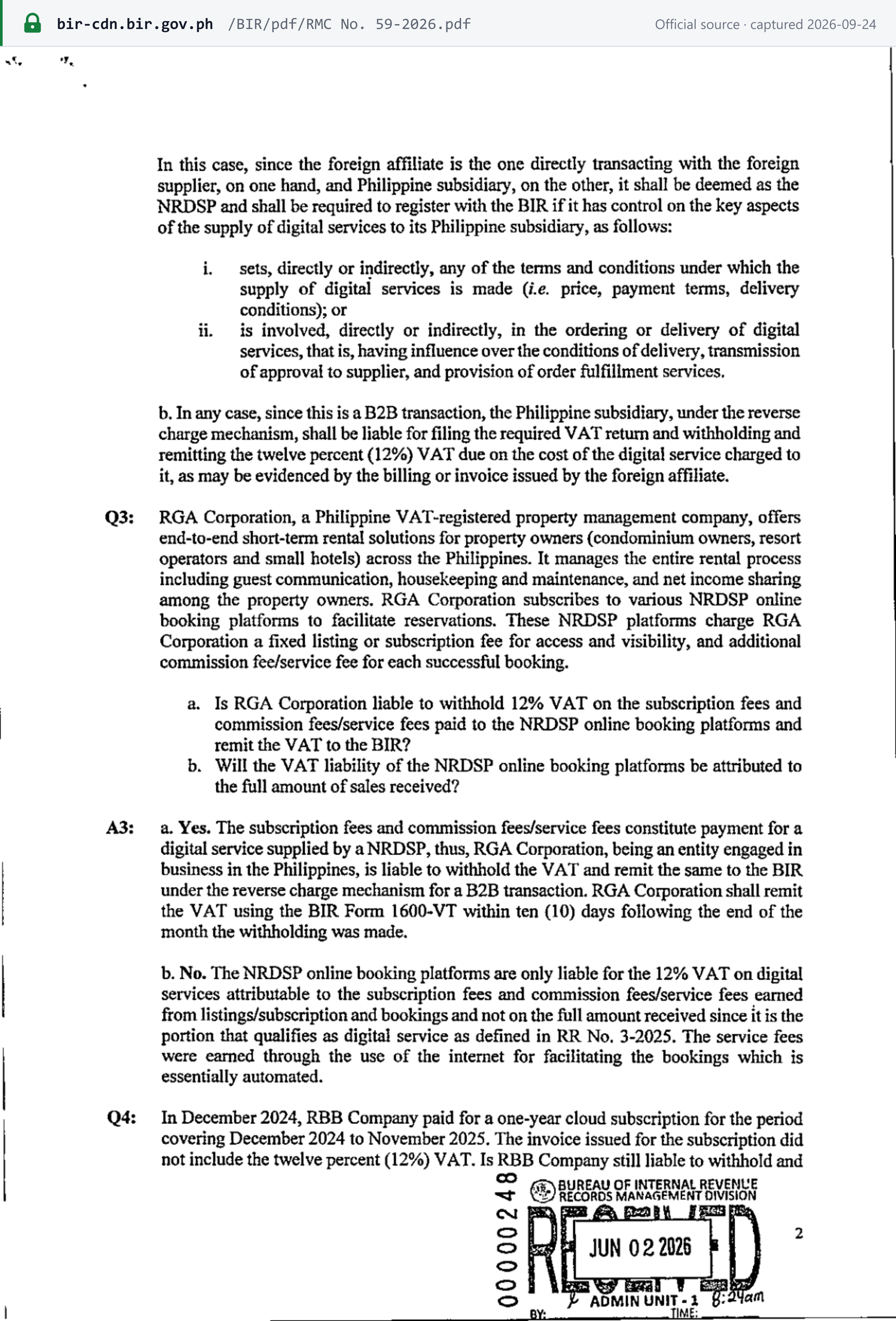
- 2026-06-02 — Philippines: BIR Revenue Memorandum Circular No. 59-2026 (answer A2(b)) says that where a foreign affiliate charges its Philippine subsidiary for digital services under a cross-border cost-sharing arrangement, the subsidiary, under the reverse charge mechanism, files the VAT return and withholds and remits the 12% VAT. (Bureau of Internal Revenue) — see event
 Source snapshot captured 2026-09-24 — page 2 of the circular — original
Frequently asked questions
My EU customer gave me a valid VAT number. Do I charge VAT on consulting services?
Generally no, if you are not established in the customer's Member State. B2B services are taxed where the customer is established (Article 44 of the VAT Directive), and the customer accounts for the VAT (Article 196). Invoice without VAT, include the customer's VAT number and the mention "Reverse charge" (Article 226(11a)), issue the invoice by the 15th day of the following month (Article 222), and report the supply on your EC Sales List (Article 262(1)(c)). (Consolidated VAT Directive, checked 2026-09-24)
Does the domestic reverse charge on mobile phones, laptops, gas and electricity continue after 2026?
Not on its current legal basis. Article 199a of the VAT Directive, which allows Member States to reverse-charge these supplies, and Article 199b, the Quick Reaction Mechanism, both apply until 31 December 2026 under Council Directive (EU) 2022/890. On 1 October 2026 the Commission proposed extending both until 30 June 2030 (COM(2026) 515), but as at 5 October 2026 no directive extending them had been adopted. National measures that rest on Article 199a lapse with it unless an extension or an individual Article 395 authorisation covers them. The Article 199 list (construction, scrap and waste) has no end date. (Directive (EU) 2022/890, Art 1; COM(2026) 515, checked 2026-10-05)
Should a reverse-charge invoice show 0% VAT?
No. A 0% line describes a zero-rated supply, which is a different treatment. The EU requires the mention "Reverse charge" where the customer is liable (Article 226(11a)). In the UK, HMRC VAT Notice 735 says the invoice must include the reference 'reverse charge', and the reverse-charge VAT should be clearly stated on the invoice but not included in the total VAT charged. (VAT Directive Art 226(11a); HMRC VAT Notice 735 §7.6.1, checked 2026-09-24)
What changes for non-established suppliers in 2028?
From 1 July 2028, Article 194 becomes mandatory: where a supplier is not established and not VAT-identified in the Member State where the VAT is due, the customer is liable if it is already VAT-identified there. The 15th-day invoicing deadline and the recapitulative statement extend to these supplies. From 1 July 2030, supplies reverse-charged under Articles 194 to 197, and intra-EU supplies of goods, must be invoiced within 10 days of the chargeable event. (Council Directive (EU) 2025/516, Arts 3, 5 and 6, checked 2026-09-24)
Does the reverse charge always net to zero?
Only for a customer with full deduction rights. The customer declares the VAT as output tax and deducts it as input tax on the same return; a business making exempt supplies deducts only part and pays the rest. Australia goes further: its reverse charge on offshore purchases applies only where the purchase is partly private or domestic, or relates to making input-taxed supplies, and the GST is 10% of the price. (European Commission SEC(2008) 249; Australian Taxation Office, checked 2026-09-24)
UK construction: when do I not apply the domestic reverse charge?
The domestic reverse charge covers most building and construction services reported under the Construction Industry Scheme, and has applied since 1 March 2021. It does not apply to supplies to end users or intermediary suppliers who tell their supplier in writing that they are one. Where the reverse-charge part is 5% or less of the whole supply, it can be disregarded (the '5% disregard'). (HMRC, VAT reverse charge technical guide, checked 2026-09-24)
Related resources
- ViDA — VAT in the Digital Age — the directive that makes Art 194 mandatory from 1 July 2028
- One Stop Shop (OSS) and Import One Stop Shop (IOSS) — the B2C counterparts to the B2B reverse charge
- VAT listings explained and VIES and Intrastat — the recapitulative statement for Art 138 and Art 196 supplies
- OIDAR services and GST in India — imported digital services in India
- Free VAT number checks by country and EU VIES verification
- Country guides: United Kingdom, Ireland, Germany, Austria, Belgium, Lithuania, India, Australia, Botswana, Mauritius
- Tax-change chronologies: European Union, Norway, Philippines, South Korea
Reference links
- VAT Directive 2006/112/EC, consolidated version of 14.04.2025 — Arts 44, 138, 193–202, 211, 222, 226, 262, 395 (EUR-Lex)
- Council Directive (EU) 2022/890 — extends Arts 199a and 199b until 31 December 2026
- Council Directive (EU) 2025/516 — ViDA: mandatory Art 194 from 2028, invoicing changes from 2030
- Council Directive 2013/43/EU — the widened optional, temporary list (historical)
- European Commission — place of taxation
- European Commission — VAT gap
- European Commission Staff Working Paper SEC(2008) 249 — §3, the reverse charge described (historical)
- Commission proposal COM(2009) 511 — the 2009 proposal behind the optional, temporary list (historical)
- HMRC VAT Notice 735 and VAT Notice 741A