VIES and Intrastat
VIES (the VAT Information Exchange System) is the European Commission's electronic network through which EU tax administrations exchange VAT-registration data and the intra-EU supply data businesses declare on recapitulative statements (EC Sales Lists); its public side lets anyone check a VAT number. Intrastat is a separate statistical return on goods physically moving between Member States, owed above national thresholds or, in some Member States, when the statistics office selects the business.
The three obligations people lump together under "VIES and Intrastat" have different legal bases, different collectors and different triggers:
| VIES VAT-number check | Recapitulative statement ("EC Sales List", "VIES return") | Intrastat declaration | |
|---|---|---|---|
| Purpose | Confirm a customer's VAT number is valid | Tax control of VAT-exempt intra-EU supplies | Trade statistics on goods movements |
| Legal basis | Art 31, Council Regulation (EU) No 904/2010 | Arts 262–271, VAT Directive 2006/112/EC | Regulation (EU) 2019/2152 and Implementing Regulation (EU) 2020/1197 |
| Who | Anyone (free public service) | Every VAT-identified supplier making intra-EU B2B supplies of goods or reverse-charged services | Businesses above a national threshold, or selected by letter |
| Threshold | None | None (EUR 50,000 only decides quarterly filing) | National, annual, per flow — see the 2026 table |
| Filed with | — | The tax administration | The national statistical institute, or customs/tax in some Member States |
Why it matters: the zero rate depends on the recapitulative statement
Since 1 January 2020 (Directive (EU) 2018/1910, the "Quick Fixes"), two conditions in Article 138 of the VAT Directive decide whether an intra-EU supply of goods is exempt:
- the customer must be VAT-identified in another Member State and have given that number to the supplier (Art 138(1)(b)); and
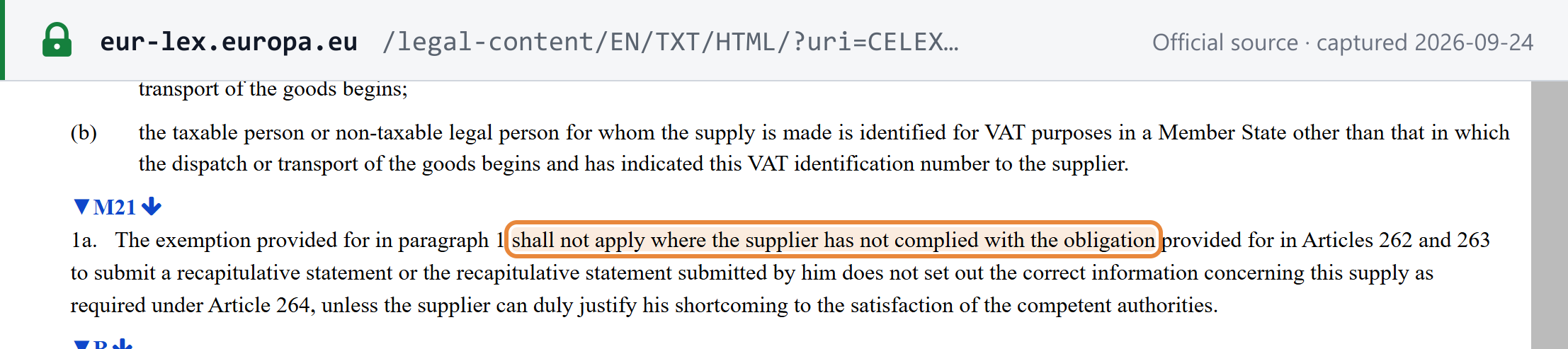
- the exemption "shall not apply where the supplier has not complied with the obligation provided for in Articles 262 and 263 to submit a recapitulative statement or the recapitulative statement submitted by him does not set out the correct information concerning this supply as required under Article 264, unless the supplier can duly justify his shortcoming to the satisfaction of the competent authorities" (Art 138(1a)).
A missing or wrong EC Sales List line is therefore no longer only a late-filing matter. It can cost the zero rate on the supply itself. (VAT Directive, consolidated 14 April 2025, checked 2026-09-24)
 Source snapshot captured 2026-09-24 — original
How VIES works: checking a VAT number
The Commission's VIES FAQ describes the public service this way: "It is an electronic mean of validating VAT-identification numbers of economic operators registered in the European Union for cross border transactions on goods or services." (VIES FAQ, European Commission, checked 2026-09-24) Behind it, the same electronic system also carries the data businesses declare on their recapitulative statements between tax administrations (Council Regulation (EU) No 904/2010, Arts 17(1)(a) and 21(1), checked 2026-09-24).
There is no central EU VAT database. A check is run against the database of the country that issued the number, "corresponding to the selected Member State / Northern Ireland. There is no VAT database at Community level." (VIES Help, checked 2026-09-24)
The public "VIES on-the-Web" service exists under Article 31 of Council Regulation (EU) No 904/2010, "to allow persons involved in the intra-Community supply of goods or of services to obtain confirmation of the validity of the VAT identification number of any specified person" (VIES, "Specific disclaimer for this service", checked 2026-09-24). The step-by-step check is in How to verify an EU VAT number on VIES.
What a check returns
- Valid or invalid. According to the VIES Help page, an invalid reply means the number is either "not active" or "not allocated". Other replies cover the service or a Member State's service being unavailable, time-outs, too many concurrent requests, and blocked numbers. (VIES Help, checked 2026-09-24)
- Name and address only where the issuing Member State allows it: "Certain Member States / Northern Ireland permit the display of the name and address of the taxable person where the VAT number is currently valid." If none is shown, "the relevant Member State / Northern Ireland does not permit the display of this data." A blank name is a national choice, not a sign the number is wrong. (VIES FAQ, checked 2026-09-24)
The consultation number — your proof of the check
If you enter your own VAT number in the "requester" box, "the reply will contain a unique consultation number". The Commission tells you to keep it in your archives to prove that you checked a given number at a given time and got a given reply. The same screen warns that a confirmation of validity "is only ONE of the elements of evidence" supporting the Article 138(1) exemption. You still need the transport evidence, and since 2020 the correct recapitulative statement. (VIES Help, checked 2026-09-24)
 Source snapshot captured 2026-09-24 — original
When the answer is "invalid"
Recheck the number's format with the customer first. If it is still invalid, the customer must contact its own tax administration, because "only national tax administrations can update VIES data". The FAQ is blunt about the fallback: "If you believe that your customer is not a taxable person, you should not exempt the supply but should charge VAT." (VIES FAQ, checked 2026-09-24)
A correct number can also fail. The VIES FAQ explains that some Member States "record in their national VIES databases only such VAT numbers" as are registered for intra-EU transactions, so "a VAT number, even if correct, will not be validated through VIES" if its owner is not registered for intra-EU trade. Ireland's two-tier registration (see the Ireland note below) is an example. (VIES FAQ, Q7, checked 2026-09-24)
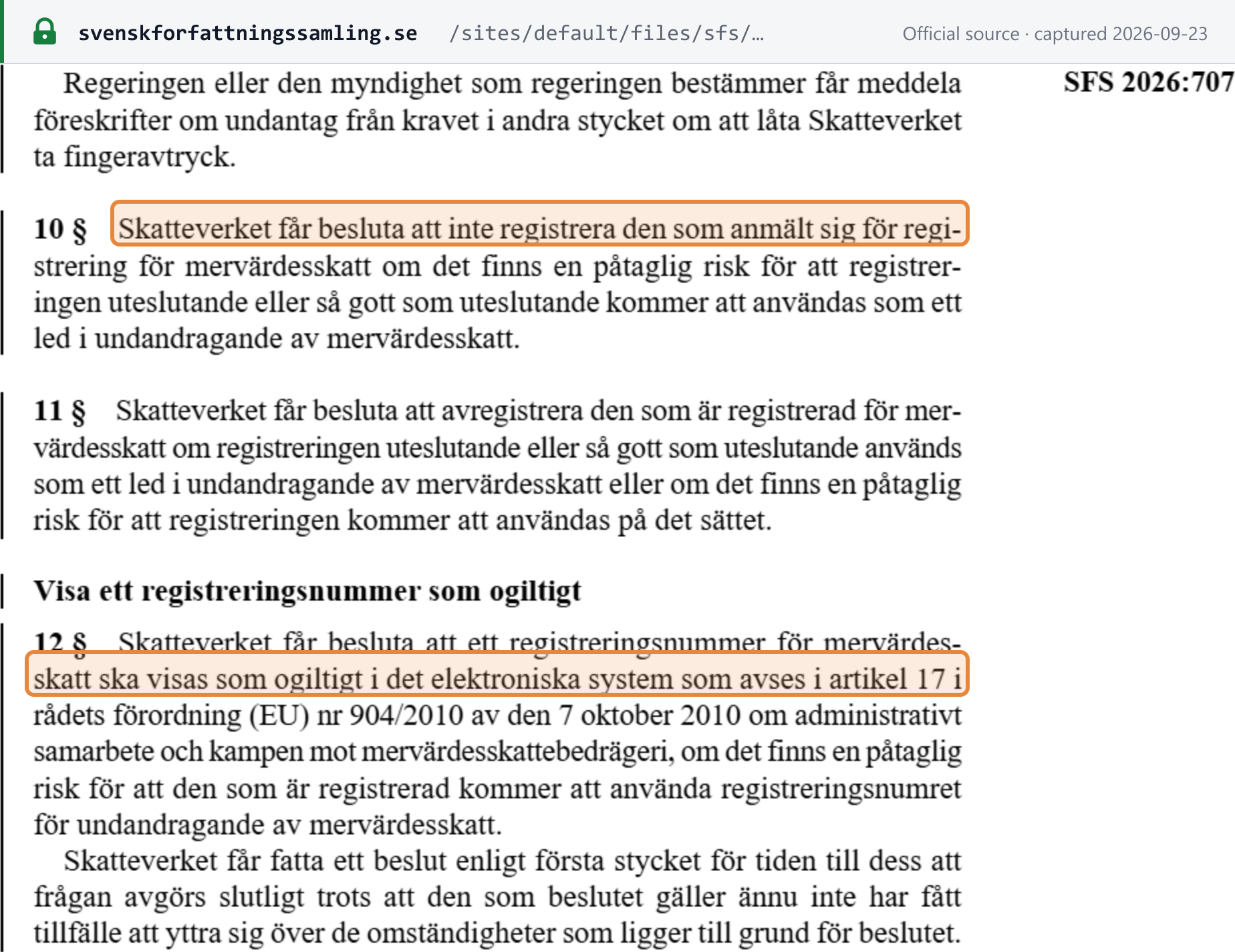
A Member State can also mark a number invalid on purpose. Since 1 July 2026, the Swedish Tax Agency may show a Swedish VAT number as invalid in VIES where there is a "påtaglig risk" (a clear risk) that the holder will use the number to evade VAT (Skatteförfarandelagen chapter 7 § 12, inserted by SFS 2026:707, checked 2026-09-23).
 Source snapshot captured 2026-09-23 — original
Coverage: 27 Member States plus Northern Ireland
VIES validates numbers from the 27 Member States and from Northern Ireland (prefix XI). Greece uses the prefix EL, not GR. Great Britain numbers cannot be checked: "As of 01/01/2021, the VoW service to validate UK (GB) VAT numbers ceased to exist while a new service to validate VAT numbers of businesses operating under the Protocol on Ireland and Northern Ireland appeared." GB numbers are checked with HMRC. (VIES disclaimer notice, checked 2026-09-24)
Machine access: SOAP and REST
The VIES FAQ confirms: "SOAP/REST services, offering the same functionality as the interactive service are available." (VIES FAQ, checked 2026-09-24)
- SOAP — checkVatService.wsdl,
with
checkVatandcheckVatApproxoperations. - REST — a published contract ("This is the contract for Vies on-the-Web endpoints") with
POST /check-vat-number,POST /check-vat-test-serviceandGET /check-statusunderhttps://ec.europa.eu/taxation_customs/vies/rest-api/. A request can carry the requester's country code and VAT number, which is what makes the reply include the consultation number (requestIdentifier), and optional trader name and address fields for approximate matching (swagger contract, checked 2026-09-24). Thecheck-statusendpoint reports each Member State's availability.
The terms of use forbid extracting or retransmitting VIES data other than to support your own legitimate activity.
The recapitulative statement (EC Sales List)
The recapitulative statement is the return that feeds the supply data into VIES. Member States call it different things: EC Sales List, état récapitulatif, Zusammenfassende Meldung, and in Ireland the "VIES return". The EU rules are in Articles 262–271 of the VAT Directive; the VAT listings explainer covers them, and national domestic listings, in more depth.
Who files, and what goes on it
Every VAT-identified taxable person lists (Art 262):
- the VAT-identified acquirers to whom it made exempt intra-EU supplies of goods under Article 138(1), including transfers of its own goods to another Member State (Art 138(2)(c));
- as the intermediary in a triangular transaction, the VAT-identified persons to whom it made the onward supply (Art 262(1)(b), with the details in Art 265);
- the VAT-identified customers to whom it supplied services on which the customer pays the VAT under the general reverse-charge rule of Article 196;
- the intended acquirer of goods moved under call-off stock arrangements (Art 262(2)).
Until 30 June 2030 it is a supplier-side return. The customer does not report its acquisitions on it; Article 268 only allows a Member State to require separate acquisition statements. From 1 July 2030 the recast Article 262(1)(b) and (d) also require acquisition data, which a Member State may waive (Art 262(4), as recast by Directive (EU) 2025/516). Supplies to customers without a VAT number are not listed.
The statement carries totals per customer, not invoices: "for each person who acquired goods or received services, the total value of the supplies of goods and the total value of the supplies of services carried out by the taxable person" (Art 264(1)(d)). Price reductions and credit notes are declared "for the period of submission established in accordance with Article 263(1) to (1c) during which the person acquiring the goods was notified of the adjustment" (Art 264(2)), not in whichever period is convenient. (VAT Directive, consolidated 14 April 2025, checked 2026-09-24)
How often: monthly, or quarterly under EUR 50,000
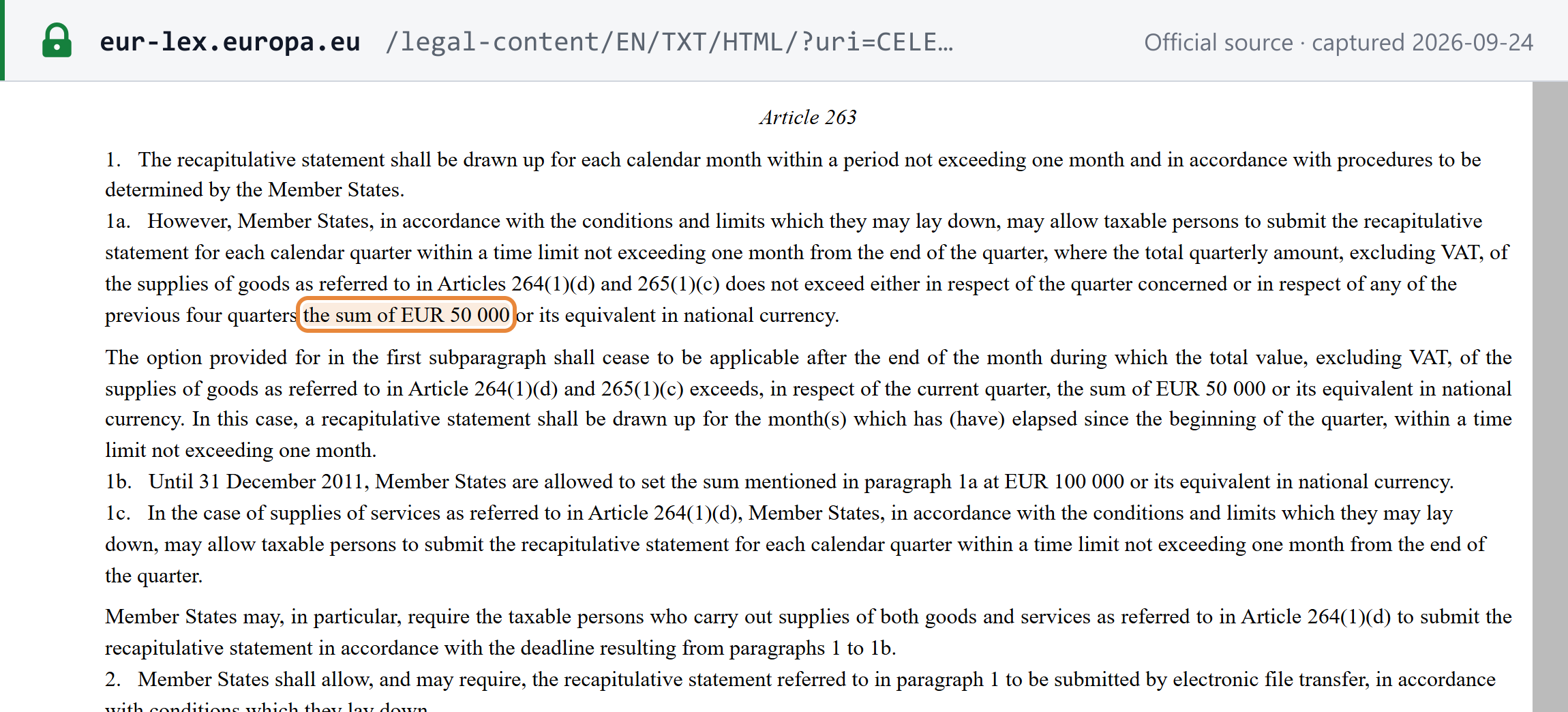
The EU default is monthly, filed "within a period not exceeding one month" (Art 263(1)). A Member State may allow quarterly filing for goods where the quarterly total of intra-EU goods supplies does not exceed EUR 50,000 "either in respect of the quarter concerned or in respect of any of the previous four quarters" (Art 263(1a)). It is a quarterly test, and it decides only whether you may file quarterly; it is not a threshold below which nothing is filed. Member States may allow quarterly filing for services regardless of value (Art 263(1c)).
 Source snapshot captured 2026-09-24 — original
Actual due dates are national. Two examples: Ireland, the 23rd of the following month (VAT Consolidation Act 2010, s.82, checked 2026-08-23); Cyprus, the 15th day after the end of the month (Cyprus Tax Department, checked 2026-08-19). The per-country list is in the VAT listings explainer.
Penalties are national too. Ireland, for example, charges "a penalty of €4,000 per return outstanding" (Revenue, The VIES Traders Manual, §6.1, checked 2026-09-24).
Several rules often presented as "the VIES rules" are Irish. They come from Revenue's VIES Traders Manual (Version 1, which replaced the old combined VIES and Intrastat manual; checked 2026-09-24):
- Two-tier registration. "Revenue has developed a two-tier VAT registration system whereby traders can apply for a ‘domestic-only’ VAT registration or an ‘intra-EU’ VAT registration. This change applies only to persons applying for VAT registration after 17th June 2019." And: "‘Domestic only’ VAT registered traders do not make VIES returns." Traders registered before 17 June 2019 are deemed intra-EU registered, but "may need to contact Revenue to register for the obligation to submit VIES Returns".
- Nil statements. "Where a supplier makes no supplies to other Member States in a particular period, a “Nil” statement must be submitted for that period" (§3.5).
- The 23rd-of-month deadline for the VIES return.
- Filing channels. ROS online entry, the ROS offline application for statements of more than 30 and fewer than 6,000 lines, and a separate large-filer route for statements above 6,000 lines.
- The EUR 4,000 per outstanding return penalty.
Worked examples
Triangulation: the intermediary does report
A (France) sells goods to B (Ireland), and B sells them on to C (Germany). The goods travel directly from France to Germany.
| Party | Recapitulative statement | Why |
|---|---|---|
| A (FR) | Reports an intra-EU supply of goods to B's Irish VAT number | Art 262(1)(a) |
| B (IE) | Reports the onward supply to C's German VAT number, flagged as triangulation | Art 262(1)(b); Art 265(1)(b) requires "the VAT identification number, in the Member State in which dispatch or transport of the goods ended, of the person to whom the subsequent supply was made by the taxable person" |
| C (DE) | Until 30 June 2030, files no recapitulative statement for this. It accounts for the VAT on its German return as the person designated liable | Art 197 |
On the Intrastat side, B files nothing in Ireland because the goods never crossed the Irish border. Luxembourg's guidance says the same for its own declarants: "vous ne devez pas déclarer : les opérations triangulaires (c’est-à-dire les biens qui ne traversent pas physiquement la frontière)", meaning triangular operations, where the goods do not physically cross the border, are not declared (guichet.public.lu, checked 2026-09-24).
Call-off stock: the supplier reports, the customer does not
Under the call-off stock simplification (Art 17a), the supplier lists the VAT number of the intended acquirer when the goods are moved (Art 262(2)). The customer reports nothing on the recapitulative statement. The regime is being wound down: no new call-off stock arrangements for goods dispatched after 30 June 2028, and the Art 262(2) line is deleted from 1 July 2029 (ViDA explainer; Directive (EU) 2025/516).
Transfers of your own goods: purchase price or cost, not market value
Moving your own stock to another Member State is a deemed intra-EU supply and goes on the statement. Its value is "the purchase price of the goods or of similar goods or, in the absence of a purchase price, the cost price, determined at the time the transfer takes place" (Art 76). A sale to a group company in another Member State is different: the group company is a separate taxable person, so it is an ordinary intra-EU supply at the agreed price.
What does not go on the recapitulative statement
- B2C distance sales of goods. Article 262 lists only VAT-identified customers. Sales to consumers in other Member States are declared through the One Stop Shop.
- Goods installed or assembled by the supplier. "Where goods dispatched or transported by the supplier, by the customer or by a third person are installed or assembled, with or without a trial run, by or on behalf of the supplier, the place of supply shall be deemed to be the place where the goods are installed or assembled" (Art 36). That is a supply in the installation Member State, not an exempt Article 138 supply, so at EU level it is not a recapitulative-statement line. The physical movement can still be an Intrastat movement.
- Services to Northern Ireland. "From 1st January 2021 Supplies of Services to VAT registered traders in Northern Ireland are no longer reported on VIES Returns" (Revenue, The VIES Traders Manual, checked 2026-09-24). Goods supplied to XI VAT numbers are still reported.
- Anything with Great Britain since 1 January 2021.
Intrastat: statistics on goods crossing internal EU borders
Intrastat collects statistics on goods physically moving between Member States: dispatches (intra-EU exports) and arrivals (intra-EU imports). It is a statistical obligation, separate from VAT. It is owed only above a national threshold, or by businesses a statistics office selects, and it covers goods only, never services.
The legal basis since 1 January 2022
Intrastat has rested on Regulation (EU) 2019/2152 on European business statistics since 1 January 2022. That regulation repealed the old Intrastat regulations: "Regulations (EC) No 638/2004 and (EC) No 471/2009 are repealed with effect from 1 January 2022", and its intra-EU trade articles "shall apply from 1 January 2022" (Regulation (EU) 2019/2152, checked 2026-09-24). The technical rules are in Commission Implementing Regulation (EU) 2020/1197 (EUR-Lex, checked 2026-09-24).
The collector is usually the national statistical institute (Destatis, CBS, INE, SCB, STATEC, GUS and others) and in some Member States the customs or tax administration (for example Finnish Customs, the Cyprus Tax Department, Irish Revenue, Spain's AEAT and Italy's ADM).
Exchange of export micro-data: why arrivals reporting is shrinking
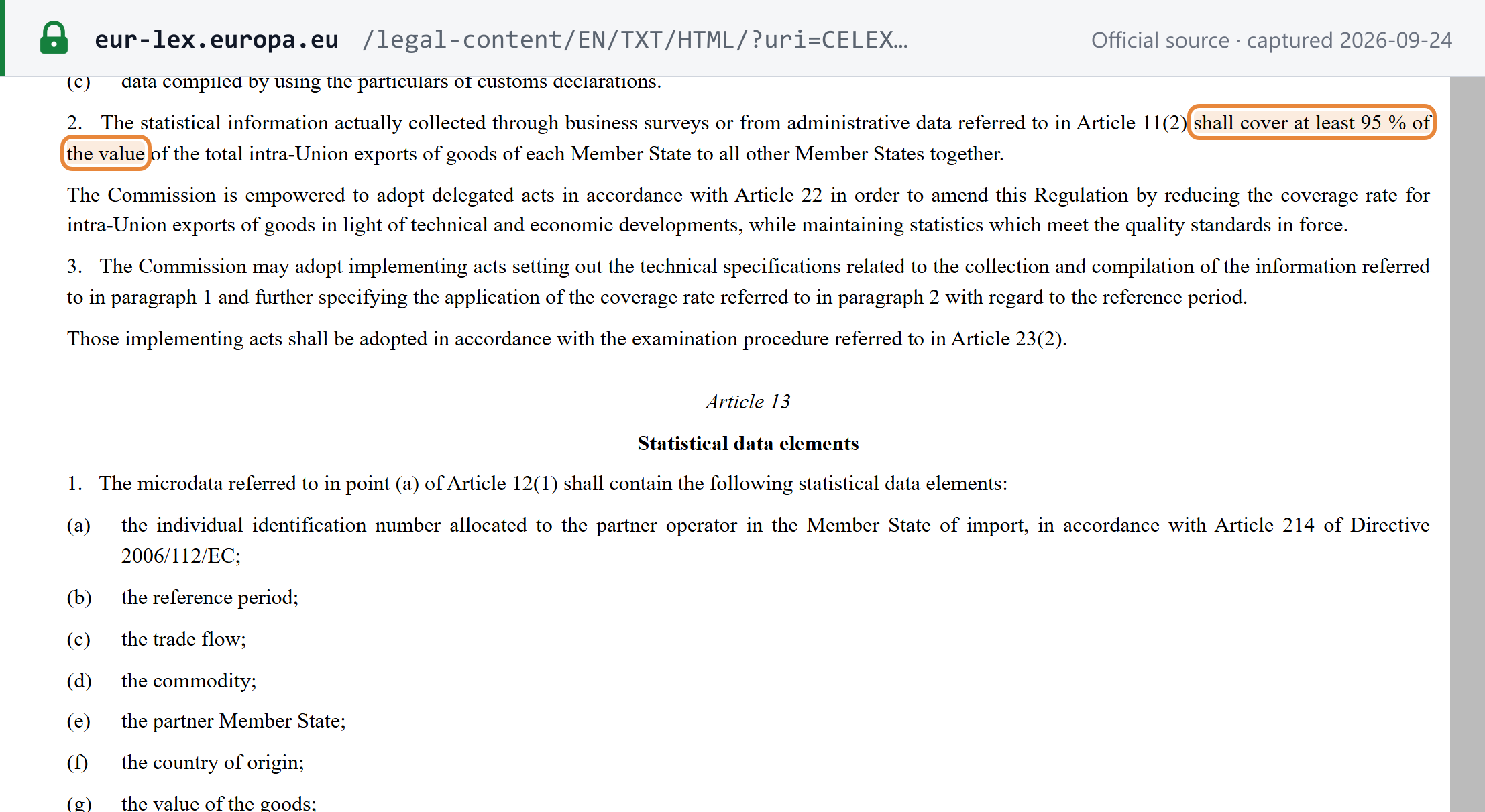
The 2022 reform's central change is the exchange of micro-data on intra-EU exports (MDE). Each Member State's statistical authority sends its export records to the Member State of import, so one country's dispatch declaration becomes another's arrivals data. The exchanged data "shall cover at least 95 % of the value of the total intra-Union exports of goods of each Member State to all other Member States together" (Art 12(2)), and each record carries "the individual identification number allocated to the partner operator in the Member State of import" and "the country of origin" (Art 13(1)(a) and (f)). (Regulation (EU) 2019/2152, checked 2026-09-24)
 Source snapshot captured 2026-09-24 — original
Two consequences for traders:
- Your dispatch lines need your customer's VAT number and the country of origin. Belgium's 2026 guide, for example, lists "the country of origin code (only for dispatches)" and "the counterparty’s VAT number (only for dispatches)" (National Bank of Belgium, Intrastat quick guide, last update July 2026, checked 2026-09-24).
- Several Member States collect fewer arrivals, or none. Estonia stopped in 2025: "From 2025, Intrastat reports must only be submitted for the dispatch of goods. The detailed data on the dispatch of goods from other countries will be used as the arrival data." (Statistics Estonia, checked 2026-09-24). Finland followed from statistical year 2026. Hungary exempts firms with arrivals up to HUF 4.5 billion and excellent data quality. Portugal released a set of companies from arrivals reporting for 2026. Italy requires monthly arrivals listings only where quarterly intra-EU acquisitions reached EUR 2,000,000 in at least one of the four previous quarters. Sources are in the table below.
 Source snapshot captured 2026-09-24 — original
France went furthest. Its customs authority says: "Depuis le mois de référence janvier 2022, la Déclaration d'échanges de biens (DEB) est remplacée par une enquête statistique (EMEBI) et une formalité fiscale (état récapitulatif TVA)." In English: since reference month January 2022 the old combined DEB has been split into a statistical survey (EMEBI) and a VAT recapitulative statement (douane.gouv.fr, checked 2026-09-24).
How the threshold works: Germany as an example
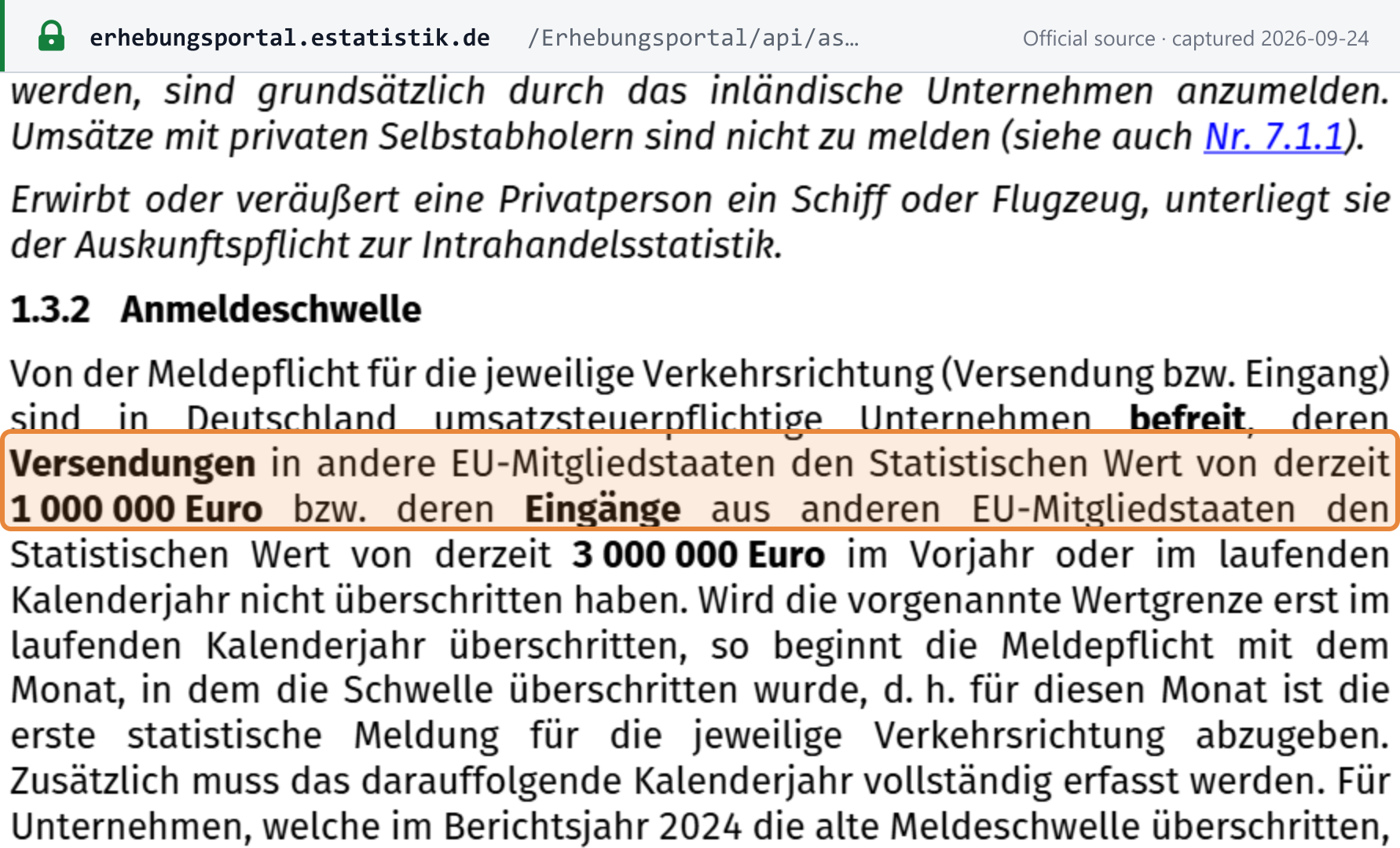
There is no EU-wide Intrastat threshold. EU law fixes the coverage requirement, and each Member State sets its own figures every year, separately for arrivals and dispatches. The mechanics also vary. In Germany, a business is exempt for a flow where its dispatches did not exceed EUR 1,000,000, or its arrivals EUR 3,000,000, "im Vorjahr oder im laufenden Kalenderjahr" (in the previous or the current calendar year). If the threshold is first crossed during the current year, reporting starts with the month in which it was crossed, and "Zusätzlich muss das darauffolgende Kalenderjahr vollständig erfasst werden" (the following calendar year must also be reported in full). Fines reach up to EUR 50,000 (Destatis, Leitfaden zur Intrahandelsstatistik 2026, §1.3.2, checked 2026-09-24). So a German business whose arrivals pass EUR 3,000,000 in November 2026 reports arrivals from November 2026 through December 2027.
 Source snapshot captured 2026-09-24 — original
Thresholds also move sharply from one year to the next. Austria's arrivals threshold is EUR 5,000,000 from reporting year 2026, against EUR 1,200,000 for dispatches:
 Source snapshot captured 2026-09-24 — original
Beyond the basic threshold
- Standard fields on a line include the commodity code, partner Member State, nature of transaction, value, and net mass or supplementary units.
- Statistical value, delivery terms and transport mode are often required only above a second, higher national threshold. Examples: Belgium's extended declaration at EUR 25 million, and Poland's detailed threshold of PLN 105,000,000 for arrivals and PLN 148,000,000 for dispatches in 2026 (GUS, checked 2026-09-24).
- Deadlines are national. They run from the 6th working day (Luxembourg, paper) to the 25th (Italy). Ireland's is the 23rd; Germany, Austria, France and the Netherlands use the 10th working day.
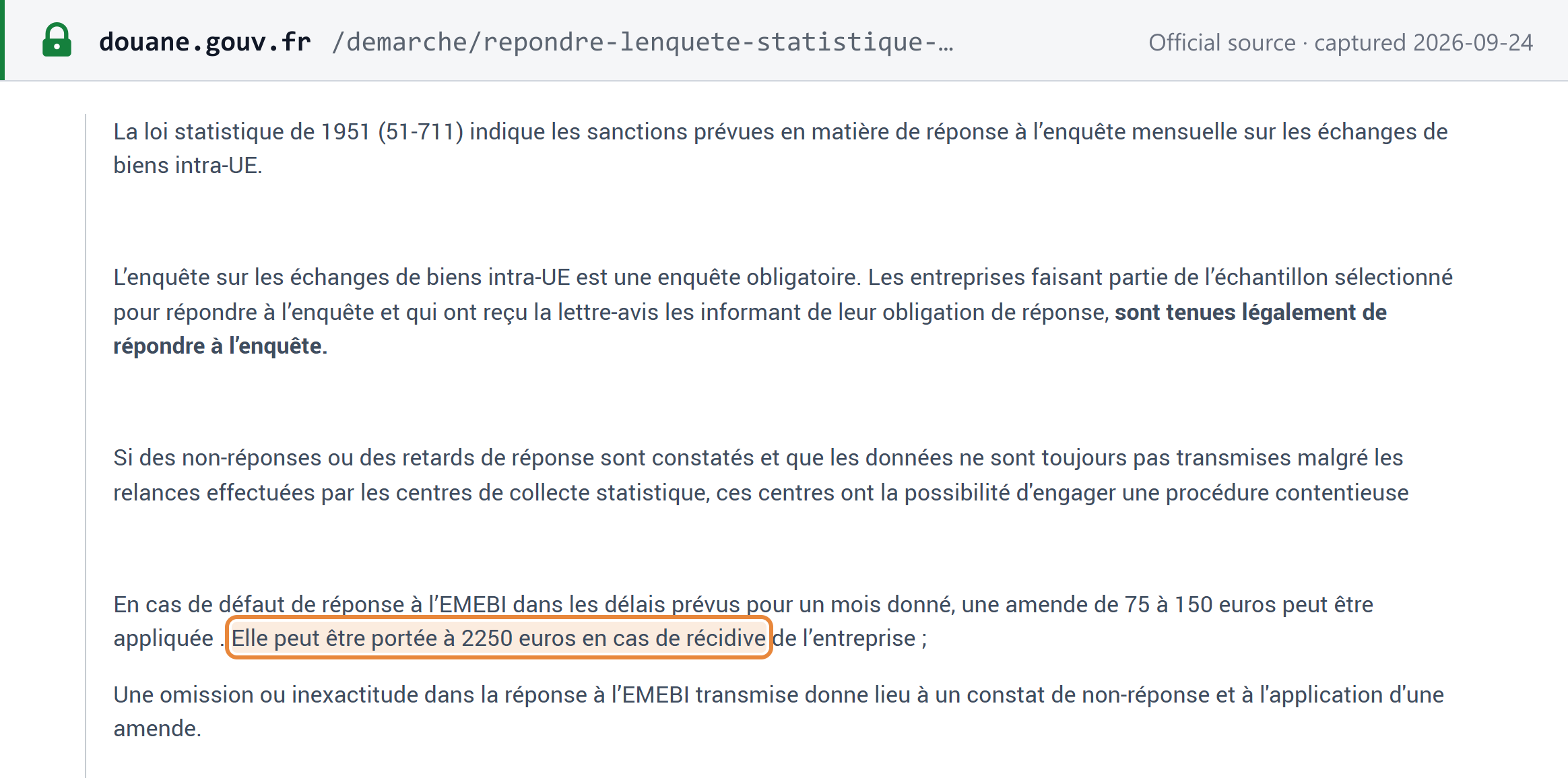
- Penalties are national. Examples: Germany up to EUR 50,000; France a fine of EUR 75 to 150 for a late EMEBI response, which "peut être portée à 2250 euros en cas de récidive" (can rise to EUR 2,250 for a repeat offence) (douane.gouv.fr; statistics law no. 51-711, art. 7, "300 euros au moins et 2250 euros au plus" for a repeat offence, Légifrance; checked 2026-09-24); Denmark a DKK 550 late-filing fee (Danmarks Statistik, Intrastat quick guide 2026, checked 2026-09-24); the Netherlands an administrative fine or an order subject to a penalty payment.
 Source snapshot captured 2026-09-24 — original
- Great Britain has been outside Intrastat since 1 January 2021. Northern Ireland ↔ EU goods movements stay in Intrastat on both sides, with partner code XI.
Intrastat thresholds 2026 by Member State
Reference year 2026, per flow. A business below both thresholds files no Intrastat, except where the statistics office selects it (France, the Netherlands) or a combined test applies (Malta). Amounts are in the currency the authority publishes. Each row shows when it was last confirmed and its source; unverified rows are marked.
| Member State | Arrivals 2026 | Dispatches 2026 | Deadline | Last confirmed | Source |
|---|---|---|---|---|---|
| Austria | EUR 5,000,000 | EUR 1,200,000 | 10th working day | 2026-09-24 | Statistik Austria |
| Belgium | EUR 1,500,000 | EUR 1,000,000 | — | 2026-09-24 | National Bank of Belgium, quick guide (July 2026) |
| Bulgaria | EUR 899,874 (BGN 1,760,000) | EUR 1,150,407 (BGN 2,250,000) | — | 2026-09-24 | NSI order РД-05-665/14.10.2025 |
| Croatia | EUR 450,000 | EUR 300,000 | — | 2026-09-24 | DZS, Intrastat upute 2026 |
| Cyprus | EUR 380,000 | EUR 75,000 | 10th day | 2026-08-19 | Cyprus Tax Department |
| Czechia | CZK 15,000,000 | CZK 15,000,000 | 12th working day (electronic) | 2026-09-24 (page undated) | Portál veřejné správy |
| Denmark | DKK 42,000,000 | DKK 11,800,000 (optional simplified reporting between DKK 11.8m and 16.5m) | Published monthly dates | 2026-09-24 | Danmarks Statistik; Intrastat quick guide 2026 |
| Estonia | Not collected since 2025 | EUR 325,000 | 14th day | 2026-09-24 | Statistics Estonia |
| Finland | Not collected from statistical year 2026 | EUR 800,000 | — | 2026-04-11 (archived official copy) | Finnish Customs (archived official copy of 2026-04-11) |
| France | No threshold: sample survey (EMEBI), selected companies receive a lettre-avis | Same | 10th working day | 2026-09-24 | DGDDI, douane.gouv.fr |
| Germany | EUR 3,000,000 | EUR 1,000,000 | 10th working day | 2026-09-24 | Destatis, Leitfaden 2026 |
| Greece | EUR 250,000 | EUR 90,000 | — | 2026-09-24 | ELSTAT, "Κατώφλια 2026" (30/01/2026) |
| Hungary | HUF 500,000,000 (firms up to HUF 4.5bn with excellent data quality exempt) | HUF 200,000,000 | — | 2026-09-24 | KSH |
| Ireland | EUR 750,000 | EUR 750,000 | 23rd | 2026-09-24 | Revenue, Intrastat Traders Manual (Feb 2026) |
| Italy | Monthly arrivals listing (INTRA-2 bis) where quarterly acquisitions reach EUR 2,000,000 in at least one of the four previous quarters | The dispatch listing (INTRA-1 bis) is also the recapitulative statement; its statistical columns are optional for monthly filers whose quarterly dispatches stayed below EUR 100,000 in all four previous quarters | 25th | 2026-09-24 | ADM Determinazione 84415/RU of 3 Feb 2026; ADM Provvedimento 194409 of 25 Sep 2017, point 3.1 |
| Latvia | unverified | unverified | — | unverified | CSB — publishes no 2026 figures |
| Lithuania | unverified | unverified | — | unverified | State Data Agency order DĮ-252 of 29 Oct 2025 (TAR) sets the 2026 thresholds |
| Luxembourg | EUR 250,000 | EUR 200,000 | 6th working day (paper) / 16th (online) | 2026-09-24 | guichet.public.lu (12.02.2026) |
| Malta | EUR 700, combined arrivals and dispatches | Same combined test | Before the 10th business day | 2026-09-24 | NSO Malta |
| Netherlands | No threshold: CBS selects the traders making up the 95th percentile of trade and notifies them by letter | Same | 10th working day | 2026-09-24 | CBS, Handleiding IHG 2026 |
| Poland | PLN 6,000,000 | PLN 2,800,000 | — | 2026-09-24 | GUS |
| Portugal | EUR 650,000 (Madeira EUR 50,000) | EUR 600,000 (Madeira EUR 50,000) | 15th | 2026-09-24 | INE, Intrastat 2026 note |
| Romania | RON 1,000,000 | RON 1,000,000 | — | 2026-09-24 | INS Order 1604/2025 |
| Slovakia | EUR 1,000,000 (agri-food EUR 200,000) | EUR 1,000,000 (agri-food EUR 400,000) | — | 2026-09-24 | ŠÚ SR |
| Slovenia | EUR 300,000 | EUR 280,000 | 15th | 2026-09-24 | SURS, Intrastat navodila 2026 |
| Spain | EUR 400,000 | EUR 400,000 | — | 2026-09-24 | AEAT ("actualmente", i.e. current at that date) |
| Sweden | SEK 15,000,000 (rolling 12 months) | SEK 12,000,000 (rolling 12 months) | Published dates | 2026-09-23 | SCB, Intrastat handledning 2026 |
| Northern Ireland (XI) | GBP 500,000 | GBP 250,000 | — | 2026-09-24 | HMRC, uktradeinfo |
"—" means the source checked for the threshold did not state a deadline. Notes on individual rows:
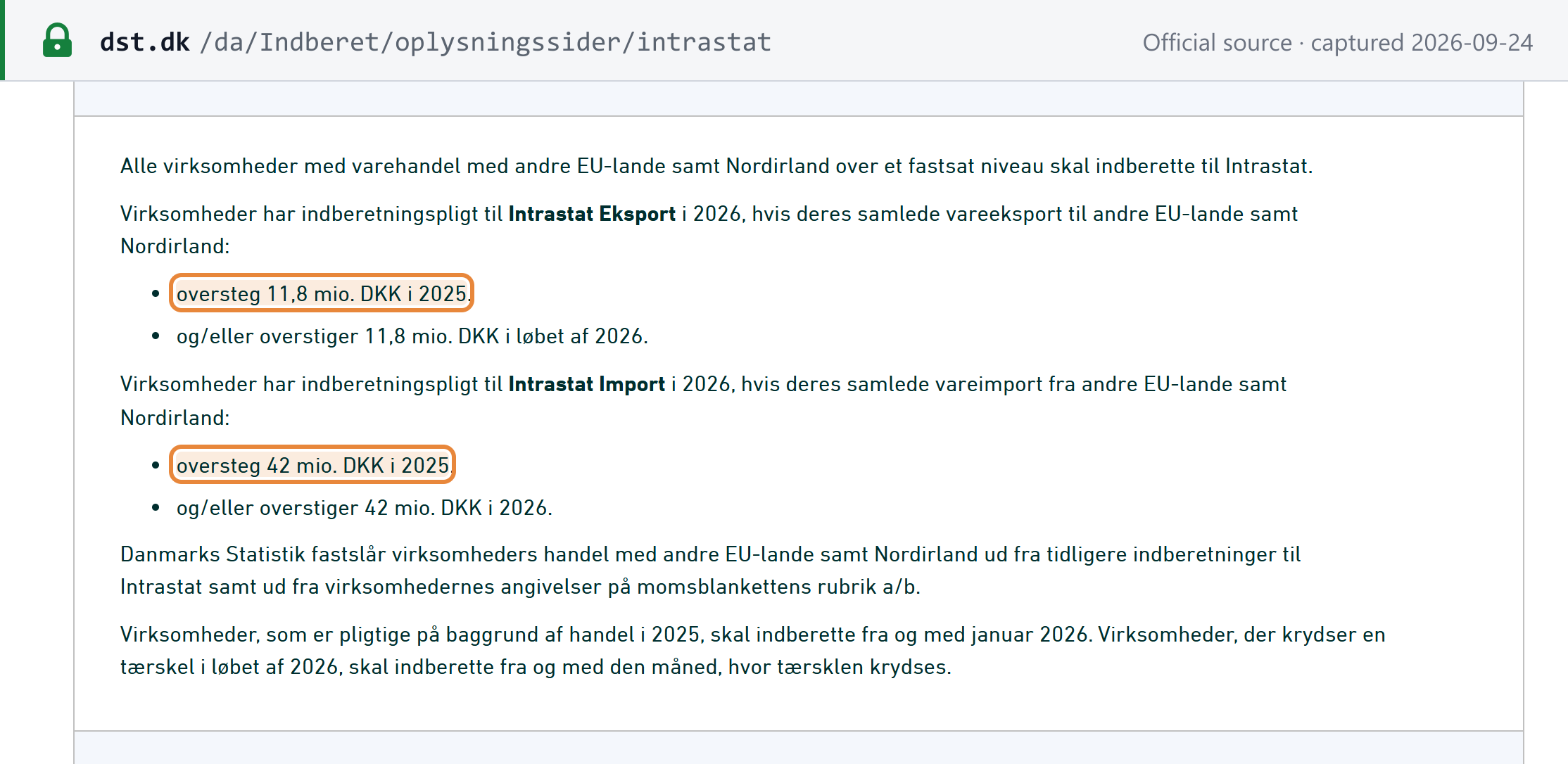
- Denmark: Statistics Denmark states the obligation outright. A business reports exports if its exports to other EU countries and Northern Ireland exceeded DKK 11.8m in 2025 or exceed it during 2026, and imports if its imports exceeded DKK 42m in 2025 or exceed it during 2026. Simplified reporting is optional, covers exports only, and is open to businesses with exports between DKK 11.8m and 16.5m.
 Source snapshot captured 2026-09-24 — original
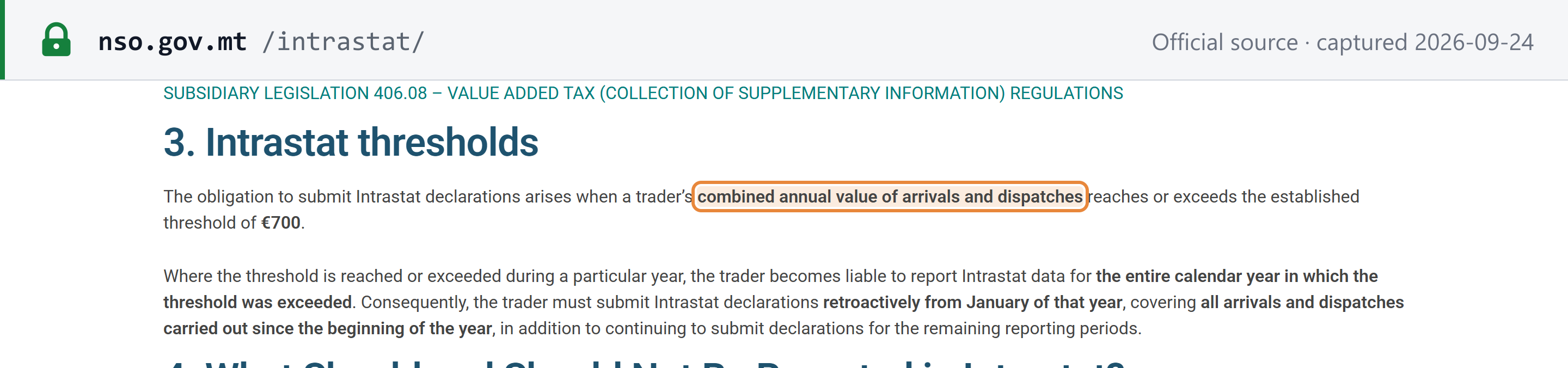
- Malta applies one combined test: the obligation "arises when a trader’s combined annual value of arrivals and dispatches reaches or exceeds the established threshold of €700". Once it is crossed, the trader reports for the entire calendar year, retroactively from January.
 Source snapshot captured 2026-09-24 — original
- Slovakia decides the 2026 obligation on trade from October 2024 to September 2025.
- Italy's INTRA listings serve tax and statistical purposes at once, so Italy has no separate dispatch "exemption threshold" in the Intrastat sense.
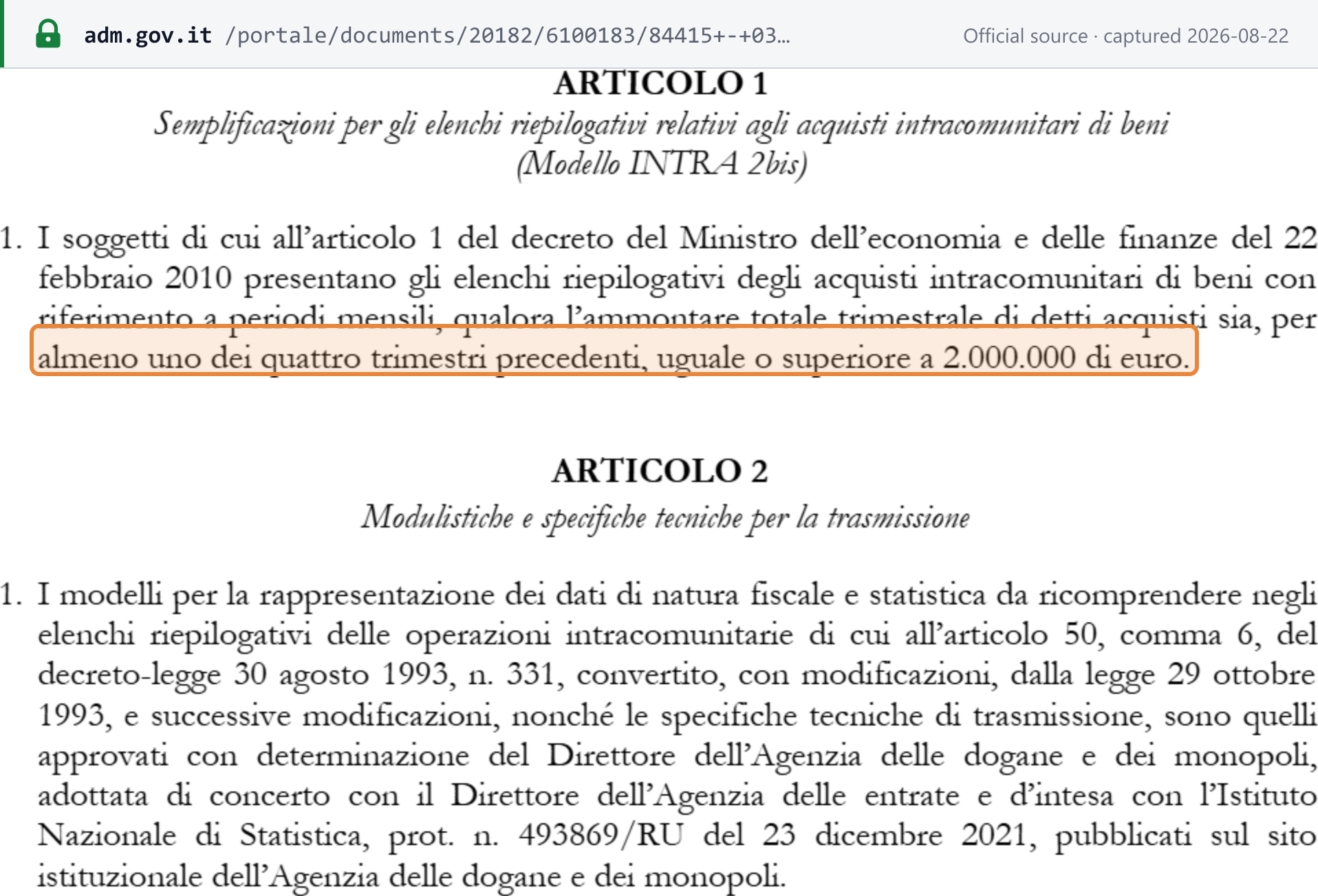 Source snapshot captured 2026-08-22 — original
Current status and dates
As at 2026-09-24, the recapitulative statement, the VIES check and Intrastat are all in force in every Member State. The dates that shaped them, and those already enacted for the future:
| Date | What changed | Status | Source |
|---|---|---|---|
| 1 Jan 2020 | Quick Fixes: a correct recapitulative statement becomes a condition of the intra-EU exemption (Art 138(1a)); the customer's VAT number becomes a substantive condition (Art 138(1)(b)); the call-off stock simplification and its reporting line (Arts 17a, 262(2)) | In force | Directive (EU) 2018/1910; VAT Directive, consolidated |
| 1 Jan 2021 | GB numbers leave VIES and Northern Ireland (XI) numbers are added; Great Britain leaves Intrastat; Ireland stops reporting services to Northern Ireland | In force | VIES; Revenue |
| 1 Jan 2022 | Intrastat moves to Regulation (EU) 2019/2152 and Implementing Regulation (EU) 2020/1197; export micro-data exchange begins; France replaces the DEB with the EMEBI survey and a VAT recapitulative statement | In force | Reg (EU) 2019/2152 |
| 1 Jan 2025 | Estonia stops collecting arrivals; Ireland's thresholds become EUR 750,000 for both flows | In force | Statistics Estonia; Revenue |
| 2026 reference year | Finland stops collecting arrivals; Austria's arrivals threshold rises to EUR 5,000,000 | In force | Finnish Customs; Statistik Austria |
| 1 Jul 2026 | Sweden may show a VAT number as invalid in VIES on fraud-risk grounds | In force | SFS 2026:707 |
| 30 Jun 2028 | Last dispatch date for new call-off stock arrangements | Enacted, future | Directive (EU) 2025/516 (ViDA) |
| 1 Jul 2028 | Supplies on which the customer pays the VAT under the Article 194 reverse charge join the recapitulative statement | Enacted, future | Directive (EU) 2025/516, Art 3, Art 6(3) |
| 1 Jul 2029 | The call-off stock line (Art 262(2)) is deleted from the recapitulative statement | Enacted, future | Directive (EU) 2025/516, Art 4, Art 6(4) |
| 1 Jul 2030 | Recapitulative statements abolished: Articles 265 to 271 are deleted and intra-EU supplies and acquisitions are reported per transaction, from e-invoice data, into a central VIES | Enacted, future | Directive (EU) 2025/516, Art 5, Art 6(5) |
Until 30 June 2030 the monthly or quarterly recapitulative statement described above remains the rule. From 1 July 2030 the ViDA directive (Council Directive (EU) 2025/516, adopted 11 March 2025) replaces it with transaction-level digital reporting built on e-invoicing. Member States must "apply those measures from 1 July 2030" (Art 6(5)). The ViDA explainer covers the wider package.
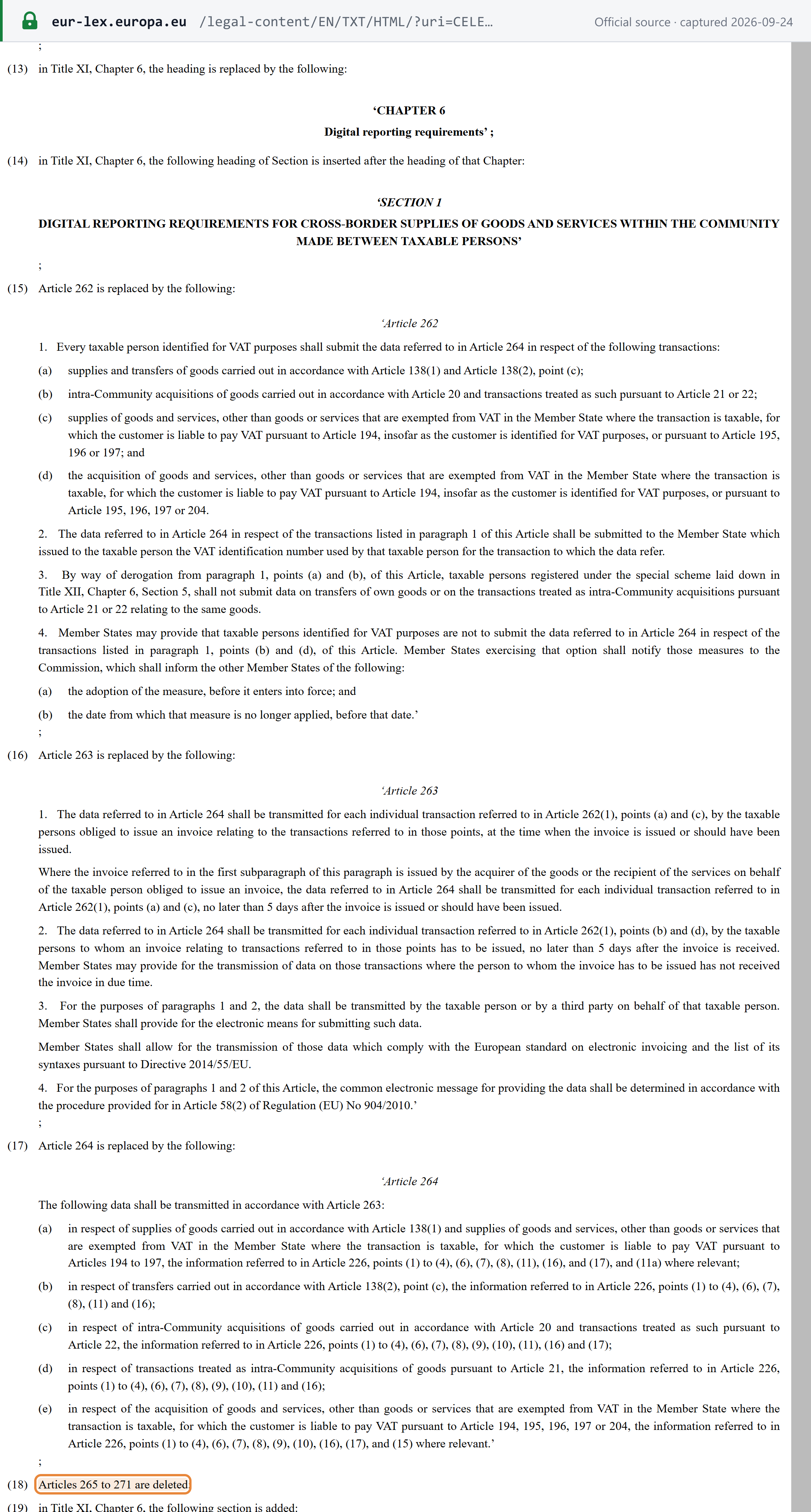 Source snapshot captured 2026-09-24 — original
Intrastat is not part of ViDA. It continues under Regulation (EU) 2019/2152, and its thresholds are reset every year.
Related changes from the feed
- 2026-08-20 — Cyprus extended the deadline for the VAT return for the period ended 30 June 2026 and the VIES recapitulative statement for July 2026 to 20 August 2026. (Cyprus Tax Department) — see event
- 2026-07-01 — Sweden's Tax Agency may mark a VAT number invalid in VIES where there is a risk of VAT fraud. (Sveriges riksdag) — see event
- 2026-05-20 — Cyprus extended the VAT return for the period ending 31 March 2026 and the April 2026 VIES recapitulative statements to 20 May 2026, because of a planned maintenance shutdown of its Tax For All platform on 7–12 May 2026. (Cyprus Tax Department) — see event
Frequently asked questions
Is a VIES consultation number enough proof to zero-rate an intra-EU sale?
No. The Commission says a validity confirmation is "only ONE of the elements of evidence" supporting the Article 138(1) exemption. You also need evidence that the goods left the Member State, and since 1 January 2020 a correct recapitulative statement is itself a condition of the exemption (Art 138(1a) of the VAT Directive). Keep the consultation number as proof of when you checked the number. (VIES Help; VAT Directive; checked 2026-09-24)
Why does VIES show no company name for some countries?
The issuing Member State decides. The VIES FAQ says: "Certain Member States / Northern Ireland permit the display of the name and address of the taxable person where the VAT number is currently valid." A blank name means the relevant Member State or Northern Ireland does not permit the display of this data. It says nothing about whether the number is valid. (VIES FAQ, checked 2026-09-24)
Is there a VIES API?
Yes. The VIES FAQ says: "SOAP/REST services, offering the same functionality as the interactive service are available." The SOAP service is checkVatService.wsdl, with checkVat and checkVatApprox; the REST service has a published contract (POST /check-vat-number, POST /check-vat-test-service and GET /check-status under ec.europa.eu/taxation_customs/vies/rest-api/). The REST service returns the consultation number (requestIdentifier) when you send your own VAT number as requester. The terms of use forbid extracting or retransmitting the data other than for your own legitimate activity. (European Commission, checked 2026-09-24)
What is the Intrastat threshold in 2026?
There is no EU-wide figure; each Member State sets its own every year, per flow. Germany: EUR 3,000,000 arrivals and EUR 1,000,000 dispatches. Austria: EUR 5,000,000 arrivals and EUR 1,200,000 dispatches. France and the Netherlands publish no threshold and select companies by letter. Estonia and Finland no longer collect arrivals. The table on this page gives all 27 Member States and Northern Ireland, with sources. (Checked 2026-09-24)
In a triangular deal, does the middle company file anything?
On the recapitulative statement, yes: the intermediary B reports its onward supply to the final customer C, with C's VAT number in the country where the goods arrive (Art 262(1)(b) and Art 265 of the VAT Directive). Until 30 June 2030, C files no recapitulative statement for the purchase. For Intrastat, B files nothing in its own country, because the goods never cross that border. (VAT Directive; checked 2026-09-24)
When do recapitulative statements disappear?
On 1 July 2030. Council Directive (EU) 2025/516 (ViDA) deletes Articles 265 to 271 of the VAT Directive and replaces the statement with per-transaction digital reporting of intra-EU supplies and acquisitions based on e-invoices, feeding a central VIES. Until then the monthly or quarterly statement stays in force everywhere. Intrastat is not affected. (Directive (EU) 2025/516, Art 5 and Art 6(5))
Related resources
- VAT listings in the EU — the recapitulative statement in depth, with national due dates and domestic listings
- How to verify an EU VAT number on VIES — the step-by-step check
- Check a VAT number: official national databases
- ViDA — VAT in the Digital Age — what replaces the recapitulative statement in 2030
- One Stop Shop (OSS) — where B2C distance sales are declared instead
- Reverse charge — the Article 196 services that go on the statement
- Country guides with VIES and Intrastat detail: Ireland, Germany, Austria, Italy, Cyprus, Luxembourg, Sweden
- Tax glossary
- Change chronologies: Cyprus, Sweden, European Union
Reference links
- Council Directive 2006/112/EC (VAT Directive), consolidated 14 April 2025 — Arts 36, 76, 138, 262–271
- Regulation (EU) 2019/2152 on European business statistics — Intrastat since 2022
- Commission Implementing Regulation (EU) 2020/1197 — Intrastat technical rules
- Council Directive (EU) 2025/516 (ViDA)
- VIES on-the-Web — European Commission
- Revenue (Ireland), The VIES Traders Manual and Intrastat Traders Manual