E-invoicing in Spain — FACe (B2G) and the B2B Mandate from 6 October 2027
| Country | Spain |
| Status - B2G | Mandatory since 15 January 2015 for the supplier types listed in Law 25/2013 (companies and similar entities; not natural persons) |
| Status - B2B | Enacted — mandatory from 6 October 2027 (volume of operations above EUR 8 million) and 6 October 2028 (all others); voluntary until then |
| Status - B2C | Outside the B2B mandate |
| Formats | B2G (FACe): signed Facturae 3.2 / 3.2.1 / 3.2.2, UBL, CII. B2B: EN 16931 in UBL, CII, EDIFACT or Facturae (the AEAT public solution uses UBL) |
| Authority | Agencia Estatal de Administración Tributaria (AEAT) for B2B, SII and Verifactu; Ministerio de Hacienda |
| Network name | B2G: FACe (Punto General de Entrada de Facturas Electrónicas). B2B: interconnected private platforms plus the AEAT public e-invoicing solution |
| Legislation | B2G: Ley 25/2013. B2B: Ley 18/2022 (Crea y Crece), Real Decreto 238/2026, Orden HAC/1028/2026 |
Overview
Spain runs two e-invoicing regimes.
- B2G (since 15 January 2015). Under Law 25/2013, the listed supplier types must invoice public administrations electronically, through a general entry point. For the General State Administration, and for the administrations that have joined it, that entry point is FACe (Punto General de Entrada de Facturas Electrónicas). (BOE — Ley 25/2013)
- B2B (enacted; applies from 6 October 2027). Ley 18/2022 ("Crea y Crece") requires all businesses and professionals to issue, send and receive e-invoices in their dealings with each other and to report invoice status. Royal Decree 238/2026 implements it. Orden HAC/1028/2026, in force since 6 October 2026, regulates the AEAT's public e-invoicing solution and starts the clock. (BOE — RD 238/2026; BOE — Orden HAC/1028/2026)
The B2B mandate is administered by the Agencia Estatal de Administración Tributaria (AEAT), which also runs the SII ledger reporting and Verifactu billing-software rules. The ministry responsible is the Ministerio de Hacienda.
The B2B model is decentralised, not clearance. Invoices travel over interconnected private platforms or through the AEAT's free public solution, which also receives a copy of each invoice. An invoice stays valid even if the public solution rejects that copy.
Mandate status & timeline
| Phase | Who | What becomes mandatory | From | Instrument |
|---|---|---|---|---|
| B2G | Supplier types listed in Law 25/2013 art. 4 | E-invoices to public administrations, through the relevant general entry point | 15 January 2015 (passed) | Ley 25/2013 |
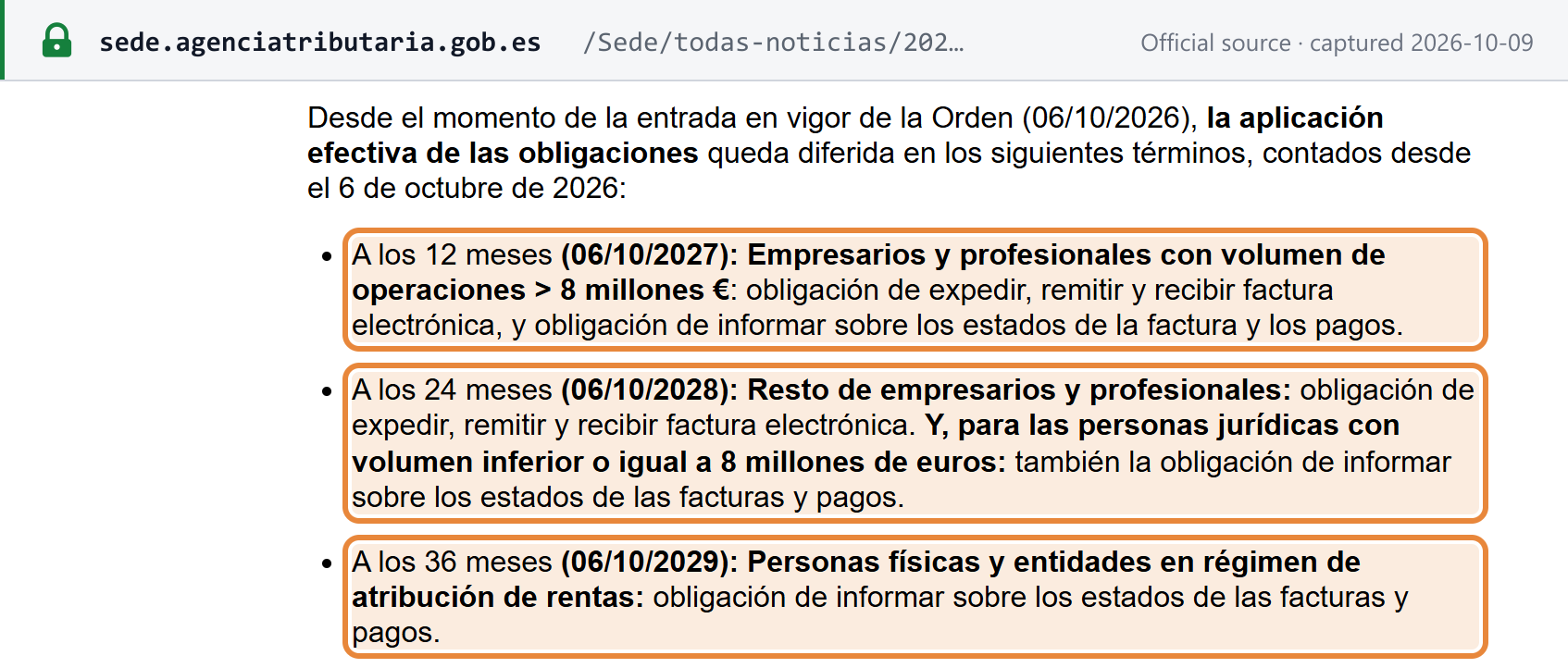
| B2B, phase 1 | Businesses and professionals whose volume of operations exceeded EUR 8 million in the preceding calendar year | Issue, send and receive structured e-invoices; report invoice status and payment | 6 October 2027 (not yet passed) | RD 238/2026 + Orden HAC/1028/2026 |
| B2B, phase 2 | All other businesses and professionals, including natural persons | Issue, send and receive. Legal persons also report status and payment | 6 October 2028 (not yet passed) | RD 238/2026 + Orden HAC/1028/2026 |
| B2B, phase 3 | Natural persons and entidades en régimen de atribución de rentas | Status and payment reporting | 6 October 2029 (not yet passed) | RD 238/2026 + Orden HAC/1028/2026 |
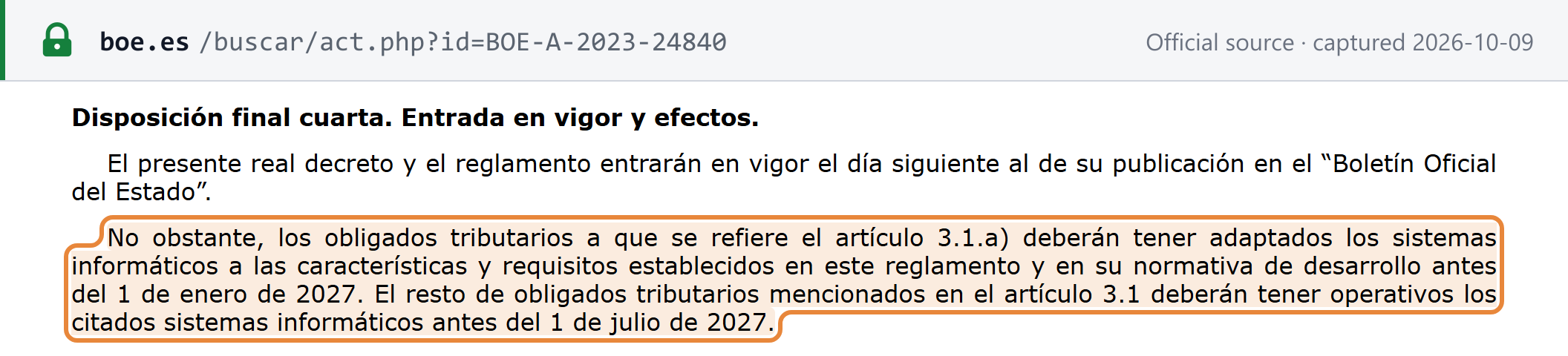
| Verifactu | Corporate income tax payers / all other obliged persons | Invoicing software meeting RD 1007/2023 | 1 January 2027 / 1 July 2027 (not yet passed) | Real Decreto-ley 15/2025 |
Sources: AEAT news, 7 October 2026; BOE — RD 238/2026; BOE — Real Decreto-ley 15/2025.
 Source snapshot captured 2026-10-09 — original
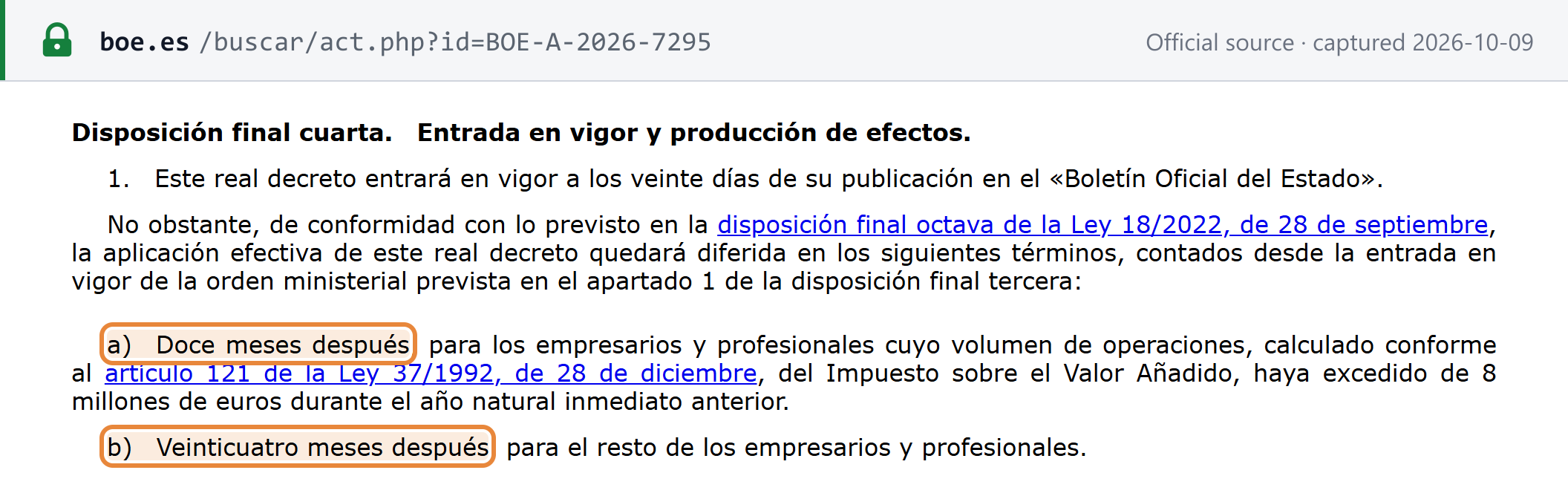
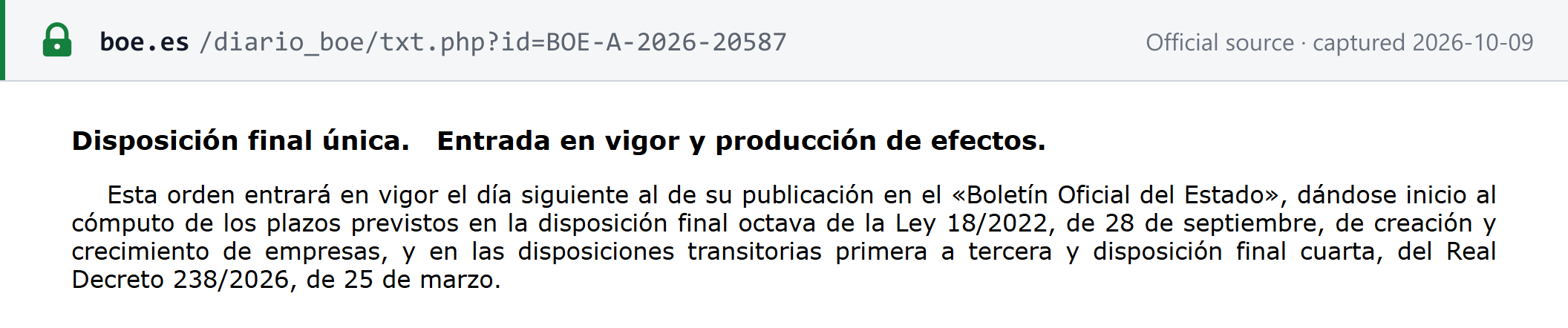
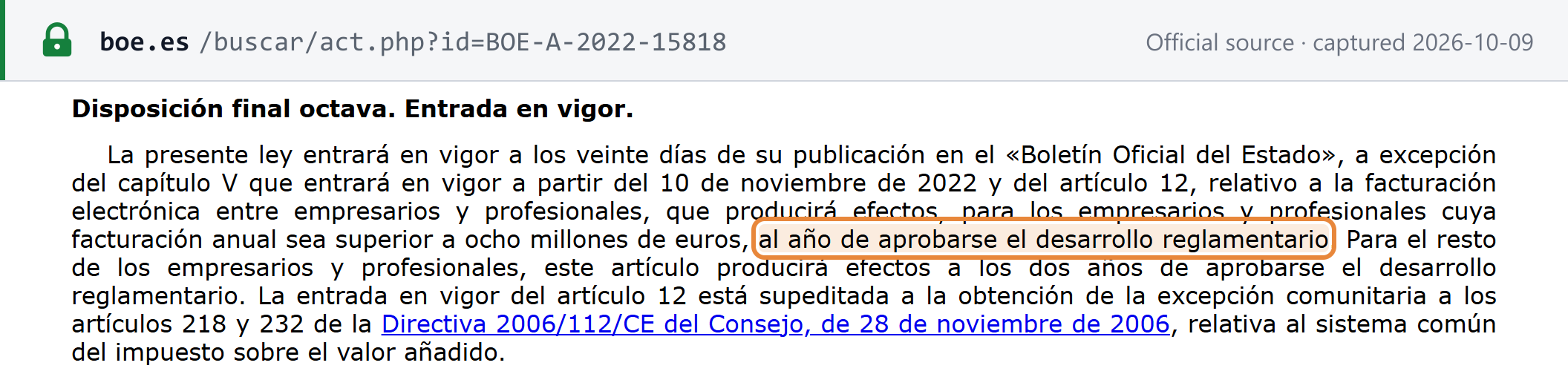
How the B2B dates are counted. RD 238/2026 applies 12 months after the ministerial order on the public solution enters into force for businesses whose volume of operations (calculated under art. 121 of the VAT Law, Ley 37/1992) exceeded EUR 8 million in the preceding calendar year, and 24 months after it for everyone else. That order is Orden HAC/1028/2026, published in the BOE on 5 October 2026 and in force on 6 October 2026. The AEAT published the resulting calendar on 7 October 2026. The clock runs from the order, not from the publication of the Royal Decree.
 Source snapshot captured 2026-10-09 — original
 Source snapshot captured 2026-10-09 — original
Superseded dates. Earlier expectations of "2024" and "2025" predate the implementing regulation. The draft order released for consultation in April 2026 targeted entry into force on 1 October 2026; advisories that still quote 1 October 2027 / 1 October 2028 are working from that draft. The final order slipped to 6 October 2026, which gives the dates above.
Before the application dates, e-invoicing between businesses and status reporting are voluntary.
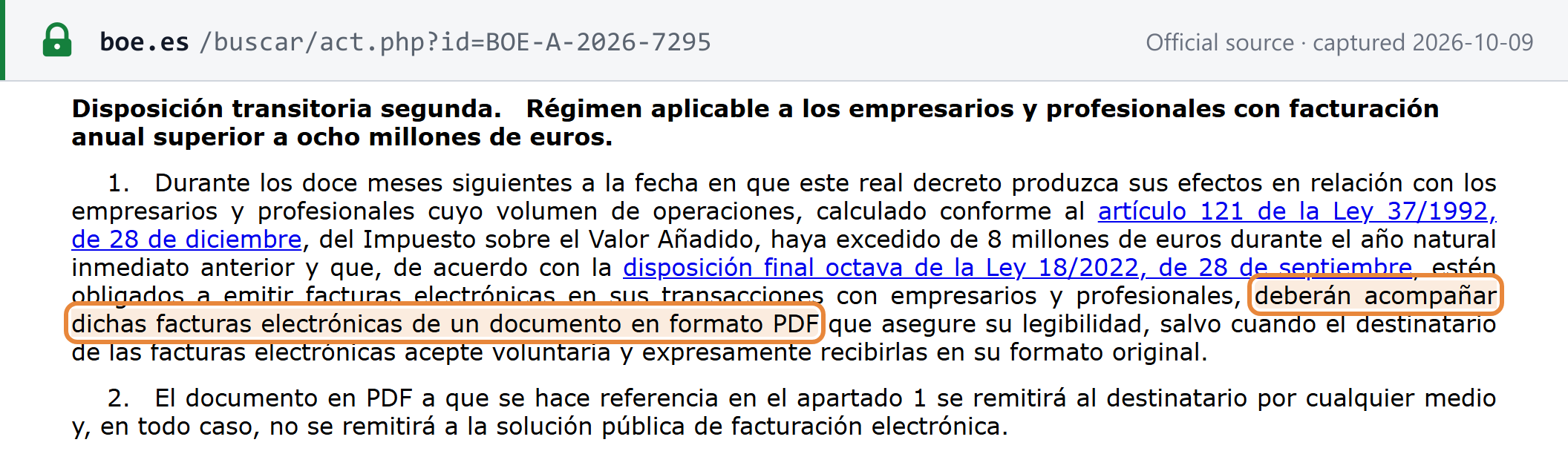
PDF copy for the first year. For 12 months after the obligation applies to them, issuers above EUR 8 million must accompany each e-invoice they issue to businesses with a PDF that ensures it can be read, unless the recipient voluntarily and expressly accepts the original format only. The PDF is a companion document; it is not sent to the public solution.
 Source snapshot captured 2026-10-09 — original
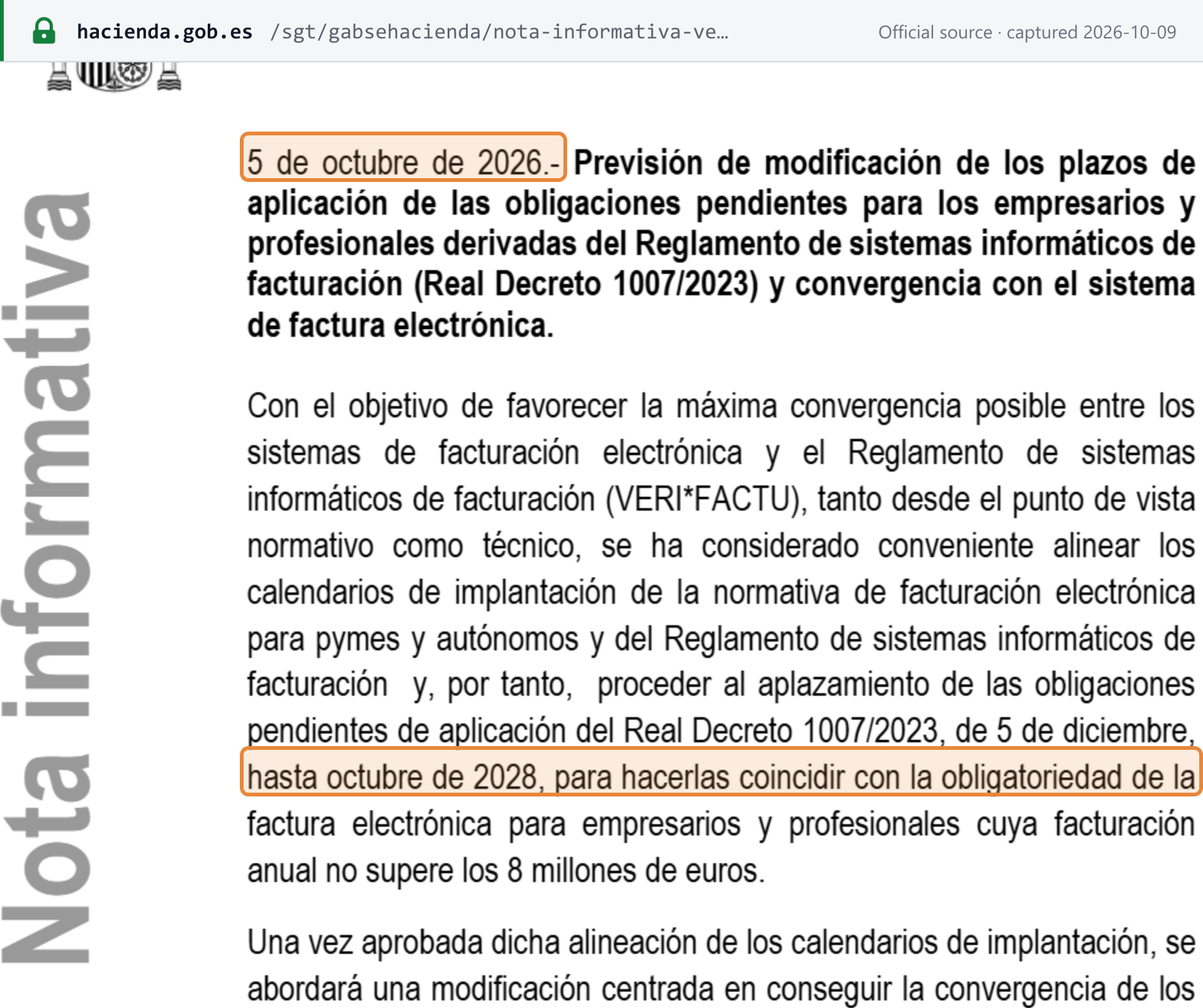
Verifactu: postponement announced, not enacted. On 5 October 2026 the Ministerio de Hacienda announced that the government plans to move the pending Verifactu obligations to October 2028, to coincide with B2B e-invoicing for businesses at or under EUR 8 million. No BOE instrument has been published, so 1 January 2027 and 1 July 2027 remain the legal dates (checked 2026-10-08). (Ministerio de Hacienda press note)
 Source snapshot captured 2026-10-09 — original
 Source snapshot captured 2026-10-09 — original
Legal basis
B2B
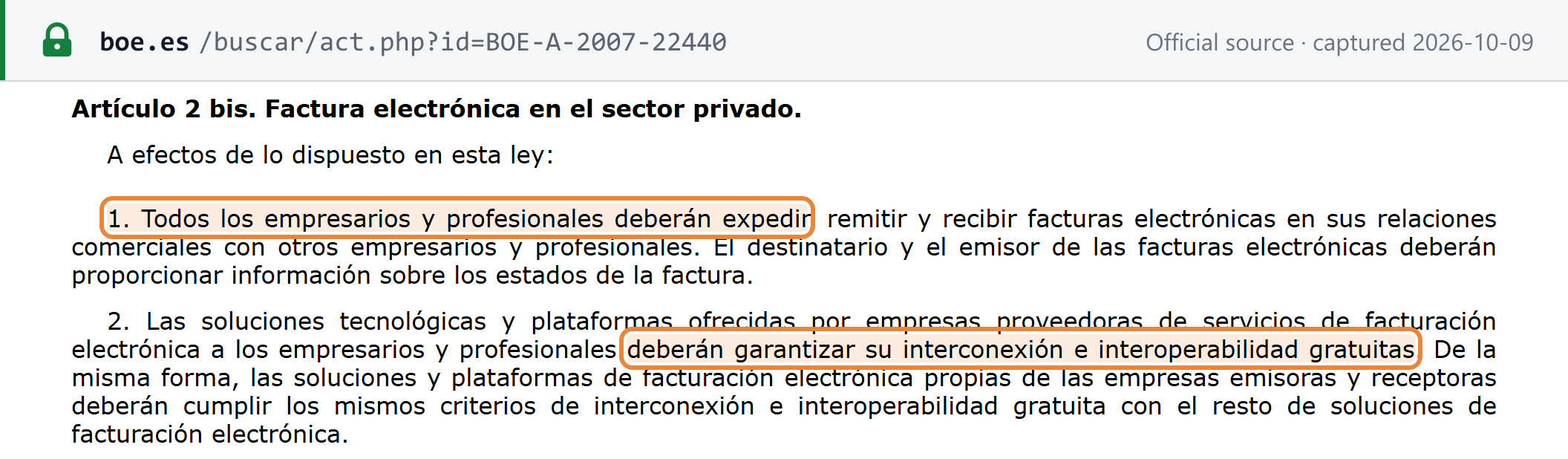
- Ley 18/2022, de 28 de septiembre, de creación y crecimiento de empresas (BOE-A-2022-15818; BOE 29 September 2022; in force 19 October 2022). Art. 12 amends art. 2 bis of Ley 56/2007: businesses and professionals must issue, send and receive e-invoices with each other, issuer and recipient must report invoice status, and e-invoicing solutions must guarantee free interconnection and interoperability. (BOE — Ley 18/2022; BOE — Ley 56/2007, consolidated)
 Source snapshot captured 2026-10-09 — original
 Source snapshot captured 2026-10-09 — original
- Real Decreto 238/2026, de 25 de marzo, which develops the mandatory e-invoicing system between businesses and professionals and amends the invoicing regulation (RD 1619/2012) (BOE-A-2026-7295; BOE 31 March 2026; in force 20 April 2026). Being in force is not the same as applying: its obligations apply on the dates above. (BOE)
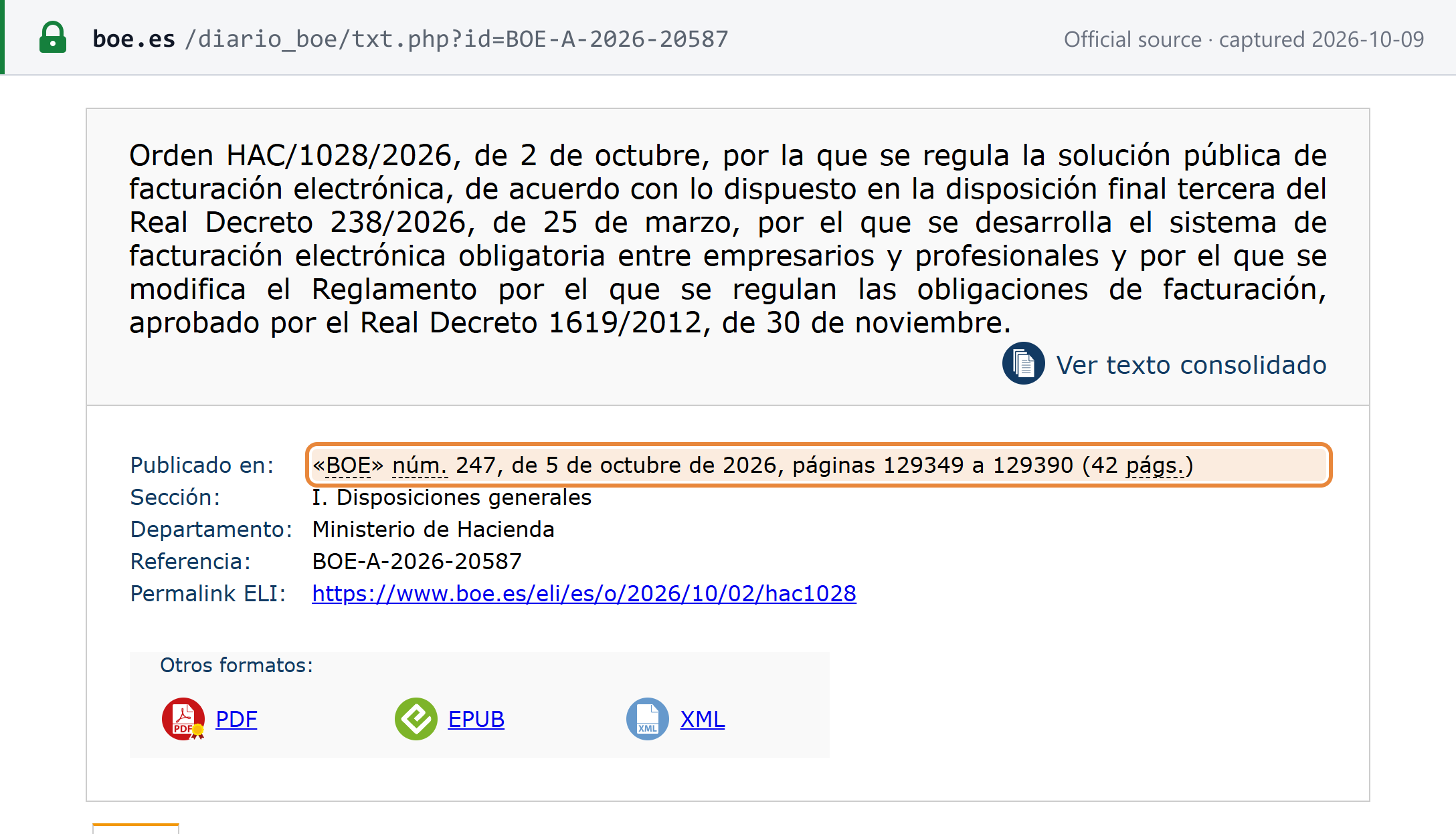
- Orden HAC/1028/2026, de 2 de octubre, which regulates the public e-invoicing solution under RD 238/2026 (BOE-A-2026-20587; BOE núm. 247, 5 October 2026; in force 6 October 2026). Its annex sets the field content by reference to UBL and EN 16931. (BOE)
 Source snapshot captured 2026-10-09 — original
B2G
- Ley 25/2013, de 27 de diciembre, de impulso de la factura electrónica y creación del registro contable de facturas en el Sector Público (BOE-A-2013-13722). (BOE)
- Orden HAP/1074/2014, de 24 de junio (BOE-A-2014-6662), whose first additional provision excludes invoices up to EUR 5,000 from mandatory presentation in FACe. (BOE)
- Ley 9/2017 de Contratos del Sector Público (BOE-A-2017-12902), the basis for the FACeB2B subcontractor channel. (BOE)
Billing software and reporting
- Real Decreto 1007/2023, de 5 de diciembre (BOE-A-2023-24840), the Verifactu requirements for invoicing software; Orden HAC/1177/2024, de 17 de octubre (BOE-A-2024-22138; in force 29 October 2024), the technical specifications; Real Decreto-ley 15/2025, de 2 de diciembre (BOE-A-2025-24446; in force 4 December 2025), the current deadlines. (BOE — RD 1007/2023; BOE — RDL 15/2025)
- SII: art. 69 bis of the VAT Regulation (RIVA). (BOE)
Scope
B2B. The obligation applies to businesses and professionals that must issue an invoice under the invoicing regulation (RD 1619/2012) when the recipient has its seat of economic activity, a permanent establishment or, failing both, its domicile or habitual residence in Spain. It also covers self-billing by the recipient and billing by third parties. (BOE — RD 238/2026)
- Excluded: transactions documented with simplified invoices under art. 4 of the invoicing regulation (RD 1619/2012), unless they are qualified simplified invoices (art. 7.2), and transactions invoiced electronically within the IATA clearing and settlement houses (CASS, BSP, SIS-ICH), where payment is settled through one of those platforms. The regulated activities of the electricity and gas market operators are also outside the Royal Decree.
- SII taxpayers are not excluded from the B2B mandate.
- Non-established suppliers: we have not found AEAT guidance on whether a supplier not established in Spain that invoices a Spanish business is in scope (checked 2026-10-08).
B2C. Consumer sales are outside the B2B mandate. A separate, older rule in Ley 56/2007 art. 2 bis covers some large consumer-facing companies.
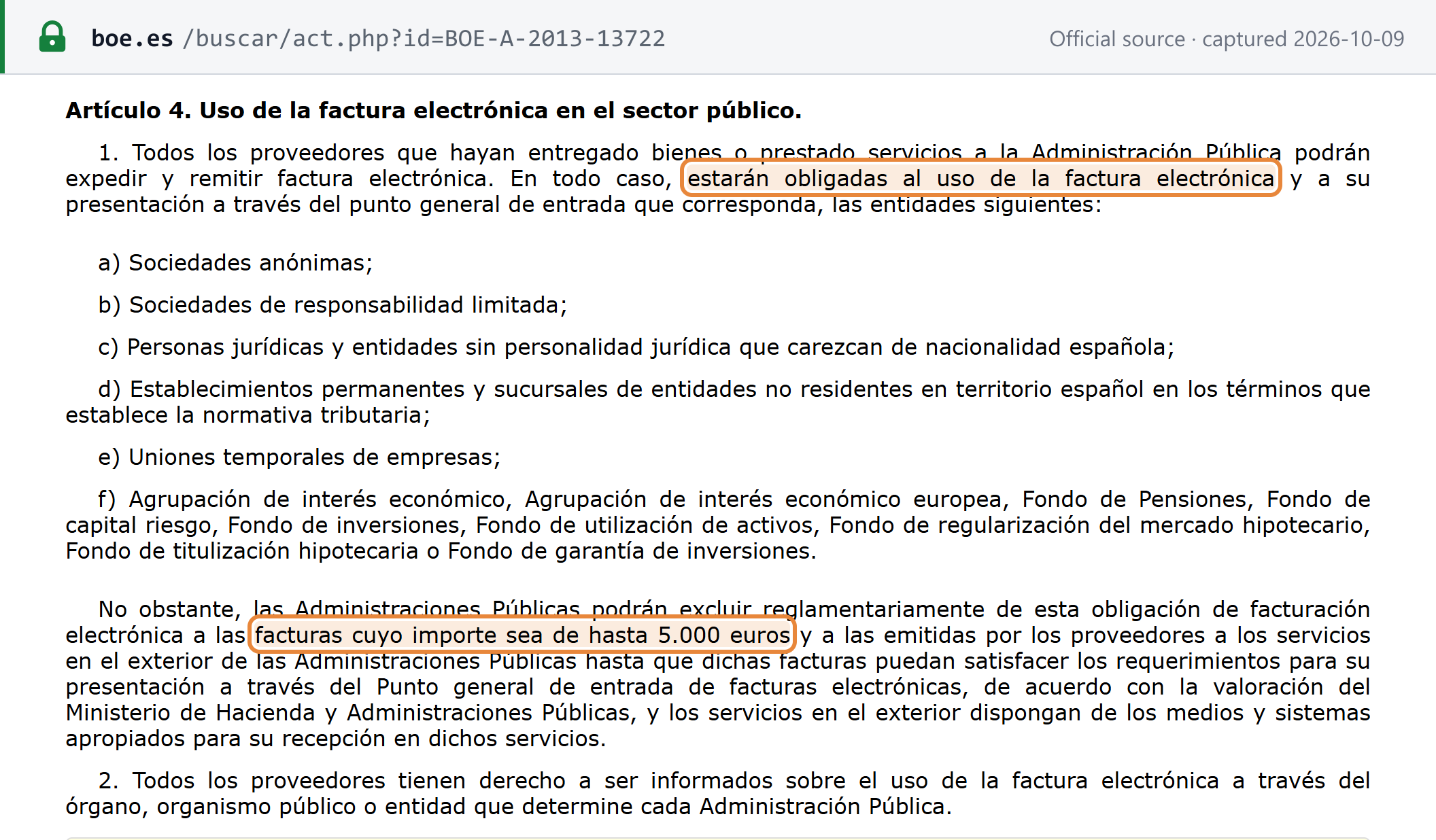
B2G. Every supplier may send e-invoices to a public administration. Law 25/2013 art. 4 makes e-invoicing, and presentation through the relevant general entry point, mandatory for these supplier types, whatever the invoice amount (BOE — Ley 25/2013):
- sociedades anónimas and sociedades de responsabilidad limitada;
- legal persons and entities without legal personality that lack Spanish nationality;
- permanent establishments and branches of non-resident entities;
- uniones temporales de empresas;
- agrupaciones de interés económico, European EEIGs, and pension, venture-capital, investment, mortgage-market, securitisation and similar funds.
Natural persons (autónomos) are not on the list.
 Source snapshot captured 2026-10-09 — original
The EUR 5,000 rule is an exclusion option, not a threshold. Art. 4 lets each administration exclude by regulation invoices of up to EUR 5,000, and invoices to its services abroad. The General State Administration did so for presentation in FACe in Orden HAP/1074/2014; any supplier may still choose to send such invoices electronically, since art. 4 lets every supplier e-invoice. Other administrations decide for themselves, so check the recipient's rules. (BOE — Orden HAP/1074/2014)
 Source snapshot captured 2026-10-09 — original
FACeB2B is a public-contract channel. Under Law 9/2017 (art. 216.5), subcontractors of the types listed in Law 25/2013 art. 4.1 must invoice the main contractor on a public contract electronically where the invoice exceeds EUR 5,000, through the single electronic registry provided for in its 32nd additional provision. That registry is FACeB2B. FACeB2B is not the platform for the B2B mandate: RD 238/2026 gives these subcontractors up to 24 months from the entry into force of the order on the public solution to move to the e-invoicing system it regulates, which will replace the current FACeB2B. (BOE — Ley 9/2017; BOE — RD 238/2026)
Format & network
B2B: private platforms and the AEAT public solution
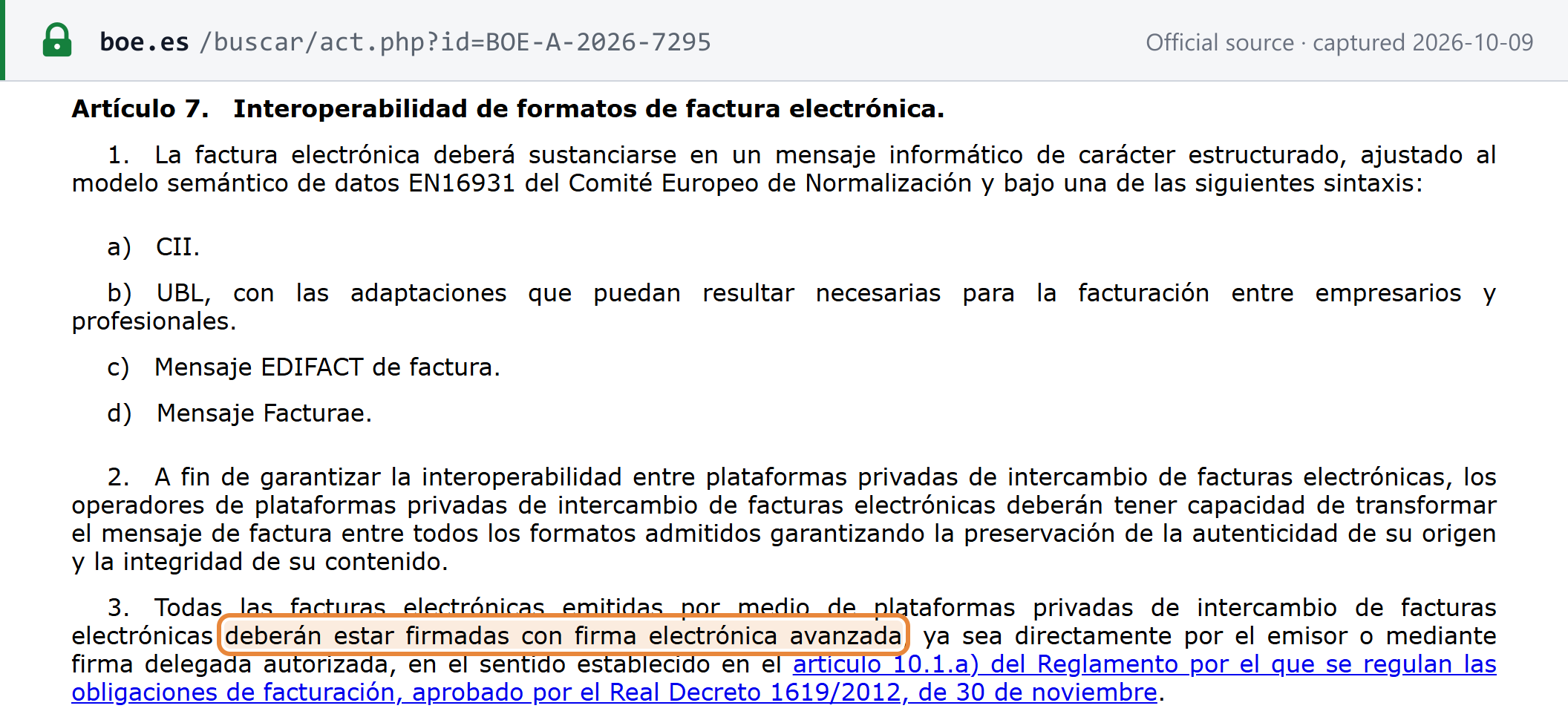
- Formats. Each invoice must be a structured message conforming to the European standard EN 16931, in UBL, CII, the EDIFACT invoice message, or Facturae. Peppol BIS messages are valid insofar as they use UBL and conform to EN 16931. UBL is the reference syntax of the public solution, which accepts only UBL. Every invoice issued through a private platform must carry an advanced electronic signature, applied by the issuer or by authorised delegated signature (art. 7.3). (BOE — RD 238/2026)
 Source snapshot captured 2026-10-09 — original
- Two ways to exchange. Businesses exchange invoices through private platforms, which must interconnect with each other, or through the AEAT's public e-invoicing solution (solución pública de facturación electrónica). Using the public solution is voluntary and free. A business that receives through a private platform must publish its e-invoice entry point; one that has not publicly identified an entry point is treated as receiving through the public solution.
- Faithful copy to the AEAT. When an invoice is not issued through the public solution, the platform or system must send the public solution a faithful electronic copy in UBL at the moment of issue, whatever syntax the original used. A copy that fails the order's validations is not admitted; that does not by itself invalidate the original invoice. The sender fixes the cause and resends the copy; if the cause is an error in the original invoice itself, the fix is a correct original invoice, sent together with a new copy. (BOE — Orden HAC/1028/2026)
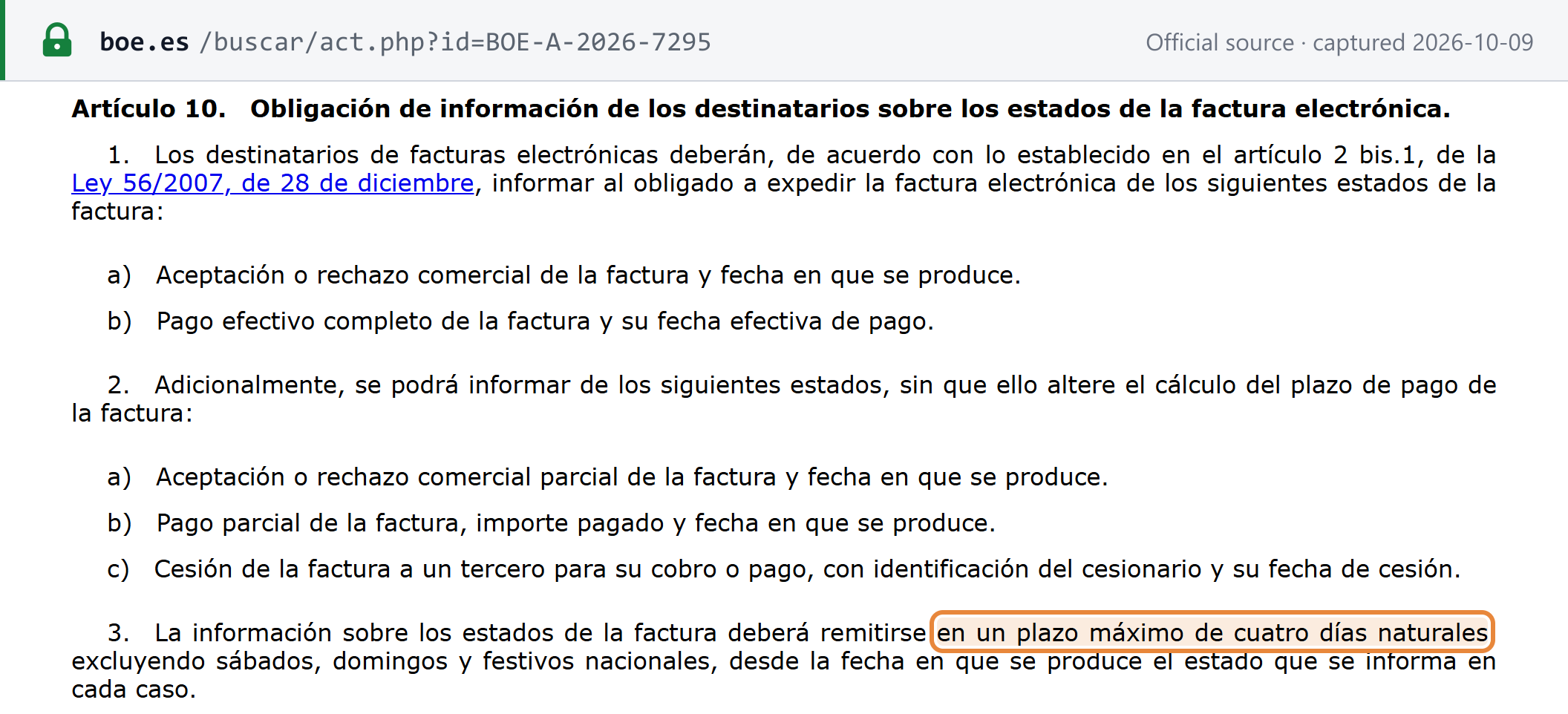
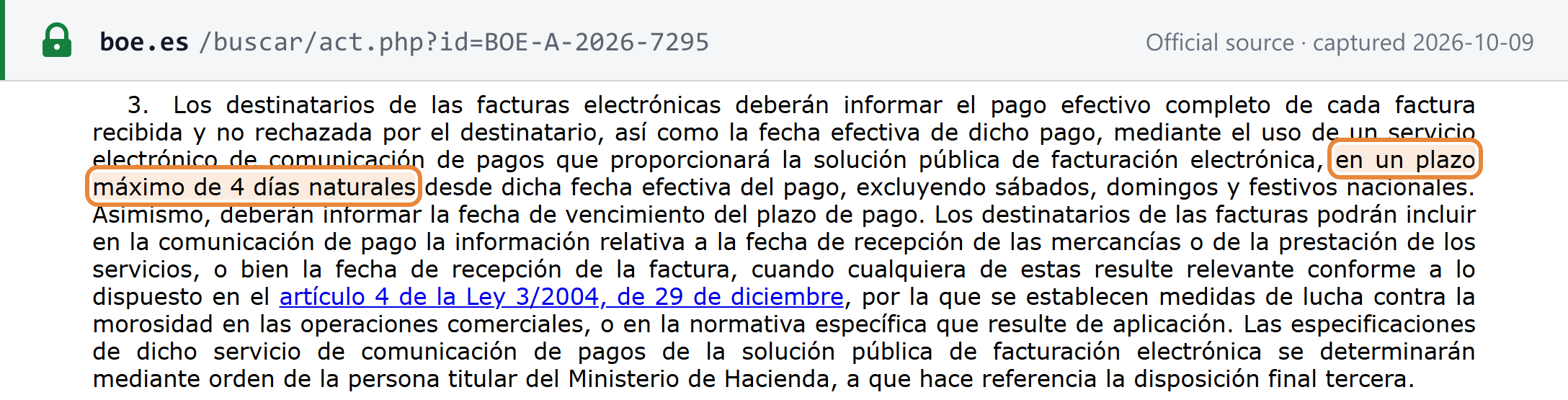
- Status and payment reporting. The recipient must report commercial acceptance or rejection (with its date) and full effective payment (with its date) within 4 calendar days, excluding Saturdays, Sundays and national holidays. Partial acceptance or rejection, partial payment and assignment of the invoice to a third party may be reported optionally. Payment is reported through the public solution's payment-communication service. The purpose is to monitor payment terms under the late-payment rules.
 Source snapshot captured 2026-10-09 — original
 Source snapshot captured 2026-10-09 — original
- Access. The public solution is accessed with an electronic certificate or, depending on the case, Cl@ve, including through a representative.
B2G: FACe
FACe is the general entry point for e-invoices to the General State Administration and to the regional governments, local entities and universities that have joined it. Some administrations run their own entry point; Catalonia, for example, uses e.FACT.
- Formats. FACe accepts signed Facturae 3.2, 3.2.1 and 3.2.2 and European-standard invoices in UBL or CII that follow FACe's EN 16931 rules (admitted since 2019). (FACe — invoice validator)
 Source snapshot captured 2026-10-09 — original
-
Signature. Under Law 25/2013 art. 5, e-invoices sent to public administrations must be structured and signed with an advanced electronic signature based on a recognised (qualified) certificate, or, for legal persons and entities without personality, an advanced electronic seal. Facturae invoices are signed in XAdES. FACe applies the signature requirement to Facturae only: invoices in the European format (UBL and CII) are not signed, and must carry the Buyer Reference. (BOE — Ley 25/2013; FACe — frequently asked questions for suppliers)
-
Addressing with DIR3 codes. Each invoice must carry the recipient's three DIR3 codes: Oficina Contable (accounting office), Órgano Gestor (managing body) and Unidad Tramitadora (processing unit). Some bodies also require the órgano proponente or a file number. The codes are in the FACe directory and in each administration's published lists.
-
Who rejects an invoice — two stages.
- At submission, FACe runs the validations an entry point may legally perform. An invoice that FACe registers, with an administrative registration number and a submission receipt, has passed them; FACe itself does not reject registered invoices. Check format, signature and DIR3 codes with the FACe validator before sending.
- After registration, only the recipient's accounting office or processing unit can reject the invoice, after their own checks, and the rejection must state the reason. FACe relays that reason; contact the unit for details.
-
Statuses and cancellation. The public statuses are Registrada (1200), Registrada en RCF (1300), Contabilizada la obligación reconocida (2400), Pagada (2500), Rechazada (2600) and Anulada (3100). A supplier cannot cancel an invoice itself: it can only request cancellation, through the portal or the web services, and the recipient's processing unit decides whether to cancel it. (BOE — Resolución de 10 de octubre de 2014; FACe — frequently asked questions for suppliers)
Reporting and billing-software layers
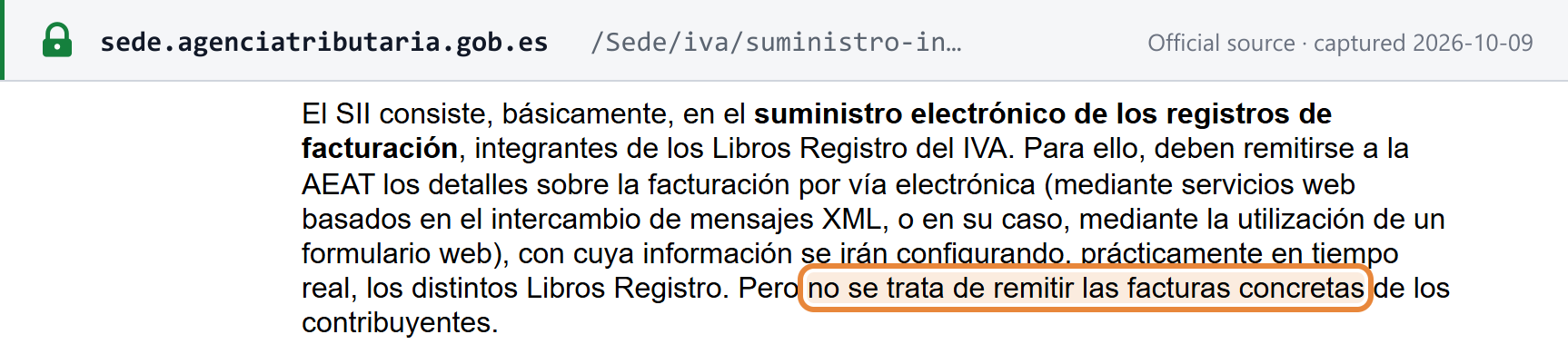
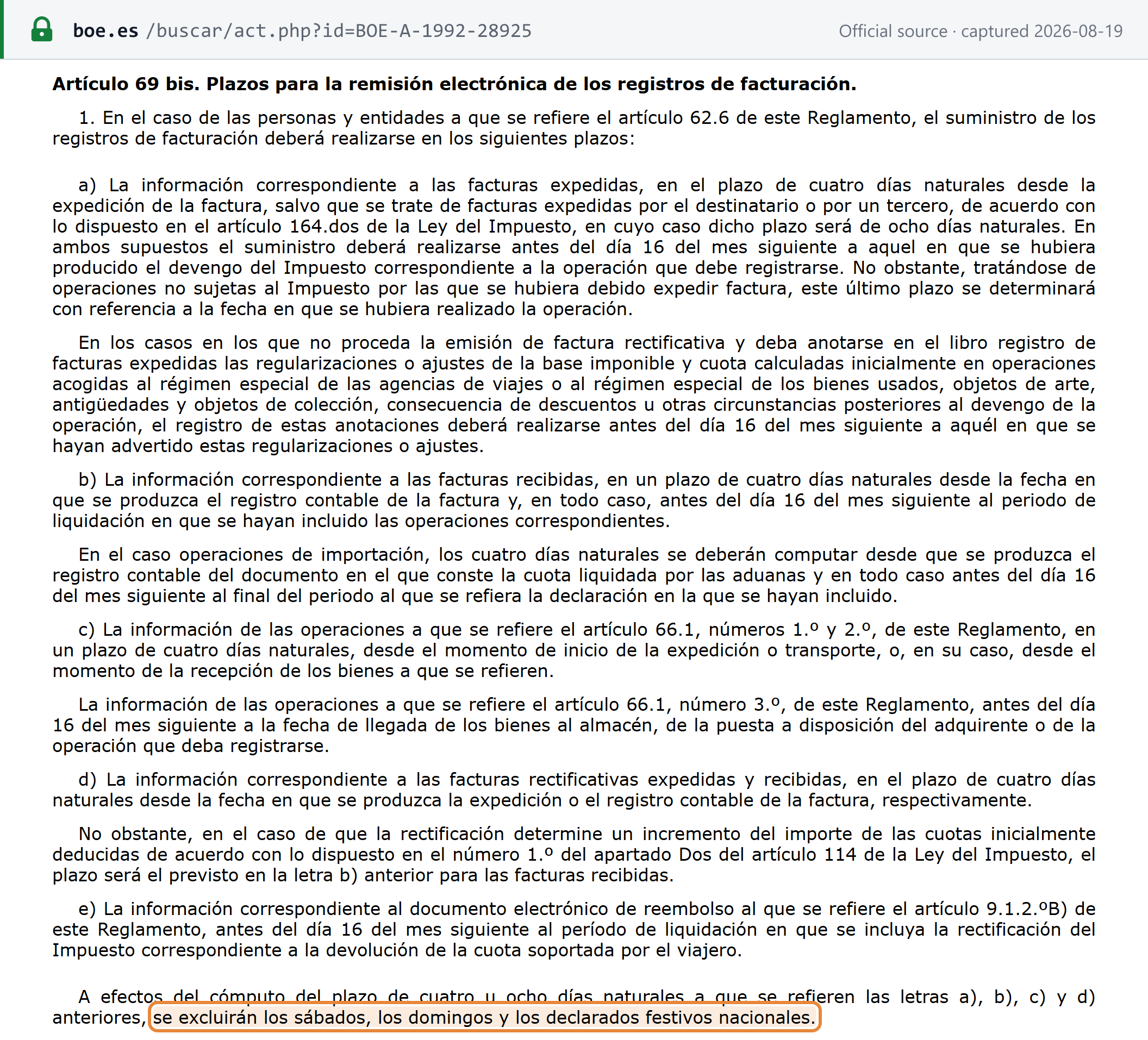
- SII (Suministro Inmediato de Información). Mandatory since 1 July 2017 for taxpayers who file VAT monthly, including large companies (turnover above EUR 6 million) and REDEME registrants. They send invoice-ledger records, not the invoices themselves, within 4 days, excluding Saturdays, Sundays and national holidays. (AEAT — SII)
- Verifactu. Invoicing software must meet the integrity, traceability and inalterability requirements of RD 1007/2023 from 1 January 2027 (corporate income tax payers) or 1 July 2027 (others). Sending the billing records to the AEAT ("VERI*FACTU" mode) is voluntary; the alternative is the non-verifiable mode with the full integrity requirements. SII taxpayers are outside Verifactu. A move to October 2028 has been announced but not enacted (see the timeline). (AEAT — Verifactu)
 Source snapshot captured 2026-10-09 — original
 Source snapshot captured 2026-08-19 — original
Onboarding: how to comply
B2B. Choose a private e-invoicing platform that interconnects with others, or plan to use the AEAT public solution (certificate or Cl@ve access). If you use a private platform, confirm that it sends the faithful UBL copy to the AEAT and supports status and payment reporting. We have not found an AEAT test environment or technical documentation for the public solution yet (checked 2026-10-08).
B2G (FACe).
- Web portal. Suppliers can submit through the portal without registering first, using an electronic certificate or Cl@ve PIN / Cl@ve Permanente.
- Web services. Automated submission from an ERP needs the supplier's certificate registered in the FACe integrators portal (integradores.face.gob.es).
- Status tracking is available through the portal or web services.
- Check the invoice with the FACe validator and confirm the recipient's DIR3 codes before submitting.
Frequently asked questions
When does B2B e-invoicing become mandatory in Spain?
Royal Decree 238/2026 applies 12 and 24 months after Orden HAC/1028/2026 entered into force on 6 October 2026. Businesses and professionals whose volume of operations exceeded EUR 8 million in the preceding calendar year must issue, send and receive structured e-invoices, and report invoice status and payment, from 6 October 2027. All other businesses and professionals must issue, send and receive e-invoices from 6 October 2028. Natural persons and entidades en régimen de atribución de rentas must report invoice status and payment from 6 October 2029. None of these dates has passed yet; until each applies, e-invoicing and status reporting are voluntary.
Sources: AEAT; BOE — Orden HAC/1028/2026.
What is the difference between FACe, FACeB2B and the AEAT public e-invoicing solution?
FACe is the general entry point for invoices to the General State Administration and the other administrations that have joined it (B2G, Law 25/2013). FACeB2B is the channel through which subcontractors on public contracts invoice the main contractor under Law 9/2017; it is not the platform for the B2B mandate. Mandatory B2B e-invoicing runs over interconnected private platforms or the free public e-invoicing solution of the Agencia Tributaria (AEAT), which works in UBL. Royal Decree 238/2026 gives those subcontractors up to 24 months to move to the new e-invoicing system, which will replace the current FACeB2B.
Sources: BOE — RD 238/2026; BOE — Ley 9/2017.
My Facturae invoice was rejected — by FACe or by the administration?
By the administration, if the invoice was registered. FACe does not reject an invoice it has registered: one with an administrative registration number and a submission receipt has passed the validations the entry point can legally perform. An invoice that fails those validations, for example one addressed to DIR3 units missing from FACe's directory, is not accepted and gets no registration number. Check the format, the signature on a Facturae invoice and the DIR3 codes (Oficina Contable, Órgano Gestor, Unidad Tramitadora) with the FACe validator before sending. A registered invoice that later shows as rejected was rejected by the recipient's accounting office or processing unit after their own checks, with a stated reason; FACe can only relay that reason, so contact the unit.
Source: FACe — frequently asked questions for suppliers.
Is Peppol BIS accepted for e-invoicing in Spain?
For B2B under Royal Decree 238/2026, invoices must follow the European standard EN 16931 in UBL, CII, EDIFACT or Facturae syntax, and Peppol BIS messages are valid insofar as they use UBL and conform to EN 16931. For B2G, FACe accepts signed Facturae 3.2, 3.2.1 and 3.2.2 and European-standard invoices in UBL or CII that follow FACe's EN 16931 rules; each invoice must still carry the recipient's three DIR3 codes.
Sources: BOE — RD 238/2026; FACe — invoice validator.
Has the Verifactu deadline moved to October 2028?
Not yet in law. Under Real Decreto-ley 15/2025, invoicing software must meet the Verifactu (RD 1007/2023) requirements from 1 January 2027 for corporate income tax payers and from 1 July 2027 for everyone else. On 5 October 2026 the Ministerio de Hacienda announced that the government plans to move these obligations to October 2028, to align them with B2B e-invoicing for smaller businesses. Until that change is published in the BOE, the 2027 dates remain the legal dates.
Sources: BOE — Real Decreto-ley 15/2025; Ministerio de Hacienda press note.
Must invoices of EUR 5,000 or less to a Spanish public administration be electronic?
Law 25/2013 makes e-invoicing mandatory for the listed supplier types, such as sociedades anónimas and limitadas, regardless of amount, but lets each administration exclude invoices of up to EUR 5,000 by regulation. The General State Administration did so for presentation in FACe in Orden HAP/1074/2014; any supplier may still choose to send such invoices electronically. Other administrations set their own rules, so check the recipient's.
Sources: BOE — Ley 25/2013; BOE — Orden HAP/1074/2014.
Recent changes
- 2026-04-20 — Real Decreto 238/2026 (BOE, 31 March 2026) entered into force, implementing mandatory B2B e-invoicing under Ley 18/2022; it applies 12 and 24 months after the ministerial order on the AEAT public solution enters into force. (Boletín Oficial del Estado) — see event
- 2025-12-04 — Real Decreto-ley 15/2025 entered into force, setting the Verifactu deadlines at 1 January 2027 (corporate income tax payers) and 1 July 2027 (others). A further move to October 2028 was announced on 5 October 2026 but has not been enacted. (Boletín Oficial del Estado) — see event
Related resources
- Spain VAT guide
- How to verify a Spanish NIF · Validate a Spanish NIF
- E-invoicing status and networks worldwide — Spain row in global context
- CTC e-invoicing models: clearance, reporting and interchange
- ViDA: VAT in the Digital Age
- Peppol explained
- E-invoicing in Portugal (eSPap) · E-invoicing in France (Chorus Pro)
- Spain tax-change chronology — every tracked Spanish change, dated and sourced
Important websites
- FACe — general entry point for B2G e-invoices
- FACe supplier portal — submission, tracking and the invoice validator
- FACe integrators portal — certificate registration for web-services submission
- Facturae — the Facturae format and signature policy
- AEAT — public e-invoicing solution (news, 7 October 2026)
- AEAT — Verifactu
- AEAT — SII