An Explainer Guide to E-invoicing in Norway
| Country | Norway |
| Status - B2G | Mandatory since 2 April 2019 for every contracting authority (FOR-2019-04-01-444) |
| Status - B2B | Issuing mandatory between bookkeeping-liable parties from 1 January 2027 — until 2030, in practice only toward buyers registered in ELMA/Peppol; receiving mandatory from 1 January 2030 (Finance Ministry transitional regulation of 25 September 2026) |
| Status - B2C | NA |
| Formats - B2G | EHF Billing 3.0 or later, Peppol BIS Billing 3.0 or later |
| Formats - B2B | From 1 January 2027: EHF Fakturering, Peppol BIS Billing, EHF Selvfakturering, Peppol BIS Self-Billing, version 3.0 or later; other structured formats (e.g. EDIFACT, E2B) by agreement until 31 December 2029. PDF is not an e-invoice |
| Model | Interchange between the parties (in practice over Peppol/ELMA) with post-audit; no clearance or e-reporting |
| Authority | Norwegian Agency for Public and Financial Management (DFØ) — Peppol Authority |
| Network name | Peppol |
| Legislation - B2G | FOR-2019-04-01-444 (e-invoicing in public procurement) |
| Legislation - B2B | Bookkeeping Act (LOV-2004-11-19-73) § 10, as amended by LOV-2026-06-19-39 (commencement FOR-2026-06-19-1154); transitional regulation FOR-2026-09-25-1913 of 25 September 2026; Bookkeeping Regulation as amended by FOR-2026-09-29-1933 |
Overview
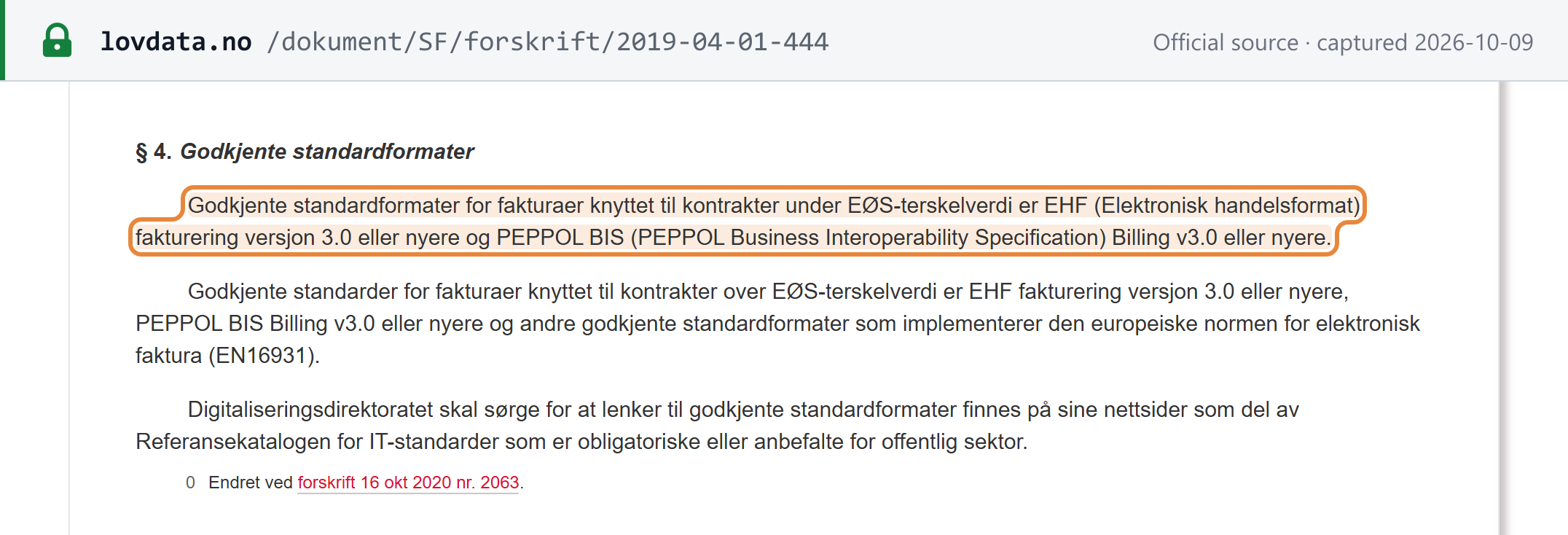
B2G. Under the Regulation on electronic invoicing in public procurement (FOR-2019-04-01-444), in force on 2 April 2019, every contracting authority under the Public Procurement Act — not only central government — must require e-invoices in an approved standard format, must be able to receive them through the Peppol network, and may withhold payment until a compliant e-invoice arrives. The approved formats below the EEA thresholds are EHF Billing 3.0 or later and Peppol BIS Billing 3.0 or later; DFØ says foreign suppliers use Peppol BIS Billing 3.0. [4] [5]
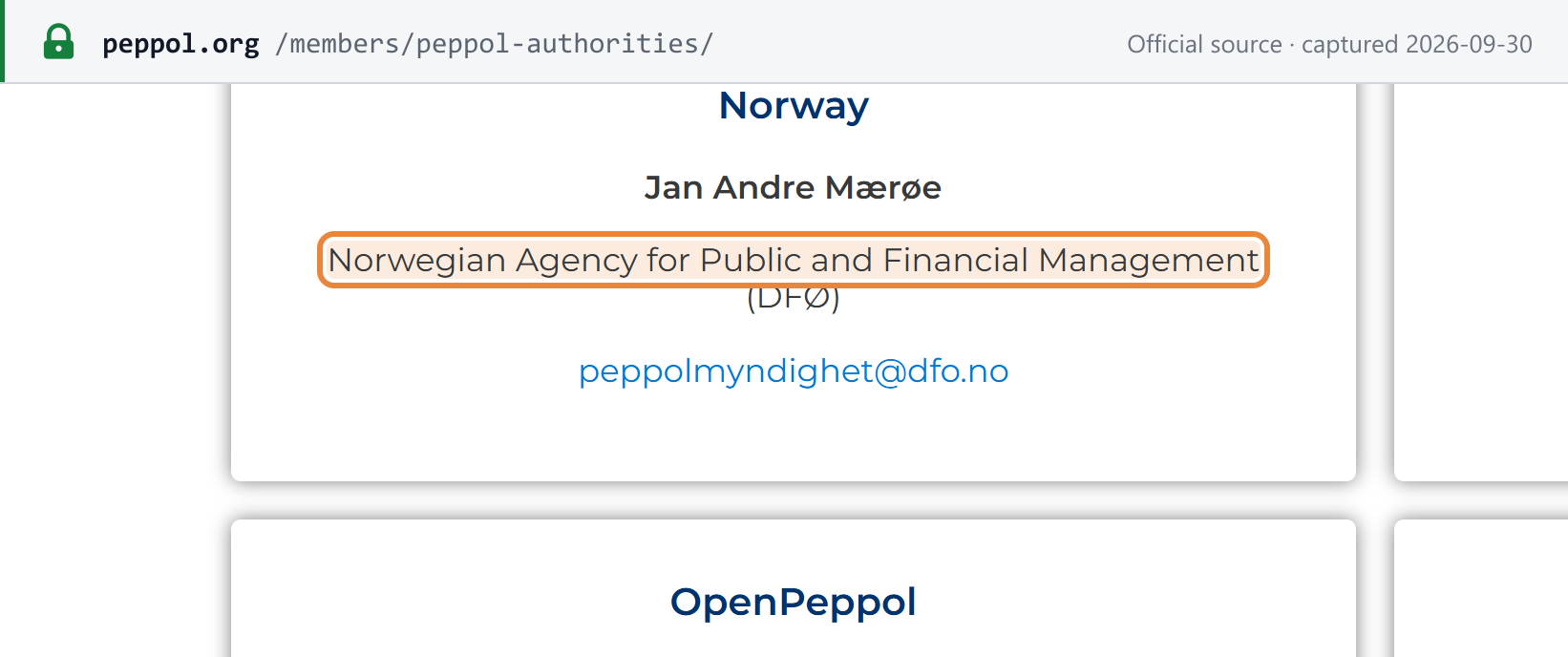
Network and authority. The network is Peppol; Norwegian receivers are listed in the ELMA receiver register, where a business's access point registers it. Norway's Peppol Authority is the Norwegian Agency for Public and Financial Management (DFØ). [1] [5]
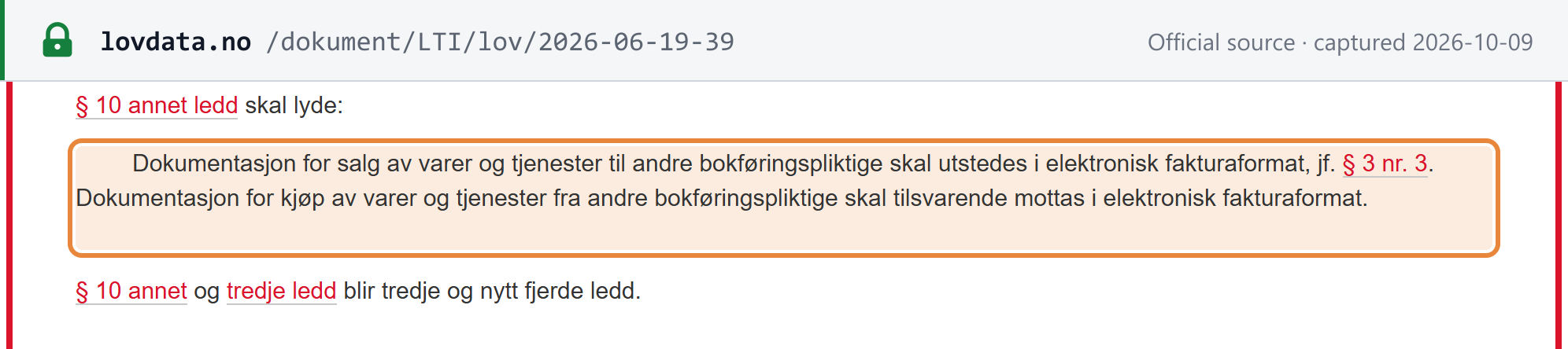
B2B. Lov 19. juni 2026 nr. 39 amended section 10 of the Bookkeeping Act so that sales documentation to other bookkeeping-liable parties is issued, and purchase documentation from them received, in electronic invoice format. The duties start on different dates: issuing from 1 January 2027, receiving from 1 January 2030. The timeline below sets out each step. For VAT, registration and invoice-content rules, see the Norway VAT (MVA) guide. [2] [7]
Model. Norway's B2B rule is a format requirement between the parties: invoices are exchanged directly between the parties, in practice over Peppol, with no clearance and no e-reporting. Neither the amending Act, the commencement resolution nor the September 2026 regulations route invoices to Skatteetaten, validate them centrally or require them to be reported (checked 2026-10-08). Skatteetaten receives totals through the VAT return, and transaction-level data only on request during a control, in SAF-T Financial format. See Lookuptax's explainers on CTC e-invoicing models and SAF-T reporting. [12]
B2B timeline and obligations
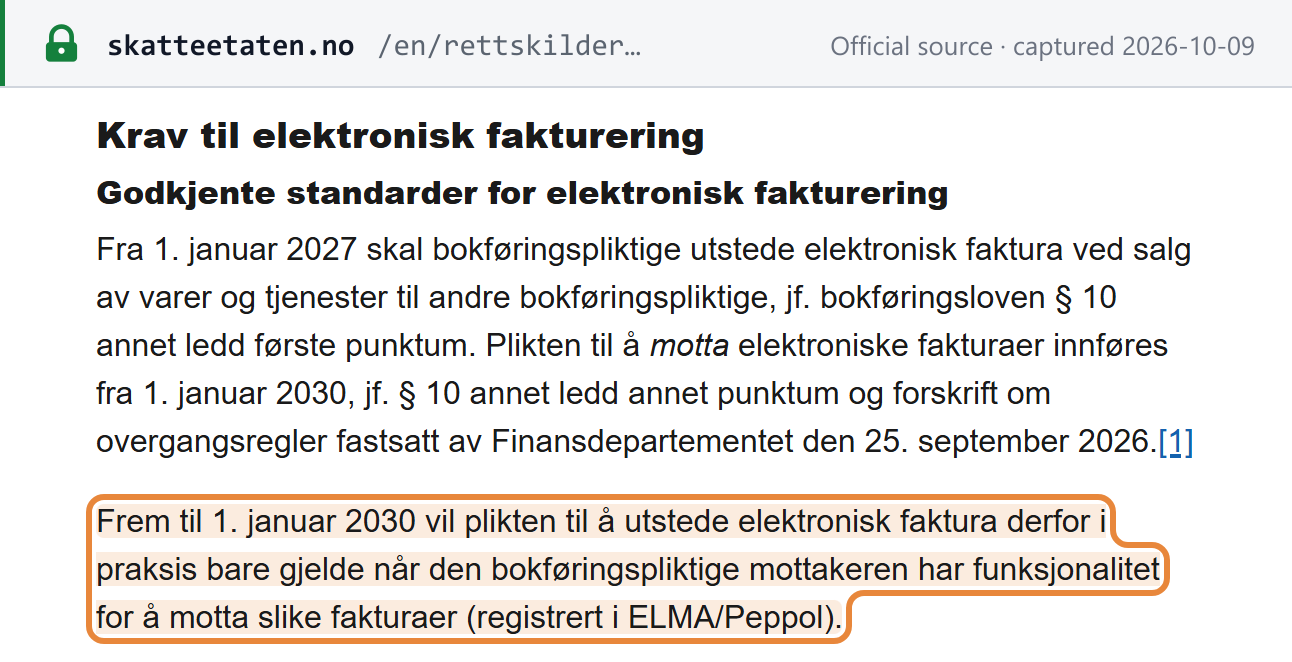
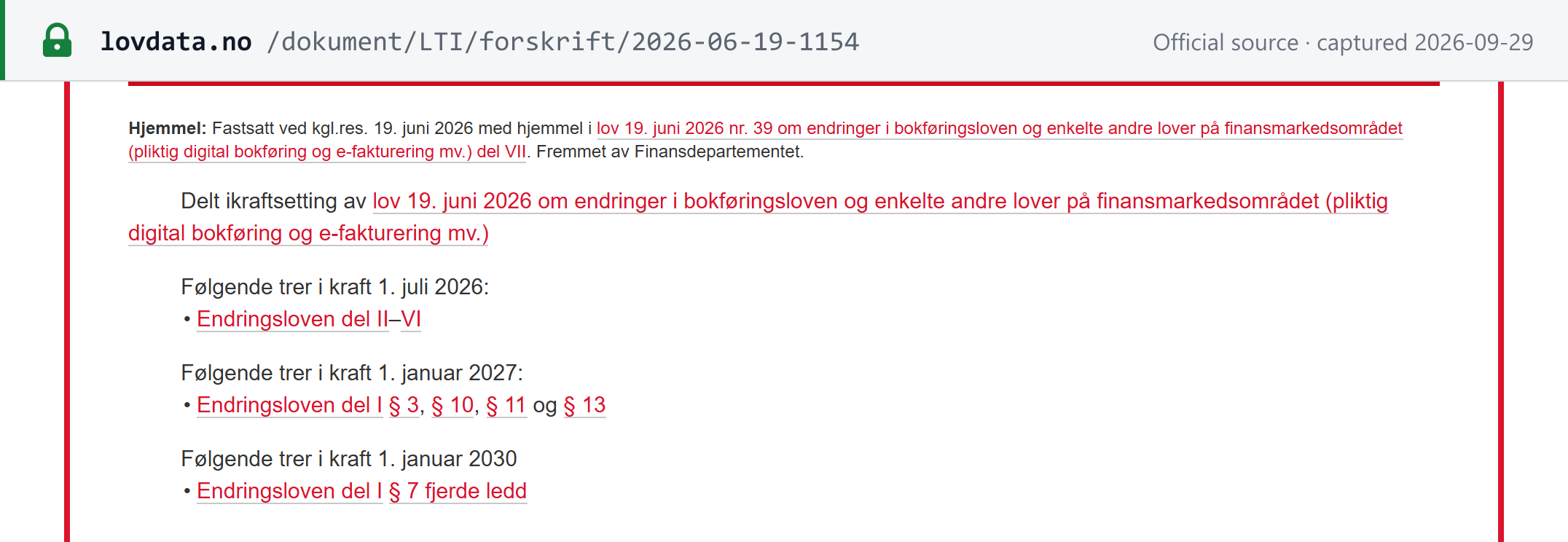
- 1 January 2027 — issuing. Royal resolution FOR-2026-06-19-1154 brings section 10 of the amended Bookkeeping Act — with the new e-invoice definition in section 3 and the rule in section 13 that e-invoices are kept in their original format — into force on this date. A bookkeeping-liable seller must issue e-invoices to bookkeeping-liable buyers. Because buyers have no duty to receive until 2030, Skatteetaten says that until 1 January 2030 the issuing duty applies in practice only where the buyer can receive e-invoices, meaning it is registered in ELMA/Peppol. [3] [9]
- Approved formats from 1 January 2027. Section 5-2-9 second paragraph of the Bookkeeping Regulation, as amended by FOR-2026-09-29-1933 (adopted 29 September 2026), lists the approved standards for an e-invoice: EHF Fakturering, Peppol BIS Billing, EHF Selvfakturering (self-billing) and Peppol BIS Self-Billing, all in version 3.0 or later. [8]

- 1 January 2027 to 31 December 2029 — other formats by agreement. In this period the seller and buyer may agree to use another electronic invoice format, provided it is still structured and suitable for automated processing, as the Act's definition requires. Skatteetaten gives EDIFACT and E2B as examples. A PDF is not an e-invoice and cannot be used where the buyer can receive one. [8] [9]

- 1 January 2028 — buyer's organisation number. Invoices to bookkeeping-liable buyers must carry the buyer's organisation number, followed by "MVA" where the buyer is VAT-registered (section 5-1-2 first paragraph). From the same date the sales document must always be sent to a bookkeeping-liable buyer (section 5-2-1 fourth paragraph). The organisation number is also the identifier Norwegian Peppol addressing uses (scheme 0192); see the Norway tax ID guide. [8]
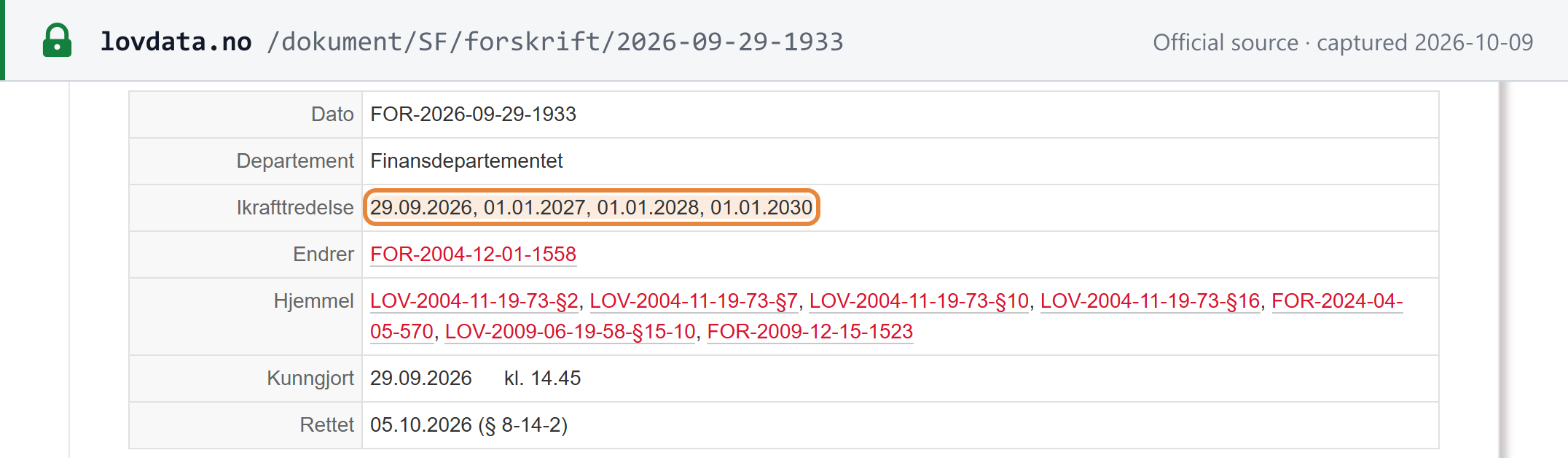
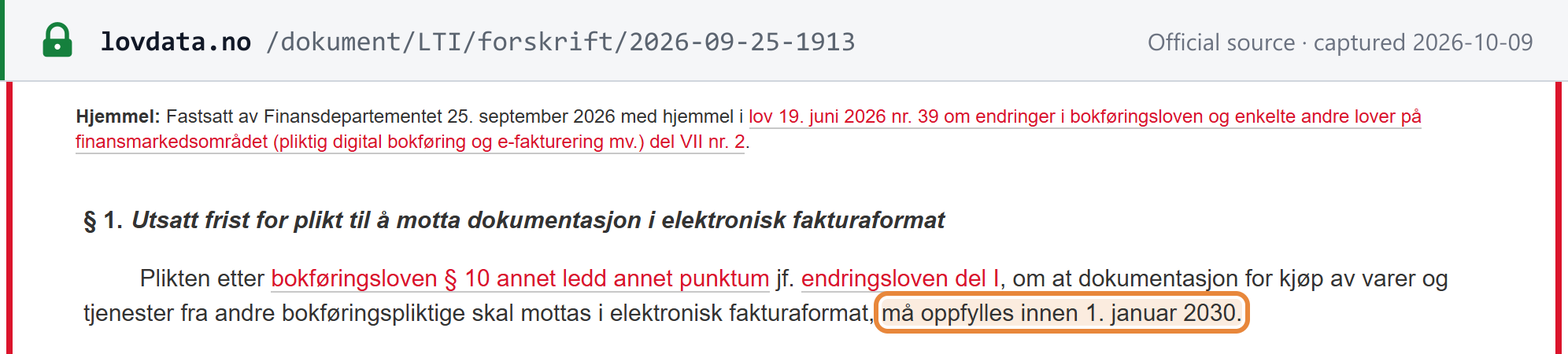
- 1 January 2030 — receiving, and electronic bookkeeping. A transitional regulation (FOR-2026-09-25-1913) adopted by the Finance Ministry (Finansdepartementet) on 25 September 2026 defers the duty to receive purchase documentation in e-invoice format to 1 January 2030; it was originally due on 1 January 2027. From the same date the books must be kept in an electronic accounting system (Bookkeeping Act section 7 fourth paragraph). The regulations published so far set no technical specification for that system (checked 2026-10-08). [7] [3] [9]
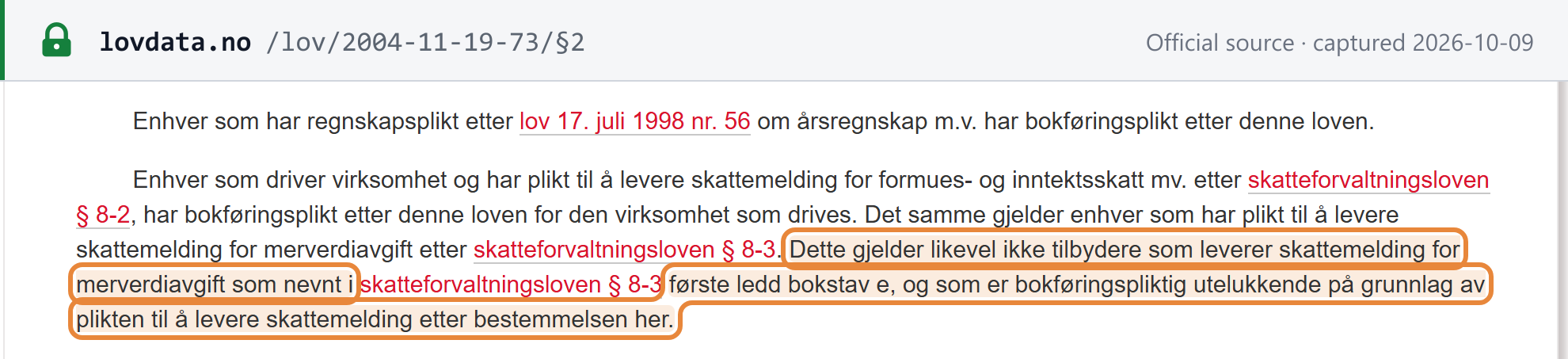
Who is covered. The duty applies only between bookkeeping-liable parties, so invoices to private individuals are out of scope. Bookkeeping liability covers everyone who must file a Norwegian VAT return, so a foreign business in the ordinary VAT Register is in scope; sellers whose only Norwegian filing is the VOEC return are excluded (Bookkeeping Act section 2). [2] [13]
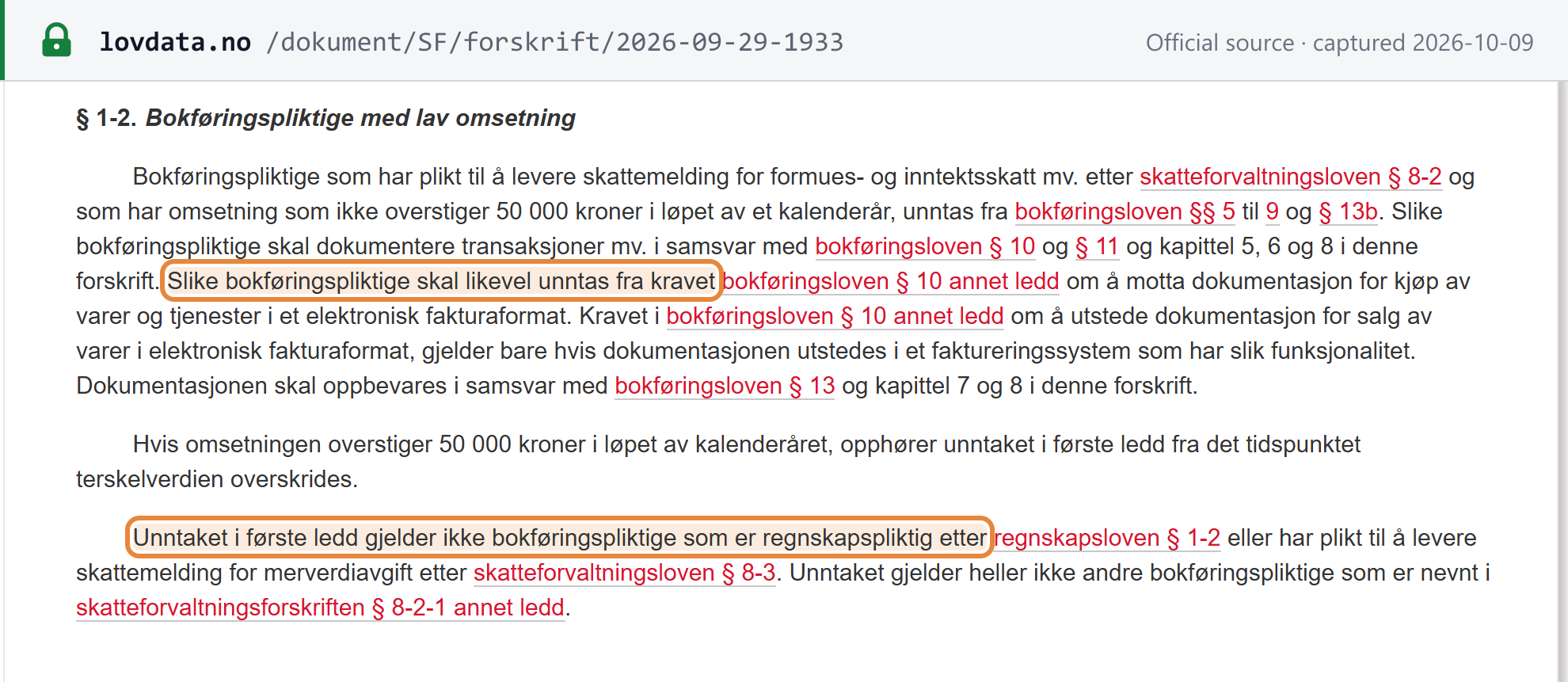
The NOK 50,000 exemption is narrow. New section 1-2 of the Bookkeeping Regulation exempts from the duty to receive e-invoices a bookkeeping-liable person whose turnover does not exceed NOK 50,000 in a calendar year. The exemption ends as soon as turnover passes NOK 50,000 in the year, and it does not apply to anyone with an accounting duty or anyone who must file a VAT return — so every VAT-registered business is outside it, whatever its turnover. [8]
Penalties. Neither the amending Act nor the September 2026 regulations set a separate penalty for failing to issue or accept an e-invoice (checked 2026-10-08). For B2G, the contracting authority may withhold payment until a compliant e-invoice arrives. [4]
Frequently Asked Questions
EHF vs Peppol BIS — which format should I use for Norwegian public entities?
EHF 3.0 and Peppol BIS Billing 3.0 are essentially the same format — EHF 3.0 adopted the Peppol BIS standard (EN 16931). Use EHF Billing 3.0 or Peppol BIS Billing 3.0 via a Peppol Access Point when invoicing any Norwegian contracting authority; FOR-2019-04-01-444 approves version 3.0 or later. The Norwegian Peppol Authority is DFØ, the Norwegian Agency for Public and Financial Management. [1] [4]
My invoice to a Norwegian government buyer was rejected — what are the most common errors?
Common Peppol BIS rejection issues for Norwegian public entities: (1) Missing organization number — 9-digit organisation number from the Central Coordinating Register for Legal Entities (Enhetsregisteret; Peppol scheme 0192) in AccountingSupplierParty; (2) VAT number format — Norwegian VAT = org number + "MVA" suffix (e.g. 123456785MVA on paper; with the ISO prefix, NO123456785MVA, in a Peppol invoice under EN 16931 rule BR-CO-09); (3) Missing payment due date; (4) Missing or invalid tax category code — Peppol BIS Billing 3.0 allows only the UNCL5305 codes AE, B, E, G, K, L, M, O, S and Z. Norway's 25%, 15% and 12% rates all use S (standard rated) with the rate stated; Z is zero-rated and E exempt. There is no separate code for a reduced rate. Validate against a Peppol validator before submitting. [6]
Is B2B e-invoicing in Norway going to become mandatory?
Yes — it has been enacted, in stages. Lov 19. juni 2026 nr. 39 amended section 10 of the Bookkeeping Act so that sales documentation to other bookkeeping-liable parties must be issued, and purchase documentation from them received, in electronic invoice format; royal resolution FOR-2026-06-19-1154 brings section 10 into force on 1 January 2027. The duty to issue starts on that date, but a Finance Ministry transitional regulation of 25 September 2026 defers the duty to receive e-invoices to 1 January 2030. Until 2030 the issuing duty therefore applies in practice only where the buyer can receive e-invoices, meaning it is registered in ELMA/Peppol. From 1 January 2027 the approved formats are EHF Fakturering, Peppol BIS Billing, EHF Selvfakturering and Peppol BIS Self-Billing, version 3.0 or later (bookkeeping regulation section 5-2-9, as amended by FOR-2026-09-29-1933). From 1 January 2027 to 31 December 2029 the parties may agree on another structured electronic format, such as EDIFACT or E2B. A PDF is not an e-invoice and cannot be used where the buyer can receive one. From 1 January 2030 the books must also be kept in an electronic accounting system. [2] [3] [7] [8] [9]
Recent changes
- 2026-09-29 — FOR-2026-09-29-1933 amended the Bookkeeping Regulation: from 1 January 2027 the approved e-invoice standards are EHF Fakturering, Peppol BIS Billing, EHF Selvfakturering and Peppol BIS Self-Billing, version 3.0 or later (section 5-2-9), with other structured formats allowed by agreement until 31 December 2029; a new section 1-2 exempts persons with turnover up to NOK 50,000 a year from the duty to receive e-invoices, but not anyone with an accounting duty or a VAT-return duty; from 1 January 2028 invoices to bookkeeping-liable buyers must carry the buyer's organisation number. (Lovdata)
- 2026-09-25 — A Finance Ministry transitional regulation (FOR-2026-09-25-1913), in force immediately, defers the duty to receive e-invoices from 1 January 2027 to 1 January 2030; the duty to issue still starts on 1 January 2027, in practice only toward buyers registered in ELMA/Peppol until 2030. (Lovdata; Skatteetaten)
- 2026-06-19 — Lov 19. juni 2026 nr. 39 amended the Bookkeeping Act; royal resolution FOR-2026-06-19-1154 brings sections 3, 10, 11 and 13 of the amending Act into force on 1 January 2027 and the electronic-accounting-system duty in section 7 fourth paragraph on 1 January 2030. The Act names no format and leaves format requirements, exemptions and transitional rules to the Ministry; the 25 and 29 September 2026 regulations above set them. (Lovdata) — see event
For more details on the Peppol network, see our Peppol Guide. For Norwegian VAT rates, registration and invoice content, see the Norway VAT (MVA) guide; to check a Norwegian VAT number, use the Norway MVA number validator. For the dated history of Norwegian tax changes, see Norway tax changes on Lookuptax.