Oman VAT guidelines
| FACTSHEET | |
|---|---|
| Country code | OM |
| Tax name | Value Added Tax (VAT) |
| Tax Authority | Tax Authority (جهاز الضرائب) |
Overview
Oman levies Value Added Tax (VAT) (Arabic: ضريبة القيمة المضافة) under the VAT Law promulgated by Royal Decree No. 121/2020. The Law is administered by the Tax Authority (جهاز الضرائب) — Article 1 defines "Authority" as "The Tax Authority" — while the Directorate General of Customs collects VAT on imported goods (Art. 84). [1]
Start date. VAT took effect on 16 April 2021, 180 days after the Law's publication in the Official Gazette. The Tax Authority's registration-dates decision gives the first registration cohort the same effective date. [2] [3]
Currency. All values in this guide are in Omani rials (OMR).
Tax year and tax periods. The tax year is the calendar year: "(12) Twelve months starting from the first of January and ending on the end of December of every Gregorian year" (Law Art. 1). Returns are filed for quarterly tax periods — see Filing and payment. [1]
Layering. VAT is a national tax. The VAT Law provides no regional or municipal rate (checked 2026-09-23). [1]
A note on sourcing: VAT Law quotes on this page come from the Tax Authority's English translation, which states that the Arabic text prevails. The Executive Regulations (issued by Decision No. 53/2021, and amended by Decisions No. 456/2022, No. 521/2023 (Official Gazette issue 1517, 25 October 2023), No. 81/2025 (Official Gazette issue 1594, 30 April 2025) and No. 189/2026) are published in Arabic only; where this guide quotes them, it gives the Arabic with an English gloss. [4]
Registration
Who should register
A person with a place of residence in Oman that carries on an activity must register when its supplies cross the mandatory registration threshold, tested two ways (VAT Law Art. 55): [1]
- Backward-looking — "the total value of supplies achieved at the end of any month in addition to the eleven months immediately preceding it, exceeds the Mandatory Registration Threshold".
- Forward-looking — "the total value of supplies, which is expected to be achieved at the end of any month in addition to the eleven months immediately following it, exceeds the Mandatory Registration Threshold".
The supplies counted are taxable supplies other than capital assets, reverse-charged supplies received, and intra-GCC supplies (Law Art. 56). A resident must apply within 30 days of either test being met, and mandatory registration takes effect on the first day of the following month (Executive Regulations Art. 110). [1] [4]
Registration threshold
| Trigger | Threshold | Measurement period | Notes |
|---|---|---|---|
| Mandatory registration (residents) | OMR 38,500 | Any month plus the preceding 11 months, or plus the expected next 11 months | Apply within 30 days; registered from the 1st of the following month (Regs Art. 110). [4] [5] |
| Voluntary registration | OMR 19,250 | Supplies or expenses in any month plus the preceding 11 months, or expected over the current month plus the following 11 months | See Voluntary registration. [5] |
| Non-residents outside the GCC | None | — | Register from the date the person becomes obliged to pay the tax. A non-resident resident in another GCC implementing state applies the Art. 55 test instead (Regs Art. 111(1)). [6] |
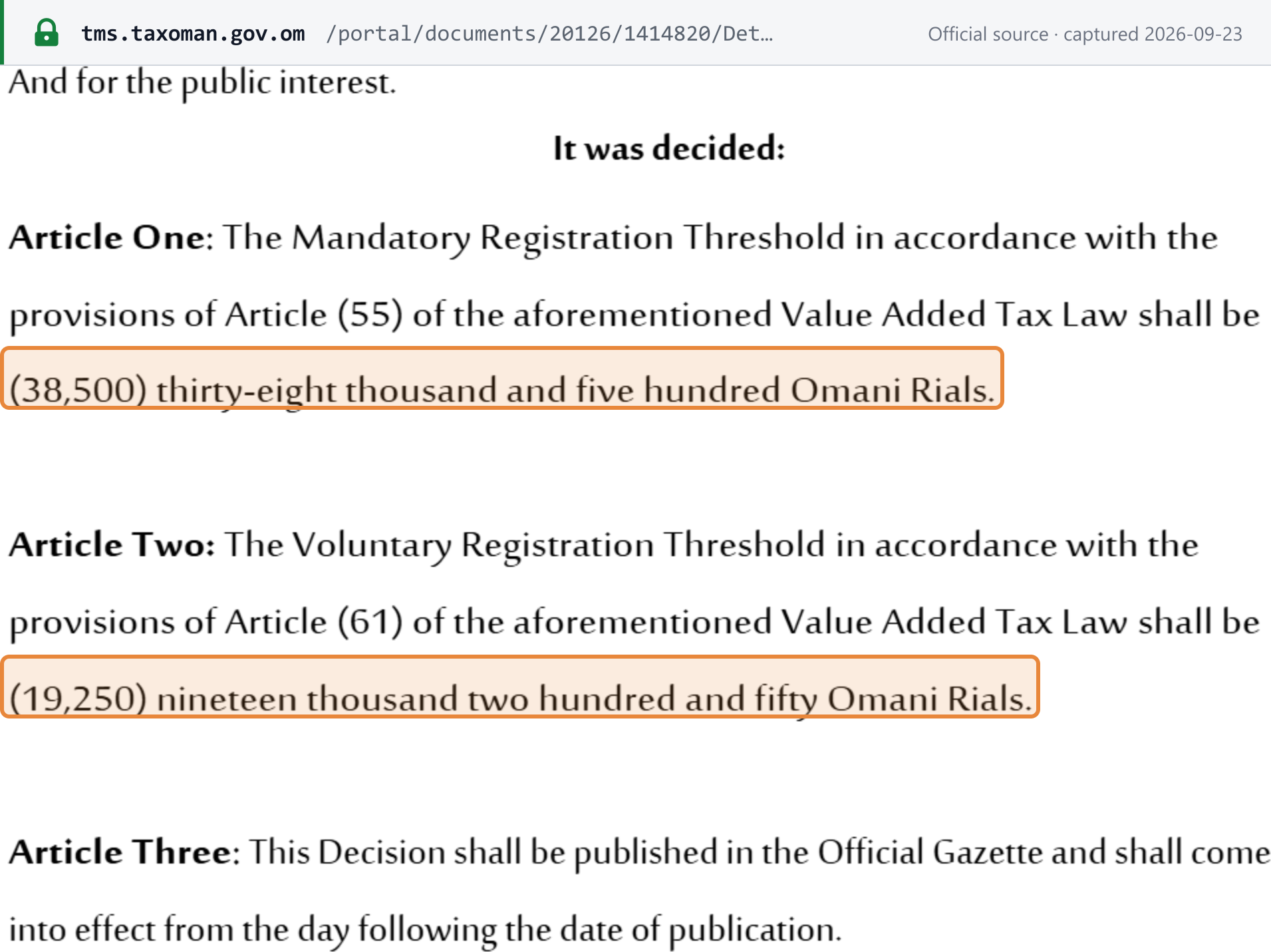
The thresholds decision states: "The Mandatory Registration Threshold … shall be (38,500) thirty-eight thousand and five hundred Omani Rials. … The Voluntary Registration Threshold … shall be (19,250) nineteen thousand two hundred and fifty Omani Rials." (Checked 2026-09-23.) [5]
Non-resident registration
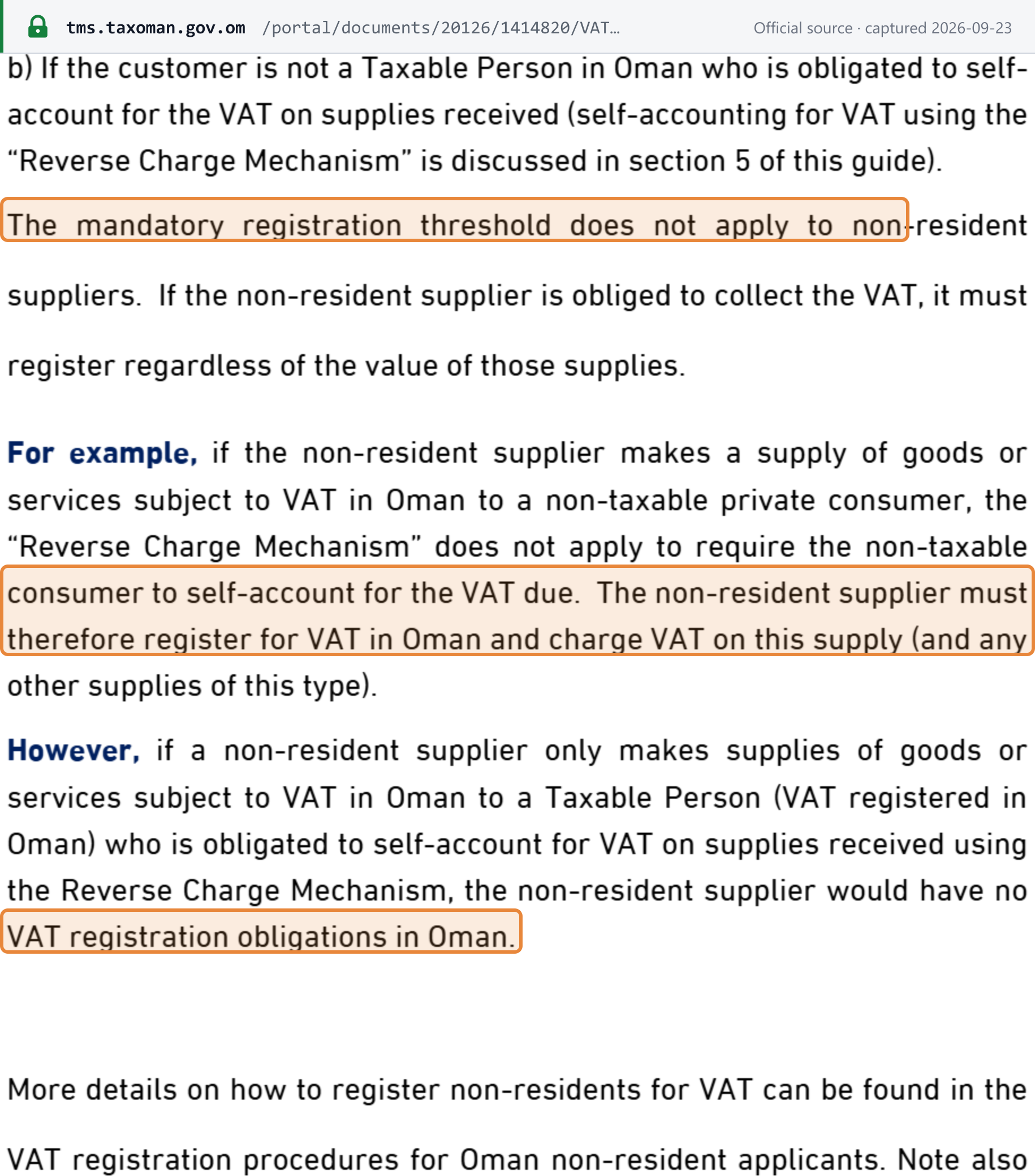
There is no threshold for non-residents established outside the GCC. VAT Law Art. 57: "Every person who has no Place of Residence in the Sultanate, shall register with the Authority, and that is from the date on which he is obliged to pay the Tax". The Tax Authority's e-commerce guide (§3.1) repeats the point: "The mandatory registration threshold does not apply to non-resident suppliers. If the non-resident supplier is obliged to collect the VAT, it must register regardless of the value of those supplies." [1] [6]
A non-resident that is resident in another GCC state implementing VAT is treated differently: it registers within 30 days of meeting the Art. 55 conditions, the same test residents use (Executive Regulations Art. 111(1)). [4]
Under the Tax Authority's non-resident registration procedures (December 2021), a non-resident established outside the GCC: [7]
- applies "twenty (20) days prior to the beginning of the month in which the first supply takes place";
- appoints a Responsible Person or tax representative resident in Oman;
- otherwise provides a guarantee or undertaking of "a value not less than 5% of taxable annual supplies and valid for one year", or a cash deposit of at least 5% of a tax period's supplies — "or OMR 100,000 if taxable supplies cannot be estimated".
Non-residents apply by submitting a registration form by email. [7]
Tax identification number
A registered person receives a VAT tax identification number (VATIN) and "must include the tax identification number on all communications, invoices, documents" (VAT Law Art. 64). The Tax Authority runs a public VATIN lookup. [1]
The Tax Authority does not publish the VATIN's format or check-digit rule on any page reviewed for this guide (checked 2026-09-23), so this guide does not state one. For the identifiers used in Oman, see Lookuptax's Oman TIN number guide. To check a counterparty's number, see how to verify a VATIN in Oman and how to verify an Oman tax card, or use Lookuptax's Oman VAT number validator.
How to register
Residents register through the Tax Authority's e-portal. Executive Regulations Art. 108 provides for registration «من خلال البوابة الإلكترونية للجهاز» ("through the Authority's electronic portal"). Non-residents use the emailed form described above. The Tax Authority decides an application within 15 days of receiving complete data and documents; otherwise the application is deemed rejected (Regs Art. 122: «خلال مدة لا تتجاوز (15) خمسة عشر يوما … وإلا اعتبر الطلب مرفوضا»). [4]
Voluntary registration
Available on either of two tests against the OMR 19,250 voluntary threshold (VAT Law Art. 61). Art. 61(1) looks back: "the total value of supplies achieved or expenses spent at the end of any month in addition to the eleven months immediately preceding it, exceeds the Voluntary Registration Threshold". Art. 61(2) looks forward: the supplies or expenses expected over the current month plus the following eleven months exceed the threshold. A person that makes only zero-rated supplies may instead apply to be exempted from registration (Art. 60). [1]
Deregistration
- Mandatory. Apply within 30 days of permanently ceasing the activity, or within 2 months of the end of the tax year in which the registration conditions stopped being met (Executive Regulations Art. 136).
- Optional. Available when supplies fall below OMR 38,500 but remain above OMR 19,250, provided the business has been registered for more than 12 months (VAT Law Art. 66; Regulations Art. 138(3)).
- Procedure. The Tax Authority decides within 30 days (Art. 140). Records must be kept for 10 years after deregistration (Art. 142). Failing to apply for deregistration when required carries a fine of OMR 1,000–10,000 (Art. 203).
- Final return. No final-return provision was located in Regulations Arts 136–142 (checked 2026-09-23).
Group registration
Available (VAT Law Art. 58). Under Executive Regulations Art. 125, every member must be resident in Oman, a legal person, and registered, and the members must be under common control — more than 50% of the voting rights or capital. A person cannot belong to two groups, and persons registered in a Special Zone are excluded. Members are jointly and severally liable for the group's tax. [1] [4]
Rates
| Rate | Applies to | Effective |
|---|---|---|
| 5% (standard) | Import and supply of taxable goods and services (VAT Law Art. 36) | Since 16 April 2021 [2] |
| 0% (zero-rated) | Listed food items (Decision No. 225/2026); human medicines and medical equipment (Decision No. 224/2026); veterinary medicines and equipment (Decision No. 223/2026); investment gold, silver and platinum; international and intra-GCC transport; means of transport; rescue aircraft and boats; oil, oil derivatives and natural gas (Art. 51); exports (Art. 52); Special Zone supplies (Art. 54) | Since 16 April 2021 [2] |
| Exempt (no VAT, no input-tax recovery) | See Exemptions | — |
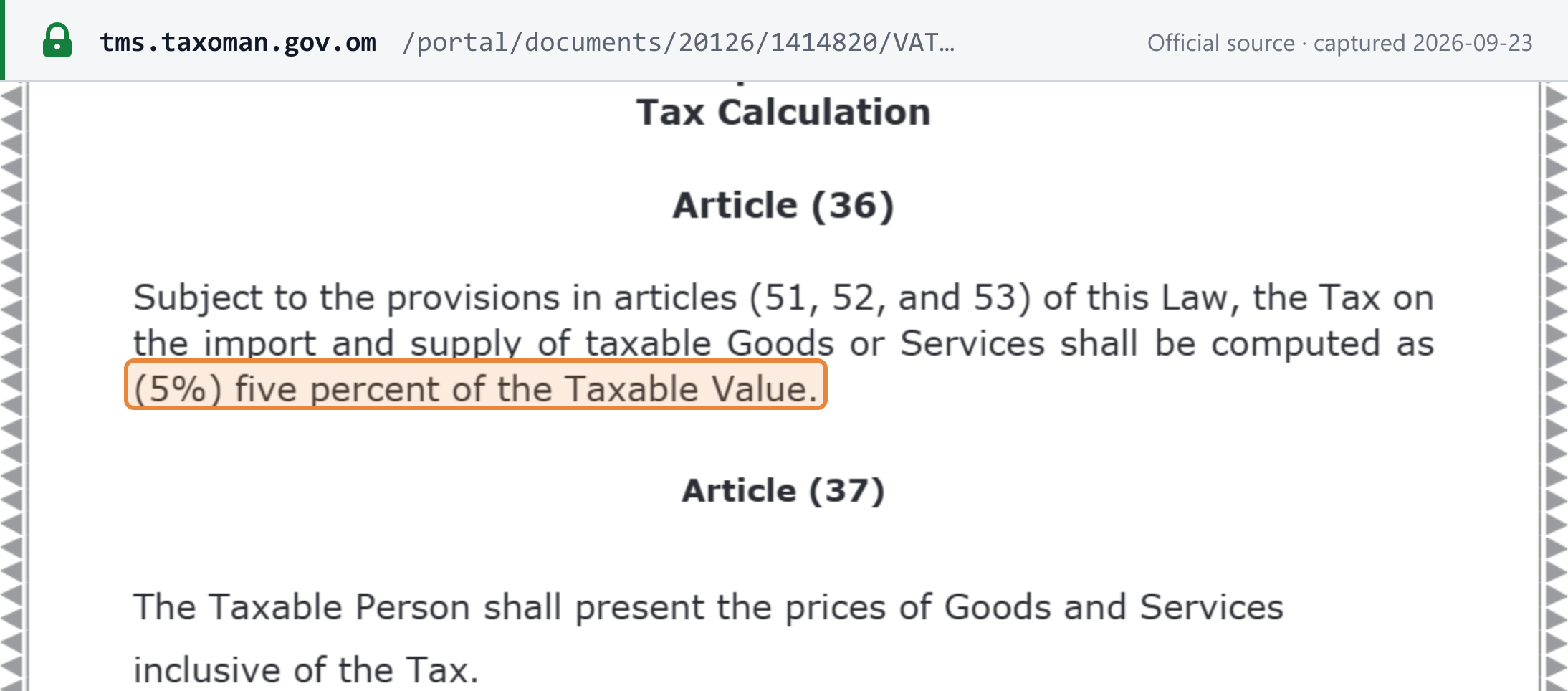
VAT Law Art. 36: "the Tax on the import and supply of taxable Goods or Services shall be computed as (5%) five percent of the Taxable Value." [1]
Zero-rated goods lists (from 1 October 2026). The Tax Authority issued Decisions No. 223/2026, 224/2026 and 225/2026 on 22 September 2026, published in Official Gazette Issue 1667 on 27 September 2026, specifying the goods and supplies subject to VAT at 0%. All three apply from 1 October 2026. [9]
- Basic food items — Decision No. 225/2026, replacing Decision No. 65/2021: live cattle, sheep, goats, camels and poultry; fresh, chilled and frozen meat; fish and seafood; dairy; eggs; fruit; vegetables; legumes; coffee; tea and spices. [10]
- Human medicines and medical equipment — Decision No. 224/2026, replacing Decision No. 59/2021: those cleared by the Ministry of Health. [11]
- Veterinary medicines and equipment — Decision No. 223/2026: those cleared by the Ministry of Agriculture, Fisheries and Water Resources. [12]
Reduced rates. Not applicable — the VAT Law provides only the 5% and 0% rates (checked 2026-09-23). [1]
Announced future rates. None. The Tax Authority's news page, which runs to 21 September 2026, announces no rate change (checked 2026-09-23).
For Oman alongside other jurisdictions, see Lookuptax's worldwide tax rates table and VAT registration thresholds table.
Cross-border rules
Imports and exports
- Imports of goods. The Directorate General of Customs collects the VAT through the Bayan customs declaration: "Any VAT due on imported goods is collected by the Directorate General of Customs along with Customs duties". A registered importer can defer import VAT to its VAT return (VAT Law Art. 86). [9] [1]
- De minimis. Neither the VAT Law (Arts 48–49) nor §3.8 of the Tax Authority's imports and exports guide publishes a VAT de minimis for imported goods (checked 2026-09-23). This guide does not cover customs-duty de minimis rules.
- Exports. Exports of goods and services to customers resident outside the GCC who benefit from them outside the GCC are zero-rated, except the services listed in Art. 24 (VAT Law Art. 52). [1]
- Reverse charge on imported services. VAT Law Art. 20: "If a Taxable Person receives Services from a Supplier who has no Place of Residence in any of the GCC States, he shall be considered as if he has supplied the Services to himself". Under Executive Regulations Art. 151, the customer records the VAT, in Omani rials, on the supplier's invoice. [1] [4]
Digital products and services
Electronically supplied services are taxed in Oman when they are used or enjoyed there. VAT Law Art. 24(4): "electronically supplied Services shall be at the place of actual use or benefit of these Services." The Tax Authority's e-commerce guide (§5.1) lists software, hosting, streaming, games, e-books, distance education, online advertising and live broadcasts as examples. There is no registration threshold for a non-resident supplier established outside the GCC — see Non-resident registration. [1] [6]
Foreign companies selling into Oman — B2B and B2C
The answer depends on who the customer is. Both halves come from §3.1 of the Tax Authority's e-commerce guide: [6]
- B2B — the customer reverse-charges, and the seller need not register. "if a non-resident supplier only makes supplies … to a Taxable Person (VAT registered in Oman) who is obligated to self-account … the non-resident supplier would have no VAT registration obligations in Oman."
- B2C — the seller registers from its first supply. "to a non-taxable private consumer, the 'Reverse Charge Mechanism' does not apply … The non-resident supplier must therefore register for VAT in Oman and charge VAT on this supply."
Marketplace / platform deemed-supplier liability
Not applicable. Neither the VAT Law nor the Tax Authority's June 2023 e-commerce guide sets a marketplace deemed-supplier rule (checked 2026-09-23). The general agency rule applies instead. VAT Law Art. 19: "The supply of Goods or Services by an agent working in his name, and on behalf of a principal is considered as a supply by the agent." [1] [6]
Place of supply
- Goods (Art. 21) — supplied in Oman "If the Goods are in the Sultanate at the start of transportation or dispatch".
- Services (Art. 23) — supplied "in the Sultanate if the taxable Supplier has a Place of Residence in it, provided the Customer is not taxable and not registered in any GCC state. Otherwise … at the Customer's Place of Residence."
- Exceptions (Art. 24) — transport, real estate, vehicle hire, telecommunications and electronically supplied services, and hospitality, cultural, sporting and educational events have their own rules.
For GCC context, see Lookuptax's UAE VAT guide.
Invoice requirements
Invoice rules sit in VAT Law Arts 67–70 and in Executive Regulations Arts 143–157. This section follows the Regulations as amended by Decision No. 456/2022 (dated 13 October 2022), not the 2021 text. That amendment set the 15-day issuance deadline (Art. 143); removed the approval and "nature of supplies" conditions for simplified invoices and added "or any other case the Authority specifies" (Art. 146); added a 15-day deadline for monthly summary invoices (Art. 150); required amended documents to be electronic where the original invoice was electronic (Art. 155); and added item 4 to the Art. 202 fines. The OMR 500 simplified-invoice ceiling and monthly summary invoices themselves were already in the 2021 Regulations (Arts 146(2) and 150). Decision No. 189/2026 amended the rules again for e-invoicing — see E-invoicing status. [10]
Mandatory content
A full tax invoice must carry the following particulars (Executive Regulations Art. 144): [4]
| # | Required field | Legal cite |
|---|---|---|
| 1 | The words "Tax Invoice" (فاتورة ضريبية) | Regs Art. 144(1) |
| 2 | Date of issue, date of supply, and date of payment | Regs Art. 144(2) |
| 3 | Sequential invoice number | Regs Art. 144(3) |
| 4 | Supplier's full name, address and tax identification number | Regs Art. 144(4) |
| 5 | Customer's name, address and tax identification number (or its foreign equivalent) | Regs Art. 144(5) |
| 6 | Description of the goods or services | Regs Art. 144(6) |
| 7 | Quantity | Regs Art. 144(7) |
| 8 | Date of any advance payment | Regs Art. 144(8) |
| 9 | Total value excluding VAT | Regs Art. 144(9) |
| 10 | VAT rate | Regs Art. 144(10) |
| 11 | Discounts or subsidies not already reflected in the price | Regs Art. 144(11) |
| 12 | Taxable value | Regs Art. 144(12) |
| 13 | VAT due | Regs Art. 144(13) |
The supplier's tax identification number must also appear on all communications and documents (VAT Law Art. 64). [1]
Issuance deadline
A taxable person must issue a tax invoice "when making a supply … including a Deemed Supply, or when receiving Consideration … before the date of supply" (VAT Law Art. 67). Executive Regulations Art. 143, as amended in 2022, sets the time limit: «ويجب إصدار الفاتورة الضريبية في موعد أقصاه (15) خمسة عشر يوما من تاريخ حدوث أي من الحالات» — the tax invoice must be issued within 15 days of the date on which any of those events occurs. The same article already let the Tax Authority require invoices in an approved electronic format in the cases it specifies. [1] [10]
Numbering and sequencing
Every tax invoice carries a sequential number (Regs Art. 144(3)). Decision No. 189/2026 adds a unique number for each e-invoice (برقم فريد لكل فاتورة). The Peppol specification for Oman (PINT OM) requires "UUID (BTOM-002) MUST be a valid UUID and MUST be version 5". [12] [11]
Credit and debit notes
Corrections are made with an amended document (مستند معدل) under Executive Regulations Art. 155, as amended in 2022. The document must refer to the invoice or group of invoices being corrected and state the amount of VAT to be adjusted. If the original invoice was issued electronically, the amended document must be electronic too. [10]
Currency and language
- Language. Arabic. Art. 144 allows English as well, provided an Arabic translation is available whenever the Tax Authority asks for it: «يكون إصدار الفاتورة الضريبية باللغة العربية، ويجوز أن تصدر باللغة الإنجليزية، على أن تتوفر لها ترجمة إلى اللغة العربية متى طلب الجهاز ذلك». [4]
- Currency and exchange rate. VAT Law Art. 68: invoices may be "issued in Omani Rials or any other currency. In case it is issued in a foreign currency, the Tax value is to be calculated in Omani Rial per the average purchase and sale price of the currency published by the Central Bank of Oman at the Tax due date." On a PINT OM e-invoice, the exchange rate is a mandatory field whenever the invoice currency is not OMR. [1] [11]
Document types
| Document | When it is used | Cite |
|---|---|---|
| Full tax invoice | Default for every taxable supply | Regs Art. 144 |
| Simplified tax invoice | Supplies worth less than OMR 500 excluding VAT, or any other case the Tax Authority specifies. It carries a reduced set of particulars with no customer details, and the customer can ask for a full invoice instead. | Regs Arts 146–147, 149 |
| Monthly summary invoice | One customer's supplies within a month; issued within 15 days of the end of the month | Regs Art. 150 |
| Profit-margin invoice | Supplies under the margin scheme | Regs Art. 145 |
| Self-billed margin invoice | Purchases of used goods | Regs Art. 152 |
| Amended document | Credit or debit adjustments | Regs Art. 155 |
- Simplified invoice. Regs Art. 146 as amended in 2022: «يجوز للخاضع للضريبة إصدار فاتورة ضريبية مبسطة في حال كانت قيمة التوريدات دون الضريبة أقل من (500) خمسمائة ريال عماني، أو في أي حالة أخرى يحددها الجهاز» — a simplified invoice may be issued where the value of supplies excluding tax is less than OMR 500, or in any other case the Authority specifies. Art. 147 lists 10 particulars. Decision No. 189/2026 adds an eleventh, «أي بيانات أخرى يحددها الجهاز» ("any other data the Authority specifies"). The 2022 wording of Art. 146 dropped the requirement for Tax Authority approval, but Art. 148 (the approval application) was not repealed. Whether approval is still needed is unresolved (checked 2026-09-23). [10] [12]
- Summary invoice. Must be issued «خلال (15) خمسة عشر يوما من انتهاء الشهر» — within 15 days of the end of the month. The Tax Authority's June 2026 e-invoicing FAQ added: "Consolidated invoices are not allowed for B2C transactions." Its September 2026 version no longer includes that answer. [10] [14]
- Bill of supply. Not applicable — the Executive Regulations define no such document (checked 2026-09-23).
Self-billing
Permitted with Tax Authority approval. VAT Law Art. 67 says "Tax Invoices may be issued by third parties … provided the Authority's approval is obtained". The Tax Authority decides an application for self-billing or third-party invoicing within 15 days (Executive Regulations Arts 153–154). The invoice must state «الخاضع للضريبة مسؤول عن سداد الضريبة المستحقة على التوريد» ("the taxable person is responsible for paying the tax due on the supply"). For e-invoicing, the Tax Authority's FAQ adds: "In cases of imports, taxpayers shall report such transactions as self-billed invoices." [21] [1] [4] [14]
Retention and audit trail
- Retention. VAT Law Art. 70: records are kept for "(10) years following the end of the Tax Year in which the Tax Return is filed", which "extends to (15) years" for records "related to real estate". [1]
- Electronic-only archiving is allowed under Executive Regulations Art. 157 if three conditions are met. The system must not allow later amendments, changes, deletions or additions after a transaction is recorded. The electronic copy must be a clear, true copy of the original. And a user manual for the system must be available when the Tax Authority asks for it. [4]
- Audit trail. Art. 143, in both its 2022 and 2026 texts, requires that an invoice's origin, integrity and legibility can be verified until the end of the retention period. The Tax Authority's auditors' powers to inspect records are set out in VAT Law Arts 78–79. [10] [12]
Technical format
Under the e-invoicing mandate, invoices are exchanged in XML over Peppol to the PINT OM specification. See E-invoicing status for the timeline and Lookuptax's Peppol guide for the network. [11]
A specimen of a compliant invoice
The Tax Authority's VAT guidelines page publishes no annotated specimen invoice (checked 2026-09-23). The layout below is Lookuptax's own illustration of the Art. 144 particulars. Every name, number and amount in it is fictional:
Tax Invoice — فاتورة ضريبية
| DescriptionRegs Art. 144(6) | QuantityRegs Art. 144(7) | Unit price (excl. VAT) | Value (excl. VAT) |
|---|---|---|---|
| Office chairs | 20 | OMR 60 | OMR 1,200 |
- Total excluding VATRegs Art. 144(9)
- OMR 1,200
- Discount not already reflectedRegs Art. 144(11)
- OMR 0
- Taxable valueRegs Art. 144(12)
- OMR 1,200
- VAT rateRegs Art. 144(10)
- 5%
- VAT dueRegs Art. 144(13)
- OMR 60
- Total including VAT
- OMR 1,260
- The words "Tax Invoice" (فاتورة ضريبية) must appear on the document — Regs Art. 144(1).
- An English-language invoice is allowed if an Arabic translation can be provided when the Tax Authority asks for it.
- At OMR 500 or more before VAT, the simplified form is not available unless the Tax Authority specifies otherwise, so a full tax invoice is issued — Regs Art. 146.
- Once the e-invoicing mandate applies to the supplier, the invoice is issued as a PINT OM XML file with a unique UUID; a QR code goes on the human-readable copy and is mandatory on every B2C invoice.
E-invoicing status
Status (as of 2026-09-23): legislated and phased; the legal obligation starts on 1 April 2027.
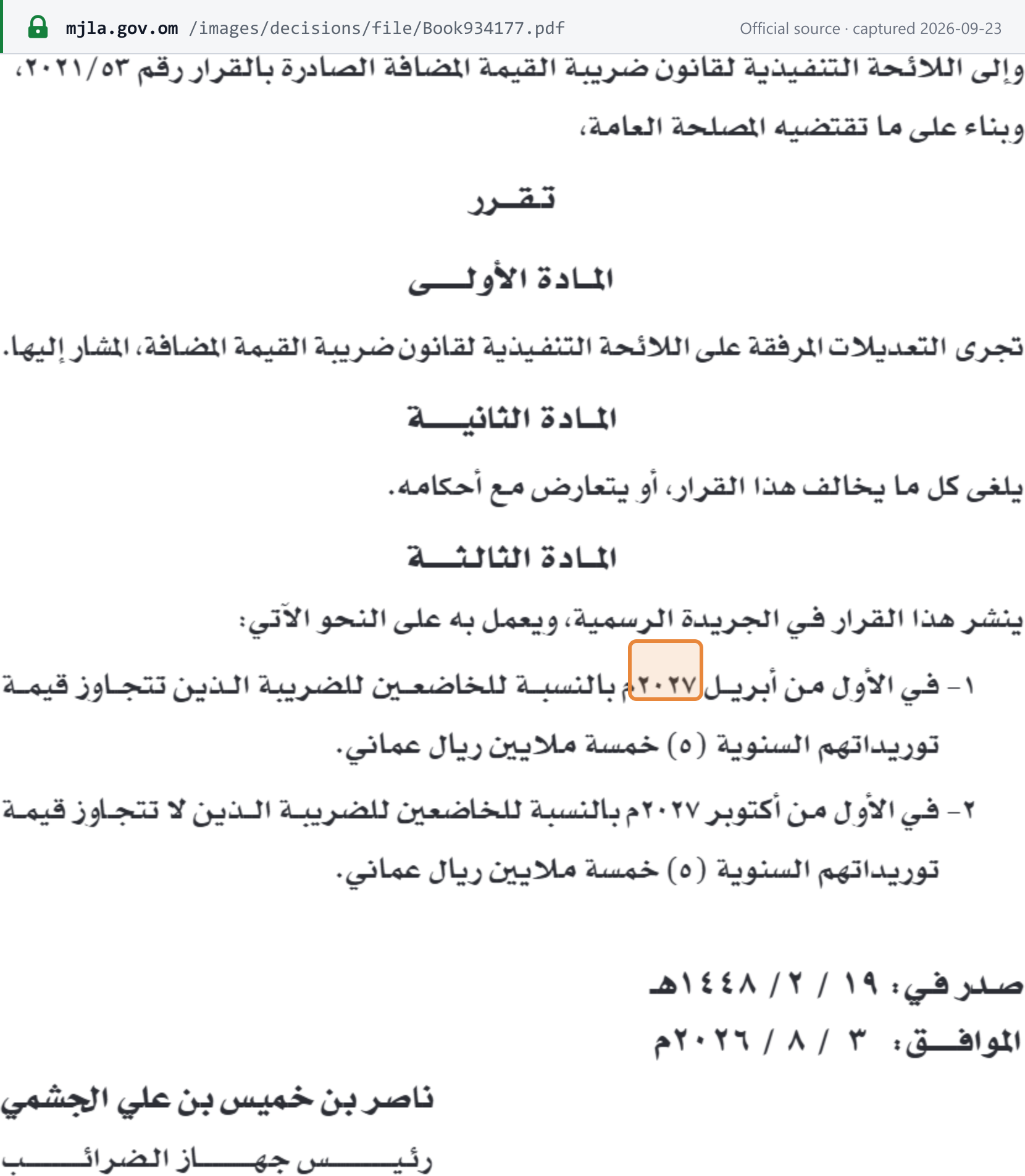
The legal mandate — Decision No. 189/2026. The decision amends the VAT Executive Regulations. It was signed on 3 August 2026 («صدر في: 19/2/1448هـ الموافق: 3/8/2026م»), published in Official Gazette issue 1660, and listed on the Ministry of Justice and Legal Affairs legislation portal on 9 August 2026. The amended Art. 143 requires a taxable person to issue the tax invoice in an approved and secured electronic format, with a unique number for each invoice. Its commencement article reads: [12] [13]
«يعمل به على النحو الآتي: 1- في الأول من أبريل 2027م بالنسبة للخاضعين للضريبة الذين تتجاوز قيمة توريداتهم السنوية (5) خمسة ملايين ريال عماني. 2- في الأول من أكتوبر 2027م بالنسبة للخاضعين للضريبة الذين لا تتجاوز قيمة توريداتهم السنوية (5) خمسة ملايين ريال عماني.»
In English: the decision applies from 1 April 2027 to taxable persons whose annual supplies exceed OMR 5 million, and from 1 October 2027 to taxable persons whose annual supplies do not exceed OMR 5 million.
| From | Who must issue e-invoices |
|---|---|
| 1 April 2027 | Taxable persons with annual supplies above OMR 5 million |
| 1 October 2027 | Taxable persons with annual supplies of OMR 5 million or less |
The decision does not say which period the OMR 5 million test uses. The Tax Authority's FAQ of 30 September 2026 does: the reference point is total annual supplies as of 31 March 2027 — you start on 1 April 2027 if supplies from 1 April 2026 to 31 March 2027, or expected supplies from 1 April 2027 to 31 March 2028, exceed OMR 5 million, and otherwise on 1 October 2027. Non-residents count only supplies made in Oman, and VAT groups are tested at group level. [21] A separate new article, «المادة (143 مكررا 2)» (Art. 143 bis 2), lets the Tax Authority's Chairman grant an exemption on application with supporting documents, for a period the Authority sets, on condition that the taxpayer files its returns and pays its tax on time. [12]
The Tax Authority's published phase plan — not the same dates. When checked on 2026-09-23, the Tax Authority's e-invoicing FAQ page still set out an earlier four-phase plan: "Phase 1: One hundred large VAT-registered companies, implementation begins in August 2026. Phase 2: All large VAT-registered companies, implementation begins in February 2027. Phase 3: All remaining VAT-registered taxpayers, implementation begins in August 2027. Phase 4: Government institutions and entities, implementation begins in February (year to be announced)". Those dates do not match Decision No. 189/2026, which is the instrument that creates the legal obligation. [15]
First electronic tax invoice reported. A Tax Authority news item listed on 21 September 2026 reports that the 2026 Tax Conference "witnessed the launch of the 'Rafid' electronic tax system alongside the issuance of the first electronic tax invoice". The item does not say how Rafid relates to Fawtara. [16]
System and network. The programme is Fawtara. It runs on Peppol's five-corner model, with invoices in XML to the PINT OM specification. The Tax Authority's e-invoicing FAQ (last updated 30 September 2026) states: [21] [11]
- "Invoices must be issued in XML format as the mandatory structured format."
- "Accredited Service Providers must use the Tax Authority's centralized SMP" — the Tax Authority runs the central participant registry. The digital certificate comes from OpenPeppol.
- "QR code is mandatory for all (B2C) transactions and transactions where the buyer is not registered for VAT, whether full or simplified." The QR code goes on the human-readable copy only.
Accredited service providers must have a "Paid up Capital of at least OMR 6,000". [17]
Scope and reporting timing. The same FAQ gives "B2B: Real-time • B2C: 24-Hours" and states that "B2C will be implemented at the same time as B2B and B2G." On paper invoices it now says: "Paper invoices can be issued, however, only e-invoices will be considered valid invoices for tax purposes." The June 2026 version had said that only B2C invoices could still be issued on paper. [21] [14]
For the full mandate — scope, the Peppol model, PINT OM, providers and penalties — see the Oman e-invoicing guide. For Oman alongside other mandates, see Lookuptax's e-invoicing status and networks table.
Filing and payment
Filing frequency
Quarterly for all registrants. Executive Regulations Art. 160 sets the tax period at «(3) ثلاثة أشهر ميلادية» (three calendar months): January–March, April–June, July–September and October–December. The Tax Authority's return-filing guide (§4) confirms: "The Tax Period for VAT is 3 months i.e., a quarter of a year." [4] [18]
Return due date
The return is due "within (30) thirty days following the end of the Tax Period" (VAT Law Art. 72). A revised return must be filed within 30 days of discovering an error (Art. 73). [1]
Payment due date and method
Tax is "payable to the Authority on the date prescribed for filing the return" (VAT Law Art. 82) — the same 30-day deadline. The return-filing guide states: "Payments must be made electronically." [1] [18]
Additional listings
Not applicable — no annual return, sales listing or purchase listing was found in the VAT Law, the Executive Regulations or the return-filing guide (checked 2026-09-23).
Input-tax recovery and blocked items
The right to deduct input tax lapses after 3 years (VAT Law Art. 44). Where inputs are used for both taxable and exempt supplies, the input tax must be apportioned (Art. 42). The Tax Authority's Input Tax guide (§2.13) lists blocked items: [1] [19]
- entertainment;
- motor vehicles for personal use seating "not more than ten (10) passengers including the driver";
- food and beverage catering;
- inputs for prohibited goods.
Refunds
- Residents. A refund claim can be made with the return when the excess deductible tax for the period exceeds OMR 100 (Executive Regulations Art. 186: «في حال تجاوز فائض الضريبة القابلة للخصم في تلك الفترة مبلغ (100) مائة ريال عماني»). The Tax Authority decides within 30 days and pays within a further 15 days (Art. 187). Claims are time-barred after 5 years. [4]
- Other refund cases. Art. 196 bis of the Executive Regulations, added by Decisions No. 521/2023 and No. 81/2025, provides refunds for charities, import VAT overpaid by non-taxable persons, re-exported goods, and the armed forces.
- Non-residents. Refunds are available on a reciprocity basis, with a minimum claim of OMR 100 (Regs Art. 191). [4]
- Tourists. The VAT Law provides for tourist refunds (Art. 87(5)). [1]
- Bad-debt relief. Provided for by VAT Law Art. 40(3). Under Executive Regulations Art. 51, the debt must have arisen from the taxable activity and be recorded in the books, and the output tax on the supply must have been declared and paid. Where the supply exceeds OMR 5,000, the procedures in Art. 52 also apply. [1] [4]
Exemptions
Exempt supplies
VAT Law Art. 47 exempts: "1. Financial Services. 2. Healthcare Services and related Goods and Services. 3. Educational Services … 4. Undeveloped land (bare land). 5. Resale of residential properties. 6. Local passenger transport. 7. Rental of properties for residential purposes." [1]
Healthcare is split. Healthcare services are exempt (Art. 47), but medicines and medical equipment are zero-rated (Art. 51). From 1 October 2026 the zero-rated lists are Decision No. 224/2026 for human medicines and medical equipment (replacing Decision No. 59/2021) and Decision No. 223/2026 for veterinary medicines and equipment; Decision No. 225/2026 is the separate basic-food list (see Rates). [1] [11] [12]
Exempt is not the same as zero-rated. VAT Law Art. 1 defines taxable supplies as supplies "at the standard or zero rate"; input tax is deductible on those, but not on exempt supplies. A business that makes both must apportion its input tax (VAT Law Art. 42). A zero-rated supplier charges 0% and recovers its input tax. An exempt supplier charges no VAT and cannot recover the input tax attributable to those supplies. [1]
Special regimes
- Special Zones. As of its October 2021 Special Zones guide, the Tax Authority states that "only the following are considered as Special Zones for VAT purposes: 1. Al Mazunah Free Zone 2. Sohar Free Zone 3. Salalah Free Zone 4. Duqm Special Economic Zone." Qualifying supplies in these zones are zero-rated (VAT Law Art. 54). [20] [1]
- Margin scheme. Available for used goods (VAT Law Art. 39) with the Tax Authority's approval (Regs Art. 43(2)), using a profit-margin invoice (Regs Art. 145). [1] [4]
- Cash accounting, flat-rate and small-business schemes. Not applicable — the VAT Law provides none (checked 2026-09-23).
Offences and penalties
Offences
The VAT Law sets two tiers of criminal offence. Prosecution happens only at the request of the Tax Authority's Chairman. Both articles allow imprisonment, a fine, or both ("or one of these penalties"). A case can be settled for between two times the minimum fine and two times the maximum (Art. 102). [1]
| Tier | Examples of the conduct | Punishment |
|---|---|---|
| Art. 100 | "Deliberately refraining to issue a Tax Invoice when required" (item 8); "Deliberately issuing an invoice stating the amount of the Tax due, other than the Tax imposed" (item 9) | Imprisonment of 2 months to 1 year and/or a fine of OMR 1,000–10,000 |
| Art. 101 | "Deliberately refraining from registering" (item 1) | Imprisonment of 1 to 3 years and/or a fine of OMR 5,000–20,000 |
Penalties
| Default | Penalty | Source |
|---|---|---|
| Late payment | "Additional Tax" of 1% per month or part of a month on the unpaid tax | VAT Law Art. 1 [1] |
| Late return, and other listed administrative failures — including, since 2022, failing to issue a tax invoice in line with the e-invoicing requirements (item 4) | OMR 500–5,000 | Regs Art. 202 [4] [10] |
| Refund obtained with false data; failure to apply for deregistration; prices not shown VAT-inclusive | OMR 1,000–10,000 | Regs Art. 203 [4] |
| Incorrect return | 1%–25% of the under-declared tax | Regs Art. 204 [4] |
| Evasion | 300% of the evaded tax | Regs Art. 205 [4] |
Frequently asked questions
I sell digital services to consumers in Oman from abroad — is there a registration threshold I can stay under?
No. The OMR 38,500 mandatory registration threshold applies to persons resident in Oman. Under Article 57 of the VAT Law, a person with no place of residence in Oman must register from the date on which it becomes obliged to pay the tax, and the Tax Authority's e-commerce guide states that the mandatory registration threshold does not apply to non-resident suppliers. What you must do depends on the customer. If you sell only to VAT-registered businesses in Oman that self-account under the reverse charge, you have no Omani registration obligation. If you sell to private consumers, the reverse charge does not apply, so you must register and charge VAT from your first supply. A business resident in another GCC state that implements VAT is the exception: it registers within 30 days of meeting the resident registration conditions (Executive Regulations Art. 111(1)). Electronically supplied services are taxed where they are actually used or enjoyed (VAT Law Art. 24(4)). [1] [6]
The Tax Authority's e-invoicing FAQ mentions February 2027, but Decision No. 189/2026 says 1 April 2027 — which date applies to us?
Decision No. 189/2026 is the legal instrument. It was signed on 3 August 2026, published in Official Gazette issue 1660, and sets two dates: 1 April 2027 for taxable persons whose annual supplies exceed OMR 5 million, and 1 October 2027 for all other taxable persons. When checked on 23 September 2026, the Tax Authority's e-invoicing FAQ web page still showed its earlier four-phase plan: 100 large companies from August 2026, all large companies from February 2027, all remaining VAT-registered taxpayers from August 2027, and government entities from a February in a year still to be announced. Those dates do not match the Decision. The Decision does not say which period the OMR 5 million test uses; the Tax Authority's FAQ of 30 September 2026 does: you start on 1 April 2027 if your supplies from 1 April 2026 to 31 March 2027, or your expected supplies from 1 April 2027 to 31 March 2028, exceed OMR 5 million, and otherwise on 1 October 2027. Non-residents count only supplies made in Oman, and VAT groups are tested at group level. [21] [12] [15]
Can we issue our Omani tax invoices in English only?
Yes, with a condition. Article 144 of the VAT Executive Regulations says a tax invoice is issued in Arabic and may be issued in English, provided an Arabic translation is available whenever the Tax Authority asks for it. The invoice may be in Omani rials or another currency. If it is in a foreign currency, the VAT must be calculated in Omani rials at the average buying and selling rate published by the Central Bank of Oman on the date the tax falls due (VAT Law Art. 68). [4] [1]
Is healthcare zero-rated or exempt from VAT in Oman?
It depends on what is supplied. Healthcare services, and the goods and services related to them, are exempt under Article 47 of the VAT Law: no VAT is charged, and the provider cannot deduct the input tax attributable to them. Medicines and medical equipment are zero-rated under Article 51: VAT is charged at 0%, and the related input tax remains deductible. From 1 October 2026 the zero-rated medicines and medical equipment are those listed in Tax Authority Decision No. 224/2026 (cleared by the Ministry of Health), and veterinary medicines and equipment are listed in Decision No. 223/2026. [11] [12] [1]
How soon after a supply must a tax invoice be issued in Oman?
Within 15 days. Article 143 of the Executive Regulations, as amended by Decision No. 456/2022, requires the tax invoice to be issued no later than 15 days after the event that triggers it — the supply itself, or receipt of payment before the supply (VAT Law Art. 67). A monthly summary invoice covering one customer's supplies must be issued within 15 days of the end of the month (Art. 150). Under Decision No. 189/2026, invoices must also be issued in an approved, secured electronic format with a unique number, from 1 April 2027 for taxable persons with annual supplies above OMR 5 million and from 1 October 2027 for all others. [10] [12]
Our supplies have fallen below the registration threshold — when can we deregister?
Deregistration is optional once your supplies fall below the OMR 38,500 mandatory threshold but stay above the OMR 19,250 voluntary threshold, provided you have been registered for more than 12 months (VAT Law Art. 66; Executive Regulations Art. 138). It is mandatory if you permanently stop the activity, in which case you must apply within 30 days, or if you stop meeting the registration conditions, in which case you must apply within 2 months of the end of that tax year (Art. 136). The Tax Authority decides within 30 days, records must be kept for 10 years after deregistration, and failing to apply when required carries a fine of OMR 1,000 to OMR 10,000. [1] [4]
Important websites
Checked live 2026-09-23 unless noted.
| Site | Purpose |
|---|---|
| Tax Authority portal | VAT registration, return filing and payment |
| VATIN validation | Checking a counterparty's VAT number |
| VAT law and regulations | The VAT Law, Executive Regulations and decisions |
| VAT guidelines | The Tax Authority's taxpayer guides |
| Fawtara e-invoicing hub | E-invoicing programme information and FAQ |
| Fawtara portal | The e-invoicing platform |
| [email protected] | Fawtara support email |
| Ministry of Justice and Legal Affairs — decisions | Published text of Decision No. 189/2026 |
| Directorate General of Customs | Import VAT and customs declarations |
Also see Lookuptax's own Oman VAT number validator.
Recent changes
- 2026-10-01 — Tax Authority Decisions No. 223/2026, 224/2026 and 225/2026 (dated 22 September 2026, Official Gazette Issue 1667 of 27 September 2026) apply from this date, specifying goods and supplies subject to VAT at 0%: basic food items (Decision 225, replacing Decision 65/2021), human medicines and medical equipment cleared by the Ministry of Health (Decision 224, replacing Decision 59/2021) and veterinary medicines and equipment cleared by the Ministry of Agriculture, Fisheries and Water Resources (Decision 223). See Rates. (Tax Authority) — see event
- 2026-09-30 — The Tax Authority's new e-invoicing FAQ defines the OMR 5 million test (supplies 1 April 2026 to 31 March 2027, or expected 1 April 2027 to 31 March 2028), puts non-residents in scope on their Oman supplies, and says only e-invoices are valid for tax purposes. (Tax Authority)
- 2026-09-21 — The Tax Authority's news page reports that the first electronic tax invoice was issued at the 2026 Tax Conference, alongside the launch of the "Rafid" electronic tax system. (Tax Authority)
- 2026-08-03 — Decision No. 189/2026 signed. It was published in Official Gazette issue 1660 and on the legislation portal on 9 August 2026. It makes electronic tax invoices mandatory from 1 April 2027 for taxable persons with annual supplies above OMR 5 million and from 1 October 2027 for all others. This replaces the Tax Authority's earlier four-phase plan (August 2026 / February 2027 / August 2027), which its e-invoicing FAQ page still shows. (Ministry of Justice and Legal Affairs)
- 2022-10-13 — Decision No. 456/2022 amended the invoicing rules in the Executive Regulations: a 15-day issuance deadline, simplified invoices without prior approval, a 15-day deadline for monthly summary invoices, electronic amended documents where the original invoice was electronic, and a fine for invoices that do not meet the electronic-invoicing requirements. (Tax Authority)
- 2021-04-16 — VAT took effect at a standard rate of 5% under the VAT Law promulgated by Royal Decree No. 121/2020. (Tax Authority)
Ahead — 1 April 2027 and 1 October 2027, the two e-invoicing start dates under Decision No. 189/2026; see E-invoicing status. For the full chronology, see Oman tax changes on Lookuptax.
Reference links
- Tax Authority — VAT Law, Royal Decree No. 121/2020 (English translation, PDF)
- Tax Authority — Decision No. 53/2021 issuing the VAT Executive Regulations (Arabic, PDF)
- Tax Authority — Decision No. 456/2022 amending the VAT Executive Regulations (Arabic, PDF)
- Ministry of Justice and Legal Affairs — Decision No. 189/2026 (Arabic, PDF)
- Ministry of Justice and Legal Affairs — Decision No. 189/2026 listing
- Tax Authority — Determining the Mandatory and Voluntary Registration Thresholds (PDF)
- Tax Authority — Determining the VAT Registration Due Dates and Effective Dates (PDF)
- Tax Authority — VAT Transitional Registration Guide
- Tax Authority — VAT Registration Procedures for Non-Resident Applicants (PDF)
- Tax Authority — VAT Taxpayer Guide (Electronic Commerce) (PDF)
- Tax Authority — VAT Taxpayer Guide (Imports and Exports) (PDF)
- Tax Authority — Determining Food Items subject to VAT at Zero Rate (PDF)
- Tax Authority — VAT Taxpayer Guide: VAT Return Filing (PDF)
- Tax Authority — VAT Taxpayer Guide (Input Tax) (PDF)
- Tax Authority — VAT Guide for Special Zones (PDF)
- Tax Authority — E-invoicing FAQ (web page)
- Tax Authority — E-invoicing FAQ, last updated 30 September 2026 (PDF)
- Tax Authority — E-invoicing FAQ, 30 June 2026 version (PDF)
- Tax Authority — E-invoicing service provider criteria
- Tax Authority — Tax Conference 2026 news item
- OpenPeppol — PINT OM specification
- Lookuptax — Oman TIN number guide
- Lookuptax — How to verify a VATIN in Oman
- Lookuptax — How to verify an Oman tax card
- Lookuptax — Peppol e-invoicing guide
- Lookuptax — E-invoicing status and the networks worldwide
- Lookuptax — VAT registration thresholds worldwide
- Lookuptax — Worldwide tax rates