Bhutan GST guidelines
| FACTSHEET | |
|---|---|
| Country code | BT |
| Tax name | Goods and Services Tax (GST) |
| Tax Authority | Department of Revenue and Customs (DRC), Ministry of Finance |
Overview
Bhutan levies a Goods and Services Tax (GST) under the GST Act of Bhutan 2020 (Dzongkha: འབྲུག་གི་ཅ་ཆས་དང་ཞབས་ཏོག་ཁྲལ་གྱི་ བཅའ་ཁྲིམས་ ༢༠༢༠ ཅན་མ།). It is a single-rate, destination-based tax: "This Act imposes GST in accordance with the destination principle, under which GST is imposed only on consumption in Bhutan" (s.68). GST applies "on taxable supplies and taxable imports" (s.12). [1]
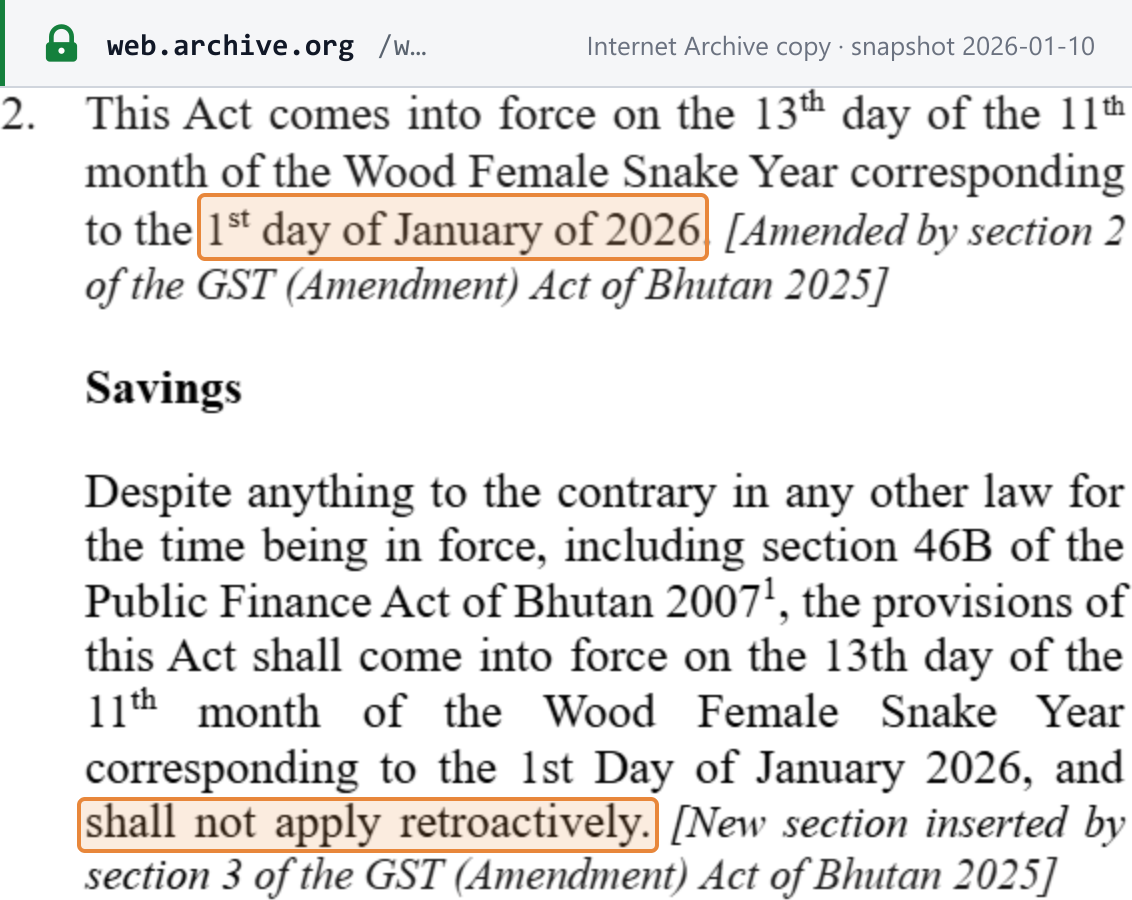
In force since 1 January 2026. The Act was passed in 2020, but its start was deferred. The GST (Amendment) Act of Bhutan 2022 held back the accounting, payment, refund and registration chapters until "the goods and services tax system is ready". The GST (Amendment) Act of Bhutan 2025 then fixed the start at 1 January 2026, and a savings clause says the Act "shall not apply retroactively". GST replaced the Sales Tax under the Sales Tax, Customs and Excise Act 2000 on the same day. DRC's notification of 27 April 2026 refers to "the implementation of the Goods and Services Tax (GST) Act of Bhutan on January 1, 2026, and the simultaneous cessation of Sales Tax". The GST Rules 2026 issued by the Ministry of Finance also commence on 1 January 2026 (rule 2). [1] [2] [8] [12]
 Source snapshot captured 2026-10-21 from the Internet Archive copy (snapshot 2026-01-10) — archived copy · official URL
Sources. Sections are cited as "GST Act s.X" from DRC's September 2025 consolidation, which incorporates the 2021, 2022 and 2025 amending Acts. The Dzongkha text is authoritative, but "in the event of any difference in the technical interpretation between the Dzongkha and the English texts, the English text shall be regarded as equally authoritative" (s.336).
Authority. "The Department of Revenue and Customs under the Ministry shall be the authority for the implementation and administration of this Act" (s.7). The Department of Revenue and Customs (DRC) also runs customs and collects GST on imports at customs clearance (s.47).
Currency. The Ngultrum (Nu., BTN). Invoice totals and GST must be stated in Ngultrum (GST Rules r.185(6)–(7)).
Tax period. A calendar month by default (s.337(105)). Quarterly periods are available on approval for smaller registrants, and government entities other than state-owned enterprises use half-years (see Filing and payment).
Layering. None. "This Act extends to the whole of Bhutan" (s.4), and neither the Act nor the Rules provide for any sub-national GST. Excise is a separate tax: the Act's former Part II, the Excise Equalization Tax, was repealed by the Excise Tax Act of Bhutan 2025, and this guide does not cover excise.
For neighbouring systems, see the India GST guide and the Nepal VAT guide. For what the tax is called elsewhere, see VAT, GST and sales tax names by country.
Registration
Who should register
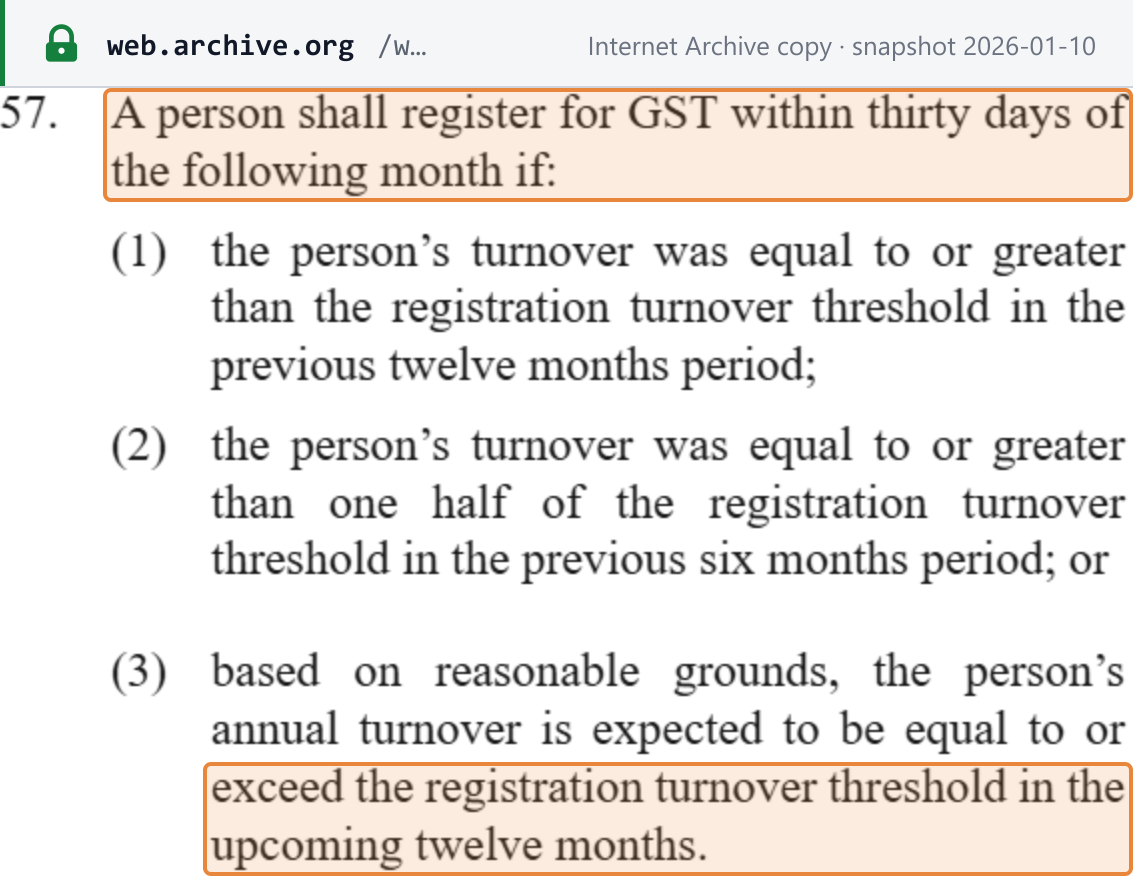
A person must register for GST "within thirty days of the following month" if any of three tests is met (GST Act s.57):
- turnover was equal to or greater than the registration turnover threshold in the previous twelve months;
- turnover was equal to or greater than half the threshold in the previous six months; or
- on reasonable grounds, annual turnover is expected to reach the threshold in the upcoming twelve months.
Tests 1 and 2 do not apply if DRC is satisfied that turnover will stay below the threshold over the next twelve months (s.58). DRC may also register a person itself where it has objective evidence (s.61). Government entities register "irrespective of turnover" (s.59). [1]
 Source snapshot captured 2026-10-21 from the Internet Archive copy (snapshot 2026-01-10) — archived copy · official URL
Registration threshold
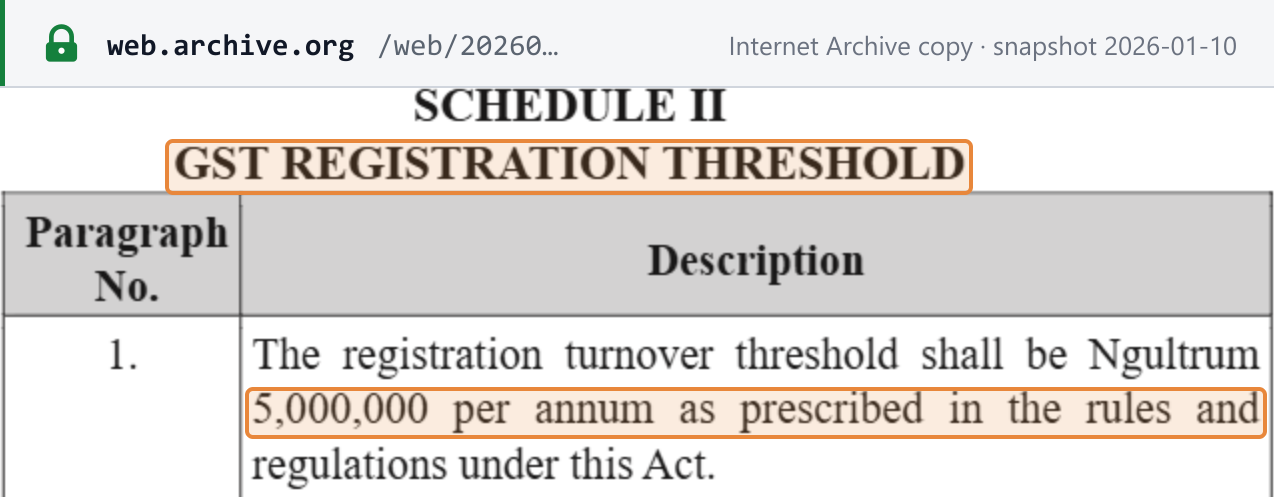
Nu. 5,000,000 of registration turnover per annum. Schedule II: "The registration turnover threshold shall be Ngultrum 5,000,000 per annum as prescribed in the rules and regulations under this Act." The six-month test in s.57(2) is therefore Nu. 2,500,000. [1]
- What counts (GST Rules r.6). The value of all supplies made in the course of economic activity, plus imported B2B services received. Disposals of capital assets and the sale of a business as a going concern are left out.
- Individuals (r.7). All of an individual's businesses are added together, wherever they are located. A jointly owned business is a separate person and is tested on its own turnover.
- DRC's summary. The DRC "Easy Guide" says: "Any business with an annual turnover of Nu. 5 million or more must register for GST". [2] [3]
 Source snapshot captured 2026-10-21 from the Internet Archive copy (snapshot 2026-01-10) — archived copy · official URL
The 2025 transition drive. For the move to GST, DRC registered existing businesses itself on the basis of their 2024 income-tax returns, with no application needed: "you are not required to submit a separate registration application. The Department of Revenue and Customs (DRC) will register your business based on your 2024 Income Tax return filing" (DRC notification DRC/GST/1/2025-2026/194, 19 August 2025, an image-only scan). DRC said registration certificates were to be issued through the BITS portal. [4]
For other countries, see VAT registration thresholds worldwide.
Non-resident registration
The law sets no separate threshold for non-residents. Section 57 and Schedule II refer to "a person", and neither the Act nor the Rules say whether a non-resident's imported B2C services count towards the Nu. 5,000,000 test. What the law does set out:
- GST representative. "Unless otherwise allowed by the Department", a non-resident that has no fixed place of business in Bhutan, makes a taxable supply and is liable for the GST on it must appoint a GST representative in Bhutan (r.122; Act s.145). The representative must be a resident, a person with a fixed place of business or a licensed representative, with twelve months of good compliance (r.125). It applies for registration and pays the GST and any penalties (r.126). DRC may ask for security (r.124).
- Simplified route for B2C services. A non-resident making only imported B2C services may opt for simplified registration and simplified returns. It then cannot claim input tax, and may have to appoint a contact person in Bhutan (r.129).
See Foreign businesses selling into Bhutan. [2]
Tax identification number
The GST registration number is the taxpayer number, which DRC calls the TPN ("Taxpayer Identification Number (TPN)" in the Easy Guide). The TPN goes on every tax invoice (r.185(3)). A cancelled registrant re-registers "using the same taxpayer number" (r.40). TPNs are issued through DRC's RAMIS taxpayer system, linked from the DRC home page as "TPN Registration". [2] [3]
Format. DRC publishes no format, length or check-digit rule for the TPN. For official lookups in other countries, see Check a VAT number.
How to register
- Get a TPN. If the business has none, register as a taxpayer with DRC through RAMIS.
- Apply for GST registration "electronically or in such form and manner as prescribed by the Department" (r.23). DRC's Easy Guide says: "Applications are made through the Bhutan Integrated Taxation System (BITS) portal." The deadline is the one in s.57: within thirty days of the following month. A person that will be required to register within 30 days of coming into existence may apply as soon as it exists (r.21).
- DRC decides within 15 days of a complete application, or 30 days for divisional registration (r.25). A person who applied on time is not a "taxable person" until DRC deals with the application (r.27).
- Effective date. For compulsory registration, the later of the date the person became liable and the date in DRC's notice (r.29). For voluntary registration, the first day of the month after the notice, or a later date the applicant asks for (r.30).
Neither the Act nor the Rules list the documents required. DRC must "maintain and publish" a list of registered persons, giving each one's name, trading name, registration number and effective date (r.31). We found no public lookup for that list. [2] [3]
Failing to register costs Nu. 10,000 for the first contravention; a repeat is a GST offence (r.262). For the general process elsewhere, see how to register for VAT, sales tax or GST.
Voluntary registration
Available, but only above Nu. 2,500,000. A person not required to register may register voluntarily if its registration turnover in the past 12 months "exceeds the voluntary registration threshold" and DRC is satisfied it can comply (r.8). The voluntary threshold is "a registration turnover of Nu. 2,500,000 in the previous 12-month period" (r.285(18)). DRC's Easy Guide words it as "Nu. 2.5 million or more"; the rule says "exceeds". A voluntary registrant must stay registered for at least two years (r.9). Registering lets a business recover input tax and issue tax invoices that its business customers can claim on. [2]
Deregistration
- Apply within 30 days of permanently ceasing to make supplies (r.33). A person no longer required to be registered may also apply (r.34).
- DRC must cancel if the person has been registered for at least 24 consecutive months, and may cancel if for less (r.35). DRC also cancels where there is no economic activity (r.36), and may cancel for missing records, unreliable returns or false information (r.37).
- After cancellation, stop issuing tax invoices, and "file a final GST return and pay all amounts due under the Act within 30 days from the end of the last tax period". Claim any refund within the same 30 days (r.39).
- Stock on hand for which input tax was claimed triggers an increasing adjustment (Act s.111). [1] [2]
Group registration
Available, and so is divisional registration.
- Group registration (rr.10–17). Two or more registered persons under common control may register as a group if each is resident or has an established place of business in Bhutan, is not in arrears, has the same tax period, is in no other group and is not under divisional registration (r.14). Apply at least 30 days before the group is to take effect. One representative member files. Supplies between members "are disregarded", and "all group members are jointly and severally liable" (r.17).
- Divisional registration (rr.18–20). A business whose divisions keep independent accounts can register them separately. Each division stays registered whatever its own turnover if the divisions together exceed the threshold (r.20). [2]
Rates
| Rate | Applies to | Source |
|---|---|---|
| 5% (standard, and the only positive rate) | All taxable supplies and taxable imports of goods and services not zero-rated or exempt | GST Act Schedule I, s.16 |
| 0% (zero rate) | Schedule V supplies: exports of goods, services used or enjoyed outside Bhutan, international transport and the other cases listed under Cross-border rules; input tax stays recoverable (s.29) | GST Act s.28, Schedule V |
| Exempt (no GST, no input credit) | Schedule IV: financial services, education, health, residential rents and the listed basic goods — see Exemptions | GST Act s.26, Schedule IV |
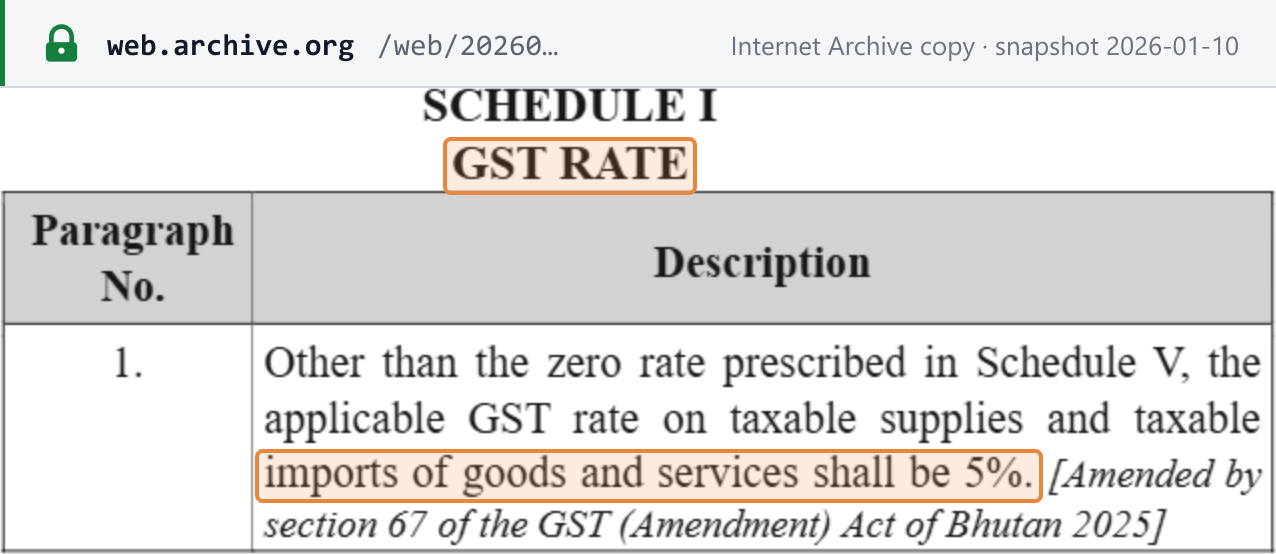
Standard rate: 5%, since 1 January 2026. Schedule I: "Other than the zero rate prescribed in Schedule V, the applicable GST rate on taxable supplies and taxable imports of goods and services shall be 5%", as amended by s.67 of the GST (Amendment) Act of Bhutan 2025. The rate took effect with the tax on 1 January 2026. DRC's Easy Guide summarises it as "Most goods and services: Taxed at 5%". [1] [3]
 Source snapshot captured 2026-10-21 from the Internet Archive copy (snapshot 2026-01-10) — archived copy · official URL
Reduced rates. None. Schedule I sets one positive rate, and neither the Act nor the Rules contain another.
What the 5% replaced. The Sales Tax rates in Schedule 1 of the Tax Act of Bhutan 2022 are repealed from 1 January 2026 (the repeal clause inserted after s.2, and s.5). "Sales tax shall not be payable on an import, sale or other transaction to the extent that it is subject to GST" (Schedule X para 4). [1]
Prices must include GST. Advertising, displaying or quoting prices exclusive of GST is an administrative contravention: Nu. 5,000, then Nu. 10,000 (s.264(4); r.262).
Announced future rates. None; DRC has announced no rate change.
For other countries' rates, see worldwide tax rates.
Cross-border rules
Imports and exports
- Imports of goods. The importer is liable (s.14(2)), and "GST payable on a taxable import shall be paid at the time of customs clearance" under the Customs Act of Bhutan 2017 (s.47). The value is the customs value plus customs duty, insurance and freight and other taxes and fees (s.23). Rule 272 says the GST value "shall be customs value including excise tax, customs duty and any other fees and charges at the time of import".
- Deferral. Approved manufacturers and processors whose returns regularly show a negative net amount can defer import GST into the return, against security (s.168; rr.89–95).
- Low-value imports. There is no general de minimis. Gifts by post or courier are GST-free where "the total invoice value does not exceed Nu.10,000", provided they are for the recipient's personal use, in non-commercial quantities and contain no alcohol (r.49). Free samples have their own relief (r.50).
- Temporary admission is relieved (s.167; r.87). "Refund of GST shall not be allowed on re-export of goods" (s.171).
- Exports are zero-rated. Goods qualify when declared for export under the Customs Act and exported. Sales by a licensed duty-free vendor to a tourist also count (Schedule V para 2). Manufacturers and exporters with regular negative net amounts can claim refunds without waiting out the carry-forward period (r.61). [1] [2]
Other zero-rated supplies (Schedule V).
- Services supplied to a customer outside Bhutan who uses or enjoys them outside Bhutan, unless they relate to land in Bhutan or are performed on goods in Bhutan (para 9).
- Services performed outside Bhutan (para 8).
- Intellectual property for use outside Bhutan (para 10).
- Inter-carrier telecommunications (para 11).
- International transport (para 12).
- The first supply of refined precious metal to a dealer (para 13).
Reverse charge on imported services
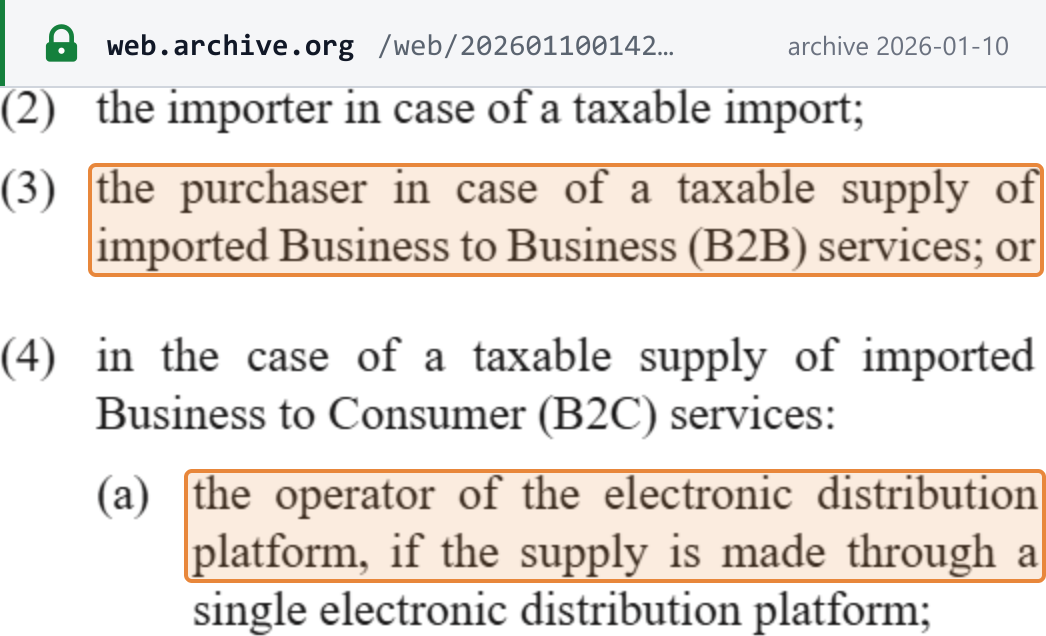
Yes, for B2B. For "a taxable supply of imported Business to Business (B2B) services" the person liable is "the purchaser" (s.14(3)). The customer is treated as incurring both output tax and input tax, and may claim the credit provided it has accounted for the output tax (s.33). A B2B customer is a taxable person acquiring the services for its economic activity at a fixed place in Bhutan (s.337(46)). Imported B2B services also count towards the customer's own registration turnover (r.6(1)(b)). [1]
 Source snapshot captured 2026-10-21 from the Internet Archive copy (snapshot 2026-01-10) — archived copy · official URL
Digital products and services
"Electronic services" are caught when delivered over a telecommunications network (s.337(24)). The list covers:
- websites, web hosting and remote maintenance;
- software and its updates;
- virtual currencies;
- images, text and information;
- access to databases;
- self-education packages;
- music, films and games;
- broadcasts and events;
- "any other supplies that are imported B2C services" made by electronic communication.
Any imported B2C service, not only an electronic one, is taxed at 5% when supplied to a Bhutanese consumer: a resident who is not registered, or who is registered but not buying for its business (s.337(10)). A recipient is treated as a Bhutanese consumer if their contact and billing address is in Bhutan, together with the location of the paying bank or the country of issue of the payment card (r.130). The law states no threshold specific to digital suppliers. [1] [2]
See VAT on digital services by non-resident suppliers.
Foreign businesses selling into Bhutan — B2B and B2C
-
B2B services. The Bhutanese business customer self-accounts under the reverse charge (s.14(3), s.33). The foreign supplier charges no Bhutanese GST.
-
B2C services. The foreign side is liable. Under s.14(4) the person liable is:
- the operator of the electronic distribution platform, if the supply goes through a single platform;
- the operator determined under the Rules, if more than one platform is involved;
- the supplier, if no platform is used.
The liable person can use the simplified registration and return route with no input credit (r.129), or register in full through a GST representative (r.122).
-
Goods. Goods delivered to Bhutanese buyers are imports, so the importer pays GST at customs (s.14(2), s.47). Goods that a non-resident installs or assembles in Bhutan are a supply made in Bhutan (s.74(2)(b)).
-
Threshold. None specific to non-residents is stated in the law (see Non-resident registration). [1] [2]
Marketplace / platform deemed-supplier liability
Yes, for services. The operator of an electronic distribution platform is liable for GST on imported B2C services supplied through it (s.14(4)(a)). A platform is a website, portal, gateway, web store or marketplace that lets persons make supplies to customers electronically and is not solely for processing payment (s.337(23)). Where several platforms are involved, r.170 sets the order:
- the operator that agreed in writing to be treated as the supplier;
- otherwise, the first operator to receive or authorise the charge;
- otherwise, the first operator to authorise delivery.
The law has no equivalent rule for goods sold through marketplaces; imported goods are taxed at the border. See marketplace deemed-supplier rules. [1] [2]
Place of supply
- Residents. "A supply by a resident shall be treated as a supply made in Bhutan" (s.72). Schedule V zero-rating then takes exports and supplies consumed abroad out of the charge (s.69).
- Non-residents with a fixed place in Bhutan. A supply made through that fixed place is made in Bhutan (s.73).
- Other non-residents (s.74). These supplies are made in Bhutan:
- immovable property in Bhutan;
- goods delivered or made available in Bhutan, or installed or assembled there;
- utilities delivered through a network to a person in Bhutan;
- services physically performed in Bhutan or related to land in Bhutan;
- imported B2B and B2C services.
- Registered non-resident to a registered customer. The service is made in Bhutan (s.76), unless the customer acquires it through a fixed place abroad (s.77). [1]
Invoice requirements
"A registered person who makes a taxable supply shall issue a serially numbered tax invoice for every supply" (GST Act s.209). The detail is in Chapter 17 of the GST Rules 2026. [1] [2]
Mandatory content
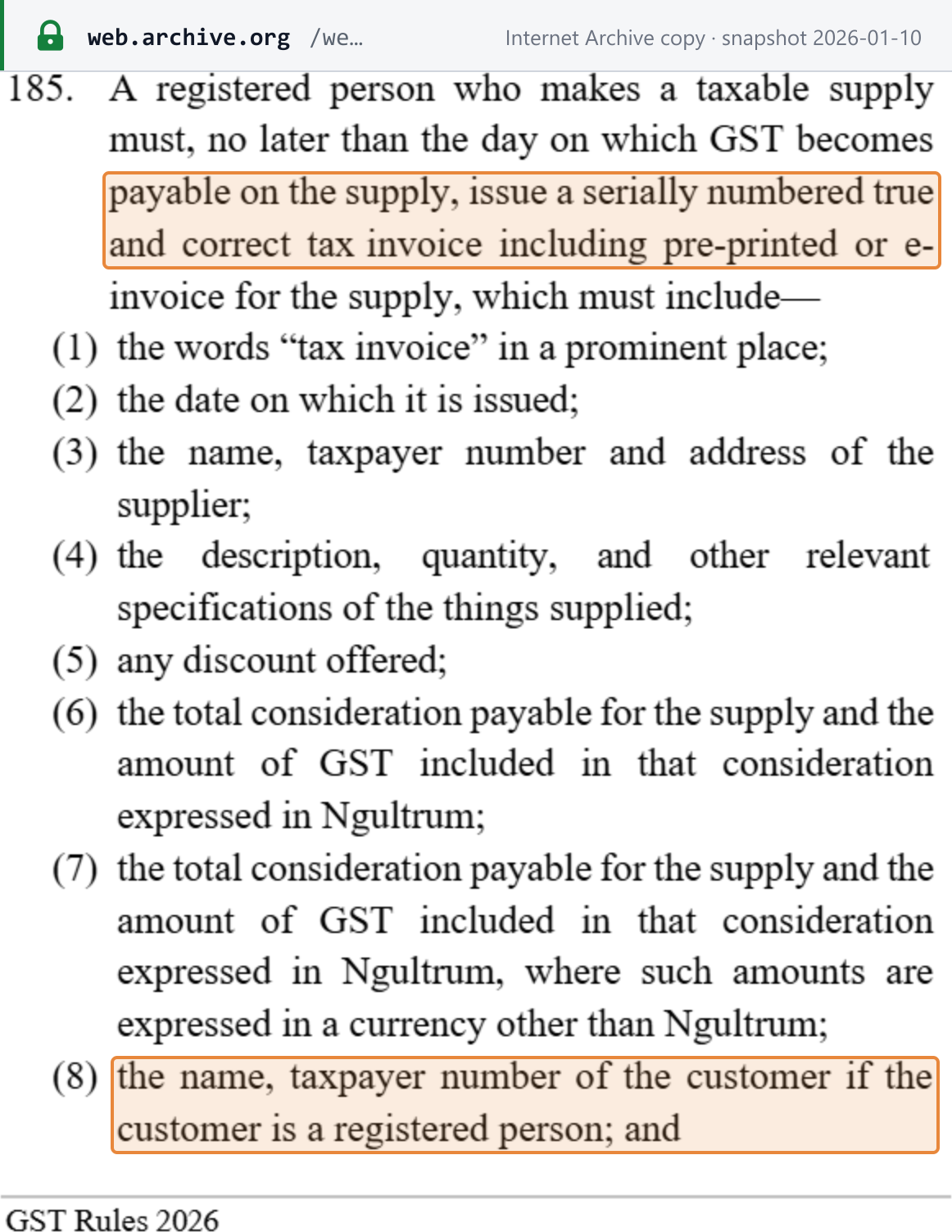
Rule 185 requires "a serially numbered true and correct tax invoice including pre-printed or e-invoice", which must include:
| # | Particular | When | GST Rules |
|---|---|---|---|
| — | Serial number | always | r.185 chapeau; Act s.209 |
| 1 | The words "tax invoice", in a prominent place | always | r.185(1) |
| 2 | Date of issue | always | r.185(2) |
| 3 | Supplier's name, taxpayer number (TPN) and address | always | r.185(3) |
| 4 | Description, quantity and other relevant specifications of what is supplied | always | r.185(4) |
| 5 | Any discount offered | when offered | r.185(5) |
| 6 | Total consideration and the GST included in it, in Ngultrum | always | r.185(6) |
| 7 | Total consideration and GST expressed in Ngultrum | invoice in another currency | r.185(7) |
| 8 | Customer's name and taxpayer number | customer is registered | r.185(8) |
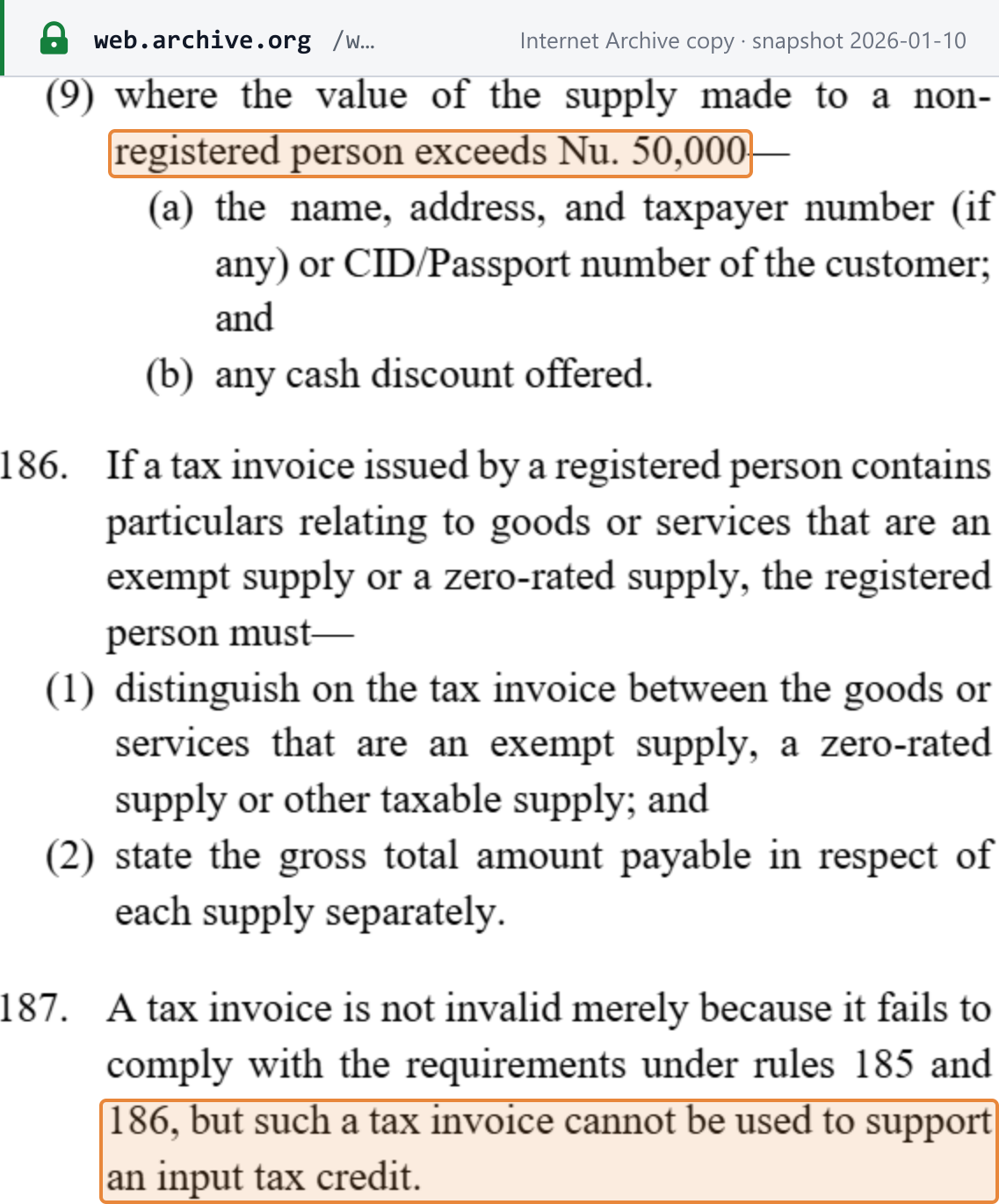
| 9 | Customer's name, address and taxpayer number (if any) or CID/passport number, and any cash discount | supply to a non-registered person exceeding Nu. 50,000 | r.185(9) |
| — | Exempt, zero-rated and taxable lines distinguished, with a gross total for each | mixed invoices | r.186 |
A defective invoice is not void, but "such a tax invoice cannot be used to support an input tax credit" (r.187). There is only one original; a replacement must be marked as a copy (r.188). [2]
 Source snapshot captured 2026-10-21 from the Internet Archive copy (snapshot 2026-01-10) — archived copy · official URL
 Source snapshot captured 2026-10-21 from the Internet Archive copy (snapshot 2026-01-10) — archived copy · official URL
Failing to issue a tax invoice costs Nu. 5,000, then Nu. 10,000 on a repeat (s.264(1); r.262).
Issuance deadline
No later than the day GST becomes payable (r.185). GST becomes payable at the earlier of the invoice being issued and any part of the consideration being paid (s.81). For progressive or periodic supplies, it is the earliest of invoice, payment or due date (s.82). A customer may ask for a missing invoice within three months of GST becoming payable, and the supplier must issue it within 15 days of the request (rr.195–197). [1] [2]
Numbering and sequencing
Invoices must be "serially numbered" (s.209; r.185). Buyer-created invoices need "a serially printed number" (r.200(6)(b)). The Rules prescribe no particular format for the series.
Credit and debit notes
Bhutan uses one document for both directions: the adjustment note. The supplier issues it "within seven days of becoming aware of the event" (s.89(1)(b); likewise s.88(1)(b)). Adjustment events are cancellations, changes in consideration, returns of goods, and changes that make a supply taxable or non-taxable (s.337(2)). Under r.190 the note must contain:
- the words "adjustment note" in a prominent place;
- the date of issue;
- the supplier's name, taxpayer number and address;
- the nature of the adjustment event and the supply it relates to;
- the effect on the GST payable;
- the customer's name and taxpayer number, if the customer is registered.
An amended tax invoice can serve as the adjustment note (r.191). Without a compliant note there is no decreasing adjustment (s.91; r.192). Bad debts need no note (r.194). Relief requires the debt to be overdue for more than two years, plus bankruptcy or exhausted recovery, and a write-off (s.97). [1] [2]
Currency and language
- Currency. Ngultrum. An invoice in another currency must also state the total and the GST in Ngultrum (r.185(7)).
- Conversion rate: none prescribed. DRC's August 2025 notice told businesses to use the rate prevailing at the end of the tax period. The Ministry of Finance's notification of 31 December 2025 records that this provision "had already been removed" from r.185(7), and deletes a stray copy of it from r.190(6). The Rules as amended therefore set no conversion rate; confirm the rate to use with DRC. [7]
- Language. No invoice-language rule. Documents given to DRC in a language other than Dzongkha or English must be translated by the person (s.334).
Document types
- Tax invoice. The only invoice type. It may be pre-printed or an e-invoice (r.185).
- Adjustment note. For credits and debits (r.190).
- Buyer-created tax invoice. For self-billing (r.200).
There is no simplified invoice and no value threshold for a lighter document. The value line that does matter is Nu. 50,000: above it, an invoice to an unregistered buyer must identify the buyer (r.185(9)). Only GST registrants may charge GST. A non-registrant collecting it commits an offence, as DRC reminded businesses on 5 January 2026. [2] [6]
Self-billing
Permitted, as a "Buyer Created Tax Invoice" (r.200). The conditions:
- a written agreement with each supplier;
- the recipient determines the value of the supply;
- the recipient gives the supplier a copy and keeps one for at least five years;
- the recipient updates its supplier list quarterly.
Each such invoice must carry every r.185 particular, a serially printed number, the words "Buyer Created Tax Invoice", and the statement "The tax shown is the output tax payable to the Department of Revenue and Customs". Agents may issue or receive invoices in the principal's name and TPN once the principal has given DRC a list of its appointed agents (rr.198–199). [2]
Retention and audit trail
- Retention: five years. Records "shall be retained for a period of five years from the end of the relevant tax period and shall be produced if required by the Department" (s.211). DRC may require longer by notice (s.212; r.203).
- What to keep. Tax invoices and adjustment notes issued and received, and customs documents for imports and exports, "original or copy, as appropriate, in such form and manner as may be required by the Department" (r.202).
- Electronic-only archiving. Neither the Act nor the Rules authorise or forbid it. E-invoices (r.185) and copies (r.202) are accepted, but no format is set.
- Audit trail. No tamper-evidence, hash or fiscal-device rule goes beyond "serially numbered true and correct". DRC officers may inspect, copy and take extracts of records with the Director's approval (ss.274–275), and require records by notice (s.276).
- Penalty. Failing to keep records costs Nu. 5,000, then Nu. 10,000 (r.262). [1] [2]
A specimen of a compliant invoice
DRC publishes no official specimen of a tax invoice, and the Rules have no forms annex. Below, Lookuptax lays out the rule 185 particulars for an illustrative domestic B2B sale at 5%. Every name, number and amount is fictional:
Tax invoice — illustrative
| Descriptionr.185(4) | Qtyr.185(4) | Unit price (excl. GST)r.185(4) | Amount (excl. GST)r.185(6) |
|---|---|---|---|
| Office chairs, model EX-1 | 10 | Nu. 4,000 | Nu. 40,000 |
| Delivery and assembly | 1 | Nu. 20,000 | Nu. 20,000 |
- Discountr.185(5)
- Nu. 0
- Value excluding GSTr.185(6)
- Nu. 60,000
- GST 5%r.185(6); Act Sch I
- Nu. 3,000
- Total consideration (GST included)r.185(6)
- Nu. 63,000
- All amounts in Ngultrum. An invoice priced in another currency must also show the total and the GST in Ngultrum — r.185(7).
- Sold to an unregistered buyer, this invoice (above Nu. 50,000) would also need the buyer’s name, address and taxpayer number, or CID/passport number, and any cash discount — r.185(9).
- An invoice that mixes taxable, zero-rated and exempt lines must separate them and give a gross total for each — r.186.
- The total is above Nu. 50,000, so no more than Nu. 50,000 of it may be paid in cash — Act s.322; r.248.
E-invoicing status
Status (as at 22 October 2026): no mandate. E-invoices are permitted, not required: rule 185 accepts a tax invoice that is "pre-printed or e-invoice". Neither the GST Act nor the GST Rules 2026 provide for clearance, real-time reporting, invoice registration numbers, invoice QR codes or fiscal devices. DRC's notices from August 2025 to June 2026 announce none. [2]
- System and network. None for invoices. The Bhutan Integrated Taxation System (BITS) is DRC's registration, return and payment portal, not an invoice-exchange network. DRC's Easy Guide says returns are filed "by logging in and entering sales and purchase details". [3]
- Phases, formats and standards. Not applicable.
- Scope. B2B, B2G and B2C: none mandated.
- Not an invoice rule. DRC's notification of 20 May 2026 on QR codes concerns the bank accounts businesses use to receive QR payments, under the Income Tax Act of Bhutan 2025. It is not an invoice QR requirement.
See CTC e-invoicing models for how other countries do it, and e-invoicing status and networks worldwide.
Filing and payment
Filing frequency
| Registrant | Tax period | Basis |
|---|---|---|
| Default (every registrant) | Monthly (calendar month) | Act s.337(105) |
| Registration turnover not above the Nu. 5,000,000 compulsory threshold, on application | Quarterly (calendar quarter) | Rules r.68–70 |
| Government entity other than a state-owned enterprise | Half-yearly (1 January–30 June, 1 July–31 December) | Rules r.166–167 |
Quarterly filing is optional and needs DRC approval: "a person may apply to the Department … to account for and pay GST on a quarterly basis, provided that the registration turnover of the person does not exceed the compulsory registration turnover threshold" (r.68). In practice that means voluntary registrants in the Nu. 2,500,000–5,000,000 band. A quarterly filer returns to monthly once turnover exceeds, or is likely to exceed, Nu. 5,000,000 (r.71). DRC's August 2025 notice presented the bands as a table; the Rules make the quarterly option an application, not an automatic switch. [1] [2] [4]
Return due date
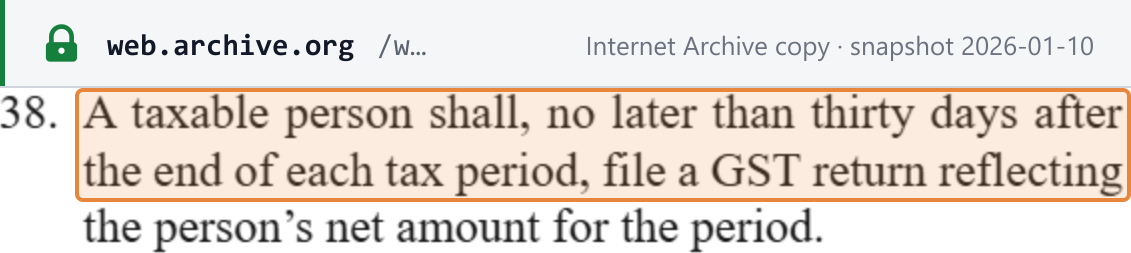
Within 30 days after the end of each tax period, for every frequency: "A taxable person shall, no later than thirty days after the end of each tax period, file a GST return reflecting the person’s net amount for the period" (s.38). Government entities use the same 30 days after each half-year (r.167(2)). A deferral of filing and payment can be requested before the due date for circumstances beyond the person's control. The late-payment penalty still runs from the original due date (rr.41–42). [1]
 Source snapshot captured 2026-10-21 from the Internet Archive copy (snapshot 2026-01-10) — archived copy · official URL
Amending a return. To increase the net amount, within five years (s.40). To reduce it, within one year (s.41).
Payment due date and method
With the return. A positive net amount "shall be paid by the taxable person at the time of filing the GST return" (s.46). Import GST is paid at customs clearance (s.47). Government entities other than state-owned enterprises must also pay over the GST they collect "by the following working day" (r.167(1)).
Method. DRC's Easy Guide says payment can be made "online through the BITS portal, via mobile banking apps, or at bank counters". DRC's notice of 30 December 2025 took its BIRMS revenue system offline to prepare "for the implementation of the new taxes (GST and Excise Tax)". Instalment arrangements normally run up to 12 months and never more than 24 (r.231). [3] [13]
Additional listings
None. Neither the Act nor the Rules require an annual GST return or a separate sales or purchase listing. Sales and purchase details are entered in the periodic return on BITS.
Input-tax recovery and blocked items
Input tax is creditable where goods or services are acquired for economic activity and for making taxable supplies (s.32). Claim it in the period of the invoice or the payment, whichever is earlier, or in any period ending within the next 12 months (ss.85–86). The claimant must hold the documents when it files (s.87), and a defective invoice cannot support a claim (r.187). Input tax on goods bought within three months before registration, for resale or for use as raw materials, can be claimed (s.107). [1]
Blocked (s.34), unless provided as employee remuneration (s.35):
- entertainment, unless providing entertainment is the business;
- club, association and society memberships;
- lottery supplies;
- passenger vehicles, and goods or services used directly in connection with them.
Cash payments above Nu. 50,000. For any part of the consideration for a taxable supply, no more than Nu. 50,000 may be paid or accepted in cash (s.322; r.248). A buyer who pays more in cash loses the input credit on that purchase (s.324), and a seller who accepts it loses the input credit on that supply (s.325).
Partial exemption. Input tax is apportioned between taxable and exempt supplies (s.36). Under a de minimis rule, exempt-related input tax is treated as taxable where the period's exempt supplies are no more than the lower of Nu. 30,000 (the monthly figure, or the monthly average for quarterly filers) and 5% of total supplies (r.59).
No transitional credit. "No transitional credit shall be available for sales tax paid on goods purchased and held in stock prior to January 1, 2026" (DRC notification of 19 August 2025). [4]
Refunds
- Excess credit. A negative net amount is carried forward, or refunded on request (ss.53–55). A refund can be claimed after three consecutive monthly periods, or one quarterly period, of carry-forward (rr.65, 67). It is immediate when registration is cancelled or activity ceases (r.66), and available without the wait to manufacturers and exporters whose returns regularly show a negative net amount (r.61). Claim within one year of filing the return (r.63).
- Timing. DRC "shall, pay the tax refund to the taxpayer no later than 30 days after the refund application is filed" (s.303), after setting off other tax debts (s.302). Late refunds carry simple interest at 5% a year (r.233). Claim overpayments within one year (s.304).
- Tourists. Visitors get refunds at departure, only through the international airport (r.147). They must buy goods worth at least Nu. 50,000, including GST, per invoice, and take them out of Bhutan (r.148). An administrative charge of 5% is deducted (r.149). DRC started the scheme on 6 February 2026, with a refund counter at Paro International Airport.
- Diplomats and international organisations claim refunds on application (ss.154–156).
- Non-resident businesses. There is no refund scheme for them, and non-residents on the simplified B2C route cannot claim input tax (r.129).
- Bad-debt relief. See Credit and debit notes (s.97). [1] [2] [9]
Contracts spanning 1 January 2026
DRC's notification DRC/GST/15/2026/392 of 27 April 2026 deals with contracts that straddle the change from Sales Tax. GST applies to the portion supplied from 1 January 2026. Invoices issued or payments received in 2025 for supplies made in 2026 belong in the first 2026 tax period. [8]
Exemptions
Exempt supplies
"GST shall not be applicable on an exempt supply or exempt import as prescribed under Schedule IV of this Act" (s.26). Only Parliament can vary the lists (s.30). No exemption can be granted by promise or administrative concession (ss.308–309).
- Exempt supplies (Schedule IV-A):
- agricultural land;
- residential leases;
- sales of residential premises, except the first sale of new premises or a resale within two years of residential occupation;
- owners'-association cost recharges;
- financial services, "except to the extent that a specific fee (not being a life insurance premium) is charged";
- going-concern sales treated as a single supply (s.116);
- education services;
- health services.
- Education and health, in detail (rr.43–48). Covered: formal curricula at licensed institutions, with meals, accommodation and administration for enrolled students; and essential medical, non-cosmetic dental, maternity, nursing and rehabilitation care. Not exempt: optional or separately charged tuition, coaching and enrichment classes; services to people who are not enrolled; cosmetic, aesthetic or elective procedures; spa, fitness and unrecognised alternative therapies.
- Exempt imports (Schedule IV-B):
- qualifying re-imports;
- goods in transit or transhipment;
- imports exempt under a ratified agreement;
- donations for natural-disaster relief;
- personal effects of Bhutanese officials returning from duty abroad;
- free baggage allowances.
- Exempt goods, domestic and imported (Schedule IV-C), listed by Bhutan Trade Classification code. As amended in 2026, the list covers:
Exemptions in other Acts. Schedule IV is not the only source of GST relief: separate Acts can also grant GST exemptions. One example is the Renewable Energy Tax Exemption Act of Bhutan 2026, on which DRC issued a public notification on 25 June 2026. Check its scope with DRC. [14]
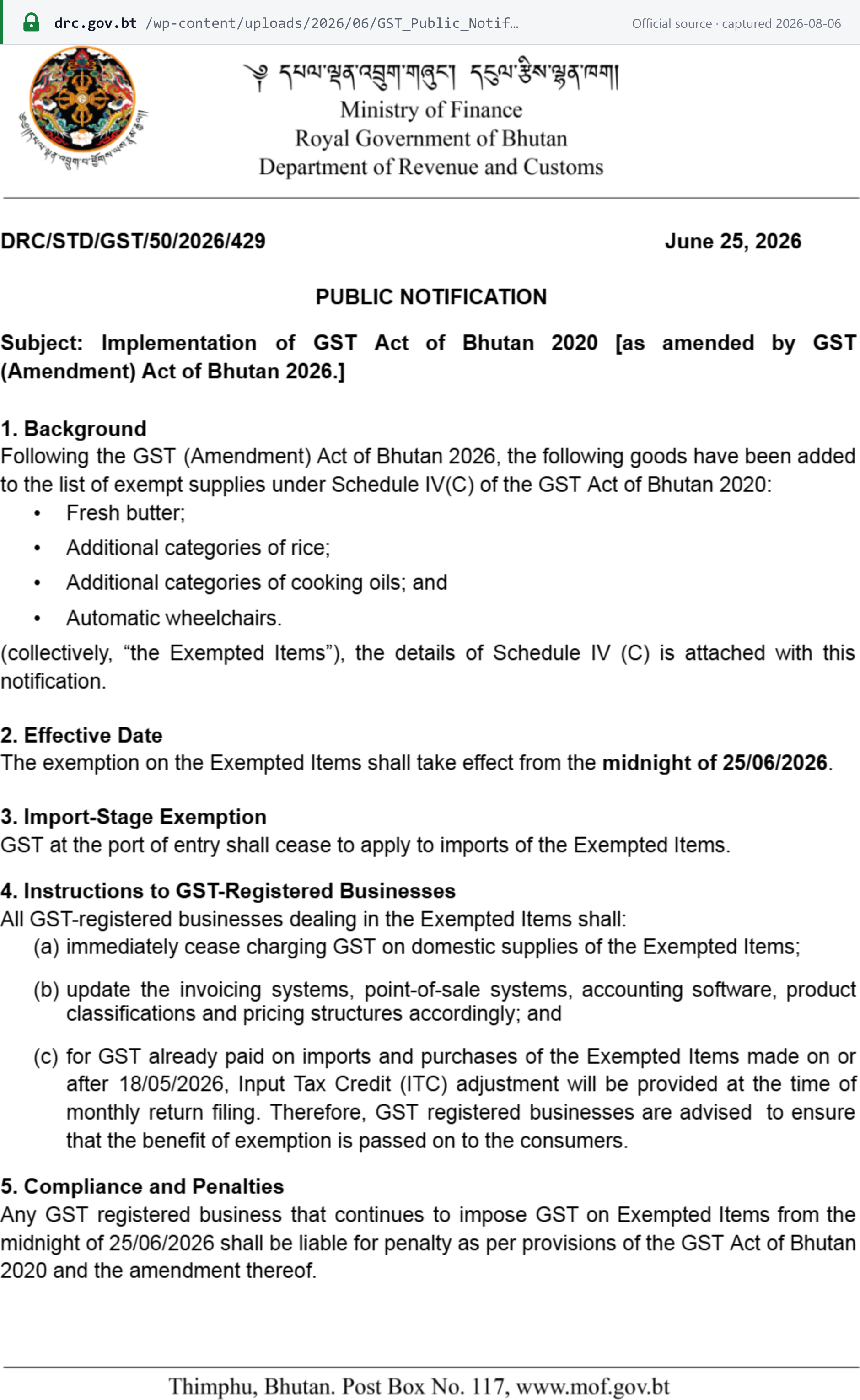
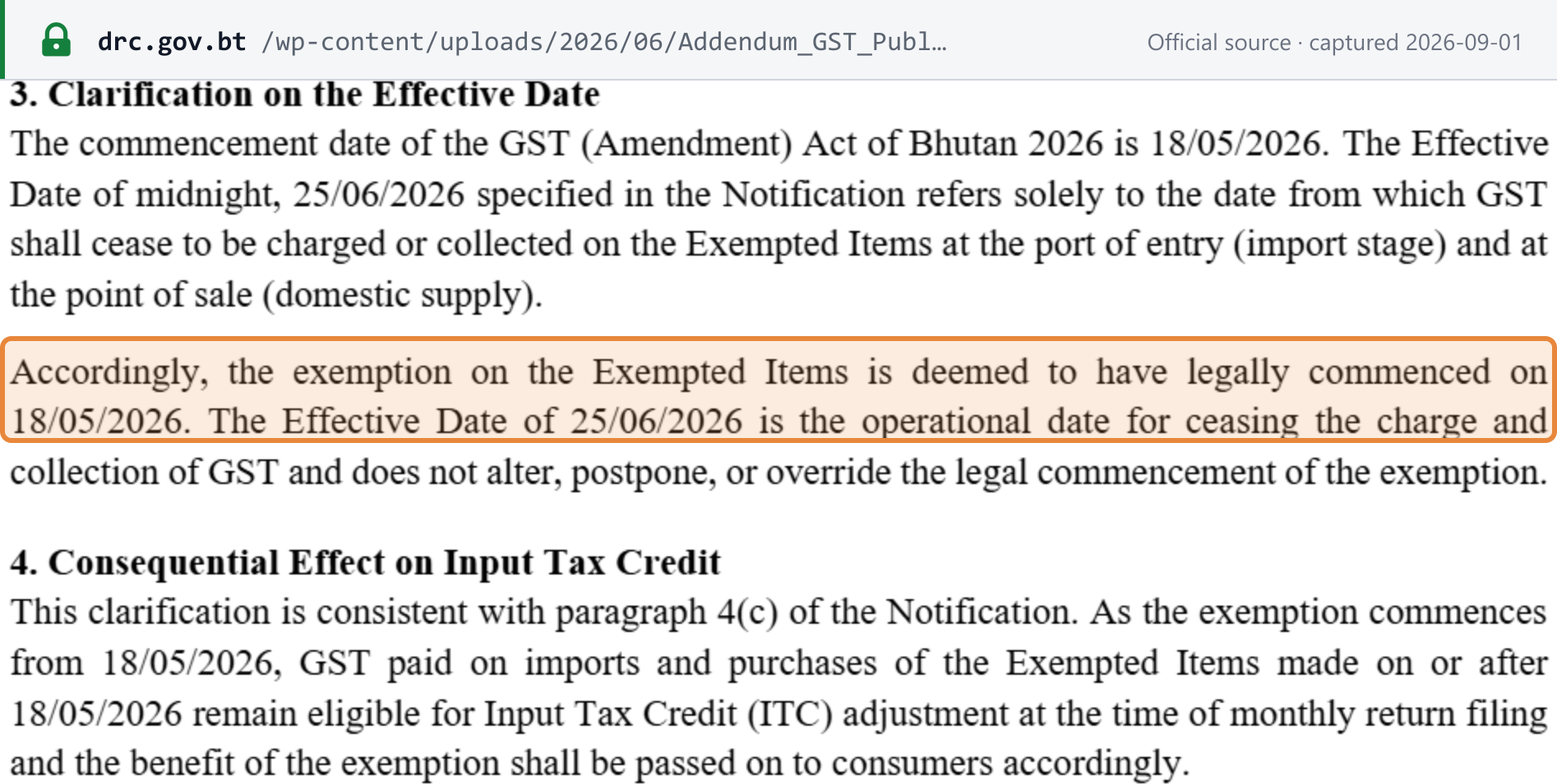
The 2026 additions. Fresh butter, further rice categories, further cooking oils and automatic wheelchairs were added to Schedule IV(C) by the GST (Amendment) Act of Bhutan 2026. DRC's Public Notification DRC/STD/GST/50/2026/429 of 25 June 2026 told businesses to stop charging GST on them from midnight on 25 June 2026. Its Addendum DRC/GST/50/2026/430 of 26 June 2026 then clarified that the Amendment Act commenced on 18 May 2026. The exemption therefore "is deemed to have legally commenced on 18/05/2026"; 25 June 2026 is only the date collection stopped. GST paid on these items from 18 May 2026 can be adjusted as input tax credit in the monthly return. The consolidated Act of September 2025 does not yet show the additions. [10] [11]
 Source snapshot captured 2026-08-06 — original
 Source snapshot captured 2026-09-01 — original
Exempt is not zero-rated. An exempt supplier gets no input tax credit: "The supplier or importer shall not be entitled to input tax credits to the extent that an acquisition or import is for the purpose of making an exempt supply" (s.27). A zero-rated supplier keeps full credit (s.29). Where a supply is both exempt and zero-rated, it is zero-rated (s.31).
Special regimes
- Second-hand goods. A dealer buying second-hand goods for resale gets a decreasing adjustment equal to the tax fraction of the purchase price (ss.136–137). This is not a margin scheme.
- Travel agents. Bhutanese tourism supplies by a non-resident, unregistered travel agent are not made in Bhutan (s.151). A resident agent's foreign tourism supplies are taxed on a margin computed under the Rules (ss.149–153).
- Duty-free vendors. Sales to tourists are zero-rated (Schedule V para 2(2)).
- Government entities. Half-yearly periods, next-working-day payment of GST collected, and no input credit (rr.166–168).
- Not provided: a flat-rate or small-business scheme (beyond voluntary registration and quarterly filing), cash accounting, or a free-zone or SEZ regime in the GST Act or Rules. [1] [2]
Offences and penalties
Offences
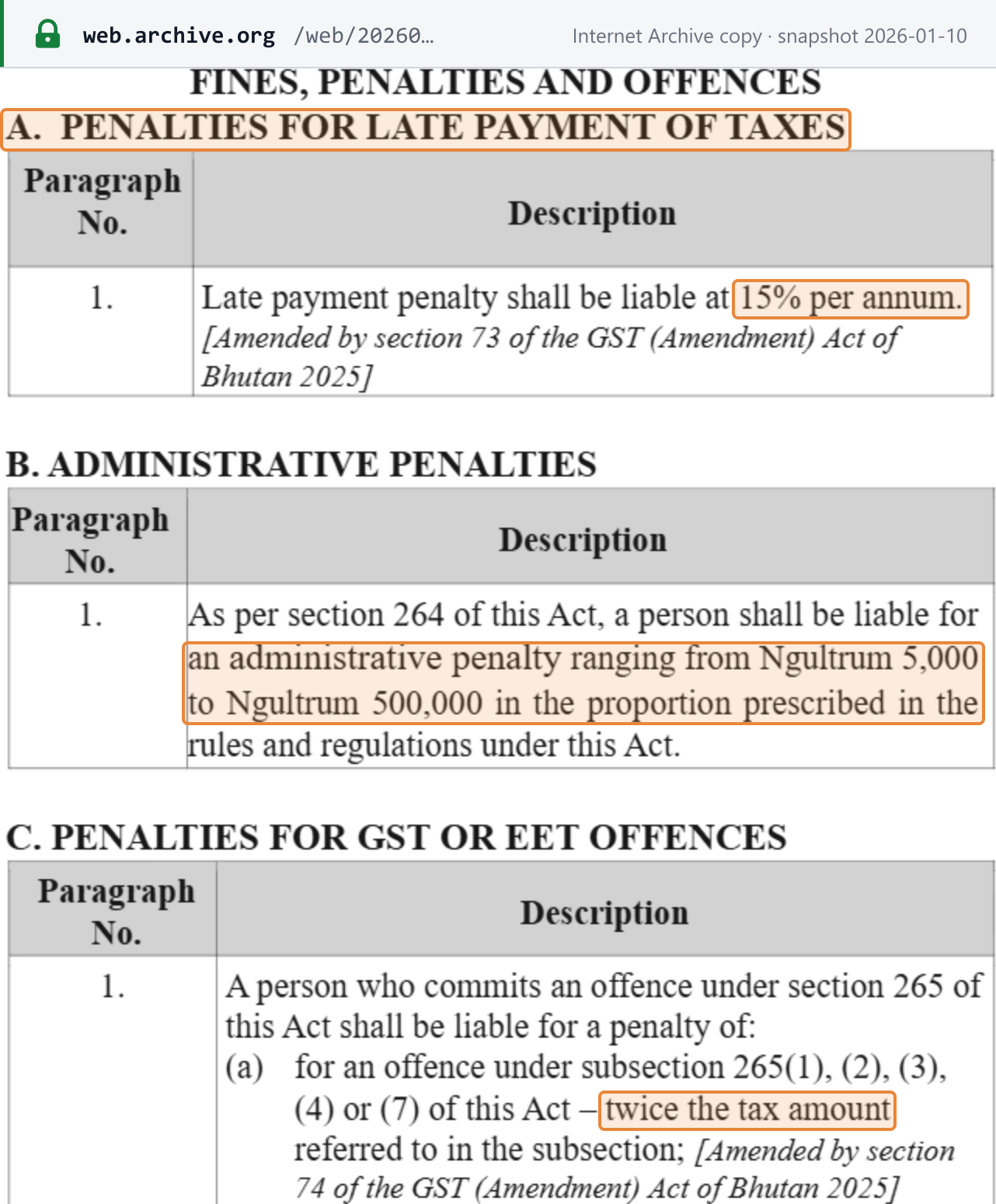
GST offences are set out in s.265, with penalties in Schedule VII-C and r.263:
| Offence (s.265) | Penalty |
|---|---|
| (1) Evading or attempting to evade GST, or fraudulently obtaining a benefit | Twice the tax amount |
| (2) Purposely creating or keeping false records | Twice the tax amount |
| (3) Destroying records to evade GST | Twice the tax amount |
| (4) Purposely making a false or misleading statement in a return, causing a shortfall or an excess credit or refund | Twice the tax amount |
| (5) Purposely not filing a return on three or more occasions | Nu. 20,000 for every failure |
| (6) Falsely representing that a person is GST-registered, or that a price includes GST | From Nu. 50,000, up to Nu. 1,000,000 |
| (7) Paying or accepting cash above the Nu. 50,000 limit (s.322) | Twice the tax amount |
| (8) Any other contravention of the Act or Rules | From Nu. 50,000, up to Nu. 1,000,000 |
Where the administrative penalty for similar conduct is higher, the higher one is imposed (Schedule VII-C para 2). A person cannot be penalised both administratively and for an offence for the same act (s.266).
Criminal exposure. If DRC finds a prima facie criminal offence, it submits its findings "to the Office of the Attorney General for Prosecution" (s.268). The GST Act itself sets no prison term.
Enforcement powers include:
- searches, with or without a warrant (ss.271–272);
- seizure and confiscation (ss.286–288);
- garnishee notices (s.244);
- departure prohibition orders, with a court order (s.249);
- withholding tax-clearance certificates (s.250);
- licence suspension (s.251);
- freezing the movement of goods (s.254).
A person with three periods unfiled or unpaid can be classed as a delinquent taxpayer (r.223). [1] [2]
Penalties
- Late payment: 15% a year, accruing daily on the outstanding tax from the date it became payable until paid (Schedule VII-A, as amended by s.73 of the GST (Amendment) Act of Bhutan 2025; s.262). It is not charged on penalties (s.261), and still runs during an approved instalment arrangement (s.263) or filing deferral (r.42(2)).
- Administrative penalties range "from Ngultrum 5,000 to Ngultrum 500,000", in the amounts the Rules prescribe (Schedule VII-B; s.264; r.262).
| Contravention (s.264) | First | Second or later |
|---|---|---|
| (1)(a) Failing to register | Nu. 10,000 | GST offence under s.265(8) |
| (1)(b)–(m) Failing to notify changes, apply for cancellation, file a return, provide documents, keep records, provide information, attend, assist, issue a tax invoice, issue an adjustment note, or comply with a garnishee or other notice | Nu. 5,000 | Nu. 10,000 |
| (2) Entering into a scheme caught by the general anti-avoidance rule | Nu. 250,000 | Nu. 500,000 |
| (3) Leaving Bhutan in breach of a departure prohibition order | Nu. 100,000 | Nu. 200,000 |
| (4) Advertising, displaying or quoting prices exclusive of GST | Nu. 5,000 | Nu. 10,000 |
| (5) A false or misleading statement causing a shortfall or an excess credit or refund | Nu. 200,000 | Nu. 400,000 |
| (7) Any other contravention | Nu. 10,000 | Nu. 20,000 |
Penalties can be remitted through an independent committee for causes outside the taxpayer's control, DRC delays or undue hardship (s.267; rr.264–268). [1] [2]
 Source snapshot captured 2026-10-21 from the Internet Archive copy (snapshot 2026-01-10) — archived copy · official URL
Frequently asked questions
Our turnover is below Nu. 5 million. Can we still charge GST in Bhutan?
Not unless you are registered. Only businesses registered with the Department of Revenue and Customs (DRC) as GST registrants may charge and collect GST; DRC said so in its public notification of 5 January 2026. Falsely representing that you are registered, or that a price includes GST, is a GST offence under section 265(6) of the GST Act, with a penalty from Nu. 50,000 up to Nu. 1,000,000. If you want to charge GST and claim input tax, you can apply for voluntary registration once your turnover in the past 12 months exceeds Nu. 2,500,000 (GST Rules 2026, rule 8).
We are a foreign SaaS or streaming business with Bhutanese customers. Who accounts for the GST?
It depends on the customer. For imported B2B services, the Bhutanese business customer accounts for the GST itself under the reverse charge (GST Act section 14(3) and section 33). For imported B2C services, the operator of the electronic distribution platform is liable if the sale goes through a platform; otherwise the foreign supplier is (section 14(4)). A non-resident making only imported B2C services can opt for simplified registration and simplified returns, but then cannot claim input tax (GST Rules 2026, rule 129). The law sets no separate registration threshold for non-residents.
Can we claim the Sales Tax we paid on stock held on 1 January 2026?
No. DRC's notification of 19 August 2025 says no transitional credit is available for sales tax paid on goods purchased and held in stock before 1 January 2026, and that taxes paid under the previous system cannot be claimed as input tax credit under GST.
What exchange rate do we use on a USD or INR invoice in Bhutan?
The GST Rules 2026 require the total and the GST to be stated in Ngultrum when an invoice is in another currency (rule 185(7)), but they no longer prescribe a conversion rate. An earlier DRC notice mentioned the rate prevailing at the end of the tax period; the Ministry of Finance's notification of 31 December 2025 records that this provision was removed. Confirm the rate to use with DRC.
Can we accept cash for a sale above Nu. 50,000 in Bhutan?
No. Cash may be paid or accepted for a taxable supply only up to Nu. 50,000 (GST Act section 322 and GST Rules 2026, rule 248). A buyer who pays more in cash loses the input tax credit on that purchase (section 324), and paying or accepting cash in breach of the limit is a GST offence carrying a penalty of twice the tax amount (section 265(7) and Schedule VII-C).
Important websites
| Site | Purpose |
|---|---|
| DRC — Department of Revenue and Customs | Tax authority home page; notices and GST news |
| DRC — Goods and Services Tax (GST) | GST hub: the Act, the Rules and DRC notifications |
| DRC — Easy Guide for Businesses and Consumers | DRC's plain-English guide to registration, rates, invoices, returns and exemptions |
| Bhutan Integrated Taxation System (BITS) | The GST portal for registration, returns and payment; reach it from the DRC site |
| RAMIS — taxpayer registration | TPN registration (linked from the DRC home page) |
| BIRMS | DRC revenue-payment system (linked from the DRC home page) |
| Electronic Customs Management System | Customs declarations, where import GST is paid (linked from the DRC home page) |
| DRC helpline | Toll-free 3999 (as given in DRC notices) |
There is no public lookup of registered persons that we could find, no rate-lookup tool (the Easy Guide's rate table is DRC's own summary) and no e-invoicing portal.
Recent changes
- 2026-06-26 — DRC Addendum DRC/GST/50/2026/430: the Schedule IV(C) exemptions legally commenced on 18 May 2026; 25 June 2026 was only the date collection stopped, and GST paid from 18 May is adjustable as input tax credit. (DRC) — see event
- 2026-06-25 — The GST (Amendment) Act of Bhutan 2026 adds fresh butter, further rice categories, further cooking oils and automatic wheelchairs to Schedule IV(C); GST stops being charged on them from midnight on 25 June 2026 (DRC/STD/GST/50/2026/429). (DRC) — see event
- 2026-04-27 — DRC notification DRC/GST/15/2026/392 on contracts spanning 1 January 2026: GST applies to the portion supplied from that date. (DRC)
- 2026-02-06 — Tourist GST refunds start, at a counter at Paro International Airport (DRC/GST/50/2026/1352). (DRC)
- 2026-01-01 — GST replaces Sales Tax (DRC/STD/GST/50/2025/997), at the single 5% rate and with the Nu. 5,000,000 registration threshold set by Schedules I and II of the GST Act. (DRC notice · GST Act)
- 2025-12-31 — The Ministry of Finance records that the end-of-period currency-conversion rule was removed from the GST Rules 2026. (MoF/DRC)
For the full chronology, see Bhutan tax changes on Lookuptax.
Reference links
- DRC — Consolidation of the GST Act of Bhutan 2020 and amendments thereof (September 2025; incorporates the 2021, 2022 and 2025 amending Acts)
- Ministry of Finance — GST Rules 2026
- DRC — Easy Guide for Businesses and Consumers
- DRC — Notification DRC/GST/1/2025-2026/194 of 19 August 2025 (GST readiness)
- DRC — Public Notification DRC/STD/GST/50/2025/997 of 19 December 2025 (introduction of GST)
- DRC — Public Notification DRC/STD/GST/50/2026/1087 of 5 January 2026 (collection of GST by registered businesses)
- Ministry of Finance — Notification on the GST Rules change (31 December 2025)
- DRC — Notification DRC/GST/15/2026/392 of 27 April 2026 (ongoing contracts)
- DRC — Public Notification DRC/GST/50/2026/1352 of 6 February 2026 (tourist refunds)
- DRC — Public Notification DRC/STD/GST/50/2026/429 of 25 June 2026 (Schedule IV(C) additions)
- DRC — Addendum DRC/GST/50/2026/430 of 26 June 2026 (commencement 18 May 2026)
- GST (Amendment) Act of Bhutan 2022
- DRC — Public Notification DRC/RAAD/BIRMS-01/2025-2026/1054 of 30 December 2025 (BIRMS downtime for the GST start)
- DRC — Public Notification on the Renewable Energy Tax Exemption Act of Bhutan 2026 (25 June 2026)
Related on Lookuptax:
- VAT registration thresholds worldwide
- Worldwide tax rates
- E-invoicing status and networks worldwide
- Reverse charge explained
- VAT on digital services by non-resident suppliers
- Marketplace deemed-supplier rules
- How to register for VAT, sales tax or GST
- India GST guide
- Check a VAT number — official lookups by country