Fiji VAT guidelines
| FACTSHEET | |
|---|---|
| Country code | FJ |
| Tax name | Value Added Tax (VAT) |
| Tax Authority | Fiji Revenue and Customs Service (FRCS) |
Overview
Fiji levies Value Added Tax (VAT) under the Value Added Tax Act 1991 (the "VAT Act"), which came into force on 1 July 1992. FRCS describes it as "a tax on spending that is levied on the supply of goods and services in Fiji", and publishes in English only. Page references below are to FRCS's compilation of the Act revised up to 1 August 2025, which also contains the Value Added Tax Regulations 1991. That compilation does not yet include the Value Added Tax (Budget Amendment) Act 2026 (Act No. 15 of 2026), in force from 1 August 2026, which is described where it changes a rule. [1] [2]
Authority. VAT is administered by the Fiji Revenue and Customs Service (FRCS), headed by a Chief Executive Officer (the "CEO" in the Act). FRCS Customs collects VAT on imports (VAT Act s.14). Most procedural rules — records, penalties, objections — sit in the Tax Administration Act 2009 (TAA), which also carries the Tax Administration (Electronic Fiscal Device) Regulations 2017; many VAT Act sections on assessment and appeals are marked "(Repealed)" because they moved there. [1] [4]
Currency. The Fiji dollar (FJD; FRCS writes "$"). Section 83 of the VAT Act requires every amount to be "expressed in Fijian currency", and consideration for a supply to be expressed in Fijian currency "as at the time of that supply". [1]
Tax period. One month, or three months for smaller businesses on application (s.32). VAT periods are not tied to the income-tax year.
Layering. VAT is a single national tax; the VAT Act provides for no provincial or municipal VAT. From 1 September 2026 to 31 August 2027 a separate national Tourism Services Tax (TST) of 5% applies alongside VAT to larger tourism businesses — see Tourism Services Tax.
For other Pacific systems, see the Australia GST guide, the New Zealand GST guide and the Samoa tax ID guide.
Registration
Who should register
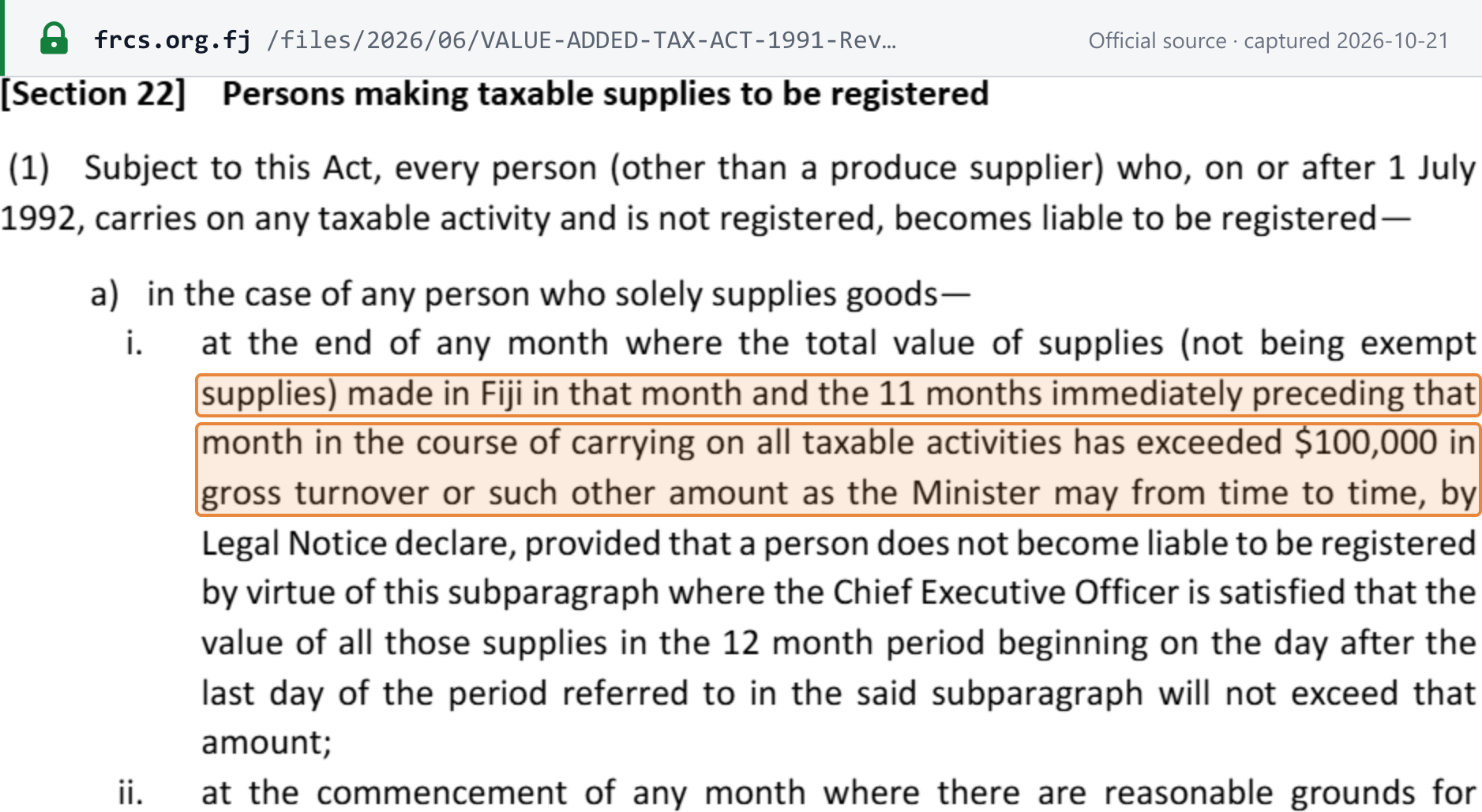
Every person (other than a produce supplier) carrying on a taxable activity in Fiji becomes liable to register once its taxable supplies pass the threshold below (VAT Act s.22(1)). The test counts supplies made "in the course of carrying on all taxable activities" of the person. Produce suppliers — those supplying produce in a raw and unprocessed state, where produce makes up at least 90% of their supplies — are outside compulsory registration. [1] [2]
Registration threshold
FJD 100,000 of taxable supplies over a rolling 12 months. Section 22(1) makes a person liable "at the end of any month where the total value of supplies (not being exempt supplies) made in Fiji in that month and the 11 months immediately preceding that month … has exceeded $100,000 in gross turnover". The same figure applies to suppliers of goods (s.22(1)(a)) and everyone else (s.22(1)(b)). [1]
- Forward-looking test. A person is also liable at the start of any month where there are reasonable grounds to believe that month and the 11 following will exceed FJD 100,000.
- Escape. A person who crossed the figure is not liable if the CEO is satisfied the next 12 months' supplies will not exceed it; a one-off excess caused by winding down a business or replacing capital assets is ignored (s.22(2)).
- Deadline. Apply "within 21 days of becoming so liable" (s.22(3)).
- History. FJD 100,000 since 1 January 2012 (Decree 10 of 2012); the Minister may change it by Legal Notice. [1] [2]
 Source snapshot captured 2026-10-21 — original
A person who should have registered and did not is registered by the CEO from the date it first became liable (s.22(5)(b)), and owes VAT on its supplies from then even though it charged none.
Non-resident registration
The VAT Act sets no separate threshold or registration regime for non-residents: s.22 applies to "every person" carrying on a taxable activity with supplies made in Fiji. The Act's only non-resident mechanism is s.29, which makes the agent in Fiji of a non-resident principal liable for the principal's returns and tax; the CEO may declare a person a non-resident or an agent for that purpose. For services bought in from abroad, see the reverse charge below. [1]
Tax identification number
VAT registration attaches to the Taxpayer Identification Number (TIN); FRCS describes no separate VAT number, and the Act's invoice rules call for "the taxpayer identification number of the supplier". A company registers with the Registrar of Companies first, then signs up as a new taxpayer so that "a new and separate TIN can be issued for the entity". [16]
Format. FRCS publishes no format, length or check digit for the TIN. Its specimen invoices use the dummy "TIN: 500000000", which is not a format rule. Lookuptax has no Fiji tax-ID page or validator yet. FRCS publishes a PDF list of VAT-registered taxpayers (as at 30 June 2026) from its VAT page; for official lookups elsewhere, see Check a VAT number.
How to register
- Get a TIN on FRCS's online portal, TPOS (Taxpayer Online Services). Companies register with the Registrar of Companies first.
- Register for VAT on TPOS, either when applying for the TIN or later: "Taxpayers can register for VAT either when they are applying for a TIN or for existing Taxpayers, they can apply via the TPOS portal after signing up."
"Applicants will not be required to pay fees for registration on TPOS." FRCS publishes no processing time. A business in a gazetted group must separately register its point-of-sale system with the VAT Monitoring System — see E-invoicing status. [2] [16]
See also how to register for VAT, sales tax or GST.
Voluntary registration
Available. Any person who carries on, or intends from a specific date to carry on, a taxable activity making other than exempt supplies may apply on the prescribed form (s.22(4)); FRCS lists this for businesses with annual gross turnover under FJD 100,000. Registering lets a business recover input tax and invoice VAT to registered customers. [1] [2]
Deregistration
- Turnover below the threshold. After 12 months of registration, a person may apply where its taxable supplies in the next 12 months will not exceed FJD 100,000 (s.23(1)–(2)).
- Ceasing all taxable activities. Notify the CEO "within 7 days of the date of cessation" (s.23(3)). Cancellation runs from the last day of that taxable period, unless taxable activity is expected to resume within 12 months.
- At any time. Produce suppliers, non-competing non-profit bodies and persons registered in error (s.23(7)).
- Assets on hand when registration ends are a deemed supply.
- Final return. A person who ceases to be registered files a final return "not later than one month after so ceasing", covering the part of the last taxable period during which it was registered (s.33(2)).
Applications are made through TPOS. [1]
Group registration
Not available in Fiji: the VAT Act has no VAT-grouping provision. Part 6 ("Special cases", ss.26–31B) covers unincorporated bodies, branches and divisions, personal representatives, agents and similar cases. Its one separate-person rule is s.27(1): a registered person whose branch or division solely supplies produce may apply for that branch or division to be treated as a separate person, which the CEO may allow where it keeps independent accounts and can be separately identified (s.27(2)). See VAT grouping for how other countries do it.
Rates
| Rate | Applies to | Source |
|---|---|---|
| 12.5% (standard) | Every taxable supply in Fiji, and imports, not zero-rated or exempt | VAT Act ss.14(1), 15(1) |
| 0% | Exports, international transport, services to non-residents and other Schedule 2 supplies, plus 21 listed essential items | VAT Act Schedule 2 |
| Exempt | Financial services, residential rent, education and other Schedule 1 supplies (no input-tax recovery) | VAT Act Schedule 1 |
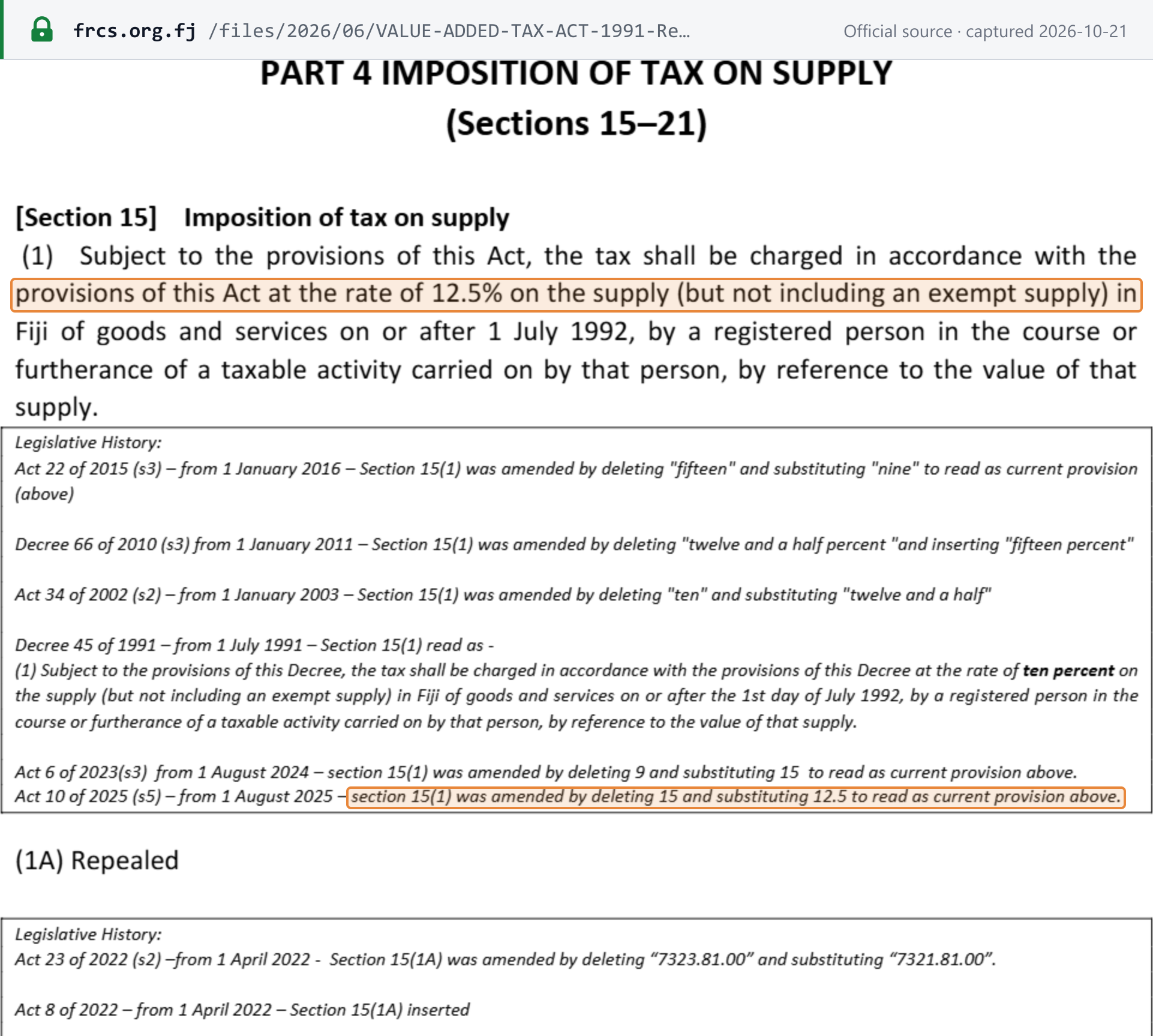
Standard rate: 12.5% since 1 August 2025. It was a cut from 15%: section 15(1) charges tax "at the rate of 12.5% on the supply (but not including an exempt supply) in Fiji of goods and services", and its history note records that Act 10 of 2025 (s.5), "from 1 August 2025", amended s.15(1) "by deleting 15 and substituting 12.5". Import VAT is charged at the same 12.5% (s.14(1)). The VAT fraction of a VAT-inclusive price is 1/9. [1] [2]
 Source snapshot captured 2026-10-21 — original
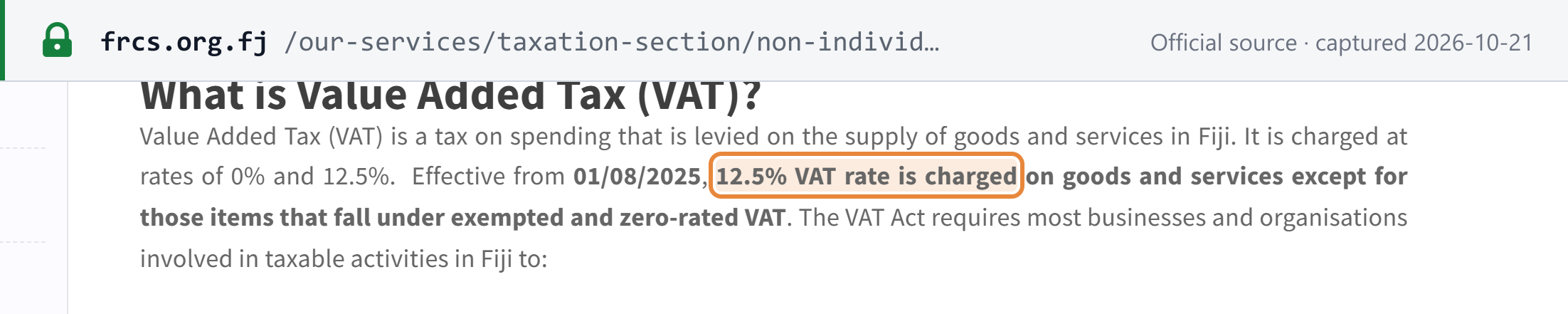
FRCS's VAT page restates both rates:
 Source snapshot captured 2026-10-21 — original
Rate history (FRCS VAT page): 10% from 1992, 12.5% from 2003, 15% from 2011, 9% from 2016, 9% general with 15% on listed items from 1 April 2022, 15% from 1 August 2023, and 12.5% from 1 August 2025. Point-of-sale systems use tax label "G" for the 12.5% rate, introduced on 1 August 2025. FRCS's tax-rates page lists the same 0% and 12.5% from 1 August 2025. [3] [2] [20]
Zero rate. Schedule 2 zero-rates, among others: exports of goods (which must leave within 28 days where the supplier enters them for export), goods outside Fiji, the sale of a going concern to a registered person, international transport, services physically performed outside Fiji, listed services to non-residents (para 14) and 21 essential items by tariff code — canned fish, cooking gas, cooking oil, baby milk, powdered milk, liquid milk, dhal, flour, garlic, kerosene, potato, onion, tea, salt, sanitary pads, soap, soap powder, sugar, toilet paper, toothpaste and rice (para 31). Every zero-rating claim is conditional on the CEO being satisfied that export earnings were remitted to Fiji. FRCS's tax-label table also says zero rating applies to prescribed medicines from 1 August 2023; we did not find the matching paragraph in the revised Schedule 2, so confirm a specific product with FRCS. [1] [2]
Reduced rates. None. The 9% rate (label "A") ended on 31 July 2023, and the 15% rate on prescribed services (Schedule 2A) has been repealed.
Announced changes. No change to the 12.5% rate has been announced: the VAT measures in FRCS's summary of the 2026–2027 Budget do not touch the rate, and the Value Added Tax (Budget Amendment) Act 2026 (Act No. 15 of 2026) does not amend s.15. [12] [13]
For other countries' rates, see worldwide tax rates.
Tourism Services Tax (TST)
A separate Tourism Services Tax at 5% applies under the Tourism Services Tax Act 2026 (Act No. 20 of 2026), assented on 17 July 2026 and in force from 1 September 2026. FRCS's guidance on it is Standard Interpretation Guideline 2026-09, marked "Final Draft (Version 2)". [10] [11] [21]
- Who. A business providing a scheduled tourism service whose annual gross turnover from those services exceeds FJD 2 million (s.3(1)). The Schedule covers licensed hotels (accommodation, refreshments and other services), vessels carrying tourists within Fiji, meals and drinks in a hotel's licensed bar or club, inbound tour services, water sports including underwater activities, surfing and river safaris, and similar services.
- How long, and where the money goes. The Ministry of Finance says TST applies "from 1 September 2026 to 31 August 2027", and for that period the tax collected "must be paid to the company that owns or operates Fiji Airways" (s.5). [23] [11]
- Which bookings. The Ministry of Finance's release of 25 August 2026 says TST "will apply only to new bookings made on or after 1 September 2026", even where the service is provided later. FRCS's guidance agrees: "TST will apply to all bookings (defined as confirmed reservation or invoices or payments) for prescribed tourism services made from 1 September 2026", and not to bookings made before then or from 1 September 2027. FRCS's earlier commencement notice spoke of services "supplied or consumed from 1 September 2026"; this guide follows the later booking-date position. [10] [23]
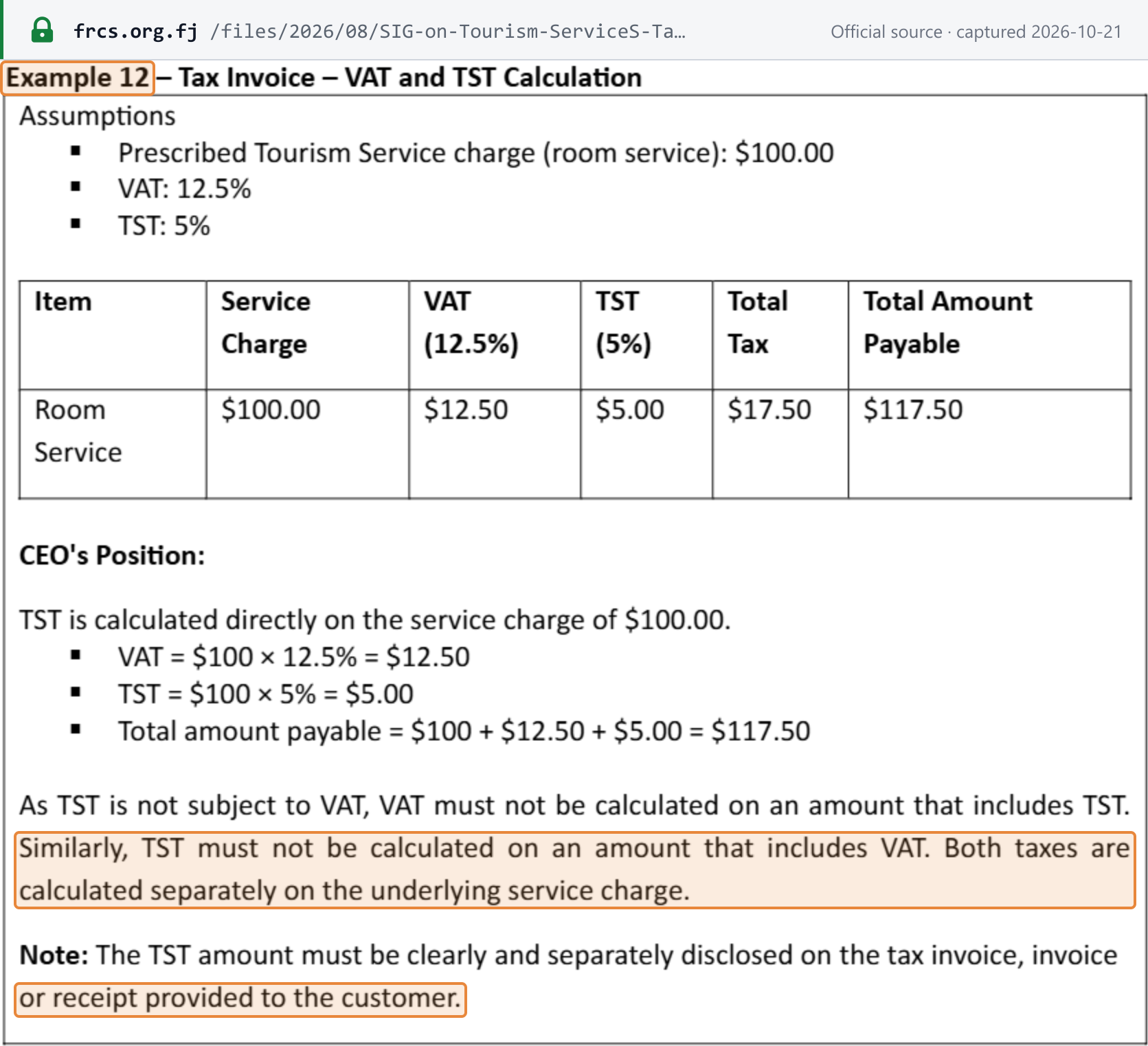
- No tax on tax. TST is "not subject to the value added tax", and it must be "clearly and separately shown on a tax invoice, invoice or receipt" (s.3(4)). FRCS adds that VAT is not subject to TST either, so both are calculated on the underlying charge.
- Returns. A monthly return of turnover, with payment by the last day of the following month (s.4(1)). Failing to file or filing a false return is an offence carrying a fine of up to FJD 25,000, up to 10 years' imprisonment, or both (s.4(2)).
- Point of sale. EFD systems use tax label "H" for TST from 1 September 2026. [24]
 Source snapshot captured 2026-10-21 — original
Cross-border rules
Imports and exports
- Imports. VAT at 12.5% is levied on goods imported into Fiji, other than Schedule 2 zero-rated goods, and collected by FRCS Customs under the Customs Act 1986 (s.14(1)). Since August 2024, goods imported for personal use — including online purchases — are no longer VAT-free, although household items zero-rated domestically stay VAT-free on import (FRCS notice of 30 August 2024, which quotes the rate then in force). FRCS publishes no VAT de minimis for imports. A registered importer recovers import VAT as input tax on the customs documentation and payment receipt. [1] [19]
- Exports. Zero-rated under Schedule 2 paras 1–4, provided the export earnings are remitted to Fiji. Goods the supplier will enter for export must leave within 28 days of the time of supply, or the supply is taxed at the standard rate. [1]
Reverse charge on imported services
Under s.21, where "relevant services" are supplied by a person who belongs outside Fiji and received by a person in Fiji "for the purposes of any taxable activity", "all the consequences shall follow under this Act as if the recipient had supplied the services in Fiji". Relevant services are those in Schedule 2 para 14 other than exempt financial services: intellectual property, advertising, consultancy, legal and accounting, data processing, staff supply, ICT services and similar. The foreign supplier's invoice serves as the tax invoice (VAT Regulations reg 10). Today the charge is at 12.5%. [1]
FRCS calls this the VAT Reverse Charge (VRC). Its brochure — written while the rate was 15% — says VRC "is paid at the time a tax clearance is applied at FRCS", that is, when the payer applies to remit the fee abroad, and that unregistered payers pay it too but "will not be able to claim the VRC paid". That collection practice is FRCS's; s.21 itself is framed around a taxable activity. [17]
See reverse charge explained for how this compares with other systems.
Digital products and services
FRCS publishes no rule taxing foreign suppliers of digital or remote services to Fijian consumers in the VAT Act, on its VAT pages or in its 2026–2027 Budget summary. The Act contains no provision on electronic or remote services, and s.21 reaches only services received for a taxable activity. The former Part 4A on "prescribed services" taxed listed domestic services at 15% and was repealed from 1 August 2023; it was not a digital-services regime. See VAT on digital services by non-resident suppliers. [1]
Foreign companies selling into Fiji — B2B and B2C
- B2B services. The Fijian business customer self-accounts under the reverse charge (s.21), and FRCS collects it at tax clearance. The foreign supplier does not register.
- B2C services. No published rule makes a foreign supplier register or collect VAT on services to Fijian consumers; s.21 does not reach a private recipient, so no VAT is collected on such supplies under the current Act. This is a gap in the rules, not an exemption.
- Goods. Import VAT is collected at the border, whoever the buyer is.
- Trading in Fiji through an agent. The agent in Fiji is liable for the non-resident principal's returns and tax (s.29).
- Threshold. None specific to non-residents. [1]
Marketplace / platform deemed-supplier liability
Not provided for: the VAT Act contains no marketplace or deemed-supplier rule. See marketplace deemed-supplier rules.
Place of supply
- Goods not moving to or from Fiji are supplied in Fiji if they are in Fiji (s.16(2)).
- Goods removed from Fiji are supplied in Fiji, then zero-rated as exports; goods removed to Fiji are supplied outside Fiji, and import VAT applies instead (s.16(3)).
- Services are supplied "in Fiji if the supplier belongs in Fiji", or in another country if the supplier belongs there (s.16(4)) — a supplier-location test, which is why s.21 is needed for imported services. Section 17 defines where a person belongs. [1]
Tourist VAT Refund Scheme
Non-resident tourists aged 13 and over can reclaim VAT on non-consumable goods bought from approved retailers, if they spend at least FJ$500 in total within two months before departure. The retailer issues a Form 7, and refunds are claimed at Nadi and Nausori airports and the cruise terminals (VAT Act s.70B and Schedule 4). [18]
Invoice requirements
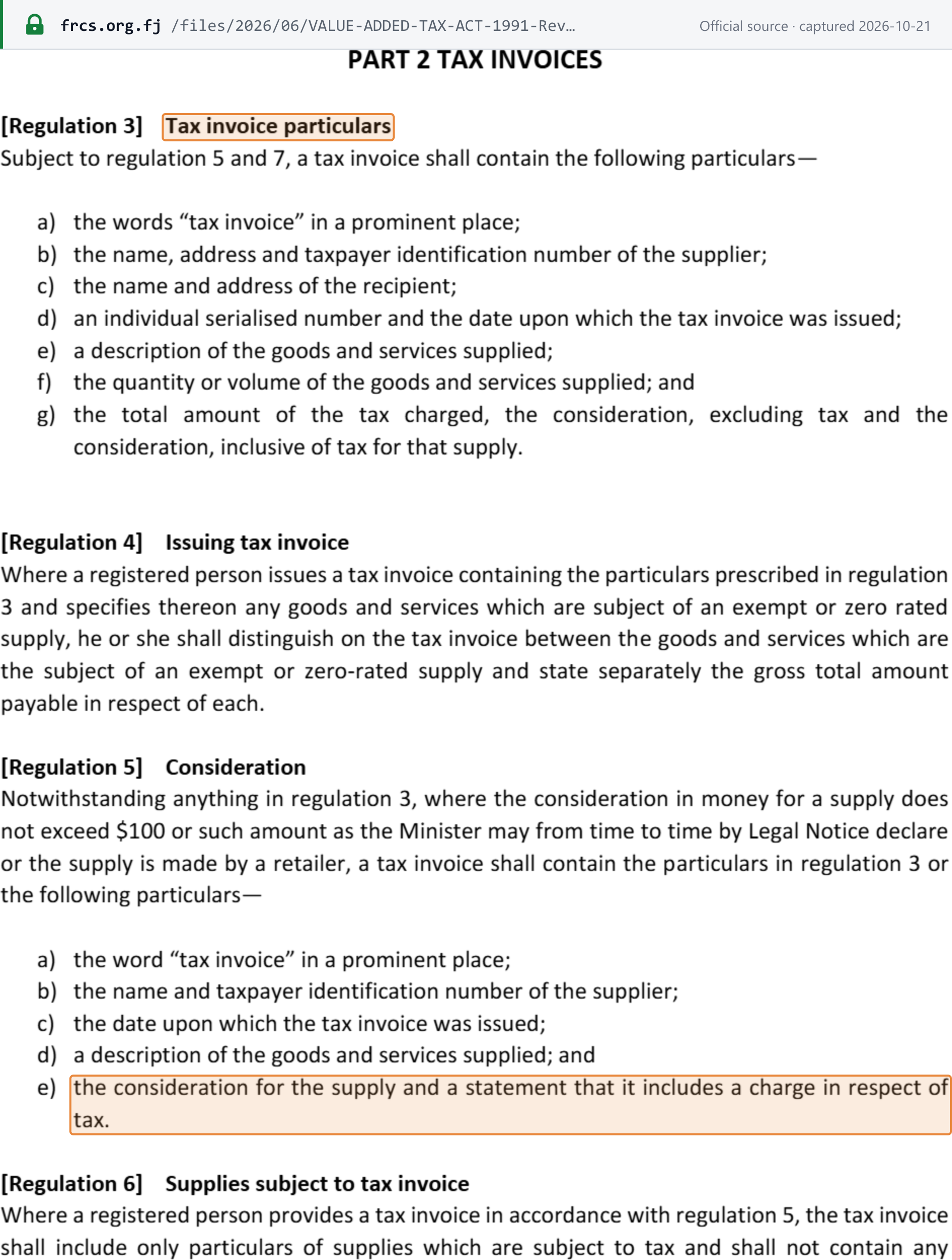
A registered supplier making a taxable supply "shall issue a tax invoice containing such particulars as specified by regulation at the time that the supply takes place" (VAT Act s.41). Only one tax invoice may be issued for each taxable supply; if the original is lost, a copy clearly marked "copy only" may be provided. The particulars are in the VAT Regulations 1991, regs 3 to 12, printed at the back of the revised Act. [1]
Mandatory content
A full tax invoice must contain (reg 3):
| # | Particular | VAT Regulations |
|---|---|---|
| 1 | The words "tax invoice" in a prominent place | reg 3(a) |
| 2 | Supplier's name, address and TIN | reg 3(b) |
| 3 | Recipient's name and address | reg 3(c) |
| 4 | An individual serialised number and the date of issue | reg 3(d) |
| 5 | Description of the goods and services | reg 3(e) |
| 6 | Quantity or volume | reg 3(f) |
| 7 | Total tax charged, the consideration excluding tax and the consideration including tax | reg 3(g) |
Where the invoice also lists exempt or zero-rated goods or services, the supplier must distinguish them and "state separately the gross total amount payable in respect of each" (reg 4). The recipient's TIN is not a reg 3 particular, but a fiscal invoice issued through an EFD for a business-to-business sale carries it — see E-invoicing status. [1]
 Source snapshot captured 2026-10-21 — original
Issuance deadline
At the time of supply (s.41); there is no deferred-issuance window. The time-of-supply rules in s.18 govern when that is. Since 1 August 2026, for hotel and accommodation services the time of supply is "at the time of checkout or at the end of the stay" (new s.18(2)(h), inserted by s.3 of the Value Added Tax (Budget Amendment) Act 2026, Act No. 15 of 2026). FRCS's revised compilation of the Act does not yet show the change. [12]
Numbering and sequencing
Each tax invoice needs "an individual serialised number" (reg 3(d)). A fiscal invoice produced through an EFD carries "the sequential serial number of the receipt" generated by the device (EFD Regulations reg 12(2)(m)). [1] [4]
Credit and debit notes
A credit or debit note is required where an invoiced supply is cancelled, the agreed consideration changes (other than a prompt-payment discount stated on the invoice), or goods are returned (s.42). Only one note may be issued for each adjustment. It must show (reg 11):
- the words "credit note" or "debit note" in a prominent place;
- the name and TIN of the registered person;
- the name and address of the recipient;
- the date of issue;
- the tax shown on the original invoice, the adjusted amount and the difference;
- a brief explanation of why the note is issued.
The adjustment is made in the return for the period in which the note is issued. [1]
Currency and language
- Currency. Amounts are expressed in Fijian currency, and foreign-currency consideration is expressed in Fijian currency "as at the time of that supply" (VAT Act s.83). FRCS publishes no exchange-rate source for the conversion.
- Language. Accounts, documents and records are kept "in Fiji in English" (TAA s.34(1)(a)). [1] [4]
Document types
| Consideration | Document | Rule |
|---|---|---|
| FJD 10 or less | No tax invoice required unless the recipient asks | reg 7 |
| FJD 100 or less, or any supply by a retailer | Simplified tax invoice permitted | reg 5 |
| Over FJD 100 (non-retail) | Full tax invoice | reg 3 |
A simplified tax invoice needs only the words "tax invoice", the supplier's name and TIN, the date, a description, and "the consideration for the supply and a statement that it includes a charge in respect of tax" (reg 5). It may list only taxable supplies, with no reference to exempt or zero-rated items (reg 6). Regulation 5 lets a retailer use the simplified form whatever the amount; FRCS's own guidance describes only the value bands. [1]
Retail price display. Retail prices must be displayed inclusive of VAT, and it is "unlawful for a registered person to display the tax component of the price of goods and services supplied at the retail level as a separate item" (s.82). Overseas tourism publicity may quote VAT-exclusive prices if it says the price is subject to tax. TST is the opposite: it must be shown separately on the invoice or receipt.
Imported services. The foreign supplier's invoice serves as the tax invoice for the reverse charge (reg 10).
Self-billing
Permitted with the CEO's prior approval (reg 8), where the parties agree that the supplier will not issue an invoice, the buyer gives the supplier a copy, and the document carries the words "buyer created tax invoice -- Fiji Revenue and Customs Service approved". The CEO may withdraw approval (reg 9), and the same rules apply to buyer-created credit and debit notes (reg 12). [1]
Retention and audit trail
- Retention. At least 7 years after the end of the tax period, kept in Fiji, in English; electronic format is expressly allowed (TAA s.34(1)(b)). Input tax may be deducted only if the tax invoice or note "is held and retained" (VAT Act s.39(5)).
- Audit trail. A fiscal invoice issued through an EFD carries a sequential receipt number, the serial number of the device's digital certificate and a digital signature "in the form of a Quick Response (QR) Code issued by the Service" (EFD Regulations reg 12(2)(m)–(o)). The device transmits each fiscal invoice to FRCS (reg 7), and tampering with an EFD or its data is an offence (reg 24).
- Records good enough to assess from. Since 1 August 2026, the records kept under TAA s.34(1)(a) must also be those "as are sufficient to enable the CEO to readily ascertain the taxpayer's tax liability" (s.4 of the Tax Administration (Budget Amendment) Act 2026, Act No. 13 of 2026). FRCS's Budget summary explains the aim: "disorganized, incomplete, or unsequenced records will no longer suffice". [26] [13]
A specimen of a compliant invoice
FRCS publishes its own annotated specimen of a full tax invoice (over FJD 100): "ABC Company Pte Limited", invoice 150, dated 22 August 2023, with the particulars tagged (1) to (8) in red. It is reproduced below. It dates from 2023 and shows "VAT 15%", the rate then in force; the standard rate has been 12.5% since 1 August 2025. The 2025 rate change did not amend regulations 3 to 5, so the layout and particulars still apply; only the rate line would differ today. The asterisked lines are zero-rated items ("All items marked * has zero VAT"), which is how the specimen keeps them apart under reg 4. FRCS also publishes a matching specimen of a simplified tax invoice under FJD 100 ("XYZ Pharmacy Pte Limited"). [5] [6]
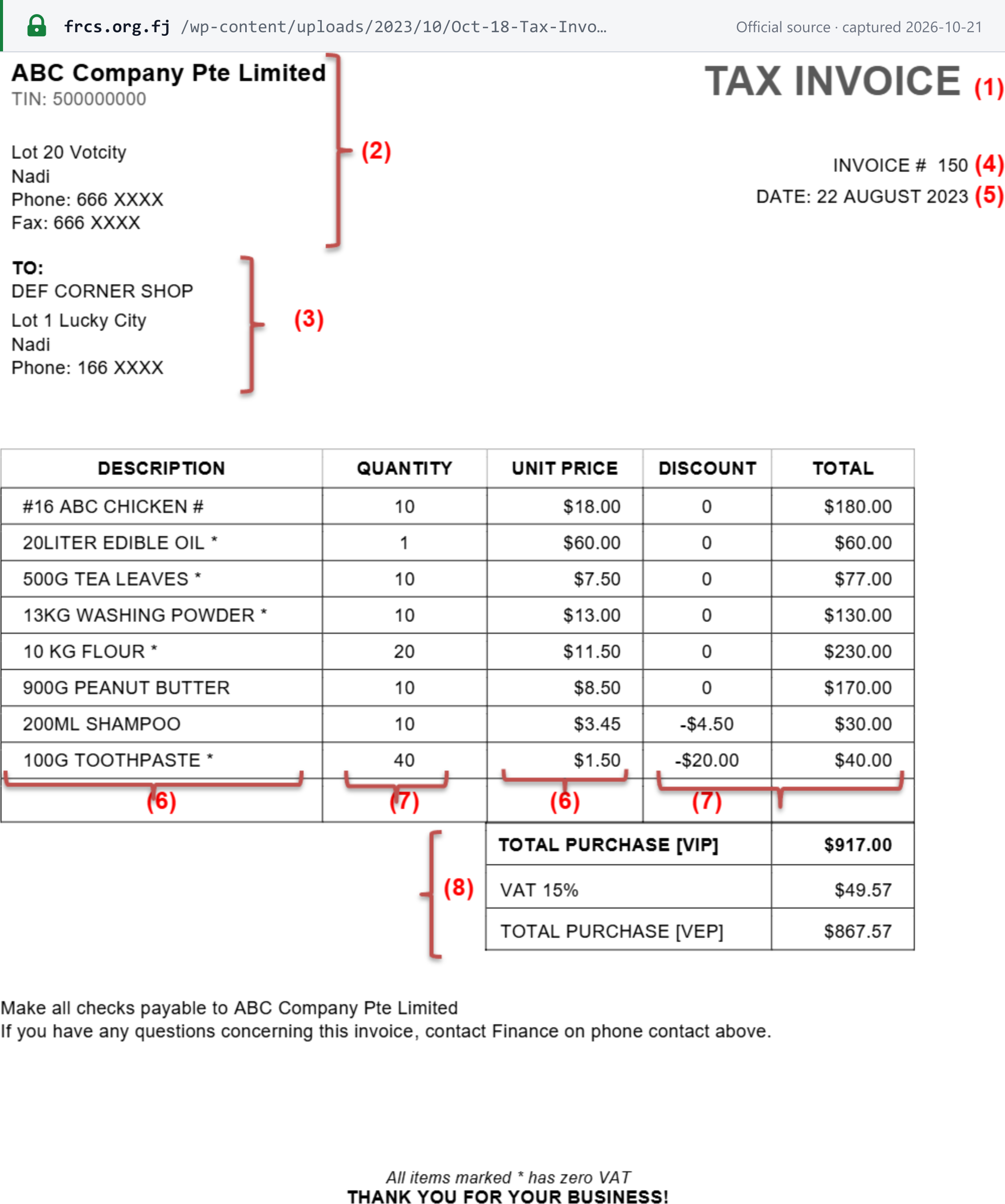 Source snapshot captured 2026-10-21 — original. FRCS's 2023 specimen: the TIN, names and figures are FRCS's dummies, and the 15% rate it shows has since been replaced by 12.5%.
E-invoicing status
Status (as at 22 October 2026): mandatory fiscalisation, phased by industry. Fiji has no structured B2B e-invoice exchange such as Peppol. Instead, businesses in gazetted groups must issue every receipt through an accredited Electronic Fiscal Device (EFD) connected to FRCS's VAT Monitoring System (VMS). The legal basis is the Tax Administration (Electronic Fiscal Device) Regulations 2017: "A taxpayer must operate an EFD for each business of the taxpayer" (reg 7(1)), and "a fiscal invoice is produced for each transaction" (reg 7(2)(h)). [4] [9]
- Model. Real-time fiscalisation. An EFD is an accredited point-of-sale system (POS) plus a Sales Data Controller (SDC). The SDC is either FRCS's online Virtual SDC (V-SDC), which "requires Internet connection to produce a transaction", or a vendor External SDC (E-SDC). The SDC signs each fiscal invoice, which is transmitted to FRCS. See fiscal devices and certified cash registers explained and CTC e-invoicing models.
- Fiscal invoice content (EFD reg 12(2)): receipt type (normal, copy, training or pro-forma), transaction type (sale or refund), payment method, cashier, item names, unit prices and quantities, totals, taxes and tax rates, total payable, the customer's TIN if the customer is a taxpayer, the business name, TIN and premises, date and time, the sequential serial number, the digital-certificate serial number, and the QR-code digital signature. For business-to-business and business-to-government sales the seller must ask for the buyer's TIN and enter it in the POS (reg 18(6)).
- Scope. Every transaction of an in-scope business: B2C, B2B and B2G alike, with the buyer's TIN added on B2B and B2G sales.
- Formats. No XML, UBL or Peppol format is mandated; the output is the signed, QR-coded fiscal invoice defined in the guidelines scheduled to the Regulations.
- Verification. Customers scan the QR code: "Scanning it with a QR reader app opens the FRCS verification website and displays a copy of the invoice." FRCS publishes no standalone verification address. [22]
- Incentive (announced). FRCS's summary of the 2026–2027 Budget announces a 150% tax deduction for the cost of installing and operating EFDs. [13]
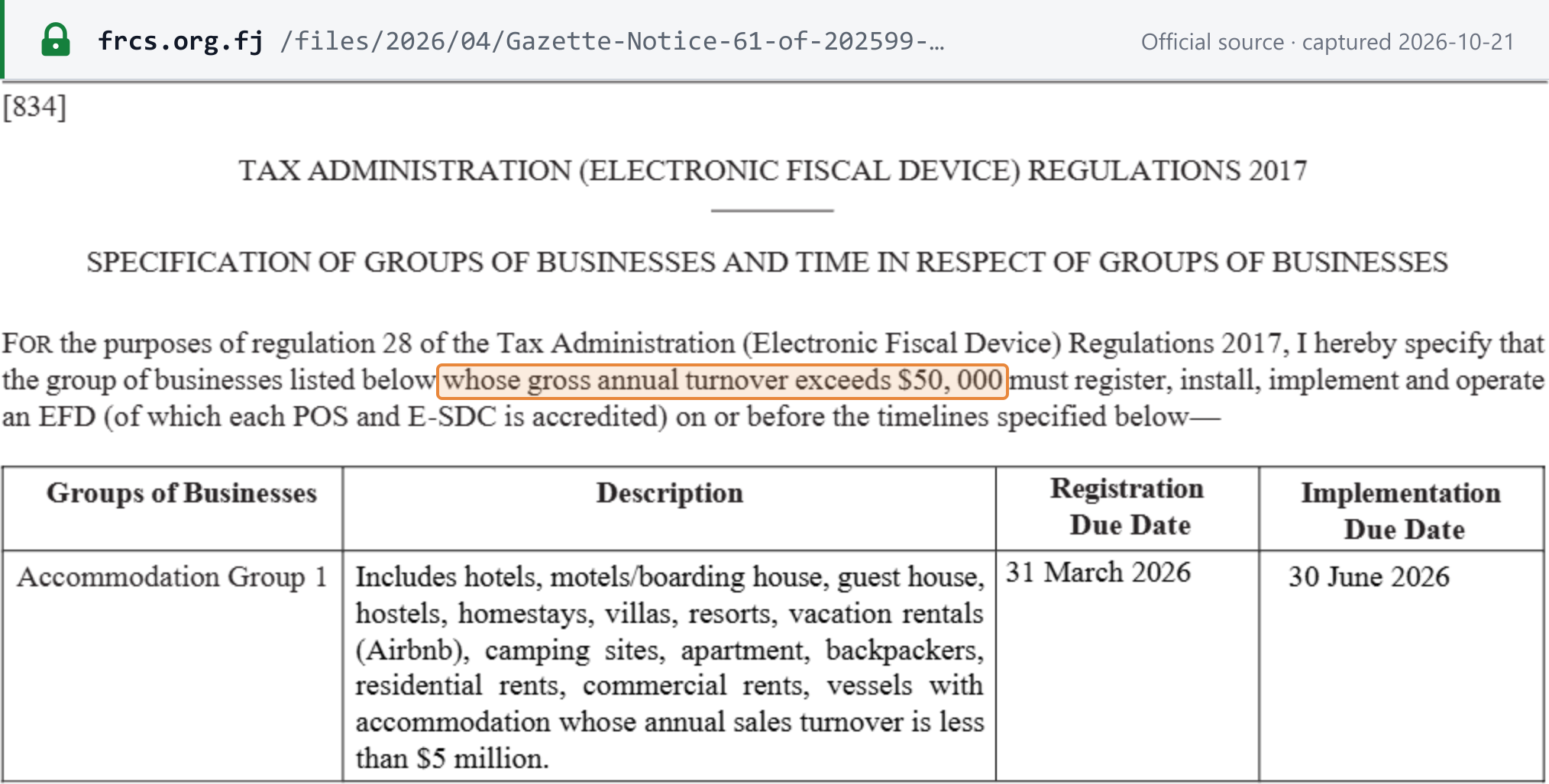
- Who. Gazette Notice No. 61 of 2025 (8 August 2025), made under EFD reg 28, requires the listed groups of businesses "whose gross annual turnover exceeds $50, 000" to "register, install, implement and operate an EFD" by set dates. This test is separate from the FJD 100,000 VAT threshold; FRCS says businesses below the VAT threshold that struggle with the deadlines should write to the CEO. [7] [8]
 Source snapshot captured 2026-10-21 — original
Phase timeline. Phase 1 (supermarkets and pharmacies) and Phase 2 (medical centres, travel agencies, accounting and law firms, hardware) had a registration deadline of 31 December 2025. Phase 3 follows Gazette Notice No. 61 of 2025 (8 August 2025), restated in FRCS's Phase 3 notice: [7] [8] [25]
| Phase 3 group | Registration due | Implementation due |
|---|---|---|
| Architecture and engineering; construction; real estate; service stations | 30 September 2025 | 31 December 2025 |
| Commercial health care; freight services | 31 December 2025 | 31 March 2026 |
| Food services | 31 December 2025 | 30 June 2026 |
| Accommodation Group 1 (annual sales under FJD 5 million) | 31 March 2026 | 30 June 2026 |
| Accommodation Group 2 (annual sales over FJD 5 million) | 30 June 2026 | 30 September 2026 |
| Wholesalers, manufacturers and retailers | 30 June 2026 | 31 December 2026 |
EFD Version 3.0. Phase 3 businesses register on EFD Version 3.0; earlier registrants continue on Version 2.0, which FRCS will switch off at the end of 2026. FRCS has published no later change to these dates.
 Source snapshot captured 2026-10-05 — original
Offences. A taxpayer who breaches the EFD operating obligations in reg 18 faces a fine of up to FJD 10,000 (turnover under FJD 500,000), FJD 25,000 (FJD 500,000 to under FJD 1.5 million) or FJD 50,000 (FJD 1.5 million or more), up to 24 months' imprisonment, or both (EFD reg 23(1)). [4]
For other countries, see e-invoicing status and networks worldwide.
Filing and payment
Filing frequency
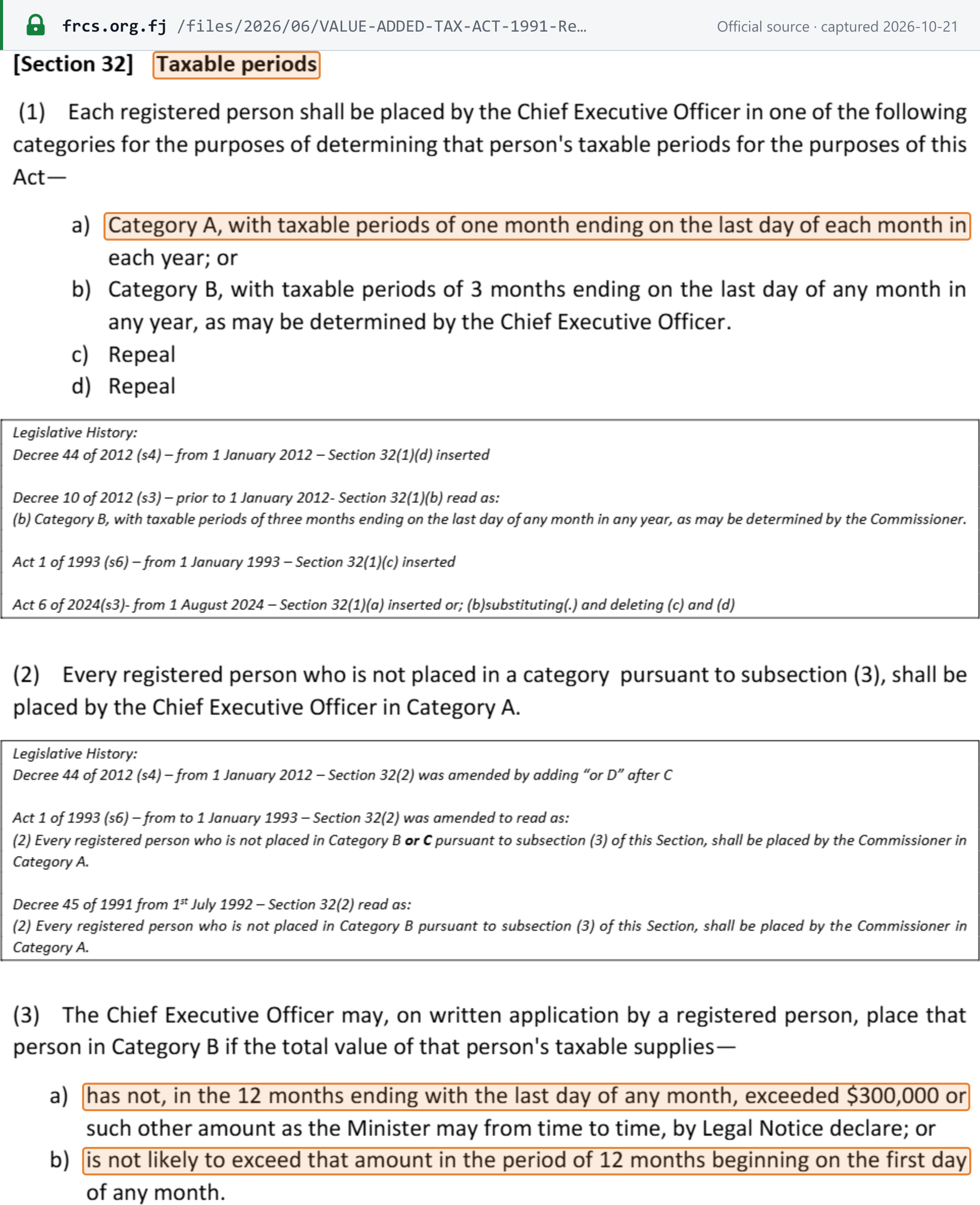
Monthly or quarterly; annual filing has ended. Under s.32 as amended by Act 6 of 2024, every registered person is in one of two categories:
- Category A — monthly, the default (s.32(2)).
- Category B — three-monthly, on written application, where taxable supplies have not exceeded, or are not likely to exceed, FJD 300,000 in 12 months (s.32(3)).
A person may apply to change category only once every 12 months (s.32(5)). The former annual Categories C and D were deleted, their last annual returns (for 2024) were due by 31 January 2025, and FRCS moved those filers to monthly or quarterly returns from 1 January 2025. FRCS's VAT page puts the line at FJD 300,001 or more for monthly returns and FJD 300,000 or less for quarterly ones. [1] [2] [14]
 Source snapshot captured 2026-10-21 — original
Return due date
By the last day of the month after the end of the taxable period: "Every registered person shall, on or before the last day of the month following the last day of every taxable period, without notice or demand furnish to the Chief Executive Officer a tax return with the accompanying Input tax schedule" (s.33(1)). A January return is due by the end of February; a January–March return by 30 April. FRCS's filing reminder of October 2026 lists September 2026 monthly returns and July–September 2026 quarterly returns as due by 31 October 2026. Returns are filed on TPOS. [1] [15]
Payment due date and method
The same day as the return (s.40(1)). FRCS accepts payment at its customer service centres, by direct deposit, online and bill payment, or by telegraphic transfer quoting the reference number; its VAT page links a PDF of online payment details. Import VAT is paid to FRCS Customs at importation. [1] [2]
Additional listings
- Input tax schedule. Every return is accompanied by a schedule of the input tax credits claimed (s.33(1); the Schedule 3 form).
- TST return. TST-registered businesses also file a monthly TST return (see Tourism Services Tax).
- There is no annual VAT return, separate sales listing or equivalent of an EC sales list; the EFD fiscal data reaches FRCS transaction by transaction.
Input-tax recovery and blocked items
Input tax on purchases used for the taxable activity is deductible, but "no deduction of input tax shall be made in respect of a supply, unless" the tax invoice or note is held when the return is filed, or, for imports, the customs documentation (s.39(5)). Purchases from unregistered suppliers carry no VAT to recover, and inputs used for exempt supplies are not recoverable; mixed use is apportioned. The VAT Act contains no specific block on entertainment or passenger vehicles. Tax is accounted on an invoice basis by default; a payments basis needs the CEO's direction and is open only to public and local authorities, non-profit bodies and persons with taxable supplies not exceeding FJD 100,000 in 12 months (s.36). [1]
Refunds
- Resident credits. A VAT credit is refunded by the end of the month following the month the return was received or due (s.65(2)), with interest on late refunds (s.67).
- Time limit. No refund of excess tax "after the expiration of the period of 3 years immediately after the end of the taxable period, unless written application for the refund is made" within it (s.65(1)).
- Bad debts. Relief for written-off bad debts (s.43).
- Non-residents. No refund scheme other than the Tourist VAT Refund Scheme. [1]
Exemptions
Exempt supplies
Schedule 1 exempts, among others:
- financial services — banking, life and medical insurance, dealings in securities and similar services;
- payment services by payment service providers (cash deposits and withdrawals, payment transactions, payment instruments);
- residential accommodation by way of hire, where used predominantly as a residence, and leasehold land rented for residential dwellings;
- the iTaukei Land Trust Board's rents and royalties distributed to iTaukei owners;
- gambling;
- donated goods and services supplied by non-profit bodies;
- education by an educational institution, and supplies incidental to it;
- employment services to Government paid from Standard Expenditure Group 6. [1]
Exempt is not zero-rated. A business making exempt supplies charges no VAT and cannot recover the input tax on its costs for them. A zero-rated supply also carries no VAT, but the supplier keeps full input-tax recovery.
Special regimes
- Produce suppliers are outside compulsory registration (s.22(1)).
- Second-hand goods bought by a dealer from an unregistered person are taxed on the gross margin (s.20); the CEO may set the margin for specified goods sold for less than FJD 500.
- Going concerns sold to a registered person are zero-rated (Schedule 2 para 8).
- Hotels. Since 1 August 2026 the time of supply for hotel and accommodation services is checkout or the end of the stay (s.18(2)(h), Act No. 15 of 2026).
- Concessions on imports are administered as import-VAT concession codes under s.14(4A), not as a free-zone VAT regime. Act No. 15 of 2026 deleted the electric-vehicle concession in s.14(4A)(d) with effect from 26 June 2026, so imported electric vehicles now bear import VAT; the same Act added concession code 313 for drug-rehabilitation centres from 1 August 2026.
- Small businesses have no flat-rate scheme; below FJD 100,000 they are outside VAT unless they register voluntarily. [1] [12]
Offences and penalties
Offences
Section 71 of the VAT Act makes it an offence, among other things, to fail to apply for registration (s.71(a)), to fail to furnish returns or information (c), to evade tax or make false returns (d), to falsify records (e), to issue a tax invoice showing tax that is not chargeable or for a supply that will not take place (f), to knowingly issue a materially wrong or incomplete tax invoice (k), and, as a registered person, to fail "to issue a tax invoice as required under this Act" (m). Fines and prison terms are set in s.72:
| Offence | Maximum on conviction | Source |
|---|---|---|
| Failure to register | FJD 10,000; the CEO first issues a notice to register and pay within 6 months, failing which up to FJD 50,000 or 10 years, or both | VAT Act s.72(3)–(3B) |
| Failure to file, or to issue a tax invoice | FJD 5,000 (first conviction) or FJD 15,000 (second), higher on later convictions, or up to 10 years, for each month of default | s.72(2) |
| Evasion, false returns, false invoicing, falsified records | FJD 10,000 or 3 times the tax involved, whichever is greater (first); FJD 20,000 or 3 times the tax (later); or up to 10 years | s.72(4) |
| Breaching the EFD operating rules | FJD 10,000 / 25,000 / 50,000 by turnover band, or up to 24 months | EFD Regulations reg 23 |
| Failing to file a TST return, or filing a false one | FJD 25,000 or up to 10 years, or both | TST Act s.4(2) |
Penalties
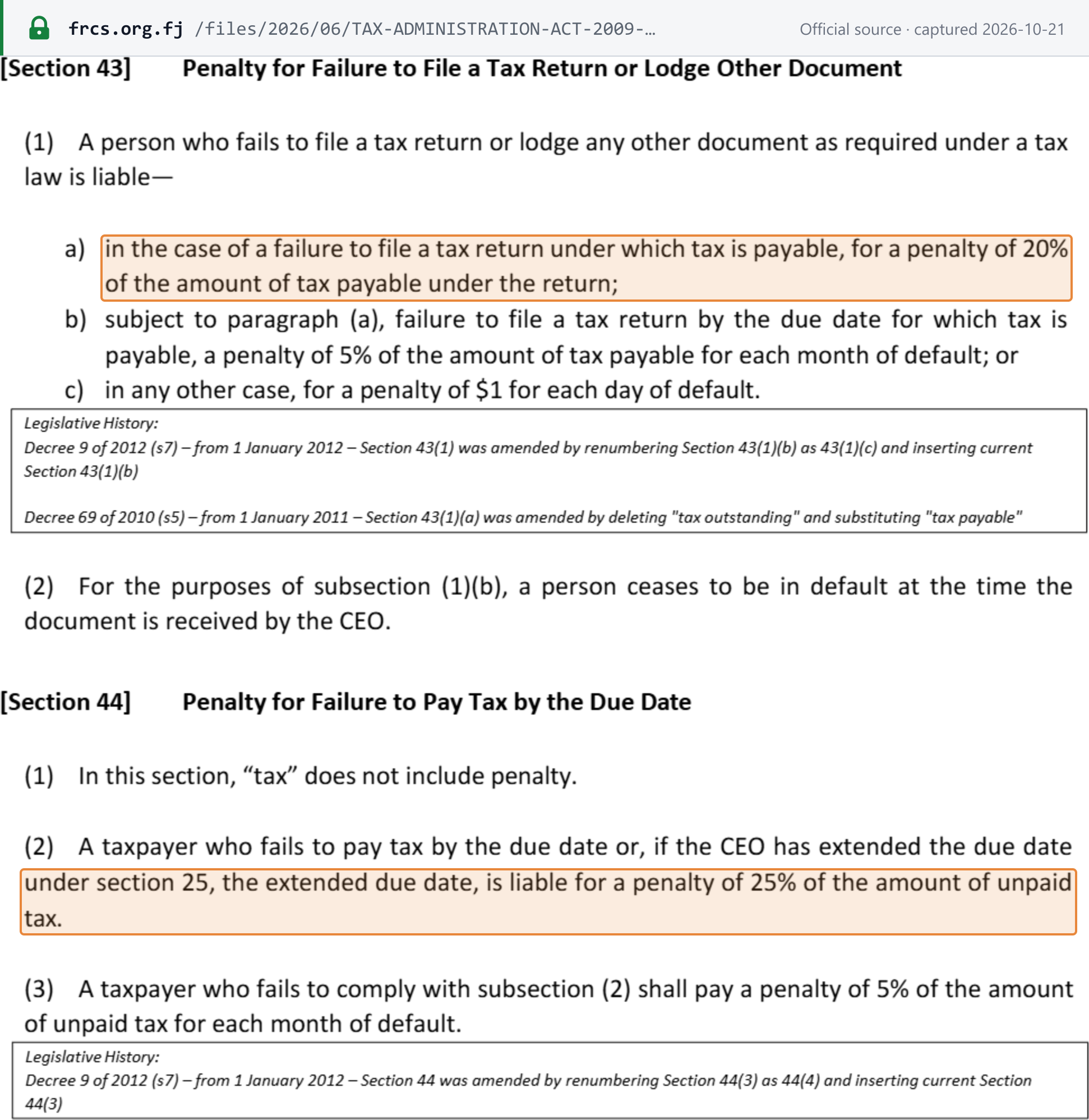
Administrative penalties for VAT are in the Tax Administration Act 2009:
| Breach | Penalty | Source |
|---|---|---|
| Late return with tax payable | 20% of the tax payable, plus 5% for each month of default | TAA s.43(1)(a)–(b) |
| Late return with no tax payable | FJD 1 per day of default | s.43(1)(c) |
| Late payment | 25% of the unpaid tax, plus 5% of the unpaid tax for each month of default | s.44(2)–(3) |
| Failure to keep proper records | 75% of the period's tax if knowing or reckless; 20% otherwise | s.45 |
| VAT evasion | 200% of the deficient tax | s.46C |
We found no separate interest charge on late VAT; the 5% monthly penalty is how the amount grows. [4]
 Source snapshot captured 2026-10-21 — original
Frequently asked questions
Is Fiji VAT 15% or 12.5%?
12.5%. Act 10 of 2025 cut the standard rate in section 15(1) of the VAT Act from 15% to 12.5% with effect from 1 August 2025, and FRCS's VAT page states the 12.5% rate. Several FRCS publications still on its website, including the PDF VAT Guide, the reverse-charge brochure and the 2023 sample invoices, were written when the rate was 15%.
Can a Fiji business still file VAT returns annually?
No. The Value Added Tax (Budget Amendment) Act 2024 removed the annual categories, and FRCS moved annual filers to monthly or quarterly filing from 1 January 2025. A business is placed on monthly returns unless the CEO agrees, on written application, to three-monthly returns because its taxable supplies have not exceeded, or are not likely to exceed, FJD 300,000 in 12 months.
Do I need an Electronic Fiscal Device if my turnover is below the FJD 100,000 VAT threshold?
Possibly. The EFD test is separate from VAT registration: Gazette Notice No. 61 of 2025 requires businesses in the listed groups whose gross annual turnover exceeds FJD 50,000 to register, install and operate an EFD by the dates it sets. FRCS says businesses below the FJD 100,000 VAT threshold that have difficulty meeting the deadlines should write to the CEO.
Does a Fiji hotel charge VAT on top of the Tourism Services Tax, or TST on top of VAT?
Neither. Under section 3(4) of the Tourism Services Tax Act 2026, TST is not subject to VAT, and FRCS's guidance says VAT is not subject to TST either. Both are calculated on the underlying charge: on a FJD 100 service, VAT at 12.5% is FJD 12.50 and TST at 5% is FJD 5.00, for FJD 117.50 in total, and TST must be shown separately on the invoice or receipt.
We pay a foreign consultant. Do we owe Fiji VAT on the fee?
Usually yes. Section 21 of the VAT Act treats listed services received from a non-resident, such as consultancy, legal, accounting, advertising and data processing, as supplied in Fiji by the Fijian recipient. FRCS collects this VAT reverse charge when the payer applies for tax clearance to remit the fee abroad, from unregistered payers too, and only a VAT-registered recipient can claim it back as input tax.
Important websites
| Site | Purpose |
|---|---|
| FRCS — Fiji Revenue and Customs Service | Tax authority home page |
| TPOS — Taxpayer Online Services | TIN and VAT registration, return filing, deregistration |
| FRCS — VAT page | VAT rules, rates, taxable periods and penalties; links the list of VAT-registered taxpayers and the online payment details |
| FRCS — Tax rates | Current and historical rates for every tax (the rate lookup) |
| List of VAT-registered taxpayers, as at 30 June 2026 (PDF) | The nearest thing to a VAT-number lookup |
| FRCS — VAT Monitoring System (VMS) | EFD hub: accredited POS and E-SDC suppliers, V-SDC |
| FRCS — VMS registration process | How to register a business on the VMS |
| FRCS — EFD gazettes | The gazette notices that set each group's EFD deadlines |
| FRCS — Laws and regulations | Revised VAT Act and Tax Administration Act |
| FRCS — Budget amendments | Budget Bills and Acts by year |
| FRCS — Tourist VAT Refund Scheme | VAT refunds for departing tourists |
Recent changes
- 2026-09-01 — The 5% Tourism Services Tax takes effect, for bookings of scheduled tourism services made from 1 September 2026; bookings made before that date are outside it. (FRCS) — see event and booking-date scope
- 2026-08-01 — The Value Added Tax (Budget Amendment) Act 2026 takes effect: hotel and accommodation supplies are made at checkout or the end of the stay; the electric-vehicle import-VAT concession ended on 26 June 2026. (Parliament of Fiji)
- 2025-08-08 — Gazette Notice No. 61 of 2025 sets the EFD Phase 3 groups and deadlines, ending with wholesalers, manufacturers and retailers on 31 December 2026, when EFD Version 2.0 also ends. (FRCS) — see event
- 2025-08-01 — The standard VAT rate is cut from 15% to 12.5% (Act 10 of 2025, amending VAT Act s.15(1)). (FRCS)
- 2025-01-01 — Annual VAT filing ends; returns are monthly, or quarterly for supplies up to FJD 300,000. (FRCS)
For the full chronology, see Fiji tax changes on Lookuptax.
Reference links
- FRCS — Value Added Tax Act 1991, revised up to 1 August 2025 (with the VAT Regulations 1991)
- FRCS — VAT page
- FRCS — Tax rates
- FRCS — Tax Administration Act 2009, revised up to 1 August 2025 (with the Electronic Fiscal Device Regulations 2017)
- FRCS — Sample tax invoice above $100, ABC Company Pte Limited (2023)
- FRCS — Sample tax invoice below $100, XYZ Pharmacy Pte Limited (2023)
- Gazette Notice No. 61 of 2025 (8 August 2025) — EFD groups and timelines
- FRCS — FRCS confirms VMS Phase 3 timelines (public notice)
- FRCS — VAT Monitoring System (VMS)
- FRCS — Standard Interpretation Guideline 2026-09, Tourism Services Tax (Final Draft, Version 2)
- Parliament of Fiji — Tourism Services Tax Act 2026 (Act No. 20 of 2026)
- Parliament of Fiji — Value Added Tax (Budget Amendment) Act 2026 (Act No. 15 of 2026)
- FRCS — Budget Summary of Revenue Policies, 2026–2027 National Budget
- FRCS — Change of VAT return filing frequency (public notice)
- FRCS — Reminder: tax filing and payment, October 2026 (public notice)
- FRCS — Registration information (non-individuals)
- FRCS — VAT Reverse Charge brochure (2025; predates the 12.5% rate)
- FRCS — Tourist VAT Refund Scheme
- FRCS — Clarification on the application of VAT on personal imports (30 August 2024)
- FRCS — New VAT tax label "G", effective 1 August 2025 (public notice)
- FRCS — Tourism Services Tax commences from 1 September 2026 (public notice)
- FRCS — VMS FAQs
- Ministry of Finance — Government confirms practical transition for Tourism Services Tax (25 August 2026)
- FRCS — TST tax label "H", effective 1 September 2026 (public notice)
- FRCS — Clarification on VMS registration requirements following the 2025–2026 National Budget (public notice)
- Parliament of Fiji — Tax Administration (Budget Amendment) Act 2026 (Act No. 13 of 2026)
Related on Lookuptax:
- VAT registration thresholds worldwide
- Worldwide tax rates
- E-invoicing status and networks worldwide
- Fiscal devices and certified cash registers explained
- Reverse charge explained
- VAT on digital services by non-resident suppliers
- How to register for VAT, sales tax or GST
- Check a VAT number — official lookups by country